
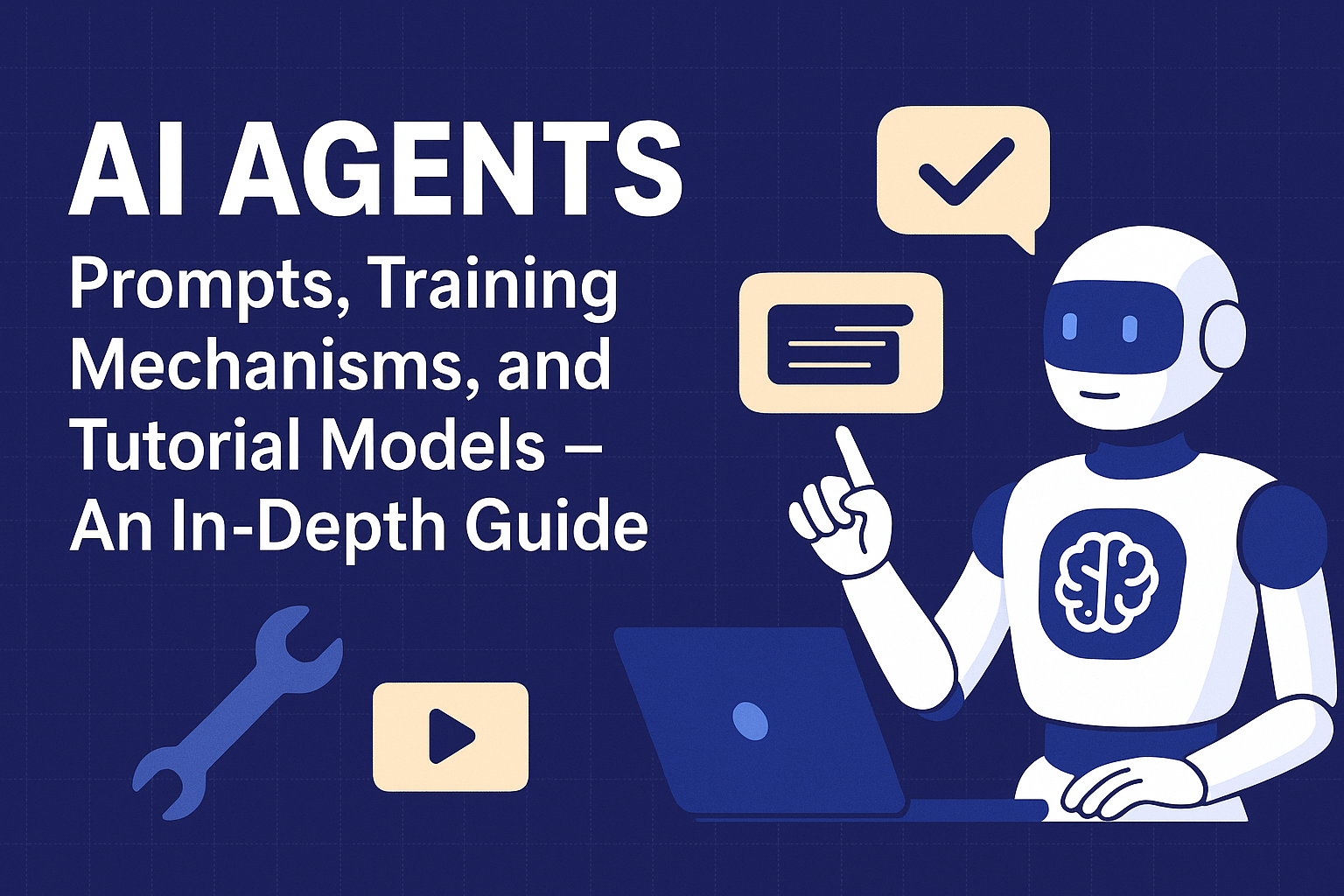
Artificial intelligence has entered a new era—one driven by autonomous AI agents. These agents can analyze information, make decisions, execute tasks, and even learn from experience. But behind their impressive abilities lies a structured ecosystem of prompts, training mechanisms, and tutorial-based models that guide how they interact with the world.
Whether you’re a developer, business owner, or tech enthusiast, understanding how AI agents work can help you unlock their full potential. This guide breaks down the core components that power modern AI agents and explains how they’re shaping the future of automation.
What Exactly Is an AI Agent?
An AI agent is a system designed to perform tasks autonomously using sensing, reasoning, and decision-making processes. Unlike traditional software—which follows static, predefined instructions—AI agents can adapt based on data patterns, environmental inputs, and user feedback.
These agents can:
- Analyze information
- Plan and execute tasks
- Interact with tools and APIs
- Learn from previous interactions
- Collaborate with humans or other AI systems
Examples range from personal assistants like Siri and Alexa to advanced workflow agents that automate business operations.
The Power of Prompts: How Instructions Shape Intelligence
Prompts are the foundational layer of interaction between humans and AI agents. They act as command structures that guide what an AI should do, how it should behave, and what outcome it should prioritize.
Types of Prompts Used in AI Agents
- Natural Language Prompts
Simple instructions written in everyday language.
Example: “Summarize this document in three bullet points.” - Structured Prompts
More formatted instructions for predictable output.
Example: “Generate JSON output with fields: title, status, and summary.” - System Prompts (or Agent Directives)
These define the AI’s long-term behavior, tone, rules, and decision framework. - Chain-of-Thought and Guided Prompts
Prompts that encourage step-by-step reasoning for complex decision-making.
Prompts serve as the operating logic behind an agent—ensuring consistency, efficiency, and accuracy.
Training Mechanisms: How AI Agents Develop Intelligence
AI agents rely on layered training systems to build expertise and learn how to operate in dynamic environments.
1. Pre-training
Large language models are trained on massive datasets—books, articles, code, and conversations—to understand general patterns in language and knowledge.
2. Fine-tuning
This stage tailors the model to a specific purpose.
Example: An AI agent fine-tuned for cybersecurity or medical triage.
3. Reinforcement Learning
Agents learn by trial and error, receiving feedback for correct or incorrect actions.
4. Tool Integration Training
Modern agents learn how to use external tools such as:
- Web browsers
- Databases
- APIs
- File systems
- Automation platforms
This transforms them from passive responders into active problem-solvers.
Tutorial-Based Models: Teaching Agents Through Examples
Tutorial-driven training has become a highly effective way to shape agent behavior. Instead of relying solely on raw data, the agent is taught through step-by-step examples—similar to how humans learn through instruction manuals.
Benefits of Tutorial-Based Training
- More predictable behavior
- Higher task accuracy
- Improved specialization
- Minimal hallucination or errors
- Better multi-step reasoning
This method is especially powerful for complex domains like coding, data analysis, or digital marketing workflows.
How AI Agents Are Transforming Real-World Workflows
AI agents are rapidly becoming digital employees—capable of automating entire processes:
- Customer support
- Market research
- Social media management
- Software debugging
- Data entry
- Sales automation
- Financial analysis
For businesses, this means lower operational costs, faster execution, and improved scalability.
The Future of AI Agents: What’s Next?
As training methods advance and tool ecosystems mature, AI agents will become even more capable. Expect breakthroughs in:
- Fully autonomous business operations
- Multi-agent collaboration
- Voice-first agent systems
- Emotionally aware AI companions
- Real-time learning and re-training
- Industry-specific expert agents
We’re moving toward a world where AI agents operate as digital team members—handling tasks, solving problems, and continuously improving.
Conclusion
AI agents represent a significant leap forward in how we interact with technology. By understanding prompts, training mechanisms, and tutorial-based models, we gain insight into what drives these intelligent systems—and how to harness them effectively.
As AI continues to evolve, those who learn to work with agents will be positioned at the forefront of the digital transformation.




Be First to Comment