
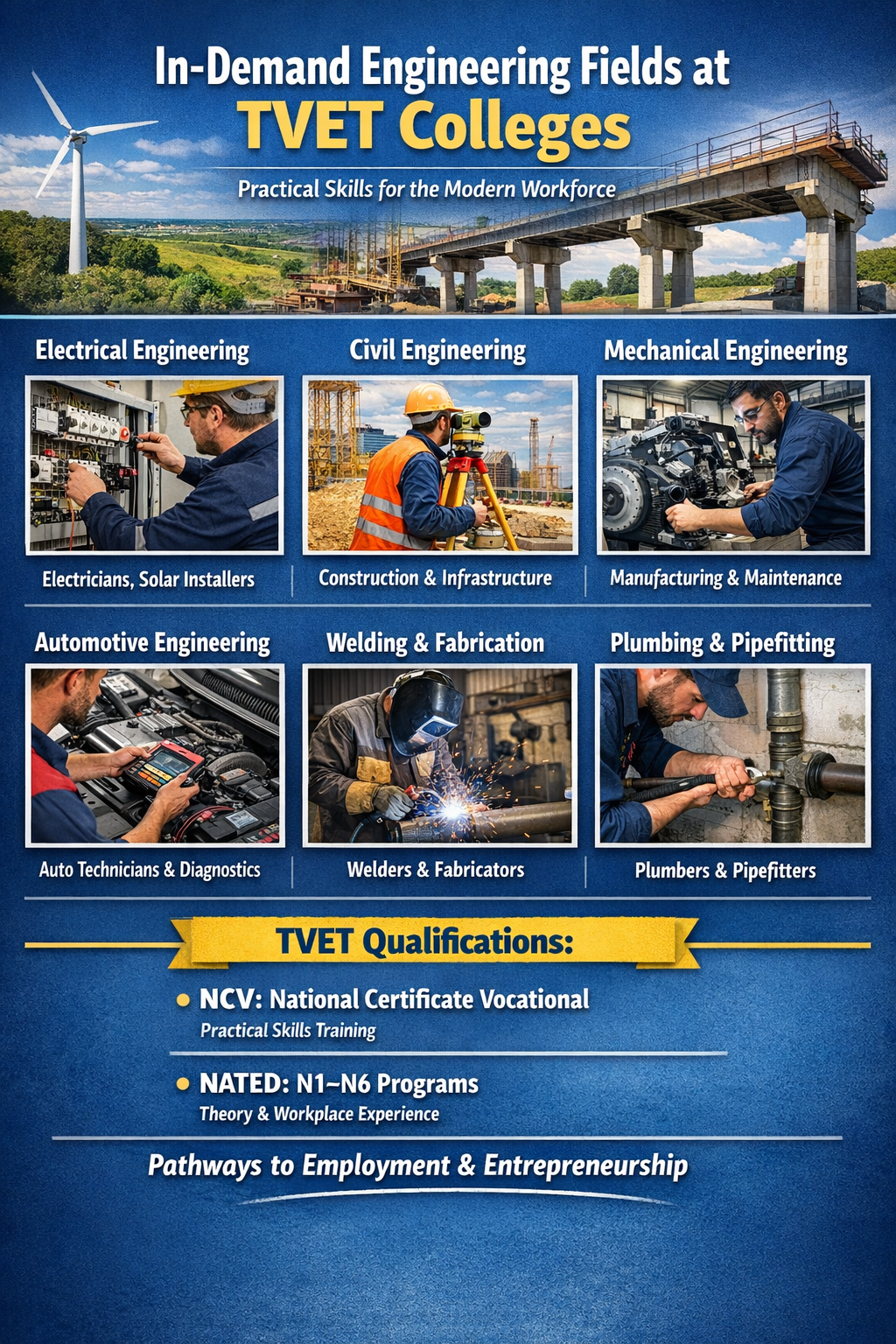
In-Demand Engineering Programs at TVET Colleges: Building Tomorrow’s Workforce
Technical and Vocational Education and Training (TVET) colleges have become increasingly vital in addressing the growing demand for skilled engineers and technicians across various industries. Unlike traditional university programs that often focus on theoretical engineering degrees, TVET colleges offer practical, hands-on training that prepares students for immediate entry into the workforce. This article explores the most in-demand engineering programs available at TVET colleges and why they represent excellent career pathways.
Understanding TVET Engineering Education
TVET colleges bridge the critical gap between academic education and industry requirements. These institutions offer National Certificates, diplomas, and specialized training programs that combine theoretical knowledge with practical skills. Engineering programs at TVET colleges typically range from N1 to N6 levels (National Certificate), followed by practical workplace experience and trade tests that lead to professional qualifications.
The beauty of TVET engineering education lies in its accessibility and practicality. Students gain real-world experience through workshops, laboratories, and industry partnerships, making them job-ready upon graduation. Many TVET programs also offer flexible learning schedules, including evening and weekend classes, making them ideal for working professionals seeking to upgrade their skills.
Mechanical Engineering
Mechanical engineering remains one of the most versatile and in-demand fields offered at TVET colleges. This program covers the design, development, installation, and maintenance of mechanical systems and machinery. Students learn about thermodynamics, fluid mechanics, materials science, manufacturing processes, and computer-aided design (CAD).
The demand for mechanical engineering technicians spans multiple industries including manufacturing, automotive, aerospace, mining, energy production, and construction. Graduates can work as mechanical technicians, maintenance engineers, production supervisors, quality control inspectors, or machinery operators. The mining sector, particularly in countries rich in natural resources, consistently seeks qualified mechanical engineering personnel to maintain heavy machinery and optimize production processes.
TVET mechanical engineering programs typically include extensive practical training in workshops where students work with lathes, milling machines, welding equipment, and precision measurement tools. This hands-on experience is invaluable, as employers seek candidates who can immediately contribute to operations without requiring extensive on-the-job training.
Electrical Engineering
Electrical engineering at TVET colleges focuses on the practical application of electrical systems, power distribution, control systems, and electronics. This field has experienced explosive growth due to increasing electrification, renewable energy projects, smart building technologies, and industrial automation.
Students in electrical engineering programs learn about circuit theory, electrical machines, power systems, industrial electronics, programmable logic controllers (PLCs), instrumentation, and electrical installation. The curriculum balances theory with practical skills such as wiring, testing electrical equipment, reading technical drawings, and troubleshooting electrical faults.
The job market for electrical engineering technicians is robust and diverse. Graduates find employment in power generation and distribution companies, manufacturing plants, construction firms, telecommunications companies, and maintenance departments across virtually every industry. With the global push toward renewable energy, there’s particular demand for technicians skilled in solar photovoltaic systems, wind energy installations, and smart grid technologies.
Electrical engineering offers excellent career progression opportunities. Starting as an electrical technician, professionals can advance to supervisory roles, become electrical engineers with additional qualifications, specialize in areas like automation or renewable energy, or even start their own electrical contracting businesses.
Civil Engineering
Civil engineering at TVET colleges prepares students for careers in construction, infrastructure development, and built environment projects. This program covers structural design, construction technology, surveying, materials testing, project management, and building regulations. Students learn to read and create technical drawings, estimate project costs, conduct site inspections, and ensure compliance with safety standards.
The demand for civil engineering technicians has grown substantially due to ongoing urbanization, infrastructure renewal projects, housing developments, and public works initiatives. Governments worldwide are investing heavily in transportation networks, water and sanitation systems, renewable energy infrastructure, and smart city developments, all of which require skilled civil engineering personnel.
TVET civil engineering graduates work as construction technicians, site supervisors, quantity surveyors, draughtspersons, materials testers, or project coordinators. They’re employed by construction companies, architectural firms, municipal governments, engineering consultancies, and property development companies. The practical skills acquired through TVET training, including the use of surveying equipment, construction materials testing, and project documentation, make graduates immediately valuable to employers.
An interesting aspect of civil engineering is its connection to sustainable development. Modern TVET programs increasingly incorporate green building practices, sustainable materials, water conservation systems, and environmentally responsible construction methods, preparing students for the construction industry’s future direction.
Automotive Engineering
Automotive engineering at TVET colleges addresses the growing complexity of modern vehicles and the transportation industry’s evolution. This program covers vehicle systems, engine technology, automotive electronics, diagnostics, maintenance procedures, and increasingly, hybrid and electric vehicle technologies.
Students learn about internal combustion engines, transmission systems, braking systems, steering and suspension, automotive electrical systems, fuel injection, emission control, and computerized diagnostic tools. Practical training includes disassembling and reassembling engines, diagnosing faults using specialized equipment, performing routine maintenance, and repairing various vehicle components.
The automotive industry faces a significant skills shortage as vehicles become more technologically advanced. Modern cars incorporate sophisticated computer systems, advanced driver assistance features, complex electronic controls, and alternative fuel technologies. TVET-trained automotive technicians who understand both traditional mechanical systems and modern automotive electronics are highly sought after.
Career opportunities extend beyond traditional auto repair shops. Graduates work for vehicle manufacturers, dealership service centers, fleet management companies, automotive parts suppliers, insurance companies (as assessors), and transportation companies. With the automotive industry’s shift toward electric and autonomous vehicles, there’s growing demand for technicians skilled in battery technology, electric motors, and advanced vehicle electronics.
Chemical Engineering
Chemical engineering technology at TVET colleges focuses on industrial chemical processes, quality control, plant operations, and safety management. This program is essential for industries involved in petroleum refining, pharmaceuticals, food and beverage production, water treatment, plastics manufacturing, and chemical production.
Students study chemistry fundamentals, chemical processes, process control, instrumentation, plant operations, quality assurance, and health and safety regulations. Practical training includes operating pilot plants, conducting chemical analyses, using process control equipment, and implementing safety procedures.
The chemical industry requires technicians who can operate complex processing equipment, monitor production parameters, conduct quality tests, troubleshoot process issues, and maintain strict safety standards. TVET graduates fill critical roles as process technicians, quality control analysts, plant operators, laboratory technicians, and safety officers.
This field offers stable employment with competitive salaries, particularly in regions with established chemical, petrochemical, or pharmaceutical industries. The emphasis on safety, environmental compliance, and quality management in TVET programs ensures graduates understand the serious responsibilities involved in chemical processing operations.
Industrial Engineering
Industrial engineering technology at TVET colleges prepares students to optimize production systems, improve operational efficiency, and manage manufacturing processes. This interdisciplinary field combines elements of mechanical engineering, business management, quality control, and systems analysis.
The curriculum covers production planning, quality management systems, lean manufacturing, workplace organization, process optimization, inventory management, and industrial safety. Students learn to analyze workflows, identify inefficiencies, implement improvement strategies, and use industrial engineering tools and software.
As manufacturing becomes more competitive globally, companies increasingly seek industrial engineering technicians who can enhance productivity, reduce waste, improve quality, and streamline operations. Graduates work in manufacturing plants, logistics companies, quality assurance departments, production management, and operations consulting.
The skills acquired in industrial engineering programs are transferable across industries. Whether in automotive manufacturing, food processing, electronics assembly, or any production environment, the principles of efficiency, quality, and continuous improvement remain relevant. This versatility makes industrial engineering graduates valuable across diverse sectors.
Mechatronics Engineering
Mechatronics represents the convergence of mechanical engineering, electronics, computer science, and control engineering. This relatively new but rapidly growing field at TVET colleges addresses the increasing automation of industrial processes and the proliferation of smart systems.
Students learn about robotics, automated systems, sensors and actuators, programmable logic controllers, pneumatics and hydraulics, computer-aided manufacturing, and industrial automation. The program emphasizes the integration of mechanical and electronic systems to create intelligent machines and automated production lines.
The Fourth Industrial Revolution, characterized by smart factories, Internet of Things (IoT) devices, and cyber-physical systems, has created enormous demand for mechatronics technicians. Industries ranging from automotive and aerospace to food processing and warehousing are implementing automated systems that require skilled personnel for installation, programming, maintenance, and troubleshooting.
Mechatronics offers exciting career prospects in cutting-edge technology fields. Graduates work as automation technicians, robotics specialists, control systems engineers, maintenance technicians for automated systems, or technical support personnel for manufacturing equipment suppliers. The multidisciplinary nature of mechatronics training makes these professionals highly adaptable and valuable in modern industrial environments.
Welding and Fabrication Engineering
Welding and fabrication engineering at TVET colleges provides specialized training in joining metals and manufacturing metal structures. While sometimes overlooked, this field is critical to construction, manufacturing, shipbuilding, pipeline installation, and numerous other industries.
Students master various welding techniques including arc welding, gas welding, TIG (Tungsten Inert Gas) welding, MIG (Metal Inert Gas) welding, and specialized processes like underwater welding. The program also covers metal fabrication, blueprint reading, metallurgy, welding inspection, and quality control.
Skilled welders and fabricators are consistently in high demand worldwide, particularly for infrastructure projects, industrial construction, oil and gas installations, and manufacturing. Many countries face severe shortages of qualified welding professionals, making this an excellent career choice with strong job security and earning potential.
TVET welding programs often lead to internationally recognized certifications that enable graduates to work globally. Experienced welders can specialize in high-demand areas such as pipeline welding, structural steel welding, pressure vessel fabrication, or aerospace welding, commanding premium salaries. Many also establish their own fabrication businesses, creating employment opportunities in their communities.
Renewable Energy Engineering
Responding to global environmental concerns and the transition toward sustainable energy, many TVET colleges now offer specialized programs in renewable energy engineering. These programs focus on solar energy systems, wind power technology, energy efficiency, and sustainable building systems.
Students learn about photovoltaic system design and installation, solar thermal systems, wind turbine technology, energy storage systems, grid integration, and energy auditing. The curriculum combines electrical engineering fundamentals with specialized knowledge of renewable energy technologies.
The renewable energy sector is experiencing unprecedented growth as governments and businesses commit to reducing carbon emissions and transitioning to clean energy. This creates substantial demand for technicians who can design, install, commission, and maintain renewable energy systems. Job opportunities exist with solar installation companies, wind farm operators, energy consulting firms, utility companies, and government energy departments.
What makes renewable energy particularly attractive is its growth trajectory. Unlike some traditional industries that may be declining, renewable energy continues expanding, offering long-term career stability. Additionally, working in this field provides the satisfaction of contributing to environmental sustainability and combating climate change.
Mining Engineering
In countries with significant mining industries, mining engineering programs at TVET colleges are critically important. These programs prepare technicians for the extraction of minerals, mine operations, safety management, and environmental compliance.
Students study mining methods, rock mechanics, mineral processing, mine surveying, ventilation systems, explosives handling, mine safety regulations, and environmental management. Practical training includes using mining equipment, conducting safety inspections, and understanding underground or open-pit mining operations.
The mining industry offers some of the highest-paying opportunities for TVET graduates, particularly in regions rich in mineral resources. Mining companies require substantial numbers of technicians for operations, maintenance, surveying, processing, and safety management. Career paths include mine surveyor, processing plant operator, blasting technician, mine safety officer, or equipment maintenance technician.
Mining engineering also offers opportunities for remote work assignments, which often come with premium compensation packages including housing, meals, and travel allowances. While the work can be demanding, the financial rewards and career advancement opportunities make it attractive to many TVET graduates.
Electronics Engineering
Electronics engineering at TVET colleges focuses on electronic circuits, communications systems, consumer electronics, and industrial electronics. This field has become increasingly important with the proliferation of electronic devices in every aspect of modern life.
The curriculum covers semiconductor devices, digital and analog electronics, microprocessors, communications systems, electronic instrumentation, and circuit design. Students gain hands-on experience assembling circuits, troubleshooting electronic equipment, programming microcontrollers, and using electronic testing equipment.
Electronics technicians find employment in telecommunications companies, consumer electronics manufacturers, medical equipment companies, aerospace and defense industries, and electronics repair services. The miniaturization of electronics and integration of smart technologies into countless products ensures continued demand for skilled electronics professionals.
Specializations within electronics offer diverse career paths. Some technicians focus on communications systems, others on medical electronics, industrial control systems, or consumer product development. The rapid pace of technological advancement in electronics means continuous learning opportunities and the potential to work with emerging technologies.
Building and Construction Engineering
Building and construction engineering at TVET colleges provides comprehensive training in building construction, construction management, building services, and property maintenance. This program differs from civil engineering by focusing more specifically on building structures and the construction process.
Students learn about building materials, construction methods, building regulations, cost estimation, project planning, building services (plumbing, electrical, HVAC), and property maintenance. The practical component includes site work, construction techniques, using hand and power tools, and understanding building codes.
The construction industry is labor-intensive and constantly requires skilled personnel. TVET building and construction graduates work as construction supervisors, site foremen, building inspectors, estimators, project coordinators, or property maintenance managers. Employment opportunities exist with construction companies, property developers, facilities management firms, and municipal building departments.
This field offers excellent entrepreneurial opportunities. Many graduates establish their own construction companies, specializing in residential building, renovations, commercial construction, or maintenance services. The practical skills and industry knowledge gained through TVET training provide a solid foundation for successful construction businesses.
Refrigeration and Air Conditioning Engineering
Refrigeration and air conditioning (RAC) engineering addresses the growing demand for climate control systems in residential, commercial, and industrial settings. This specialized field combines mechanical and electrical engineering principles with thermodynamics and fluid mechanics.
Students study refrigeration cycles, heat transfer, air conditioning systems, refrigerants and environmental regulations, electrical controls, system design, installation procedures, and maintenance techniques. Practical training includes working with various refrigeration and AC units, diagnosing faults, charging systems with refrigerant, and installing complete HVAC systems.
Climate change and rising global temperatures have increased demand for cooling systems, making RAC technicians highly sought after. Additionally, the phase-out of environmentally harmful refrigerants and the introduction of new, eco-friendly alternatives requires trained technicians who understand modern systems and regulations.
Career opportunities include working for HVAC contractors, building maintenance companies, refrigeration equipment manufacturers, supermarket chains (which use extensive refrigeration), cold storage facilities, or starting an independent service business. The work often involves both installation of new systems and maintenance of existing equipment, providing diverse daily experiences.
Why Choose TVET Engineering Programs?
TVET engineering programs offer several compelling advantages. First, they’re generally shorter than university degree programs, allowing students to enter the workforce sooner. Most TVET engineering qualifications can be completed in two to three years, compared to four or more years for university engineering degrees.
Second, TVET programs are typically more affordable, reducing the financial burden on students and their families. Lower tuition costs and shorter program duration mean less debt and faster return on educational investment.
Third, the practical, hands-on focus of TVET education means graduates possess job-ready skills. Employers consistently report that TVET graduates require less on-the-job training and adapt quickly to workplace demands. The emphasis on practical competencies over pure theory produces technicians who can immediately contribute to organizational productivity.
Fourth, TVET engineering careers offer excellent earning potential. Skilled technicians in fields like welding, mining, mechatronics, and refrigeration often earn salaries comparable to or exceeding those of university graduates in other fields. As technicians gain experience and additional certifications, their earning potential increases substantially.
Fifth, TVET qualifications provide clear pathways for career advancement. Graduates can progress to supervisory and management roles, pursue additional certifications to specialize in high-demand areas, or continue their education through bridging programs that lead to engineering degrees. Many TVET colleges have articulation agreements with universities, allowing graduates to advance their qualifications if desired.
Industry Partnerships and Job Placement
One of TVET colleges’ greatest strengths is their close relationships with industry. Many programs include workplace experience components where students complete internships or learnerships with partner companies. These experiences provide invaluable exposure to real work environments, professional networking opportunities, and often lead directly to employment after graduation.
Industry advisory committees help TVET colleges keep their curricula relevant and aligned with current industry needs. Equipment and training methods are regularly updated to reflect technological advances and changing workplace practices. This ensures graduates learn the most current techniques and technologies employers require.
Many TVET colleges also maintain job placement services that connect graduates with employers actively seeking qualified technicians. Some industries experiencing severe skills shortages even sponsor student training, guaranteeing employment upon successful completion of the program.
The Future of TVET Engineering Education
As industries evolve and new technologies emerge, TVET engineering programs continue adapting to meet changing demands. Digital manufacturing, artificial intelligence, sustainable technologies, and advanced materials are being integrated into existing programs. New specialized programs are being developed to address emerging fields.
The COVID-19 pandemic accelerated the adoption of blended learning approaches, combining online theoretical instruction with essential hands-on practical training. This flexibility makes TVET education more accessible to students in remote areas or those balancing work and study.
Governments and industry associations increasingly recognize TVET’s critical role in economic development and skills development. Enhanced funding, improved facilities, and upgraded equipment are making TVET engineering programs more attractive and effective than ever.
Conclusion
TVET colleges offer diverse, practical engineering programs that address critical skills shortages across multiple industries. From traditional fields like mechanical and electrical engineering to emerging areas like renewable energy and mechatronics, these programs provide accessible pathways to rewarding careers.
The combination of hands-on training, industry relevance, affordability, and strong employment prospects makes TVET engineering programs excellent choices for students seeking practical, career-focused education. As technology advances and industries evolve, the demand for skilled engineering technicians will only increase, ensuring that TVET engineering graduates remain valuable contributors to economic growth and industrial development.
For prospective students considering their educational and career options, TVET engineering programs represent not just a qualification, but a gateway to stable, well-compensated employment in fields that are fundamental to modern society. Whether drawn to the problem-solving aspects of mechanical systems, the precision of electronics, the creativity of design and fabrication, or the cutting-edge nature of automation and renewable energy, there’s a TVET engineering program suited to diverse interests and aptitudes.
The engineers and technicians trained through TVET colleges are the backbone of modern industry, the builders of infrastructure, the maintainers of essential systems, and the implementers of technological advancement. Their practical skills and hands-on expertise ensure that the designs and innovations of engineering professionals become working reality, making TVET engineering education indispensable to continued technological progress and economic prosperity.




Be First to Comment