
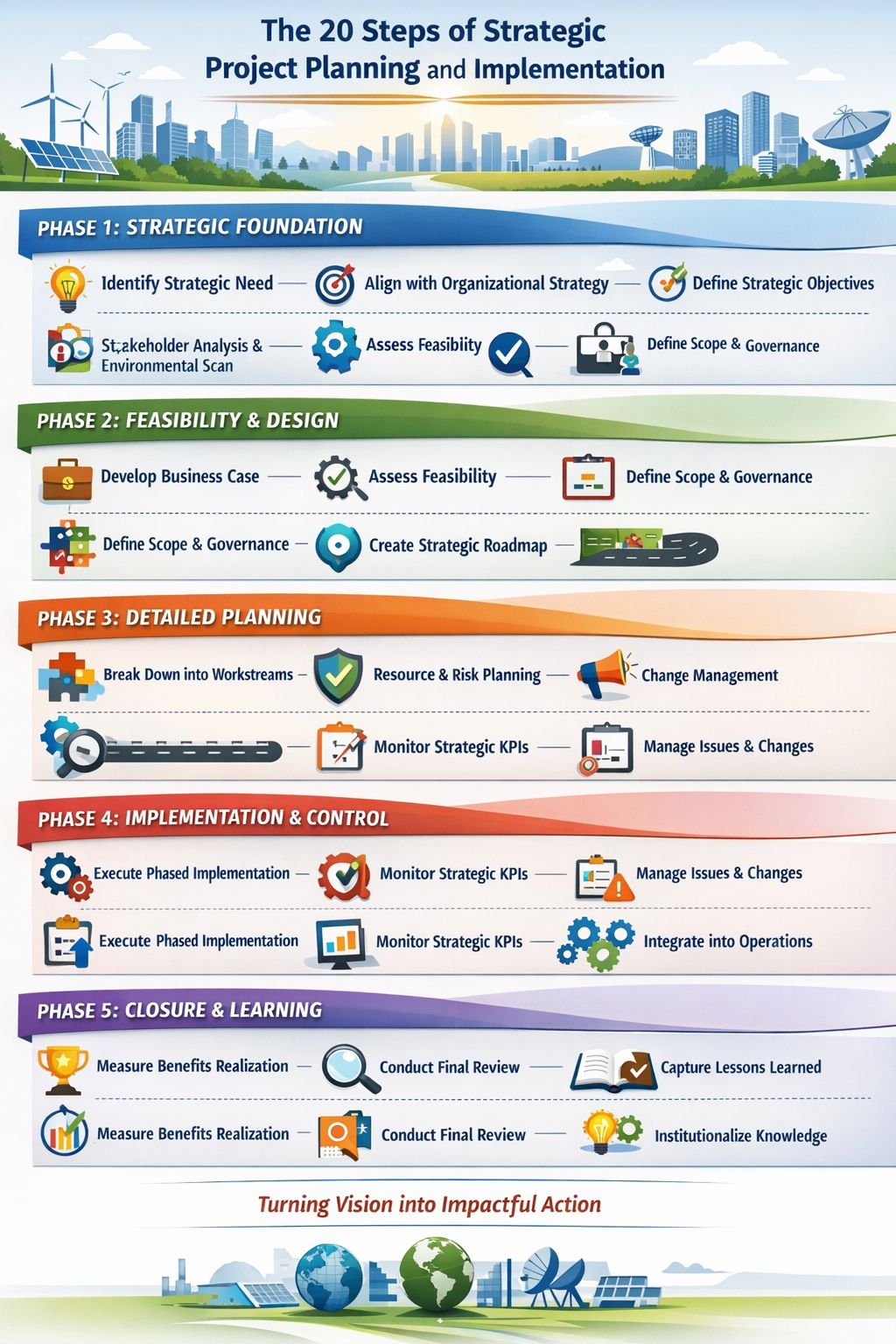
Successfully executing strategic projects requires meticulous planning, disciplined implementation, and continuous adaptation. This comprehensive guide walks through twenty critical steps that transform ambitious visions into tangible results.
Phase 1: Foundation and Initiation
Step 1: Define Strategic Alignment
Before initiating any project, establish clear connections between the proposed initiative and your organization’s overarching strategic objectives. This alignment ensures resource allocation supports broader business goals rather than isolated efforts. Conduct stakeholder interviews to understand how different departments perceive the project’s strategic value. Document explicit linkages between project outcomes and corporate key performance indicators, creating a compelling business case that demonstrates why this project deserves priority over competing initiatives.
Step 2: Conduct Comprehensive Stakeholder Analysis
Identify every individual, group, or organization that will influence or be influenced by your project. Map stakeholders across two dimensions: their power to affect project outcomes and their level of interest in the project. This creates four quadrants requiring different engagement strategies. High-power, high-interest stakeholders demand close collaboration and frequent communication. High-power, low-interest stakeholders need enough satisfaction to prevent interference. Low-power, high-interest stakeholders become valuable advocates when kept informed. Understanding these dynamics prevents political obstacles that derail even technically sound projects.
Step 3: Establish Project Governance Structure
Create a formal governance framework that defines decision-making authority, escalation pathways, and accountability mechanisms. Establish a steering committee comprising senior leaders who can remove organizational barriers and authorize resource reallocation. Define the project sponsor’s role in championing the initiative at executive levels. Clarify the project manager’s authority boundaries and establish regular governance touchpoints where strategic direction gets reviewed and adjusted. Without clear governance, projects drift as competing priorities dilute focus and minor issues escalate into crises.
Step 4: Develop Detailed Scope Definition
Transform abstract strategic objectives into concrete deliverables with explicit boundaries. Document what the project will accomplish and, equally important, what falls outside its scope. Use techniques like work breakdown structures to decompose high-level goals into manageable components. Define acceptance criteria for each major deliverable so stakeholders share common expectations. Scope creep kills projects by fragmenting resources across ever-expanding objectives, so treat scope management as an ongoing discipline rather than a one-time definition exercise.
Phase 2: Planning and Design
Step 5: Assemble the Project Team
Select team members based on required competencies, not just availability. Balance technical expertise with soft skills like communication, adaptability, and collaborative problem-solving. Consider whether team members need dedicated assignment or can contribute part-time without compromising other responsibilities. Define roles with precision to avoid duplicated effort or neglected responsibilities. Invest time in team formation activities that build trust and establish productive working norms. High-performing teams develop shared mental models that enable rapid, coordinated responses when plans inevitably require adjustment.
Step 6: Create Integrated Project Schedule
Develop a realistic timeline that sequences activities based on dependencies, resource constraints, and risk mitigation strategies. Use critical path analysis to identify which activities determine overall project duration and warrant closest monitoring. Build in appropriate buffers that acknowledge uncertainty without creating perverse incentives for inefficiency. Ensure the schedule reflects actual work patterns rather than idealized assumptions about productivity. Validate timeline feasibility with team members who will execute the work, as their practical insights often reveal flaws in theoretical plans.
Step 7: Develop Comprehensive Budget
Translate resource requirements into financial projections covering personnel, materials, technology, facilities, and contingencies. Distinguish between capital expenditures and operational costs, as these have different organizational approval processes and accounting treatments. Include both direct project costs and allocated overhead expenses. Build contingency reserves proportional to identified risks rather than arbitrary percentages. Establish budget tracking mechanisms that provide early warning when spending trends threaten to exceed allocations, enabling corrective action before small variances become catastrophic overruns.
Step 8: Design Risk Management Framework
Systematically identify potential threats and opportunities that could affect project success. Assess each risk across two dimensions: probability of occurrence and magnitude of impact if it materializes. Develop response strategies for high-priority risks, choosing between avoidance, mitigation, transfer, or acceptance based on cost-benefit analysis. Assign risk owners who monitor specific threats and trigger predetermined responses when warning indicators appear. Treat risk management as continuous surveillance rather than upfront planning, as project evolution and environmental changes introduce new risks while resolving others.
Step 9: Establish Quality Standards and Processes
Define what “good” looks like for project deliverables through measurable quality criteria. Establish inspection and testing protocols that verify compliance with specifications before deliverables get accepted. Implement quality assurance processes that prevent defects rather than merely detecting them after the fact. Create feedback loops where quality data informs process improvements. Balance quality aspirations against schedule and budget constraints, recognizing that perfection often becomes the enemy of good enough. Document quality standards in language stakeholders understand rather than technical jargon that obscures real requirements.
Step 10: Develop Communication Plan
Design information flows that ensure stakeholders receive relevant updates through appropriate channels at optimal frequencies. Tailor message content and format to different audience needs; executives want strategic summaries while team members need operational details. Establish regular reporting rhythms that create predictability without generating unnecessary bureaucracy. Define escalation protocols for issues requiring higher-level attention. Leverage multiple communication modalities including meetings, dashboards, emails, and collaboration platforms to reinforce critical messages and accommodate different preferences. Effective communication prevents the vacuum that gets filled with rumors and misunderstandings.
Phase 3: Execution and Monitoring
Step 11: Launch Project with Formal Kickoff
Mark the transition from planning to execution with an event that aligns stakeholders around shared objectives and working methods. Use kickoff meetings to review project scope, success criteria, roles, schedules, and communication expectations. Address questions and concerns while momentum and attention remain high. Create emotional commitment beyond intellectual agreement by articulating the vision’s significance and celebrating the team assembled to achieve it. A strong launch establishes collaborative norms and shared accountability that sustain performance through inevitable challenges.
Step 12: Execute Work Packages According to Plan
Begin systematic execution of scheduled activities, transforming plans into tangible progress. Empower team members with clear authority to make decisions within defined boundaries while escalating issues that exceed their mandate. Maintain focus on critical path activities that determine overall timeline while ensuring parallel workstreams progress appropriately. Foster collaboration across functional boundaries, as strategic projects typically require integration of diverse capabilities. Monitor whether actual work patterns match planned approaches, identifying early signals that methods require adjustment.
Step 13: Implement Progress Tracking Systems
Establish mechanisms that provide objective visibility into project status across scope, schedule, budget, quality, and risk dimensions. Use earned value management techniques that compare planned value, actual cost, and earned value to reveal whether projects are ahead or behind schedule and under or over budget. Track leading indicators that predict future performance rather than merely reporting historical results. Visualize complex data through dashboards that enable rapid pattern recognition. Ensure tracking systems inform decisions rather than merely satisfying reporting requirements.
Step 14: Manage Changes Through Formal Process
Recognize that change is inevitable in complex strategic initiatives as new information emerges and circumstances evolve. Establish a change control board that evaluates proposed modifications against criteria including strategic alignment, impact on scope/schedule/budget, risk implications, and stakeholder acceptance. Document all approved changes and update project plans accordingly to maintain single source of truth. Distinguish between changes requiring formal approval and minor adjustments within project manager authority. Resist the temptation to accommodate every requested change, as excessive flexibility destroys focus and predictability.
Step 15: Conduct Regular Performance Reviews
Schedule periodic assessments where project teams and governance bodies examine progress, evaluate performance against success criteria, and adjust strategies as needed. Use these reviews to celebrate accomplishments, address underperformance, reallocate resources, and recommit to objectives. Encourage honest dialogue about obstacles and failures rather than defensive posturing that obscures reality. Apply lessons learned from completed work packages to improve approaches for remaining activities. Ensure reviews drive action rather than merely documenting status, translating insights into concrete commitments with assigned ownership and deadlines.
Phase 4: Integration and Transition
Step 16: Integrate Deliverables into Operational Environment
As project components reach completion, begin systematic integration into the organization’s ongoing operations. This transition requires more than technical deployment; it demands process redesign, organizational restructuring, and cultural adaptation. Develop detailed transition plans that specify who does what by when to shift from project execution mode to business-as-usual operations. Provide adequate training and support so end-users develop competence and confidence with new capabilities. Address resistance proactively through change management techniques that acknowledge concerns while building commitment to new approaches.
Step 17: Validate Achievement of Success Criteria
Conduct formal verification that project deliverables meet specified requirements and acceptance criteria. This validation involves more than internal project team assessment; it requires stakeholder confirmation that outcomes satisfy the needs that justified project investment. Test deliverables under realistic conditions rather than idealized laboratory settings. Measure actual benefits against projected benefits in the original business case. Document any gaps between promised and delivered value, along with explanations for variances. Secure formal sign-off from authorized stakeholders before declaring project completion.
Step 18: Transfer Knowledge and Documentation
Ensure sustainable value by transferring critical knowledge from temporary project teams to permanent organizational roles. Develop comprehensive documentation covering system architecture, operating procedures, maintenance requirements, and troubleshooting guides. Conduct training programs that build organizational capability to operate, maintain, and enhance project deliverables. Create communities of practice where expertise gets shared across organizational boundaries. Archive project artifacts including plans, designs, decisions, and lessons learned so future initiatives benefit from accumulated experience. Knowledge transfer prevents organizational capability from walking out the door when project teams disband.
Step 19: Conduct Post-Implementation Review
After sufficient operational experience with project deliverables, conduct a retrospective analysis examining what worked well, what fell short, and what lessons apply to future initiatives. Evaluate project management processes, technical approaches, stakeholder engagement strategies, and resource allocation decisions. Measure actual benefits against projected benefits, investigating root causes of any significant variances. Document recommendations for improving organizational project management capability. Create psychological safety where participants can acknowledge mistakes without fear of punishment, as honest reflection generates more valuable insights than self-congratulatory celebrations.
Step 20: Formalize Project Closure
Bring the project to official conclusion through administrative and symbolic actions that provide closure for participants and stakeholders. Release project resources back to functional managers or reassign them to other initiatives. Close financial accounts and reconcile final expenditures against budgets. Conduct final reporting to governance bodies and key stakeholders summarizing achievements, challenges, and lessons learned. Recognize and celebrate team contributions through appropriate means. Archive all project documentation in accessible repositories. Formal closure provides psychological completion while ensuring organizational memory preserves valuable lessons for future strategic initiatives.
Conclusion
Strategic project planning and implementation demands rigorous discipline across these twenty interconnected steps. Success requires balancing competing demands: strategic vision with tactical execution, comprehensive planning with adaptive flexibility, individual accountability with collaborative teamwork, and ambitious objectives with realistic constraints. Organizations that master this balance transform strategic aspirations into operational realities, building competitive advantage through superior execution capability. The journey from concept to completion tests organizational maturity, but those who navigate it successfully create lasting value that extends far beyond any single project’s deliverables.




Be First to Comment