
Introduction
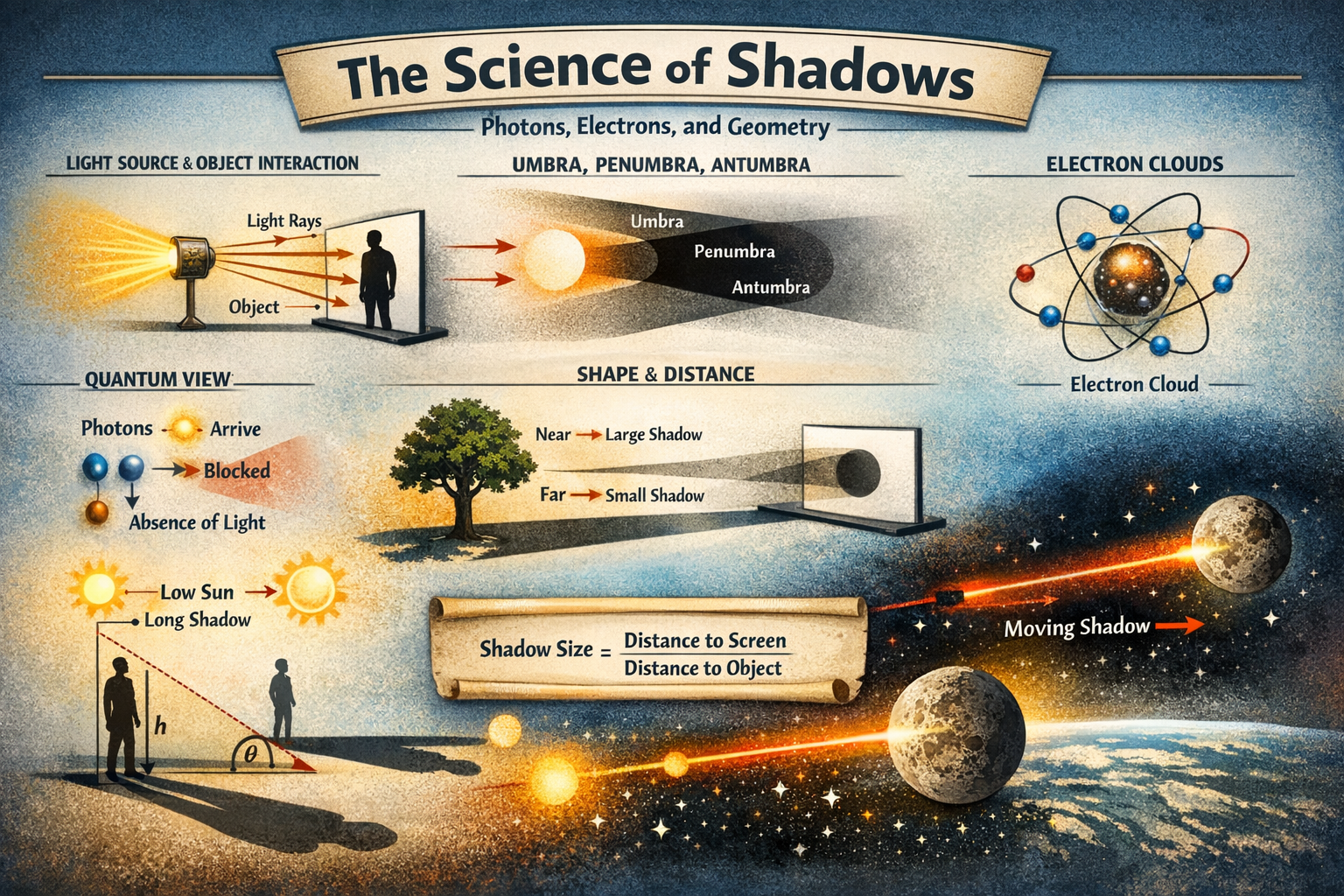
Shadows are among the most ubiquitous yet least understood phenomena in our daily lives. They appear simple—dark silhouettes cast when light is blocked—yet their formation involves complex interactions between photons, matter, and geometry. Shadow architecture, the study of how shadows form, transform, and behave in space, bridges physics, geometry, and visual perception. Understanding shadows requires examining the fundamental particles of light (photons), the atomic structure of objects (electrons), and the geometric relationships between light sources, objects, and surfaces.
This article explores the intricate physics underlying shadow formation, from quantum-scale photon-electron interactions to macroscopic geometric principles that determine a shadow’s size, shape, and sharpness.
The Nature of Light: Photons as Shadow Architects
What Are Photons?
Photons are elementary particles that constitute electromagnetic radiation, including visible light. Unlike particles with mass, photons are massless packets of energy that travel at the speed of light in a vacuum: approximately 299,792,458 meters per second (about 300,000 kilometers per second or 186,282 miles per second). This constant speed, denoted as c, is one of the fundamental constants of nature and the upper limit for information transfer in our universe.
Photons exhibit wave-particle duality, behaving as both waves and particles depending on how they’re observed. As waves, they have frequencies and wavelengths that determine their color and energy. As particles, they carry discrete quantities of energy determined by the equation E = hf, where E is energy, h is Planck’s constant (6.626 × 10⁻³⁴ joule-seconds), and f is frequency.
How Photons Travel
In empty space, photons travel in straight lines called rays, a principle known as rectilinear propagation. This straight-line travel is fundamental to shadow formation. When billions upon billions of photons stream from a light source, they radiate outward in all directions (for a point source) or in parallel beams (for a collimated source like the sun at Earth’s distance).
The behavior of light rays can be modeled using geometric optics, where we trace the paths of representative rays to predict where light will and won’t reach. Where photons cannot reach due to an obstruction, a shadow forms. This simple principle becomes complex when we consider the size of light sources, the nature of materials, and the quantum interactions occurring at the boundary between light and matter.
The Electromagnetic Spectrum
Visible light represents only a tiny fraction of the electromagnetic spectrum, spanning wavelengths from approximately 380 nanometers (violet) to 750 nanometers (red). While we typically discuss shadows in terms of visible light, the same principles apply to all electromagnetic radiation—radio waves, microwaves, infrared, ultraviolet, X-rays, and gamma rays can all cast “shadows,” though we may not perceive them with our eyes.
The wavelength of light becomes important when considering diffraction effects at shadow edges. When light encounters edges comparable to its wavelength, it bends slightly into the shadow region, creating subtle interference patterns. For most everyday shadows cast by visible light around macroscopic objects, these effects are minimal but measurable.
Electrons and Material Interaction: Why Objects Block Light
The Electron’s Role in Opacity
When we ask why an object blocks light and creates a shadow, we’re really asking: why doesn’t light pass through this material? The answer lies in how photons interact with electrons in the material’s atoms.
Atoms consist of nuclei surrounded by electron clouds. These electrons exist in specific energy levels or orbitals. When a photon strikes an atom, it can be absorbed if its energy matches the difference between two electron energy levels. The electron jumps to a higher energy state, and the photon ceases to exist in its original form. The electron may then return to its lower energy state, re-emitting a photon—but often in a random direction, not necessarily the direction the original photon was traveling.
This absorption and re-emission process is what makes materials opaque. In opaque materials like wood, metal, or human tissue, photons are absorbed and scattered so thoroughly that virtually no light in the original direction makes it through to the other side. The region behind such an object receives no direct light—creating a shadow.
Transparent, Translucent, and Opaque Materials
Not all materials interact with light identically. In transparent materials like clear glass or air, the molecular structure allows photons to pass through with minimal absorption. The electrons are arranged such that visible light photons don’t have the right energies to be absorbed, so light travels through relatively unimpeded.
Translucent materials like frosted glass or thin paper absorb and scatter some light but allow some transmission. These create partial shadows with softer edges and lighter interior regions. The shadow’s darkness depends on how much light the material absorbs versus scatters or transmits.
Opaque materials effectively block all light in the visible spectrum. Metals are particularly opaque because they have free electrons that can absorb photons of almost any visible energy. Organic materials like skin and fabric contain complex molecules with many electron energy levels, allowing absorption across broad wavelength ranges.
Material Thickness and Shadow Quality
The thickness of a material significantly affects shadow formation. Even materials that appear opaque can transmit some light if made sufficiently thin. A human hand held against a bright light shows this effect—the edges glow reddish as some longer-wavelength photons penetrate the tissue. The shadow of such a partially transmissive object has a darker central region (umbra) where almost no light penetrates, surrounded by a lighter region (penumbra) where some scattered or transmitted light reaches.
Shadow Geometry: Shape, Size, and Position
The Umbra and Penumbra
Shadow architecture distinguishes between two primary shadow regions, determined by the geometry of the light source and object:
The Umbra is the shadow’s darkest region, where the object completely blocks all direct light from the source. For a point light source (infinitely small), the entire shadow is umbra—perfectly dark with sharp edges. The umbra’s size and shape are determined by projecting straight lines (light rays) from the light source, tangent to the object’s edges, to the surface receiving the shadow.
The Penumbra is the partial shadow region where the object blocks some but not all of the light source. This occurs with extended light sources (sources with measurable size). Within the penumbra, an observer would see part of the light source blocked by the object but part still visible. The penumbra creates the soft, gradual edges characteristic of most real-world shadows.
For solar eclipses, these concepts become dramatically visible. The moon’s umbra traces a narrow path across Earth’s surface where the sun is completely blocked (total eclipse), while the much larger penumbra creates a partial eclipse over a wider region.
Mathematical Relationships: The Shadow Size Equation
The size of a shadow depends on three factors: the size of the object, the distance from the object to the light source, and the distance from the object to the shadow-receiving surface. For a point light source, the relationship follows similar triangles:
Shadow size / Object size = (Light-to-surface distance) / (Light-to-object distance)
Or more precisely:
Shadow size / Object size = (d₁ + d₂) / d₁
where d₁ is the distance from light source to object, and d₂ is the distance from object to surface.
This equation reveals several important principles:
- Shadows grow larger as objects move closer to the light source (d₁ decreases). When you move your hand toward a lamp, the shadow on the wall grows dramatically.
- Shadows grow larger as objects move farther from the receiving surface (d₂ increases). Moving your hand away from a wall while keeping it the same distance from the light source enlarges the shadow.
- For distant light sources (d₁ >> d₂), such as the sun, the shadow size approximates the object size. This is why shadows at midday are roughly the same size as the objects casting them—the sun is so far away that the ratio approaches 1:1.
Shadow Shape and Object Form
A shadow’s shape is a projection of the object’s silhouette as seen from the light source’s perspective. This projection depends on the object’s orientation relative to the light direction.
For three-dimensional objects, the shadow is essentially a two-dimensional mapping onto the receiving surface. A sphere casts a circular shadow regardless of rotation because its silhouette is always circular. A cube, however, casts shadows of different shapes depending on its orientation—a square when face-on, a hexagon when viewed at certain angles, or even a triangle when viewing from a corner.
The human body creates particularly complex shadows because of its irregular, organic shape. A person’s shadow changes dramatically with body position—standing spreads vertically, sitting compresses, and various poses create recognizable silhouettes that we interpret unconsciously. This is the basis for shadow puppetry, where hand and finger positions create recognizable shapes.
Multiple Light Sources and Shadow Multiplication
When multiple light sources illuminate an object, multiple shadows form, one for each light source. Each shadow’s umbra corresponds to light blocked from one specific source, while regions receiving light from some sources but not others create overlapping penumbrae of varying darkness.
This creates the complex shadow patterns in environments with multiple light sources, like streets with several streetlamps or rooms with multiple bulbs. The darkest regions occur where all shadows overlap—where the object blocks all sources. The lightest regions receive light from all sources with no obstruction.
The Speed of Shadows: A Fascinating Paradox
Can Shadows Move Faster Than Light?
One of the most intriguing questions in shadow architecture concerns the speed at which shadows can move. Remarkably, shadows can appear to move faster than light, without violating relativity’s prohibition on faster-than-light travel. This occurs because shadows aren’t physical objects—they’re the absence of light, and absences can “move” at any speed.
Consider a searchlight beam sweeping across a distant cloud bank. If the light rotates at a constant angular velocity, the illuminated spot on the clouds moves in a circle. If the clouds are sufficiently far away, the spot’s linear velocity can exceed the speed of light. The spot moves from position A to position B faster than light could travel between those points. However, no information or matter actually travels between A and B—different photons illuminate each position.
The same principle applies to the edge of a shadow. When you rapidly move your hand between a light source and a distant wall, the shadow’s edge can sweep across the wall faster than light speed. But this doesn’t allow faster-than-light communication or energy transfer. The shadow edge at different positions is created by different photons being blocked at different times.
The Actual Speed: The Speed of Darkness
When a light source is turned on, the shadow doesn’t form instantaneously everywhere. The “wave of darkness” propagates at the speed of light. When you place an object in front of a light source, the shadow forms on a distant wall after a delay equal to the distance divided by the speed of light.
For everyday distances, this delay is imperceptible. For a wall 3 meters away, the delay is 10 nanoseconds (10 billionths of a second). But for astronomical distances, the delay becomes significant. When Earth passes through the moon’s shadow during a solar eclipse, the shadow is traveling at the moon’s orbital velocity (about 1 kilometer per second), and different locations on Earth enter the shadow at different times.
Distance and Shadow Characteristics
Near-Field Shadows: Close to the Object
In the near field (the region very close to the shadow-casting object), shadows display sharp boundaries and high contrast, particularly for small, concentrated light sources. The umbra is well-defined, and the penumbra is narrow or nonexistent if the light source is small enough.
Near the object, the shadow closely matches the object’s shape in both form and size. This is the regime of contact shadows—the dark regions where objects meet surfaces, critical in photography and art for conveying depth and contact.
Far-Field Shadows: Distance Effects
As distance from the object increases, several changes occur in shadow characteristics:
Shadow size increases following the geometric relationships described earlier. The shadow’s angular size as seen from the light source remains constant, but the linear size grows with distance.
Edge sharpness decreases for extended light sources. The penumbra width grows proportionally with distance, causing shadows to appear increasingly blurred. This is why shadows from small, close sources (like a candle) have sharper edges than shadows from large or distant sources (like an overcast sky).
Shadow density may decrease if the object partially transmits or scatters light. As the shadow grows larger, any transmitted light spreads over a greater area, potentially creating lighter shadows at great distances.
Atmospheric Effects on Long-Distance Shadows
For shadows cast over very long distances, particularly through Earth’s atmosphere, additional factors come into play. Atmospheric scattering redirects some light into shadow regions, lightening them. This is why shadows outdoors are rarely pure black—the blue sky acts as a secondary light source, filling shadows with diffuse blue light.
Atmospheric refraction bends light paths slightly, particularly near the ground where temperature gradients create density variations. This can curve shadow edges or create mirages where shadows appear disconnected from their objects.
Human Shadows: A Special Case
Body Geometry and Shadow Form
The human body represents a complex, irregular form that creates distinctive shadows. Our bilateral symmetry, upright posture, and characteristic proportions make human shadows immediately recognizable, even in silhouette. This recognition is so fundamental that we can identify individuals by their shadow’s gait and posture.
A standing human approximately 1.7 meters tall casts a shadow whose length varies dramatically with sun angle:
- At noon with the sun directly overhead (90° elevation): The shadow is minimal, roughly matching body dimensions horizontally.
- At 45° sun elevation: The shadow extends about 1.7 meters.
- At 15° sun elevation (early morning or late afternoon): The shadow extends over 6 meters.
- At sunset (sun near horizon): The shadow can extend dozens or hundreds of meters, limited only by terrain and obstacles.
The mathematical relationship for shadow length L given body height H and sun elevation angle θ is:
L = H / tan(θ)
Dynamic Human Shadows
Human shadows are rarely static. Walking, running, and gesturing create continuously changing shadow forms. The shadow’s motion combines the body’s movement with the changing projection angle. A person walking perpendicular to the light source creates a shadow that stretches and compresses rhythmically with their gait.
This dynamic quality makes human shadows valuable for motion analysis. Researchers can extract gait characteristics, estimate speed, and even identify medical conditions affecting movement by analyzing shadow motion patterns. Sports scientists use shadow analysis to study biomechanics when direct body measurement is impractical.
Indoor vs. Outdoor Human Shadows
Indoor shadows from artificial lights typically show:
- Sharper edges (smaller light sources)
- Multiple shadows from multiple lights
- Shorter shadows (closer light sources)
- More consistent shadow length throughout the day
Outdoor shadows from the sun show:
- Softer edges (despite the sun’s small angular size, atmospheric scattering acts as a large diffuse source)
- Single dominant shadow direction
- Dramatic length changes throughout the day
- Seasonal variation in shadow length and direction
Practical Applications of Shadow Architecture
Art and Photography
Artists have exploited shadow architecture for millennia. Renaissance painters mastered chiaroscuro—the interplay of light and shadow—to create three-dimensional form on flat canvases. They understood intuitively that shadow placement, sharpness, and darkness convey information about light source position, object form, and spatial relationships.
Photographers use shadow analysis to determine optimal lighting. The “golden hour” near sunrise and sunset is prized partly because long shadows create texture and depth. Studio photographers manipulate light source size, distance, and number to control shadow characteristics precisely.
Architecture and Sundial Design
Architects must consider shadow patterns when designing buildings. Solar access laws in many jurisdictions limit how much shadow a building can cast on neighboring properties. Designers create shadow studies—diagrams showing shadow patterns at different times and seasons—to optimize natural lighting and minimize unwanted shading.
Sundials represent the oldest practical application of shadow architecture. By understanding how a shadow’s position and length change with sun position, ancient civilizations created remarkably accurate timekeeping devices. The gnomon (shadow-casting element) angle and calibration depend on latitude, and the hour lines must account for the sun’s changing declination throughout the year.
Solar Energy Optimization
Solar panel installations require detailed shadow analysis. Even partial shading dramatically reduces panel efficiency, so installers must account for shadows from trees, buildings, and other panels. Computer simulations trace the sun’s path throughout the year, predicting shadow patterns and optimal panel placement.
Forensic Analysis and Surveillance
Shadow analysis assists criminal investigations by helping determine when photographs or videos were recorded. By analyzing shadow length and direction, experts can estimate the sun’s position and thus the time and season. This technique has verified or refuted photographic evidence in legal cases.
Security systems increasingly use shadow analysis to detect intrusions. Since shadows move differently than objects, advanced algorithms can distinguish actual objects from shadow motion, reducing false alarms.
Advanced Topics in Shadow Physics
Wave Optics and Diffraction at Shadow Edges
The geometric optics model treats light as rays and predicts perfectly sharp shadow edges. However, light’s wave nature creates diffraction effects—slight bending around obstacles and interference patterns near shadow boundaries.
When light passes close to an edge, it spreads slightly into the geometric shadow region. This creates alternating bright and dark fringes (diffraction patterns) at high magnification. The effect is most noticeable when the edge is comparable to the wavelength of light (hundreds of nanometers) and when using coherent light sources like lasers.
For most everyday shadows, diffraction effects are negligible, but they prevent perfectly sharp shadow edges even with ideal point sources. The fundamental resolution limit due to diffraction is on the order of the wavelength of light—about 0.5 micrometers for visible light.
Colored Shadows and Spectral Effects
When multiple colored light sources illuminate an object, the resulting shadows display surprising colors. For example, with red and cyan lights, an object casts two shadows: one appears cyan (receiving only cyan light, blocked from red) and one appears red (receiving only red light, blocked from cyan).
This phenomenon demonstrates that shadow color depends on which wavelengths are blocked versus which reach the shadow region from other sources. The sky acts as a blue light source, which is why outdoor shadows often appear bluish—they receive skylight but are blocked from direct sunlight.
Atmospheric phenomena create spectacular shadow effects. “Shadow rays” or crepuscular rays appear as beams of light separated by shadows from clouds. The rays appear to diverge from the sun due to perspective, though they’re actually parallel. At sunset, antisolar rays (anticrepuscular rays) can appear to converge toward the antisolar point on the opposite horizon.
Quantum Considerations
At the quantum level, shadow formation involves photon-electron interactions governed by quantum electrodynamics. When we say an object “blocks” light, countless quantum events occur: photons are absorbed by electrons, exciting them to higher energy states; electrons re-emit photons through fluorescence or phosphorescence; and the statistical sum of billions of such interactions creates the macroscopic shadow we observe.
Quantum uncertainty means we cannot predict exactly which photons will be absorbed and which will pass by an atom. We can only calculate probabilities. For macroscopic objects with vast numbers of atoms, these probabilities average out to predictable behavior, but for nanoscale objects, quantum effects become significant.
Conclusion
Shadow architecture reveals that shadows, far from being simple absences of light, are complex phenomena governed by fundamental physics and geometry. From the quantum interactions between photons and electrons that determine material opacity, to the geometric relationships that determine shadow size and shape, to the relativistic considerations of shadow motion, the study of shadows touches nearly every aspect of physics.
Understanding shadows enhances our appreciation of light itself. Shadows are light’s negative space, defining through absence what light defines through presence. The interplay between object, photon, electron, geometry, and distance creates the rich shadow landscape we navigate daily, often without conscious awareness.
As we’ve explored, the speed of light governs shadow formation, traveling at 299,792,458 meters per second to create the boundaries between illumination and darkness. The shape of shadows reflects the geometry of both objects and light sources, while distance modulates shadow size and sharpness through precise mathematical relationships. The human shadow, in particular, serves as a constant companion—a projection of our form that shifts and dances with our movements and the sun’s journey across the sky.
From ancient sundials to modern solar arrays, from artistic masterpieces to forensic investigations, shadow architecture finds applications across human endeavor. By understanding the physics of shadows, we gain tools to manipulate light, predict shadow behavior, and appreciate the subtle interplay of illumination and obstruction that shapes our visual world.




Be First to Comment