
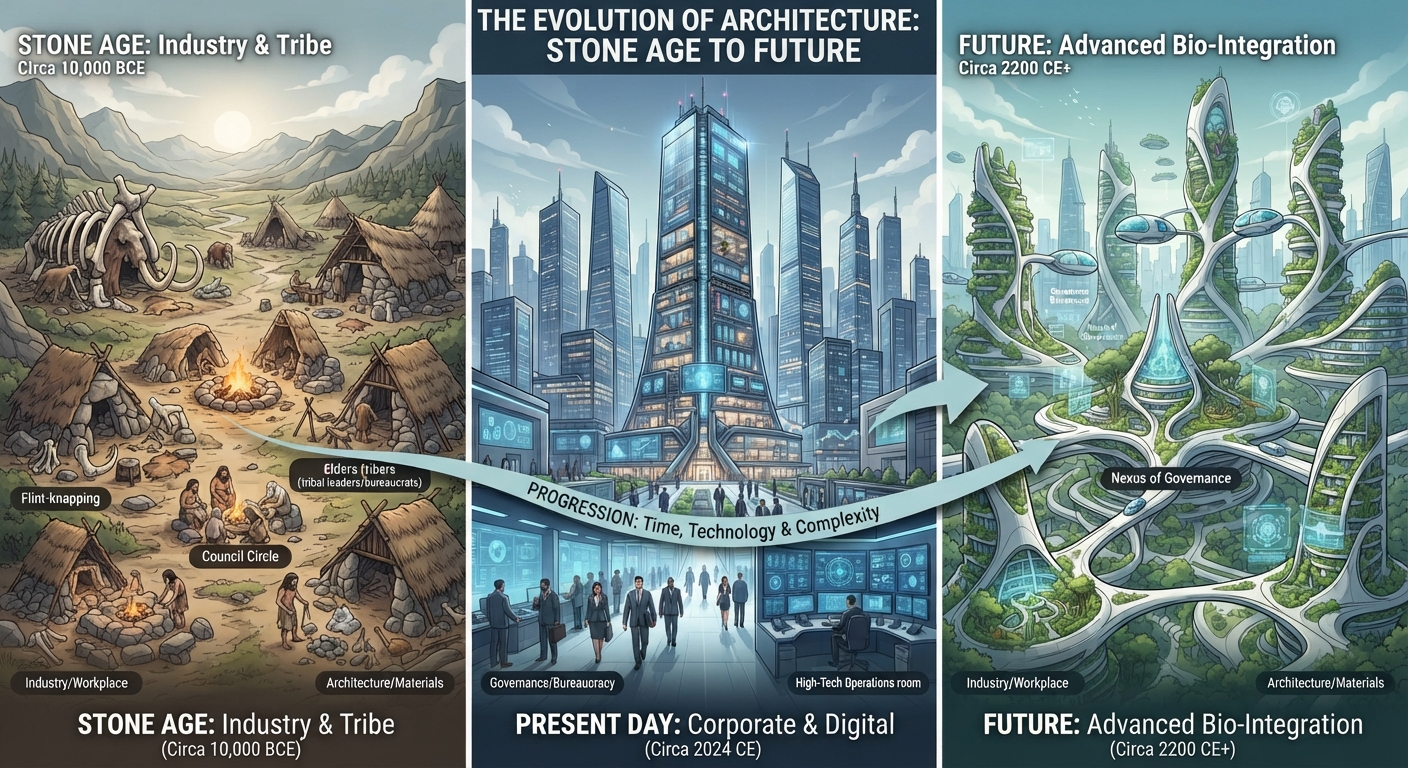
A Comprehensive Thesis
Subtitle: From prehistoric stone-tool production and primitive economic administration to modern industrial management, artificial intelligence, digital governance, and the industries of the future (3000–4000 AD).
Abstract
The history of human industrial development is fundamentally a history of technological invention, knowledge accumulation, resource management, organisation, production, and administration.
Long before modern factories, computers, governments, corporations, and artificial intelligence existed, prehistoric human societies had already developed the foundations of industrial activity.
During the Stone Age, human beings discovered how to select raw materials, manufacture tools, organise labour, distribute resources, develop specialised skills, and transmit technical knowledge between generations.
These activities established the foundations of what we can today understand as an early industrial and administrative ecosystem.
The central argument of this thesis is that the fundamental principles of industry have remained relatively consistent, while the technologies, organisational structures, administrative institutions, and levels of productivity have transformed dramatically.
We can therefore examine five major stages:
- Stone Age industries: survival technology and primitive production.
- Ancient civilisations: organised production, accounting, taxation, and administration.
- Industrial revolutions: mechanisation, factories, engineering, and corporate bureaucracy.
- Present industries: digital infrastructure, artificial intelligence, automation, and global economic networks.
- Future industries: autonomous production, intelligent administration, advanced robotics, biotechnology, and computational economic systems.
CHAPTER 1: The architecture of Stone Age industries
Acheulean Handaxe from St. Acheul, France
8
1.1 Understanding the Stone Age industrial system
The Stone Age refers to a vast period of human prehistory during which stone was a principal material used to manufacture tools and equipment.
It is conventionally divided into three major periods:
| Period | Approximate characteristics |
|---|---|
| Palaeolithic (Old Stone Age) | Hunting, gathering, stone-tool manufacturing |
| Mesolithic (Middle Stone Age) | More specialised tools and changing subsistence systems |
| Neolithic (New Stone Age) | Agriculture, permanent settlements, pottery, polished tools |
These periods did not begin or end simultaneously everywhere in the world.
The Stone Age should not be understood as a period without intelligence or organisation. It involved experimentation, environmental knowledge, technical problem-solving, and increasingly sophisticated cooperation.
1.2 The first industrial production architecture
Imagine an early community producing stone tools.
Before a tool could be manufactured, several activities had to take place:
- Identify suitable stone deposits.
- Recognise materials with useful physical properties.
- Collect and transport the raw materials.
- Select the appropriate manufacturing technique.
- Shape the stone into a useful instrument.
- Inspect the finished tool.
- Distribute it among members of the community.
- Maintain knowledge of how to manufacture and use it.
This is an early example of a production chain.
Stone Age production architecture
1. Natural resources
Stone, wood, bone, animal hides and plant materials
2. Resource identification and collection
Observation, selection and transportation
3. Technical production
Stone shaping, toolmaking and finishing
4. Quality and functional testing
Sharpness, durability and suitability
5. Distribution and utilisation
Hunting, food processing, construction and other activities
6. Knowledge transmission
Demonstration, imitation, teaching and experimentation
This sequence resembles the fundamental architecture of a modern manufacturing company.
The difference is that today’s production systems use industrial machinery, digital databases, advanced materials science, financial accounting, and automated quality-control systems.
1.3 The first technological industries
Stone Age societies developed several important technological activities.
Vuursteen, het staal van de oudheid / Het gebruik van zwerfstenen | STENEN ZOEKEN
A. Stone-tool industry
Production of cutting, scraping, pounding and piercing instruments. This required knowledge of material properties, force, fracture and shape.
B. Bone and wood technology
Manufacture of implements using biological materials, demonstrating diversification beyond stone.
What we know now about how ancient archers made their bows | National Geographic
C. Textile and basketry technologies
Development of fibres, weaving, containers and storage systems, particularly important in later prehistoric societies.
File:Neolithic Pottery (28650540752).jpg – Wikimedia Commons
D. Pottery industry
Transformation of clay through shaping, drying and firing into durable containers.
Révolution néolithique et échanges préhistoriques dans le Vexin (Gommecourt, 78)
E. Agricultural industry
Cultivation, harvesting, food processing and storage established more permanent production economies.
The significance of these industries was not simply the production of physical objects. They represented the emergence of accumulated technological knowledge.
CHAPTER 2: The emergence of technological bureaucracy
A SUMERIAN CLAY CUNEIFORM TABLET, THIRD DYNASTY OF UR, CIRCA 2042 B.C. | Christie’s
Age of Registers III: The Roman Empire: When Registration Became Law
10
2.1 What is technological bureaucracy?
The term technological bureaucracy describes an administrative system in which people, institutions, rules, records, specialised knowledge, and technologies work together to coordinate economic and industrial activities.
It is important to distinguish two concepts:
- Technology: The tools, machines, knowledge, and methods used to produce goods and services.
- Bureaucracy: The organised administrative structure responsible for coordinating people, responsibilities, resources, rules, decisions, and accountability.
The two became increasingly interconnected as human societies grew more complex.
A prehistoric community could coordinate many activities through direct communication and shared customs. A large agricultural civilisation, however, needed more formal methods of recording land, labour, food supplies, taxation, ownership, and trade.
This created the foundations of institutional administration.
2.2 The Mesopotamian administrative revolution
A SUMERIAN CLAY CUNEIFORM TABLET, THIRD DYNASTY OF UR, CIRCA 2042 B.C. | Christie’s
One of the most important transformations occurred in ancient Mesopotamia.
Around 3500–3000 BCE, administrative record-keeping and the development of writing became increasingly important in managing expanding urban economies.
The earliest surviving written records include information about commodities, agricultural production, deliveries, labour, and economic transactions.
The administrative system increasingly required specialised people who could:
- Record economic transactions.
- Measure agricultural production.
- Manage storage facilities.
- Monitor deliveries.
- Record labour obligations.
- Maintain institutional records.
- Report information to authorities.
The development of writing helped expand the administrative capacity of early states. Research examining Mesopotamian political development has found associations between writing, larger administrative structures, and greater state capacity. USC Price+1
This was a major historical development: information became an instrument of economic coordination and institutional power.
2.3 The evolution of the bureaucratic model
The following table illustrates how administrative systems evolved.
| Historical stage | Administrative model | Main responsibility |
|---|---|---|
| Stone Age | Community coordination | Shared resources and production |
| Agricultural societies | Village administration | Land, crops and storage |
| Ancient civilisations | State bureaucracy | Taxes, labour and records |
| Medieval economies | Royal and institutional administration | Trade, property and public works |
| Industrial age | Corporate bureaucracy | Employees, factories and production |
| Digital age | Information-based administration | Data, networks and automation |
| Future economy | AI-assisted intelligent governance | Coordinated, monitored and optimised systems |
An important distinction: Stone Age societies had forms of organisation, but we should not describe them as possessing modern bureaucracies. Formal bureaucratic institutions emerged much later.
CHAPTER 3: The architecture of industrial bureaucracy
From strikes to labor laws: How the US adopted the 5-day workweek — Firmspace
9
3.1 The First Industrial Revolution
Approximately from the late eighteenth century, industrial production began transforming through mechanisation, steam power, and factory organisation.
Production moved increasingly from small workshops and household-based activities into larger factories.
This introduced new administrative challenges:
- How many workers were required?
- How much raw material was available?
- How many products could be manufactured?
- How would production costs be calculated?
- Who would supervise the factory?
- How would products be transported and distributed?
Industrialisation therefore required a more sophisticated management structure.
3.2 The Second Industrial Revolution
Electrical energy, steel production, chemical industries, telecommunications, and mass-production methods expanded industrial capacity.
Factories became larger and required specialised management.
The modern industrial corporation developed a hierarchical architecture.
A Section of the Drafting Room at the The Schenectady Works of the General Electric Company, 1903
A simplified industrial corporate structure looked like this:
Board of Directors
Strategic oversight and governance
Chief Executive Management
Business strategy and executive decisions
Production management
Financial management
Human resources
Technology management
Supervisors and operational departments
Industrial employees and technical specialists
This model provided a clear distribution of authority, responsibilities, and reporting relationships.
Research into the development of industrial corporations explains why complex manufacturing processes encouraged unified management and hierarchical structures. Springer+1
3.3 The Third Industrial Revolution
История развития ЧПУ станков: от первых автоматизированных систем до современных технологий | Симиди
The Third Industrial Revolution introduced electronics, computers, telecommunications, and industrial automation.
The administrative system began changing from paper-based management towards computerised information management.
New professional responsibilities emerged:
- Computer systems administration.
- Software engineering.
- Information technology management.
- Database administration.
- Telecommunications management.
- Cybersecurity.
- Digital financial management.
Information became a major industrial resource.
CHAPTER 4: The comparison between Stone Age and modern industrial systems
The most interesting comparison is not simply between primitive tools and sophisticated machinery.
It is the comparison between the underlying systems that make production possible.
| Industrial component | Stone Age | Modern economy |
|---|---|---|
| Raw materials | Stone, wood, bone | Metals, polymers, silicon, composites |
| Energy | Human effort, fire | Electricity, renewables, nuclear and other energy systems |
| Production | Manual toolmaking | Automated factories and robotics |
| Knowledge | Experience and demonstration | Science, engineering and databases |
| Accounting | Informal resource allocation | Financial accounting and digital systems |
| Administration | Community coordination | Government and corporate institutions |
| Quality control | Practical inspection | Scientific testing and automated measurement |
| Distribution | Local exchange and movement | International supply chains |
| Communication | Speech and physical signals | Internet, satellites and telecommunications |
| Innovation | Experimentation | Research laboratories and computational science |
4.1 The fundamental continuity
Consider a simple example.
A Stone Age community needed suitable materials to manufacture an effective tool.
A modern semiconductor company needs suitable materials to manufacture a microprocessor.
The technologies are extraordinarily different, but both systems depend on:
- Identifying suitable resources.
- Understanding their physical properties.
- Developing a manufacturing process.
- Controlling production quality.
- Organising labour and knowledge.
- Distributing the finished product.
This illustrates an important principle:
Industrial advancement does not eliminate the basic requirements of production; it increases their complexity, precision, scale, and interdependence.
CHAPTER 5: The architecture of the present technological economy (2026)
OpenAI deepens Samsung alliance on next-generation AI chips | Domain-b.com
AM Automation | Montarz instalacji elektrycznych – profesjonalne usługi | Szczecin
Microsoft data center south of Atlanta would be larger than Mall of Georgia
8
The contemporary economy is moving beyond conventional factory management.
Modern industrial organisations depend on interconnected technological infrastructures.
5.1 The seven pillars of modern industrial administration
1. Physical infrastructure
Buildings, roads, electricity networks, water systems, telecommunications, machinery, and transport.
2. Scientific and technological infrastructure
Engineering, physics, chemistry, materials science, mathematics, biotechnology, and computer science.
3. Digital infrastructure
Computers, servers, databases, cloud computing, communication networks, and cybersecurity.
4. Human capital
Scientists, engineers, economists, accountants, programmers, administrators, technicians, and skilled workers.
5. Financial infrastructure
Banking, capital investment, financial reporting, insurance, payments, and economic planning.
6. Institutional governance
Government departments, industrial regulators, corporate boards, legal institutions, standards organisations, and auditing systems.
7. Intelligence and automation
Artificial intelligence, machine learning, robotics, predictive analytics, and automated decision-support systems.
These seven pillars must operate as an integrated economic architecture.
5.2 The modern intelligent industrial model
National and corporate strategic governance
Digital administration and data intelligence
AI and analytics
Financial systems
Engineering and R&D
Human capital
Industrial operations
Factories, agriculture, energy, mining, logistics and services
Economic and social outcomes
Productivity, employment, innovation, prosperity and sustainability
Information and performance measurements flow back to management for evaluation and improvement.
5.3 The transformation of the bureaucrat into a technology administrator
Historically, an administrator primarily worked with records, documents, instructions, accounts, and institutional procedures.
Today, the administrator must increasingly understand the relationship between people, data, technology, and economic systems.
The modern technology administrator may be responsible for:
- Digital infrastructure.
- Information security.
- Technology budgets.
- Data quality.
- Operational performance.
- AI governance.
- Regulatory compliance.
- Innovation management.
- Human-resource development.
This is an important change: administrative competence increasingly requires scientific, mathematical, technological, and economic understanding.
Research suggests that digital technologies and AI can change how bureaucracies operate, potentially making administration more responsive while also creating new governance challenges. ScienceDirect+1
CHAPTER 6: The future industrial and technological bureaucracy (2030–2100)
AI-Powered Smart-City-Brain Could Transform Future Urban Sustainability Models | Technology
Industry Radar | TheBioTechReview
12
The future industrial economy is likely to become increasingly dependent on intelligent machines, advanced computing, robotics, scientific discoveries, and automated administrative processes.
These developments are possibilities and projections, not guaranteed predictions.
6.1 The emergence of intelligent administration
Imagine a future manufacturing company in which its administrative infrastructure integrates:
- Artificial intelligence for analysing production information.
- Robotics for physical manufacturing.
- Sensors for monitoring equipment.
- Digital twins for simulating industrial operations.
- Blockchain or other secure records for tracking transactions.
- Advanced databases for managing resources.
- Human experts for strategic decisions, accountability, and ethical oversight.
The result could be an intelligent industrial organisation.
Its administration would no longer depend exclusively on people manually collecting information and preparing reports.
Instead, information could move continuously between production equipment, financial systems, management, and regulatory institutions.
6.2 Six future industrial sectors
How GlobalFoundries’ Expansion Under the CHIPS Act Bolsters US Tech Leadership — GripRoom
1. Advanced semiconductor industries
More sophisticated processors, specialised AI chips, advanced materials, and increasingly integrated computing systems.
Exploring the Financial Viability of Vertical Farming: Enhancing with AI and Automation
2. Intelligent agricultural industries
Automated cultivation, soil monitoring, precision irrigation, crop analytics, and agricultural robotics.
3. Intelligent energy industries
Advanced electricity networks, renewable energy integration, storage systems, and predictive maintenance.
첨단바이오로 제2의 반도체 신화 쓴다 – 산업종합저널 동향
4. Biotechnology industries
Genomics, computational biology, medical research, and advanced biological manufacturing.
Industry 6.0: The Dawn of Autonomous Manufacturing Powered by AI | by Naveen | Medium
5. Intelligent manufacturing
Autonomous production systems, precision engineering, additive manufacturing, and industrial robotics.
Financial Market Infrastructure (FMI): Overview and Trends | Fondexx
6. Computational financial industries
AI-supported accounting, digital payments, risk analysis, financial infrastructure, and intelligent economic planning.
6.3 The future administrative hierarchy
A future organisation could evolve towards a hybrid structure in which humans and AI systems have clearly separated responsibilities.
| Level | Future responsibility |
|---|---|
| Institutional governance | Human leadership, laws and accountability |
| Strategic intelligence | Human executives supported by AI analysis |
| Digital administration | Data management and administrative automation |
| Scientific management | Engineers, scientists and research systems |
| Operational intelligence | Robotics and automated production |
| Independent oversight | Auditors, regulators and human reviewers |
The important principle is that AI should support institutional decision-making rather than automatically replace human responsibility.
A future system must retain human oversight, transparency, privacy, cybersecurity, and mechanisms for correcting mistakes.
CHAPTER 7: The proposed industrial architecture of the year 3000–4000
Реголит, как живая и мертвая вода — польза и вред от лунной пыли
Hello from DSSL Robots | DSSL Robots
15
This chapter explores a long-term conceptual scenario. It is speculative, not a scientific forecast.
Imagine a civilisation that has developed extremely advanced computational systems, materials science, energy infrastructure, and autonomous manufacturing.
Its industrial administration might operate across several interconnected levels.
7.1 Five levels of a future civilisation’s industrial organisation
Level 1: Planetary resource intelligence
A scientific information system monitors natural resources, environmental conditions, energy availability, and material requirements.
Level 2: Scientific knowledge infrastructure
Research institutions combine mathematics, physics, chemistry, biology, engineering, and computational science.
Level 3: Intelligent industrial production
Automated manufacturing systems produce equipment, infrastructure, materials, and technological components.
Level 4: Economic administration
Computational systems coordinate financial records, resource allocation, infrastructure investment, and economic performance under human-defined rules.
Level 5: Civilisational governance
Institutions establish the laws, ethical standards, environmental responsibilities, and long-term objectives governing technological development.
7.2 The transformation of industrial management
The long-term evolution could be represented as follows:
Four thousand years of organisational evolution
- Stone AgeManual coordinationPractical knowledge, community cooperation, resource collection and toolmaking.
- Ancient civilisationsWritten administrationAccounting, taxation, public institutions, specialised occupations and economic records.
- Industrial and digital civilisationCorporate and computational managementFactories, engineering, financial systems, telecommunications, computers and AI.
- Conceptual future civilisationIntelligent institutional coordinationHighly integrated scientific, industrial, computational and governance infrastructures.
The central question for future civilisation will not simply be how to manufacture more products.
It will be how to coordinate increasingly complex technological systems while maintaining economic fairness, environmental sustainability, human development, and institutional accountability.
CHAPTER 8: Mathematical and scientific methodology for measuring industrial development
A serious industrial development model must be measurable.
Mathematics provides methods for examining productivity, costs, resources, efficiency, labour, innovation, and institutional performance.
8.1 Industrial productivity
Productivity measures the relationship between output and resources used.
\[ P=\frac{Q}{R} \]
Where:
- \(P\) = productivity.
- \(Q\) = quantity of output.
- \(R\) = resources used.
For example, if an industrial facility manufactures 1,000 components using 200 labour-hours:
\[ P=\frac{1000}{200}=5 \]
The facility produces five components per labour-hour.
8.2 Economic production function
An industrial economy can be modelled using a production function:
\[ Y=A K^\alpha L^\beta \]
Where:
- \(Y\) = total production.
- \(A\) = technological efficiency.
- \(K\) = physical capital.
- \(L\) = labour.
- \(\alpha\) and \(\beta\) = production parameters.
This illustrates how capital, labour, and technological efficiency interact.
Stone Age production depended heavily on human skills, materials, and practical experience. Modern industries combine skilled labour with advanced capital equipment, software, scientific knowledge, and energy infrastructure.
8.3 Administrative efficiency
We can also construct a proposed administrative performance indicator:
\[ E_a=\frac{D_c}{T \times C} \]
Where:
- \(E_a\) = administrative efficiency indicator.
- \(D_c\) = correctly completed decisions or tasks.
- \(T\) = time required.
- \(C\) = resources consumed.
This is an illustrative management model, not a universally standardised economic measurement.
Its purpose is to examine whether administrative systems are producing accurate results efficiently.
8.4 Innovation investment
A simplified innovation investment model is:
\[ I_r=\frac{R\&D}{GDP}\times100 \]
Where:
- \(I_r\) = research and development investment as a percentage.
- \(R\&D\) = research and development expenditure.
- \(GDP\) = gross domestic product.
This helps governments and businesses assess the proportion of economic output directed towards scientific and technological advancement.
8.5 Industrial development as a feedback system
The industrial intelligence feedback loop
Economic and scientific objectives
Resource and capital allocation
Industrial production and innovation
Measurement and performance data
Evaluation, auditing and corrective decisions
The cycle repeats, supporting continuous improvement.
This methodology can be applied to a prehistoric production study, a modern manufacturing company, or a national industrial development programme.
CHAPTER 9: Applying the industrial evolution model to South Africa
South Africa’s South Deep gold mine sells 20% more gold in latest quarter
The Future of Farming: Embracing Autonomous AgriTech in South Africa
12
South Africa provides an important example of why historical industrial knowledge must be connected to modern technological development.
A country cannot build a competitive modern economy through administrative structures alone. It needs an integrated system of education, infrastructure, research, finance, industrial production, and competent governance.
9.1 Seven strategic development priorities
| Priority | Required development |
|---|---|
| Education | Mathematics, physics, chemistry, accounting and computer science |
| Mining | Advanced mineral processing and materials science |
| Agriculture | Agricultural biotechnology and automated farming |
| Manufacturing | Industrial machinery, electronics and component production |
| Energy | Reliable electricity and modern energy infrastructure |
| Digital economy | AI, cloud computing, cybersecurity and data centres |
| Administration | Transparent public institutions and measurable performance |
9.2 Building a modern industrial knowledge ecosystem
South Africa can learn from the entire historical progression:
- From Stone Age communities: practical innovation and resource knowledge.
- From ancient civilisations: accounting, recordkeeping and institutional administration.
- From industrial civilisation: engineering, manufacturing and production management.
- From digital civilisation: data infrastructure, computational intelligence and automation.
- From future industrial models: responsible integration of science, technology, institutions and human capital.
The objective should be to build an economy that does not merely consume imported technologies but also develops the scientific and industrial capacity to create them.
CHAPTER 10: The 15 fundamental principles of industrial civilisation
The following principles summarise the entire thesis.
| No. | Principle | Industrial significance |
|---|---|---|
| 1 | Resource intelligence | Understanding available materials |
| 2 | Scientific knowledge | Understanding natural laws |
| 3 | Technical innovation | Developing useful technologies |
| 4 | Human capital | Developing skilled populations |
| 5 | Production organisation | Coordinating industrial activities |
| 6 | Accounting | Measuring economic resources |
| 7 | Bureaucratic governance | Establishing responsibilities and accountability |
| 8 | Infrastructure | Building systems that support production |
| 9 | Financial management | Allocating investment and capital |
| 10 | Data intelligence | Converting information into knowledge |
| 11 | Automation | Improving production capabilities |
| 12 | Research and development | Creating new discoveries |
| 13 | Quality management | Maintaining production standards |
| 14 | Sustainability | Protecting resources and the environment |
| 15 | Institutional intelligence | Coordinating society’s long-term development |
CHAPTER 11: Critical research questions and hypotheses
For this thesis to become a serious academic research project, the following questions are important.
Research question 1: How did prehistoric stone-tool production establish the foundations of organised industrial activity?
Research question 2: How did the emergence of writing, accounting, and formal administration transform economic organisation?
Research question 3: Why did industrialisation require hierarchical bureaucratic institutions?
Research question 4: How are digital technologies transforming traditional bureaucratic structures?
Research question 5: Can artificial intelligence improve industrial productivity while maintaining human accountability?
Research question 6: What institutional and educational infrastructure will future industrial economies require?
Proposed research hypotheses
- H1: Technological advancement increases the complexity of industrial coordination.
- H2: Better information systems can improve institutional and economic performance.
- H3: Human capital development is essential for successful industrial transformation.
- H4: Scientific innovation and effective governance are complementary drivers of economic development.
- H5: AI-supported administration can improve operational efficiency when supported by appropriate accountability and oversight.
CHAPTER 12: Final conclusion — From stone tools to intelligent industrial civilisation
The history of industrial civilisation demonstrates an extraordinary transformation in human capabilities.
During the Stone Age, human beings used observation, experimentation, practical knowledge, and cooperation to manufacture the tools required for survival.
As settlements expanded, societies needed increasingly sophisticated ways of organising production and resources.
Ancient civilisations developed writing, accounting, taxation, and formal administrative institutions. These innovations allowed economic activities to be coordinated across larger populations and territories.
The Industrial Revolution introduced machinery, electricity, factories, and corporate management structures. The digital revolution subsequently introduced computers, global communications, databases, automation, and artificial intelligence.
The next stage may involve increasingly autonomous and interconnected industrial systems, supported by scientific research, computational intelligence, and advanced institutional governance.
However, one principle remains fundamental throughout this history:
Technology creates productive capabilities, knowledge creates understanding, human capital creates expertise, and effective institutions organise these resources into economic development.
The most advanced civilisation will therefore not necessarily be the one possessing the greatest number of machines or the most powerful computers.
It will be the one capable of integrating scientific knowledge, technological innovation, economic intelligence, human development, and responsible administration into a sustainable system.
The 4,000-year industrial development equation
\[ \text{Civilisational Development} \]
\[ =\text{Knowledge}+\text{Technology}+\text{Human Capital} \]
\[ +\text{Capital}+\text{Governance}+\text{Innovation} \]
The central thesis
From the first stone-tool manufacturing systems to future intelligent industries, the continuous advancement of human civilisation depends on the ability to transform knowledge into organised, productive, and sustainable economic activity.
Selected academic references and further reading
- OpenStax World History — Ancient Mesopotamia and the development of early civilisation. Read the chapter.
- Digital Corpus of Cuneiform Lexical Texts — Early administrative writing and economic records. Explore the research.
- Ur III Economy and Bureaucracy — Ancient Mesopotamian administrative systems. Read the academic paper.
- Setting the Stage for Corporate Headquarters — The evolution of industrial corporations. Read the research.
- How Is Technological Change Affecting the Nature of the Corporation? — The digital transformation of corporate organisation. Read the British Academy paper.
- Digital Technologies, Artificial Intelligence, and Bureaucratic Transformation — Future administrative structures. Read the research.
- Specialised and Persistent Raw Material Procurement by Humans in the Middle Pleistocene — Important archaeological evidence from South Africa. Read the 2026 research.
Final academic perspective: Industrial history should not be studied as a collection of disconnected inventions. It should be studied as the evolution of an interconnected system of natural resources, science, technology, labour, economics, administration, and institutional intelligence.



Be First to Comment