
Comprehensive Scientific Thesis
MOLECULAR BIOLOGY • HUMAN GENETICS • BIOCHEMISTRY • CELLULAR ENGINEERING
1. Introduction: Understanding the ribosome as a molecular machine
The human body is an extraordinarily complex biological system. Beneath its visible organs, tissues, blood vessels and cells exists a microscopic manufacturing network responsible for producing the proteins required for life.
At the centre of this manufacturing network is the ribosome.
A ribosome is a sophisticated molecular machine found inside human cells. Its principal responsibility is to manufacture proteins by reading genetic instructions carried by messenger RNA (mRNA).
Proteins are essential because they perform thousands of biological functions, including:
- Building and maintaining muscles, skin and other tissues.
- Producing enzymes that control chemical reactions.
- Supporting the immune system.
- Transporting oxygen and other substances.
- Regulating communication between cells.
- Supporting the structure and operation of the brain and nervous system.
- Maintaining cellular growth, repair and normal functioning.
To understand the ribosome properly, we must examine the relationship between four fundamental biological components:
- DNA: The long-term genetic information storage system.
- RNA: The molecular information-transfer and processing system.
- Ribosome: The molecular protein-manufacturing machine.
- Protein: The functional molecular products that perform much of the work inside the human body.
The relationship between these components is one of the foundations of modern molecular biology.
2. The complete architecture: From human DNA to functional proteins
Chapter: The Cell — The Biology Primer
The fundamental biological information pathway is commonly called the central dogma of molecular biology.
It describes how genetic information is used to produce proteins.
\[ DNA \rightarrow RNA \rightarrow Protein \]
The process has two major stages:
Stage 1: Transcription
A section of DNA containing a gene is used as a template to produce RNA, particularly messenger RNA.
Stage 2: Translation
The ribosome reads the messenger RNA sequence and assembles amino acids into a protein.
An important distinction is that DNA does not directly manufacture proteins. Instead, it stores the genetic instructions that cells use to produce them.
The biological production network
DNA
Genetic information storage
Contains genes encoded in nucleotide sequences
TRANSCRIPTION
mRNA
Genetic message
Carries a processed copy of genetic instructions
TRANSLATION
RIBOSOME
Molecular protein factory
Reads mRNA and joins amino acids together
PROTEIN
Biological functional product
Folds into a functional molecular structure
This information pathway connects the genetic blueprint to the molecular machinery that maintains human life.
3. The molecular architecture of the human ribosome
New insights into the cell’s protein factory | SLS – Swiss Light Source | PSI
Ribosome, translation and cancer – CRCL
9
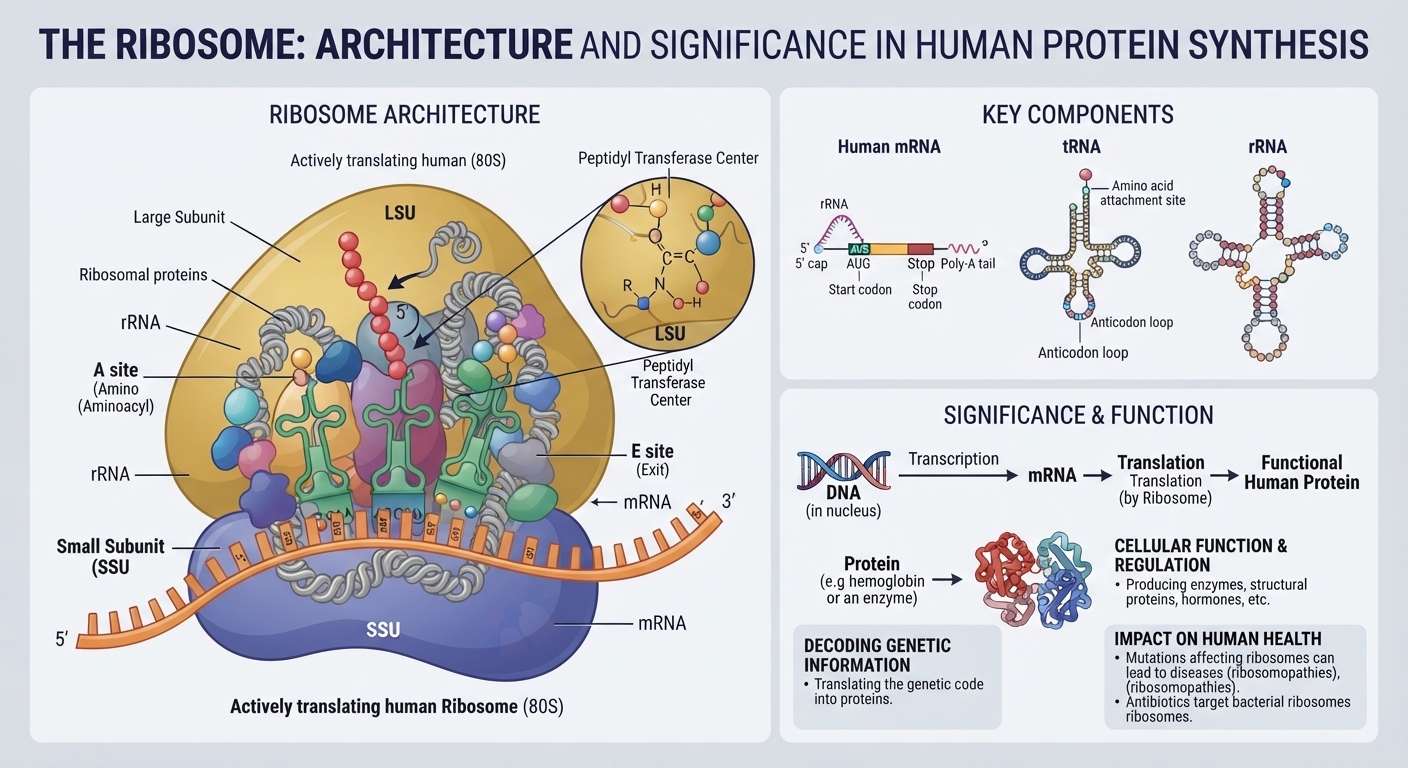
The human ribosome is an extremely organised molecular assembly made from ribosomal RNA (rRNA) and ribosomal proteins.
The complete cytoplasmic human ribosome is known as an 80S ribosome.
It consists of two major subunits:
| Component | Main responsibility |
|---|---|
| 40S small subunit | Reads and decodes mRNA instructions |
| 60S large subunit | Catalyses peptide-bond formation |
| 80S complete ribosome | Coordinates the complete translation process |
The 40S and 60S values are sedimentation coefficients, measured in Svedberg units. They are not ordinary measurements of mass, so 40S + 60S does not equal 100S.
3.1 The small ribosomal subunit: 40S
The small subunit contains:
- One major RNA molecule called 18S ribosomal RNA.
- Approximately 33 ribosomal proteins in the commonly used human structural description.
Its principal responsibilities include:
- Binding to messenger RNA.
- Identifying the correct starting position.
- Reading the genetic message.
- Checking the pairing between mRNA codons and transfer RNA anticodons.
- Helping ensure that amino acids are assembled in the correct sequence.
Think of the 40S subunit as the information-reading and decoding department of the molecular factory.
3.2 The large ribosomal subunit: 60S
Pre-Ribosomal RNA Processing in Human Cells: From Mechanisms to Congenital Diseases | MDPI
The large subunit contains three types of ribosomal RNA:
- 28S rRNA.
- 5.8S rRNA.
- 5S rRNA.
It contains approximately 47 ribosomal proteins in the commonly used human structural description.
Its central responsibility is to catalyse the formation of peptide bonds, connecting individual amino acids into a growing protein chain.
This is a remarkable characteristic: the ribosome’s main chemical manufacturing activity is performed by RNA itself, not simply by its surrounding proteins.
The ribosome is therefore described as a ribozyme, meaning an RNA molecule or RNA-containing structure with catalytic activity. PubMed Central (PMC)+2
4. The three operational stations of the ribosome
The ribosome has three major transfer-RNA binding sites. They work together like a coordinated production line.
Biology: Ribosomes and Protein Synthesis Sites Infographic | LivePhysics™
| Station | Full name | Function |
|---|---|---|
| A site | Aminoacyl site | Receives incoming amino-acid-carrying tRNA |
| P site | Peptidyl site | Holds the tRNA carrying the growing protein chain |
| E site | Exit site | Releases the used tRNA |
How these stations cooperate
A station – Arrival
A transfer RNA (tRNA) arrives carrying an amino acid. Its anticodon matches the appropriate codon on the mRNA.
P station – Production
The tRNA carrying the growing amino-acid chain is positioned here. The ribosome facilitates the formation of another peptide bond.
E station – Exit
After transferring its amino acid, the empty tRNA moves towards the exit site and leaves the ribosome.
This coordinated process repeats until the protein’s amino-acid sequence is complete. NCBI+2
5. Understanding the four principal molecular components
To understand how this machine operates, we must distinguish the different molecules that participate in protein synthesis.
Genetika šiuolaikiniame pasaulyje | Brainy Boom
A. DNA – Genetic information
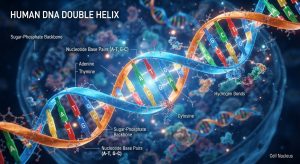
DNA contains four principal nucleotide bases: adenine (A), thymine (T), guanine (G) and cytosine (C). Their sequence stores genetic information.
Medical illustration of messenger RNA or mRNA molecule.
B. mRNA – Messenger
Messenger RNA carries the information copied from a gene to the ribosome. RNA uses uracil (U) instead of thymine (T).
C. tRNA – Amino-acid transporter
Transfer RNA connects the genetic code to the corresponding amino acid. It has an anticodon that recognises an mRNA codon.
RCSB PDB – 1J5E: Structure of the Thermus thermophilus 30S Ribosomal Subunit
D. rRNA – Ribosomal framework and catalyst
Ribosomal RNA forms much of the ribosome’s structure and performs essential functions in decoding and peptide-bond formation.
An additional molecule is important: aminoacyl-tRNA synthetase. These enzymes attach the correct amino acids to their corresponding tRNAs, helping maintain the accuracy of protein synthesis.
6. The 20 amino acids: The raw materials of protein manufacturing
Unnatural Amino Acids – by Simon Barnett
The human body uses 20 standard amino acids to construct its proteins.
These amino acids are connected in different sequences to create different protein molecules.
Some examples include:
| Amino acid | Three-letter abbreviation | Importance |
|---|---|---|
| Glycine | Gly | Protein structure and flexibility |
| Alanine | Ala | Metabolism and protein construction |
| Leucine | Leu | Protein synthesis regulation |
| Lysine | Lys | Protein structure and modification |
| Methionine | Met | Initiation of many protein chains |
| Cysteine | Cys | Disulfide bonds in protein structures |
| Tryptophan | Trp | Precursor for important biological molecules |
| Glutamic acid | Glu | Protein chemistry and metabolism |
There are nine amino acids considered essential in human nutrition. They must be obtained through food because the human body cannot produce sufficient quantities of them.
The amino-acid sequence determines important aspects of a protein’s folding and eventual biological function.
7. How the ribosome reads the genetic code
The ribosome reads mRNA in groups of three nucleotides.
Each group is called a codon.
For example:
An example of genetic translation
ILLUSTRATIVE mRNA SEQUENCE
AUG
Start
GCU
Alanine
UUU
Phenylalanine
UGA
Stop
Resulting amino-acid sequence
Methionine
Alanine
Phenylalanine
UGA is a termination codon. It does not encode another amino acid.
The genetic code contains 64 possible codons:
- 61 codons specify amino acids.
- Three codons signal termination: UAA, UAG and UGA.
AUG normally serves as the initiation codon and specifies methionine.
This triplet-reading system allows the ribosome to convert a nucleotide sequence into an amino-acid sequence. NCBI+1
8. The four stages of protein manufacturing
Research : Fachbereich Chemie : Universität Hamburg
Stage 1: Initiation
The ribosome begins assembling around the mRNA.
- Translation initiation factors help prepare the 40S subunit.
- The initiator tRNA carrying methionine is positioned.
- The appropriate start codon is recognised.
- The 60S subunit joins the 40S subunit.
The completed 80S initiation complex is ready to manufacture a protein.
Stage 2: Elongation
This is the main manufacturing phase.
- New aminoacyl-tRNAs arrive.
- Their anticodons match the mRNA codons.
- Peptide bonds connect the amino acids.
- The ribosome moves along the mRNA.
- The protein chain becomes progressively longer.
Stage 3: Termination
The ribosome reaches one of the three stop codons.
Release factors recognise the termination signal and help release the completed polypeptide.
Stage 4: Ribosome recycling
The ribosomal complex is disassembled into its two subunits.
The components can subsequently participate in another round of protein synthesis.
These four stages are coordinated by specialised translation factors and energy-dependent molecular processes. NCBI+1
9. Where are ribosomes manufactured inside human cells?
An important question is: if ribosomes manufacture proteins, where does the cell manufacture the ribosomes themselves?
The answer is the nucleolus, a specialised region inside the cell nucleus.
Ribosome production is called ribosome biogenesis.
It involves several coordinated processes.
- Ribosomal RNA genes in DNA are transcribed to produce precursor ribosomal RNA.
- The precursor RNA is processed and chemically modified.
- Ribosomal proteins are manufactured in the cytoplasm using existing ribosomes.
- These proteins enter the nucleus and associate with developing ribosomal RNA.
- The developing ribosomal subunits undergo assembly and maturation.
- The 40S and 60S subunits are exported through nuclear pores.
- They become functional cytoplasmic ribosomes when they assemble around an mRNA during translation.
The process requires numerous proteins, RNA molecules and assembly factors.
The nucleolus is therefore not simply a storage area. It is a highly organised ribosome-production and assembly centre. PubMed Central (PMC)+2
10. Free ribosomes versus attached ribosomes
Human cells contain ribosomes in different operational locations.
Ch 10-The Endoplasmic Reticulum Flashcards | Quizlet
10.1 Free ribosomes
Free ribosomes operate in the cytoplasm.
They produce many proteins that function:
- Inside the cytoplasm.
- Inside the nucleus.
- Inside mitochondria, after being imported.
- In various other cellular compartments.
10.2 Endoplasmic-reticulum-bound ribosomes
Other ribosomes become associated with the rough endoplasmic reticulum (rough ER).
They manufacture proteins that are generally destined for:
- Secretion outside the cell.
- Insertion into cellular membranes.
- Delivery to certain internal cellular compartments.
The rough ER provides an environment where newly manufactured proteins can enter a system of folding, modification and transport.
An important scientific distinction: free and ER-bound ribosomes are not fundamentally different manufacturing machines. A ribosome can change its association depending on the destination signals of the protein being produced.
11. What happens after the ribosome manufactures a protein?
The production of an amino-acid chain does not automatically mean that a functional protein has been completed.
A newly manufactured polypeptide must acquire an appropriate three-dimensional structure.
PPT – Molecular Cell Biology PowerPoint Presentation, free download – ID:5979091
PPT – Cell Theory PowerPoint Presentation, free download – ID:1378082
8
There are several important stages.
1. Primary structure
The sequence of amino acids joined together.
2. Secondary structure
Local folding patterns, including alpha helices and beta sheets.
3. Tertiary structure
The overall three-dimensional arrangement of an individual protein chain.
4. Quaternary structure
The association of multiple protein subunits into one functional complex, where applicable.
The role of molecular chaperones
Molecular chaperones help newly synthesised proteins fold correctly and reduce inappropriate molecular interactions.
Some proteins also undergo:
- Chemical modifications.
- Removal of particular amino-acid segments.
- Addition of carbohydrate groups.
- Disulfide-bond formation.
- Assembly with other proteins.
A protein that folds incorrectly may be retained, refolded or directed towards cellular degradation systems.
This is important because protein structure is closely connected to protein function.
12. The significance of proteins in human survival
Proteins are not merely structural materials. They are active molecular components of almost every biological system.
NuSep Blog | Proteins in the Body Infographic
Consider the following examples.
| Protein | Main biological responsibility |
|---|---|
| Haemoglobin | Transports oxygen in red blood cells |
| Collagen | Provides structural support to connective tissues |
| Insulin | Helps regulate blood glucose |
| Actin | Supports cell structure and movement |
| Myosin | Participates in muscle contraction |
| Antibodies | Recognise specific foreign substances |
| Amylase | Helps digest starch |
| DNA polymerase | Participates in DNA replication |
| Ion channels | Regulate movement of ions across membranes |
| Albumin | Helps maintain blood plasma properties and transport substances |
These proteins have different structures and functions, but their production depends on genetic information and cellular protein-synthesis machinery.
The connection to human organs
Brain Diagram Generator – Create Neuroscience Illustrations with AI – ConceptViz
Brain and nervous system
Proteins form ion channels, receptors, transporters and enzymes that support electrical signalling and communication between neurons.
Medicine Hack – Think Smart. Live Healthy
Heart
Contractile proteins, including actin and myosin, help cardiac muscle contract and pump blood.
Liver
Liver cells manufacture many enzymes, transport proteins, plasma proteins and metabolic regulators.
Your immune system explained – 16 Mar 2023 – How It Works Magazine – Readly
Immune system
Antibodies, receptors and signalling proteins support the recognition and response to biological threats.
PPT – Muscle Overview PowerPoint Presentation, free download – ID:3008709
Muscular system
Structural and contractile proteins maintain muscle architecture and movement.
The significance is that protein synthesis connects the genetic information stored in cells to the practical functioning of human organs.
13. The relationship between DNA mutations, ribosomes and protein abnormalities
One of the most important discoveries in molecular biology is that changes in DNA can sometimes change the proteins produced by cells.
A mutation is a change in the nucleotide sequence of DNA.
For example, a mutation can:
- Change an amino acid in a protein.
- Introduce an early stop signal.
- Alter how much protein is produced.
- Affect how RNA is processed.
- Prevent a protein from folding correctly.
Types of mutations – MHCC Biology 112: Biology for Health Professions
Consider the relationship:
\[ DNA\ mutation \rightarrow RNA\ change \rightarrow Protein\ change \]
However, not every DNA mutation changes a protein. Some mutations occur in regions that do not encode proteins, and some coding mutations do not alter the amino acid because the genetic code is redundant.
What happens when ribosome production is disrupted?
The ribosome itself also requires accurate construction and regulation.
Defects in ribosomal proteins or ribosome assembly can cause disorders collectively known as ribosomopathies.
Examples include:
- Diamond–Blackfan anaemia.
- Shwachman–Diamond syndrome.
- Certain forms of Treacher Collins syndrome.
These conditions demonstrate how disturbances in the cell’s protein-manufacturing machinery can affect human development and tissue function.
The relationship between DNA, ribosomes and protein production is therefore important not only for normal biology but also for understanding disease.
14. Ribosomes and the human energy system
Protein manufacturing is an energy-dependent process.
The ribosome requires energy to coordinate the movement of molecular components and the construction of proteins.
Two important energy molecules are:
- ATP – adenosine triphosphate.
- GTP – guanosine triphosphate.
GTP is particularly important during translation initiation, aminoacyl-tRNA selection and ribosomal translocation.
ATP is required in other stages of protein production, including amino-acid activation and charging of tRNA.
The Enzymes Of Glycolysis In A Eukaryotic Cell Are Located In The at Marcia Chester blog
The mitochondria are important because they generate much of the ATP used by human cells.
This creates an important biological connection:
\[ \text{Nutrients} \rightarrow \text{Cellular metabolism} \rightarrow \text{ATP production} \rightarrow \text{Protein synthesis} \]
This is not a single uninterrupted reaction. It is a coordinated relationship between metabolism and the machinery responsible for manufacturing proteins.
An additional discovery: Mitochondrial ribosomes
Human cells also contain specialised ribosomes inside mitochondria.
These are called mitochondrial ribosomes or mitoribosomes.
Unlike the cytoplasmic 80S ribosome, human mitochondrial ribosomes are approximately 55S and have a different molecular composition.
Their principal responsibility is manufacturing the 13 proteins encoded by mitochondrial DNA. These proteins are important components of the oxidative phosphorylation system, which produces ATP.
This means human cells possess two major ribosomal systems:
| Ribosomal system | Location | Main function |
|---|---|---|
| Cytoplasmic 80S | Cytoplasm and rough ER | Manufactures most cellular proteins |
| Mitochondrial 55S | Mitochondria | Manufactures 13 mitochondrially encoded proteins |
Most mitochondrial proteins, however, are manufactured by cytoplasmic ribosomes and subsequently imported into mitochondria.
15. Ribosomes and modern medical science
Understanding ribosomes has become important in several areas of medicine, biotechnology and pharmaceutical research.
Group web site of Prof. Nenad Ban’s research group – The Ban Lab | ETH Zurich
15.1 Antibiotic research
Many antibiotics work by interfering with bacterial ribosomes.
Bacterial ribosomes differ structurally from human cytoplasmic ribosomes. This difference makes it possible for some medicines to target bacterial protein production more selectively.
15.2 Cancer research
Cancer cells can alter their protein-production systems to support rapid growth and division.
Researchers study ribosome production, translation regulation and protein synthesis to understand these changes and identify potential treatment targets.
15.3 Genetic medicine
Scientists investigate how genetic instructions can be modified, corrected or regulated to address certain diseases.
Understanding how mRNA is translated by ribosomes is essential to this research.
15.4 mRNA technology
mRNA-based vaccines demonstrate how researchers can use synthetic messenger RNA to instruct human cells to manufacture a selected protein antigen.
The ribosome reads the supplied mRNA and produces the encoded protein, allowing the immune system to recognise it.
15.5 Structural molecular biology
Modern cryo-electron microscopy allows scientists to study ribosomes in extraordinary molecular detail.
This technology helps researchers understand:
- The arrangement of ribosomal RNA and proteins.
- How molecular components interact.
- How translation factors control movement.
- How medicines interact with molecular structures.
The 2009 Nobel Prize in Chemistry recognised Venkatraman Ramakrishnan, Thomas A. Steitz and Ada E. Yonath for research into the structure and function of ribosomes. Nobel Prize+2
16. How does the human body regulate ribosome activity?
The human body does not manufacture every protein continuously at the same rate.
Instead, cells regulate protein production according to their needs.
For example, a liver cell, muscle cell and neuron have different responsibilities and therefore produce different collections of proteins.
Several biological mechanisms control this process.
A. Gene regulation
Cells control which genes are active and how much RNA is produced from them.
B. Messenger RNA regulation
Cells control mRNA processing, transport, stability and availability for translation.
C. Translation regulation
Translation initiation factors and other regulatory proteins determine when and how efficiently ribosomes manufacture proteins.
D. Protein degradation
Cells also remove proteins that are damaged, unnecessary or no longer required.
One important mechanism is the ubiquitin-proteasome system, which labels selected proteins for destruction.
This creates a balanced biological system:
\[ \text{Protein production} \leftrightarrow \text{Protein degradation} \]
The balance is essential for maintaining healthy cellular operations.
17. Multiple ribosomes working on one messenger RNA
One particularly remarkable feature of molecular manufacturing is that several ribosomes can translate the same mRNA simultaneously.
This arrangement is called a polysome or polyribosome.
Polyribosome. Process of translation mRNA by ribosome in clusters.
Instead of one ribosome manufacturing a protein and then starting again, several ribosomes can move along the same messenger RNA.
The advantages include:
- Increased protein-production capacity.
- Efficient use of genetic instructions.
- Faster availability of certain proteins.
- Better coordination of cellular manufacturing.
Think of this as multiple production machines working from the same set of manufacturing instructions.
It is one of the ways cells increase their protein-production efficiency.
18. The ribosome compared with a modern industrial manufacturing factory
The ribosome provides an extraordinary example of biological engineering.
Its molecular operations can be compared with the architecture of an industrial manufacturing system.
| Modern industrial system | Biological ribosome system |
|---|---|
| Technical blueprint | DNA |
| Production instructions | mRNA |
| Information-reading department | 40S subunit |
| Manufacturing assembly system | 60S subunit |
| Incoming raw materials | Amino acids |
| Material transportation | tRNA |
| Assembly machinery | Ribosome |
| Quality control | Molecular proofreading and cellular surveillance |
| Finished manufactured product | Protein |
| Production energy | ATP and GTP |
There is an important scientific difference: the ribosome is not a conscious machine, nor does it make independent decisions. Its operation emerges from molecular interactions governed by chemistry and physics.
Nevertheless, the comparison provides a useful way of understanding its organisation.
19. The complete biological architecture: DNA to human survival
Levels Of Organization Heart at Marie Vicente blog
The entire system can be understood through seven interconnected levels.
- Level 1 – DNAStores the genetic information.
- Level 2 – GenesParticular DNA sequences provide instructions for functional RNA or proteins.
- Level 3 – RNATransfers, processes and regulates genetic information.
- Level 4 – RibosomeDecodes mRNA and assembles amino acids.
- Level 5 – ProteinsPerform structural, chemical, transport and regulatory functions.
- Level 6 – Cells and tissuesOrganise proteins into functioning biological systems.
- Level 7 – Human organs and the bodyCoordinate the activities necessary for human survival.
This hierarchy demonstrates how microscopic molecular activity contributes to the functioning of the entire human body.
20. Advanced scientific research questions
For university-level molecular biology and biotechnology studies, the ribosome raises several important research questions.
| Research area | Important scientific question |
|---|---|
| Molecular architecture | How do ribosomal RNA and proteins form a stable functional machine? |
| Genetic engineering | How can changes in genetic instructions alter protein production? |
| Cellular energy | How does cellular energy availability influence translation? |
| Protein folding | How do molecular chaperones improve protein folding? |
| Medical biotechnology | How can ribosomal mechanisms support new medical technologies? |
| Cancer biology | How does altered ribosome production contribute to abnormal cell growth? |
| Artificial intelligence | How can computational models predict protein structures and interactions? |
| Synthetic biology | How can scientists construct artificial biological systems that produce useful proteins? |
These research areas connect molecular biology with physics, chemistry, computer science, medicine and biotechnology.
21. The significance of studying ribosomes in the modern economy
Understanding ribosomes is not limited to academic biology. It has major economic and technological implications.
Several modern industries depend on knowledge of molecular biology.
Biopharmaceutical industry
Develops vaccines, therapeutic proteins and biological medicines.
Why Genome Sequencing May Hold the Key to Preventing Genetic Diseases
Genomics industry
Studies genetic information, inherited characteristics and genetic variation.
Cryogenic electron microscopy | Tomáš Kouba Group
Structural biology
Uses advanced imaging and computational methods to understand molecular architecture.
LLMs for Bioinformatics Code Generation: Copilot vs ChatGPT | Technology Networks
Bioinformatics and AI
Uses mathematics, computer science and artificial intelligence to analyse DNA, RNA and proteins.
For South Africa and other developing economies, these fields offer opportunities in:
- Biotechnology education.
- Pharmaceutical research and development.
- Genomic data analysis.
- Laboratory technology.
- Agricultural biotechnology.
- Biomedical engineering.
- Computational biology.
Building expertise in molecular biology can therefore contribute to scientific innovation, employment, industrial development and modern healthcare.
22. Important scientific terminology
| Scientific term | Meaning |
|---|---|
| Genome | The complete genetic material of an organism |
| Gene | A DNA sequence that produces a functional RNA or contributes to protein production |
| Nucleotide | Basic building block of DNA and RNA |
| Transcription | Production of RNA from a DNA template |
| Translation | Production of a polypeptide using mRNA instructions |
| Ribosome | Molecular machine responsible for translation |
| Codon | Three-nucleotide sequence in mRNA |
| Anticodon | Three-nucleotide sequence in tRNA that recognises a codon |
| Amino acid | Building block of proteins |
| Polypeptide | Chain of amino acids joined by peptide bonds |
| Proteome | Complete collection of proteins produced by a cell, tissue or organism under specified conditions |
| Proteomics | Scientific study of proteins and their functions |
| Ribosome biogenesis | Production and assembly of ribosomes |
| Ribozyme | RNA molecule with catalytic activity |
23. Final scientific conclusion
The ribosome is one of the most important molecular machines in the human body.
Its significance lies in its ability to convert genetic information into biological function.
DNA stores the genetic instructions. RNA carries and processes those instructions. The ribosome reads messenger RNA and assembles amino acids into proteins. Those proteins then participate in constructing, regulating and maintaining the biological systems that sustain human life.
The most remarkable discovery is that this entire process operates at a microscopic molecular scale through highly coordinated chemical interactions.
The ribosome demonstrates how information, molecular structure, energy and chemistry combine to create the functional machinery of living organisms.
The central scientific principle is this: DNA provides genetic information, the ribosome translates that information, and proteins perform many of the operations that make human life possible.
24. Recommended scientific reading and references
The following scientific resources provide deeper information for continued study.
- How Cells Read the Genome: From DNA to Protein – Molecular Biology of the Cell, NCBI Bookshelf.
- Translation Phases in Eukaryotes – NCBI Bookshelf.
- Eukaryotic Ribosome Assembly – Annual Review of Biochemistry.
- Crystal Structure of Eukaryotic Ribosome – PMC.
- 2009 Nobel Prize in Chemistry – Ribosome Structure and Function.
- Translation of mRNA – NCBI Bookshelf.
25. Suggested next level of molecular biology study
A particularly valuable continuation would be a detailed investigation of how the ribosome, DNA, mitochondria, amino acids, enzymes and proteins interact as one integrated biological manufacturing network.
That would extend the study from individual molecular machines to the complete biochemical architecture of the human cell.


Be First to Comment