
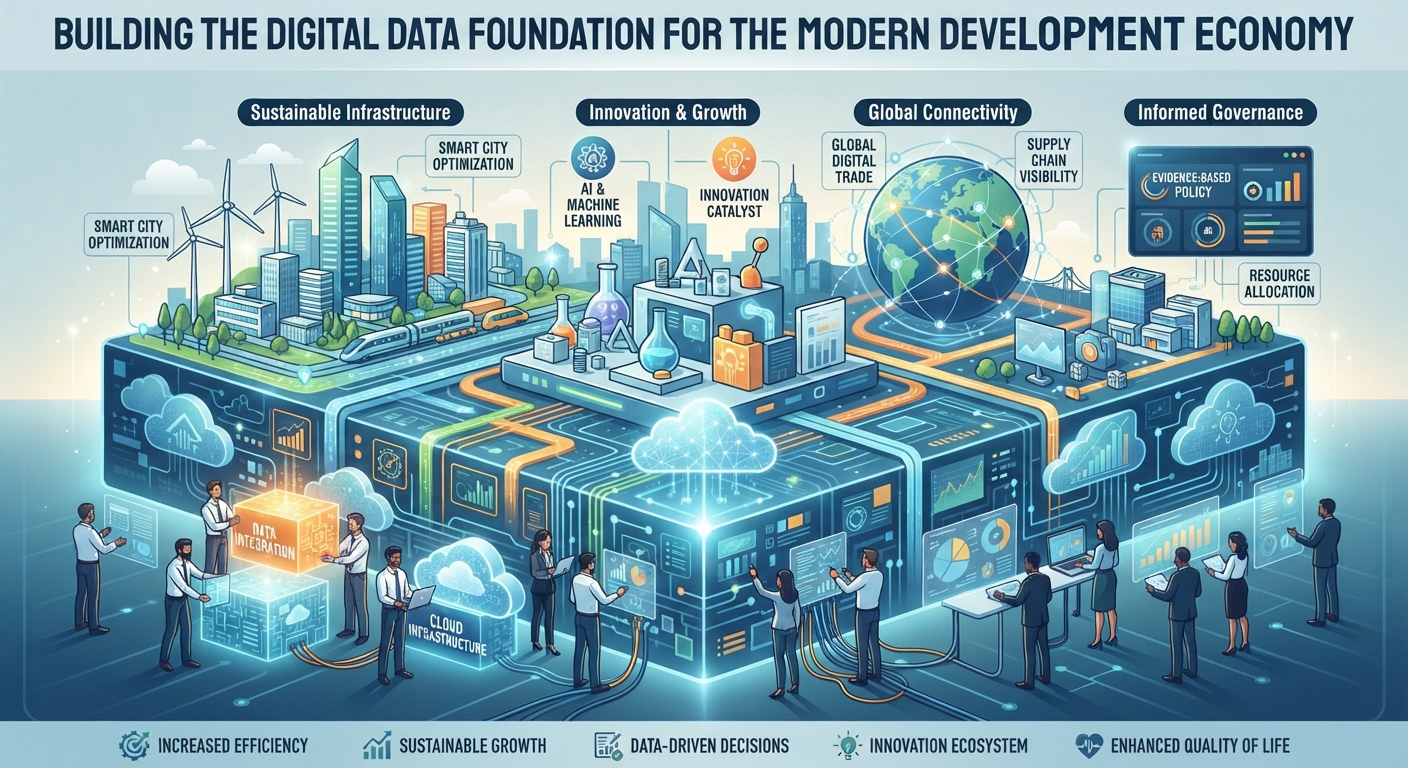
Comprehensive Thesis
A scientific, technological, mathematical and economic examination of digital information as the foundation of modern development
Abstract
Digital data and information have become among the most important resources in the development of modern civilisation. Just as agricultural land, minerals, electricity, transportation and financial capital transformed previous economic eras, digital information is transforming how nations produce goods, deliver services, manage institutions, conduct scientific research, educate populations and develop new industries.
The modern economy increasingly depends on the ability to collect, organise, store, process, analyse, protect and distribute information.
However, data alone does not automatically create economic value. Its value emerges when human intelligence, mathematical models, computing infrastructure, artificial intelligence, scientific knowledge and institutional decision-making transform raw data into useful information and practical solutions.
The central thesis is that digital data is an economic resource, information is a productive asset, and intelligent information management is an essential capability for sustainable national development.
Chapter 1: Understanding digital data and information
1.1 What is digital data?
Digital data is information represented in a machine-readable form, principally through binary digits.
Computers process digital information using two fundamental values:
- 0 – a binary zero.
- 1 – a binary one.
These two values form the foundation of digital computing.
Azure Developer Day – Hyderabad | Reskilll
Every digital activity depends on the representation and processing of data.
Examples include:
- Banking transactions.
- Medical laboratory results.
- Satellite observations.
- Agricultural soil measurements.
- Manufacturing production records.
- Telecommunications signals.
- Educational records.
- Artificial intelligence training information.
- Government population statistics.
- Business financial transactions.
Digital data can describe physical objects, human activities, economic transactions, environmental conditions and scientific observations.
1.2 Difference between data, information, knowledge and intelligence
These four concepts are closely connected but have different purposes.
| Concept | Meaning | Example |
|---|---|---|
| Data | Raw recorded facts | Daily rainfall: 20 mm |
| Information | Organised data with meaning | Rainfall increased this week |
| Knowledge | Understanding relationships | Rainfall affects soil moisture |
| Intelligence | Applying knowledge to decisions | Adjusting an irrigation plan |
The transformation can be represented as:
RAW DATA
Measurements, records and observations
INFORMATION
Organised, classified and contextualised data
KNOWLEDGE
Patterns, relationships and understanding
INTELLIGENT DECISIONS
Innovation, productivity and economic development
This transformation is one of the most important processes in a modern knowledge economy.
1.3 Why digital information is economically valuable
Consider a manufacturing company that records:
- The number of products manufactured.
- The amount of electricity consumed.
- The quantity of raw materials used.
- The number of defective products.
- The time required for production.
- The cost of transporting products.
When these records are analysed together, management can identify inefficiencies, reduce waste, improve production planning and allocate capital more effectively.
The economic value does not come simply from possessing the records. It comes from using the information to improve production.
Chapter 2: The complete architecture of digital information
Digital information requires an interconnected technological ecosystem.
Modern Data Architecture: An Overview of Lambda and Kappa Architectures | Credera
A complete digital information architecture contains eight major layers.
2.1 Data generation layer
This is where information originates.
Sources include:
- Computers and mobile devices.
- Industrial machines.
- Sensors and Internet of Things devices.
- Financial institutions.
- Satellite systems.
- Scientific instruments.
- Government databases.
- Agricultural monitoring equipment.
For example, a soil sensor can measure moisture, temperature and electrical conductivity.
Each measurement becomes a digital data point.
2.2 Data collection and ingestion layer
Data ingestion means transferring information from its original source into a system where it can be processed.
Technologies include:
- Application programming interfaces (APIs).
- Internet communication protocols.
- Industrial data networks.
- Electronic forms.
- Database connections.
- Streaming data platforms.
The objective is to collect information accurately, consistently and securely.
2.3 Data storage layer
Information must be stored so that it can be retrieved and used.
Study: Data Centers Can Ease Power Shortages & Support AI Demand
Product Functional Architecture | SCloud Documentation
Scaling RAG to 20M Docs: Challenges & Solutions
9
Major storage technologies include:
| Technology | Primary function |
|---|---|
| Relational databases | Structured records |
| Data warehouses | Organised analytical information |
| Data lakes | Large collections of raw and processed data |
| Cloud storage | Remotely accessible storage infrastructure |
| Distributed databases | Information across multiple computing systems |
| Data archives | Long-term preservation |
A country, institution or business needs reliable storage architecture to protect important information.
2.4 Data processing layer
Raw information often contains inconsistencies, duplicate records, missing values and errors.
Data processing involves:
- Cleaning information.
- Removing duplication.
- Standardising formats.
- Validating records.
- Combining related datasets.
- Preparing information for analysis.
The quality of the final decision depends partly on the quality of the information entering the system.
2.5 Data analytics layer
Data analytics uses mathematical and computational methods to identify patterns and relationships.
Important methods include:
- Descriptive analytics: What happened?
- Diagnostic analytics: Why did it happen?
- Predictive analytics: What might happen?
- Prescriptive analytics: What action should be considered?
These methods allow organisations to move beyond historical reporting towards evidence-based planning.
2.6 Artificial intelligence layer
Apis-IA | Domain-Focused AI Tools for Data-Driven Decisions
Artificial intelligence can analyse large datasets, identify complex patterns, recognise images, process language and support predictions.
Examples include:
- Predicting equipment maintenance requirements.
- Detecting unusual financial transactions.
- Forecasting electricity demand.
- Analysing agricultural conditions.
- Supporting medical image interpretation.
- Optimising transportation networks.
AI systems are only as useful as their data, design, validation and operating environment allow them to be.
2.7 Information distribution layer
Information must reach the people and systems that need it.
Distribution technologies include:
- Fibre-optic networks.
- Mobile telecommunications.
- Satellite communications.
- Internet infrastructure.
- Secure business networks.
- Government information portals.
This layer makes digital information accessible across geographical boundaries.
2.8 Cybersecurity and governance layer
Every layer requires protection.
Important controls include:
- Encryption.
- Access permissions.
- Identity verification.
- Secure backups.
- Monitoring and auditing.
- Data classification.
- Privacy protection.
- Disaster recovery.
Without trust, security and responsible governance, digital information infrastructure becomes vulnerable.
Chapter 3: The significance of digital information in economic development
Digital information is becoming a productive resource across virtually every economic sector.
Its importance can be examined through ten development areas.
3.1 Industrial and manufacturing development
Integracja technologii produkcyjnych: Jak stworzyć spójny ekosystem Przemysłu 4.0? – Blog – 2Motion
Modern factories use digital information to coordinate machines, workers, production schedules, inventory and quality control.
For example, a factory can collect information about:
- Machine operating hours.
- Production output.
- Electricity consumption.
- Raw material availability.
- Product quality.
- Maintenance requirements.
This creates opportunities to improve industrial productivity.
Economic significance: Better production planning, reduced waste, improved product quality and more efficient use of industrial capital.
3.2 Agricultural development
Artemis II: 5 technológia, amit a NASA-nak köszönhet a mezőgazdaság – Agroinform.hu
Agriculture is increasingly becoming a data-intensive industry.
Farmers can use digital information to understand:
| Information collected | Agricultural application |
|---|---|
| Soil moisture | Irrigation planning |
| Soil nutrients | Fertiliser management |
| Temperature | Crop-condition monitoring |
| Rainfall | Water-resource planning |
| Satellite imagery | Crop development assessment |
| Market prices | Commercial planning |
| Crop disease observations | Early intervention |
Consider a ginger farm.
A digital agricultural information system could combine soil measurements, rainfall, temperature, irrigation records, planting dates and harvest results.
Over several growing seasons, the farmer can build a historical database that helps identify which conditions are associated with better production.
This transforms farming from experience-based management alone into evidence-supported agricultural management.
3.3 Financial and banking development
The Technology Shift Happening Behind Every Transaction
Financial institutions depend on accurate digital information.
Examples include:
- Customer account records.
- Electronic payments.
- Credit assessments.
- Transaction histories.
- Financial reporting.
- Fraud monitoring.
- Risk management.
- Regulatory compliance.
Digital financial information allows institutions to process transactions, maintain financial records and make more informed assessments.
It also supports financial inclusion by enabling digital payment systems and accessible financial services.
3.4 Healthcare and medical research
Digital health information can improve the organisation and analysis of medical knowledge.
Examples include:
- Electronic health records.
- Laboratory results.
- Medical imaging.
- Pharmaceutical research.
- Public-health statistics.
- Hospital resource management.
When properly governed, combined datasets can help researchers identify disease patterns and evaluate healthcare interventions.
Privacy, informed consent, confidentiality and medical accuracy remain essential.
3.5 Education and human capital development
Tecnologia nas escolas: desafios, avanços e caminhos no Brasil – Tecnologia | Blog da Mestres EAD
Digital information creates new opportunities for developing human capital.
Educational institutions can use information systems to:
- Monitor educational progress.
- Identify knowledge gaps.
- Organise scientific research.
- Distribute educational resources.
- Develop digital literacy.
- Support mathematics and science education.
- Improve institutional planning.
A modern economy requires people who can understand, interpret, evaluate and apply digital information.
The objective should not simply be to produce more computer users. It should be to develop people capable of solving complex problems using mathematics, science, logic and technology.
3.6 Government and public administration
Governments manage enormous quantities of information.
Examples include:
- Population statistics.
- Infrastructure records.
- Public expenditure.
- Education statistics.
- Health services.
- Agricultural production.
- Employment information.
- Transportation systems.
Integrated information systems can improve public-service coordination, budget planning and infrastructure investment.
For example, reliable population and transportation data can help government identify where additional roads, schools, hospitals and public transport infrastructure may be needed.
3.7 Telecommunications and digital connectivity
Redes de Telecomunicaciones: Conceptos y Funcionamiento
Telecommunications is the transportation infrastructure of digital information.
The modern information economy depends on:
- Fibre-optic cables.
- Mobile telecommunications.
- Internet exchange points.
- Data centres.
- Satellites.
- Wireless communication networks.
- Submarine communication cables.
These systems connect businesses, institutions, individuals and international markets.
Without reliable connectivity, the economic value of digital information cannot be distributed effectively.
3.8 Scientific research and innovation
Digital information accelerates scientific discovery by allowing researchers to collect, compare and analyse large quantities of experimental observations.
Applications include:
- Genome research.
- Materials science.
- Physics simulations.
- Climate modelling.
- Astronomy.
- Drug discovery.
- Semiconductor research.
Scientific development increasingly depends on the combination of experimental data, mathematical modelling, computational power and human reasoning.
3.9 Transportation and logistics
Digital information allows logistics companies to coordinate:
- Vehicle locations.
- Delivery schedules.
- Warehouse inventories.
- Fuel consumption.
- Traffic conditions.
- Shipping documentation.
- Supply-chain movements.
Better information coordination can reduce delays, improve reliability and support more efficient distribution of goods.
3.10 Energy and electricity infrastructure
Modern electricity systems generate information from power stations, transmission lines, substations, smart meters and renewable-energy installations.
This information can support:
- Electricity-demand forecasting.
- Grid maintenance.
- Renewable-energy integration.
- Energy-efficiency programmes.
- Infrastructure investment.
A country’s digital economy ultimately depends on reliable energy infrastructure.
Chapter 4: Mathematical architecture of the digital information economy
Mathematics is fundamental to understanding how digital information creates economic value.
The following models provide a foundation for analysing information systems.
4.1 The data growth model
Suppose an organisation stores \(D_0\) terabytes of information and its data grows at a constant annual rate \(r\).
The projected quantity of data after \(t\) years is:
\[ D(t)=D_0(1+r)^t \]
Where:
- \(D(t)\) = projected data volume.
- \(D_0\) = initial data volume.
- \(r\) = annual growth rate.
- \(t\) = number of years.
This model helps organisations plan storage capacity, computing infrastructure and information-management budgets.
4.2 The information-processing model
A simplified model of information productivity is:
\[ P=\frac{Q}{T} \]
Where:
- \(P\) = processing productivity.
- \(Q\) = quantity of useful information processed.
- \(T\) = time required.
However, processing speed alone does not determine information quality.
An organisation processing millions of inaccurate records is not necessarily more productive than one processing fewer, carefully validated records.
4.3 The economic value model
A useful simplified framework is:
\[ V_d=B_c-C_t-C_m-C_r \]
Where:
- \(V_d\) = net economic value of a data initiative.
- \(B_c\) = measurable benefits created.
- \(C_t\) = technology costs.
- \(C_m\) = maintenance and management costs.
- \(C_r\) = risk-related costs.
Benefits may include increased revenue, reduced waste, improved productivity and better resource allocation.
This is a planning model, not a universal formula for assigning a monetary value to data.
4.4 The data quality model
Information quality can be evaluated through several dimensions:
| Dimension | Meaning |
|---|---|
| Accuracy | Is the information correct? |
| Completeness | Are essential records present? |
| Consistency | Do records agree across systems? |
| Timeliness | Is the information sufficiently current? |
| Validity | Does it follow the required rules? |
| Uniqueness | Are unnecessary duplicate records avoided? |
An organisation should establish measurable quality standards before relying on its information for important decisions.
4.5 The network effect
Digital platforms can become more valuable when additional users, businesses and institutions participate.
A simplified illustration is:
\[ V \propto n(n-1) \]
Where \(n\) represents the number of connected participants.
This is related to Metcalfe’s Law, a conceptual model of network value. Real networks do not necessarily follow this relationship precisely.
The economic principle is that connectivity can create additional value through communication, transactions, collaboration and information exchange.
Chapter 5: The relationship between digital data and artificial intelligence
Acciones tecnológicas hoy: Nvidia, Apple y Microsoft lideran | EBC Financial Group
Artificial intelligence and digital data are interconnected components of the modern technological economy.
AI systems use data to learn statistical relationships, recognise patterns and produce outputs.
A simplified architecture looks like this:
1. DIGITAL DATA
Documents, images, measurements, records
2. DATA PREPARATION
Cleaning, validation and organisation
3. MACHINE LEARNING
Training and pattern identification
4. AI MODEL
Prediction, classification and generation
5. HUMAN DECISION-MAKING
Evaluation, judgement and implementation
An important distinction must be understood:
- Data is the material used by AI systems.
- Algorithms define how data is processed.
- Models learn patterns from training data.
- Computing infrastructure supplies processing capacity.
- Human oversight evaluates the results and determines appropriate action.
AI cannot automatically correct every problem in its training data. Poor-quality, incomplete or biased information can produce unreliable results.
5.1 The emerging importance of data engineering
Data engineering is the discipline responsible for building the systems that collect, transform, store and deliver information.
It is therefore one of the essential foundations of the AI economy.
Without reliable data engineering, even sophisticated AI systems may struggle to deliver dependable results.
Chapter 6: Digital information as a foundation of national development
A modern development economy needs an integrated national information ecosystem.
This ecosystem should connect government, industry, universities, financial institutions, research organisations, small businesses and citizens.
How the Smart City can build itself | Roland Berger
Consider the following national development architecture:
| Economic sector | Information infrastructure | Development objective |
|---|---|---|
| Agriculture | National agricultural databases | Food security |
| Mining | Geological and operational data | Mineral productivity |
| Manufacturing | Industrial information systems | Industrialisation |
| Education | National education databases | Human capital |
| Healthcare | Health information systems | Public health |
| Banking | Secure financial networks | Financial inclusion |
| Energy | Electricity monitoring systems | Energy security |
| Transport | Logistics information networks | Trade efficiency |
| Research | Scientific data infrastructure | Innovation |
| Government | Integrated administrative systems | Public accountability |
6.1 South Africa’s digital development opportunity
South Africa has opportunities to strengthen its economy through coordinated digital infrastructure and information management.
Important development priorities include:
First: Agricultural intelligence. Build accessible agricultural information systems that help farmers understand soil conditions, weather, production costs and markets.
Second: Industrial intelligence. Improve the collection and use of manufacturing, mining and engineering information.
Third: Educational intelligence. Strengthen mathematics, science, computing and data-analysis education.
Fourth: Financial intelligence. Improve secure digital financial services and financial information management.
Fifth: Public-sector information. Improve the accuracy, accessibility and responsible integration of public information.
Sixth: Research infrastructure. Expand the capacity of universities and research institutions to manage scientific datasets and computational research.
Seventh: Small-business digitisation. Enable smaller enterprises to use affordable accounting, inventory, customer-management and business analytics systems.
The objective should be to develop domestic technological capabilities rather than simply consume digital services developed elsewhere.
Chapter 7: The semiconductor and data-centre infrastructure behind the information economy
Digital information does not exist independently of physical infrastructure.
Every major digital information system depends on hardware, electricity, cooling, telecommunications and semiconductor technology.
Google-Anthropic Deal Secures 5 GW AI Compute Capacity, ETDatacenters
Eenmalige tegenvaller drukt winstgevendheid van X-fab | MarketScreener Nederland
9
7.1 The semiconductor foundation
Semiconductor chips are essential components of digital information infrastructure.
They perform functions such as:
- Mathematical calculations.
- Data processing.
- Memory management.
- Network communication.
- Artificial intelligence computation.
- Data storage control.
The semiconductor ecosystem involves several important industries.
| Industry | Responsibility |
|---|---|
| Chip designers | Design processors and integrated circuits |
| Semiconductor foundries | Manufacture integrated circuits |
| Equipment manufacturers | Supply chip-production machinery |
| Memory manufacturers | Produce semiconductor memory |
| Electronic component manufacturers | Integrate chips into equipment |
7.2 Data-centre architecture
A data centre is a physical facility that houses computing and information infrastructure.
Its main components include:
- Servers.
- Storage systems.
- Network switches.
- Routers.
- Fibre-optic connections.
- Electrical distribution systems.
- Cooling infrastructure.
- Physical security.
- Backup power systems.
- Fire detection and protection.
A data centre provides the computing foundation for cloud services, digital banking, AI applications, government databases and international communication.
7.3 Why infrastructure matters economically
Countries that develop strong capabilities in telecommunications, semiconductors, cloud computing and data-centre operations can strengthen their technological independence and industrial competitiveness.
However, these investments require substantial capital, specialised skills, reliable electricity and long-term planning.
Chapter 8: Data ownership, privacy, cybersecurity and information governance
As digital information becomes economically valuable, questions about ownership, control and responsible use become increasingly important.
8.1 Data ownership and control
Organisations should establish:
- Who collects the data?
- Who is authorised to access it?
- Who is responsible for its accuracy?
- What purposes can it be used for?
- How long should it be retained?
- Under what circumstances can it be shared?
Personal information requires particular protection.
In South Africa, the Protection of Personal Information Act (POPIA) establishes important requirements for responsible processing of personal information.
8.2 Cybersecurity
Beetoric | Presentación institucional
Cybersecurity protects information systems against unauthorised access, disruption, manipulation and loss.
Its major components include:
- Confidentiality: protecting information from unauthorised access.
- Integrity: ensuring information is not improperly changed.
- Availability: ensuring authorised users can access information when needed.
These three principles are commonly called the CIA security triad.
8.3 Data governance
Data governance is the framework of responsibilities, policies and standards that ensures information is properly managed.
A strong governance system includes:
| Governance area | Responsibility |
|---|---|
| Data quality | Maintain accurate records |
| Data security | Protect information |
| Data privacy | Respect individual rights |
| Data access | Control permissions |
| Data standards | Establish consistent formats |
| Data retention | Manage information over time |
| Accountability | Assign clear responsibilities |
Information governance should be considered a strategic management function, not merely an IT department responsibility.
Chapter 9: The future development of the digital information economy
The next stage of economic development will increasingly combine information technology with physical infrastructure, scientific research and intelligent automation.
Several technologies will influence this transformation.
9.1 Internet of Things (IoT)
IoT connects physical devices to digital information networks.
Examples include industrial sensors, agricultural monitoring systems, smart electricity meters and transportation equipment.
9.2 Edge computing
Edge computing processes information closer to where it is generated.
This can reduce communication delays and the need to transfer all information to a distant data centre.
It is particularly useful in industrial automation, transportation and real-time monitoring.
9.3 Digital twins
A digital twin is a digital representation of a physical object, process or system.
For example, a manufacturing company could create a digital representation of a production facility to monitor operations and evaluate possible improvements.
9.4 Blockchain and distributed ledgers
These technologies can provide shared, tamper-evident records across multiple participants.
Potential applications include supply-chain tracking, transaction records and certain forms of digital asset management.
They are not suitable for every information-management problem, and they do not automatically guarantee that the original information is accurate.
9.5 Quantum computing
Quantum computing explores computational methods based on quantum-mechanical principles.
It may eventually offer advantages for selected scientific and optimisation problems.
It is not a general replacement for conventional computers or existing databases.
9.6 Autonomous information systems
Future systems will increasingly combine AI, sensors, robotics and automated decision-support technologies.
Such systems may help coordinate industrial production, manage energy resources and improve logistics.
Human accountability, safety and transparency will remain essential.
Chapter 10: A practical development framework for building a digital information economy
Building an information economy requires more than buying computers or establishing internet connectivity.
It requires a coordinated development programme.
The following ten-stage framework provides a foundation.
The 10-stage digital development framework
- Stage 1: Establish information infrastructureDevelop reliable electricity, internet connectivity, telecommunications and computing infrastructure.
- Stage 2: Build data collection systemsEstablish standardised methods of collecting information across economic sectors.
- Stage 3: Develop national databasesCreate secure, well-organised and interoperable information systems.
- Stage 4: Establish data governanceDefine information ownership, access, privacy, security and accountability.
- Stage 5: Develop human capitalEducate people in mathematics, science, computing, statistics and data engineering.
- Stage 6: Strengthen research institutionsDevelop scientific research, experimentation and computational capabilities.
- Stage 7: Introduce artificial intelligenceApply AI where validated information and measurable economic benefits justify its use.
- Stage 8: Digitise businessesSupport small, medium and large enterprises in adopting productive information systems.
- Stage 9: Connect economic sectorsImprove information exchange between agriculture, manufacturing, mining, finance, education and government.
- Stage 10: Measure development outcomesEvaluate productivity, employment, innovation, service quality, economic inclusion and investment returns.
Chapter 11: Measuring the success of a digital development economy
Digital development should be measured through actual economic outcomes rather than the number of computers, databases or AI applications purchased.
The following indicators can be used.
| Indicator | What it measures |
|---|---|
| Digital infrastructure coverage | Connectivity and accessibility |
| Data quality | Reliability of information |
| Digital literacy | Population’s technological capabilities |
| Business digitisation | Enterprise adoption |
| Research output | Scientific and technological progress |
| Labour productivity | Output relative to labour input |
| Industrial productivity | Efficiency of production |
| Cybersecurity resilience | Ability to protect information systems |
| Digital inclusion | Access across communities |
| Innovation investment | Funding for new technologies |
A country should also examine whether digital investment creates productive employment, improves public services and increases the competitiveness of domestic industries.
Chapter 12: The relationship between digital information and human capital
One of the most important principles of the modern information economy is that technology alone cannot create sustainable development.
Human capital determines how effectively a society can use technological resources.
A modern digital economy requires several categories of expertise.
Essential human capital disciplines
Forschung & Entwicklung – IABG
Mathematics
Quantitative reasoning and modelling
Weiterbildung in Software Engineering | OST
Computer science
Software and computational systems
This computer is like my second brain
Statistics
Measurement and evidence analysis
Branches | Silicon Austria Labs
Engineering
Physical and technological infrastructure
How AI Helps Economists Forecast Inflation and GDP — Edu AI Blog
Economics
Resource allocation and productivity
Litefoot Technology | Managed IT Services Tennessee & Southeast
Cybersecurity
Information protection and trust
A particularly important educational principle is to combine these disciplines rather than teach them as completely isolated subjects.
For example, a student studying agricultural economics should understand soil science, mathematics, data analysis, financial accounting and digital technology.
This interdisciplinary knowledge makes it possible to solve practical economic problems.
Chapter 13: Strategic conclusions and economic development principles
The development of a digital information economy rests on several fundamental principles.
Principle 1: Information is a productive economic resource.
Accurate information improves the ability of organisations to understand markets, manage resources and make decisions.
Principle 2: Data quality determines analytical reliability.
Incorrect or incomplete information can lead to poor decisions, regardless of how advanced the technology is.
Principle 3: Digital infrastructure is essential national infrastructure.
Fibre networks, electricity, data centres, semiconductors and computing systems are important foundations of modern production.
Principle 4: Human intelligence remains central.
Technology should increase human capabilities rather than replace the importance of education, scientific reasoning and accountability.
Principle 5: Information must connect economic sectors.
Agriculture, manufacturing, mining, banking, transportation, education and government can become more productive through responsible information exchange.
Principle 6: Cybersecurity creates economic trust.
Businesses and citizens must have confidence that their information is protected and used responsibly.
Principle 7: Digital development must produce measurable value.
Technology investments should contribute to productivity, innovation, employment, economic inclusion and improved public services.
Final thesis: Digital information as the foundation of the next economic civilisation
The development of digital data and information represents a fundamental transformation in the organisation of modern economic activity.
Historically, economic development depended heavily on access to land, agricultural production, minerals, industrial machinery, electricity and transportation. Today, these resources remain important, but their productive utilisation increasingly depends on digital information and computational intelligence.
A modern agricultural enterprise needs information about soil, climate, production and markets. A manufacturing company needs information about machinery, materials, production quality and demand. A financial institution needs accurate transaction records and risk information. A government needs reliable population, infrastructure and economic statistics.
These examples demonstrate that information is becoming an interconnected productive resource across the entire economy.
However, the greatest opportunity is not simply to collect more data. It is to build institutions, technological infrastructure and human capabilities that can transform information into scientific discoveries, industrial innovation, improved public services and sustainable economic growth.
The future competitiveness of nations will increasingly depend on their ability to generate reliable information, develop technological knowledge, educate intelligent human capital and convert scientific understanding into productive economic activity.
The central development equation can therefore be expressed conceptually as:
\[ \boxed{ \text{Data} +\text{Knowledge} +\text{Technology} +\text{Human Capital} =\text{Development Potential} } \]
This is not an automatic mathematical guarantee of growth. It represents the interconnected foundations upon which a productive digital economy can be constructed.
Recommended academic reading and research foundations
These institutions provide important research on digital development, information economics and technological infrastructure.
- World Bank — Digital development, data governance and economic transformation. Digital Development.
- International Telecommunication Union (ITU) — Global telecommunications and digital connectivity. ITU research.
- OECD — Digital economy, productivity and data governance. OECD Digital Economy.
- UNESCO — Science, education and technological development. UNESCO research.
- Statistics South Africa — National economic and population statistics. South African statistical information.
- CSIR — Scientific research and technological innovation. CSIR research.


Be First to Comment