
COMPREHENSIVE SCIENTIFIC THESIS
Peptides in Skincare: Science, Myths, and Innovations – Meder USA
3 Parts of a Nucleotide and How They Are Connected
8
1. Introduction: Understanding Human DNA
Human DNA (Deoxyribonucleic Acid) is one of the most remarkable biological information-storage systems in nature.
It contains the genetic instructions required for the development, functioning, growth, maintenance and reproduction of the human body.
Almost every cell in the human body contains DNA. This DNA provides biological instructions that influence how cells develop their specialised functions, how proteins are produced, and how genetic characteristics are inherited.
One way to understand DNA is to compare it with a highly organised digital information system:
- DNA is the information-storage medium.
- Genes are functional instruction units.
- Chromosomes are organised packages of genetic information.
- RNA acts as an intermediary in using genetic instructions.
- Proteins perform many of the biological operations inside the body.
- Cells are the biological operating environments.
However, DNA is much more than a simple biological computer. It operates within a complex living system involving chemical reactions, cellular signals, environmental influences and regulatory mechanisms.
Central scientific quotation:
Human DNA is the molecular library of biological inheritance, storing instructions that help organise the development, operation and continuity of human life.
2. The Molecular Architecture of DNA
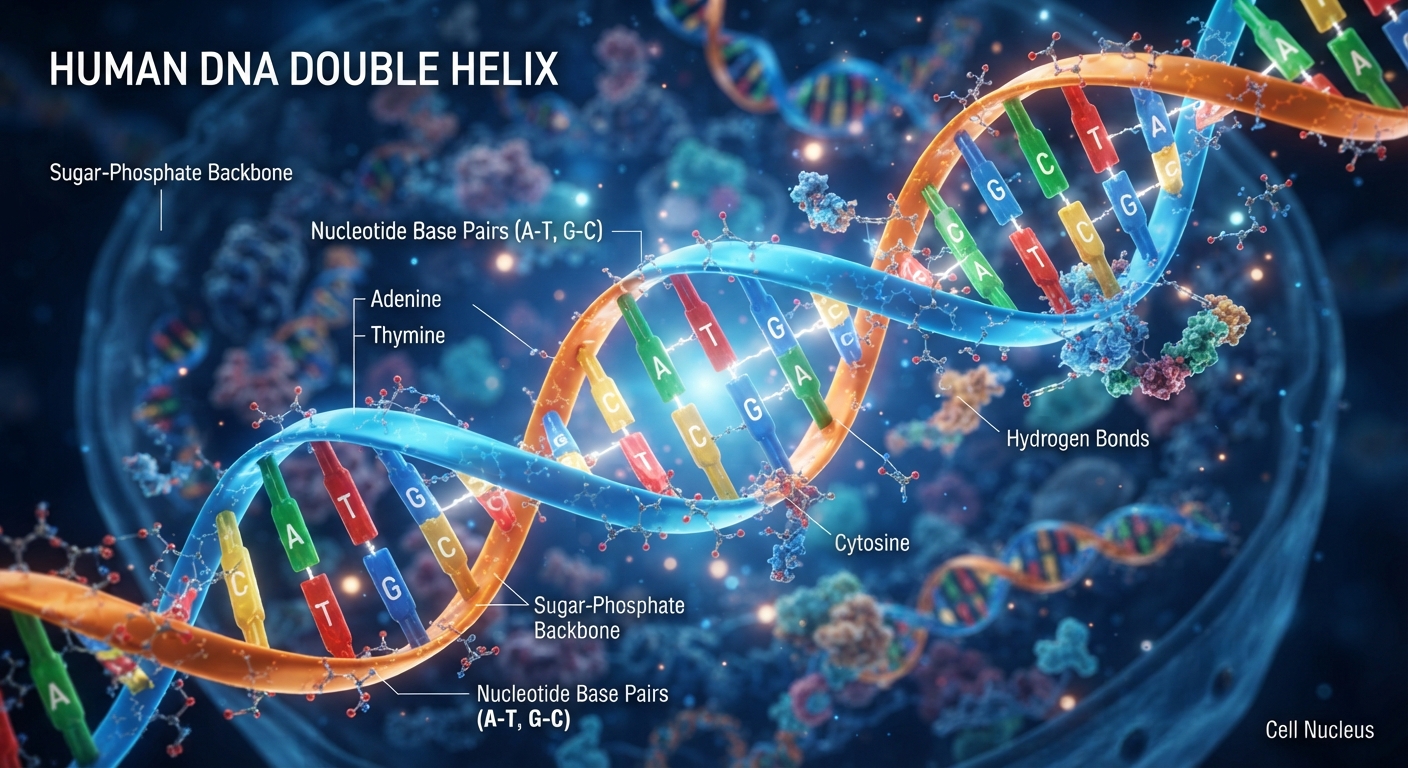
DNA has a double-helix structure, resembling a twisted ladder.
It consists of two long molecular strands twisted around one another.
Each strand is made from smaller chemical building blocks called nucleotides.
A nucleotide contains three components:
- A phosphate group.
- A five-carbon sugar called deoxyribose.
- A nitrogenous base.
The four nitrogenous bases are:
| Base | Scientific abbreviation |
|---|---|
| Adenine | A |
| Thymine | T |
| Guanine | G |
| Cytosine | C |
These four bases form the genetic alphabet.
Complementary base pairing
DNA follows a specific pairing arrangement:
- Adenine pairs with Thymine (A–T).
- Guanine pairs with Cytosine (G–C).
The two strands are held together through hydrogen bonds.
The significance of this arrangement is that each strand can serve as a template for producing its complementary strand during DNA replication.
This is fundamental to the transmission of genetic information.
3. The Four Chemical Letters and Biological Information
DNA stores information through the sequence of its four bases.
For example, consider this simplified DNA sequence:
A T G C C A T G G A T CChanging the order of these letters changes the genetic information.
A DNA sequence can contain thousands, millions or billions of bases.
The complete human genome contains approximately 3.2 billion base pairs in its haploid reference representation.
The genome is the complete collection of genetic material in an organism.
Human DNA is extraordinarily information-dense because four chemical building blocks can form an enormous number of different sequences.
4. The Architecture of the Human Genome
The human genome is organised into several levels.
| Biological level | Structure | Function |
|---|---|---|
| 1 | Nucleotide | Basic DNA building block |
| 2 | DNA strand | Stores genetic sequence |
| 3 | Double helix | Two complementary DNA strands |
| 4 | Nucleosome | DNA wrapped around histone proteins |
| 5 | Chromatin | DNA and associated proteins |
| 6 | Chromosome | Organised genetic structure |
| 7 | Genome | Complete genetic information |
4.1 Human chromosomes
Most human cells contain 46 chromosomes arranged in 23 pairs.
- 22 pairs are autosomes.
- One pair consists of sex chromosomes.
Typically, females have XX chromosomes and males have XY chromosomes, although variations in sex chromosome arrangements occur.
The 23 pairs contain inherited genetic information from both biological parents.
4.2 Why DNA must be packaged
If DNA from one typical human cell were stretched out, it would measure approximately two metres.
Yet this material must fit inside a microscopic cell nucleus.
The solution is sophisticated molecular packaging.
DNA wraps around proteins called histones, forming nucleosomes. These structures are further organised into chromatin and chromosomes.
This packaging allows DNA to fit into the nucleus while also helping regulate which genes are accessible.
5. Genes: The Functional Instructions of DNA
File:Gene structure eukaryote 2 annotated.svg – Wikimedia Commons
A gene is a region of DNA that contributes to producing a functional biological product, usually a protein or functional RNA molecule.
The human genome contains approximately 19,000–20,000 protein-coding genes.
Genes help influence:
- Blood characteristics.
- Enzyme production.
- Cell development.
- Immune-system functions.
- Hormone production.
- Tissue development.
- Metabolism.
- Biological growth.
However, genes do not operate independently.
They work within networks of regulatory sequences, proteins, RNA molecules and cellular signalling systems.
Important distinction
Not all DNA is made up of genes.
A significant portion of the genome consists of non-protein-coding DNA, including regulatory sequences and regions with structural or other biological functions.
These regions are important because they help control when, where and how genetic information is used.
6. DNA Replication: How Genetic Information Is Copied
File:DNA replication en.svg – Wikimedia Commons
DNA replication is the biological process through which a DNA molecule is copied.
It occurs before cell division so that daughter cells can receive genetic information.
The process is called semiconservative replication.
This means that each newly formed DNA molecule contains:
- One original DNA strand.
- One newly synthesised DNA strand.
The major molecular components
| Component | Biological responsibility |
|---|---|
| Helicase | Separates the DNA strands |
| Primase | Produces RNA primers |
| DNA polymerase | Builds new DNA strands |
| Ligase | Joins DNA fragments |
| Topoisomerase | Helps manage DNA twisting and tension |
| Proofreading systems | Help identify and correct copying errors |
Why replication matters
Without DNA replication, growing tissues could not produce new cells while preserving their genetic information.
Replication supports:
- Embryonic development.
- Tissue growth.
- Replacement of old cells.
- Wound healing.
- Maintenance of many body tissues.
DNA replication is highly accurate, although occasional mutations can occur.
7. From DNA to RNA to Protein
This is one of the most important principles in molecular biology.
Chapter: Transcription & Translation — The Biology Primer
The process is commonly described as the central dogma of molecular biology:
\[ DNA \rightarrow RNA \rightarrow Protein \]
It involves two major stages.
Stage 1: Transcription
Transcription is the process of using DNA as a template to produce RNA.
An enzyme called RNA polymerase performs this process.
In protein-coding genes, the resulting messenger RNA (mRNA) carries genetic instructions to the cellular protein-production machinery.
Stage 2: Translation
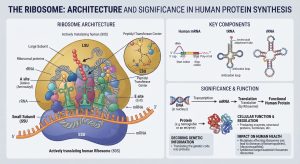
Translation occurs at cellular structures called ribosomes.
The ribosome reads the mRNA sequence in groups of three bases called codons.
Each codon specifies an amino acid or a translation signal.
Amino acids are joined together to form a protein.
Example of the process
Stage 1
DNA
Stored genetic instructions
Transcription
Messenger RNA
Carries a copy of genetic instructions
Translation at ribosomes
Stage 2
Protein
Performs biological functions
Proteins are essential for the functioning of the human body.
They include:
- Enzymes that accelerate chemical reactions.
- Structural proteins that support tissues.
- Receptors that detect cellular signals.
- Transport proteins that move substances.
- Antibodies that contribute to immune defence.
- Hormones and signalling proteins that coordinate biological activities.
8. DNA and the Architecture of Human Cells
Gerador de Diagrama do Ciclo Celular | SciDraw AI
DNA is connected to nearly every major cellular activity.
However, different cell types use different combinations of genes.
For example:
| Cell type | Specialised function |
|---|---|
| Neurons | Transmit electrical and chemical signals |
| Muscle cells | Generate mechanical force |
| Red blood cells | Transport oxygen |
| Liver cells | Metabolism and detoxification |
| White blood cells | Immune defence |
| Intestinal cells | Absorption and digestion support |
| Skin cells | Protection and barrier maintenance |
Most of these cells contain essentially the same nuclear genome, but they activate different sets of genes.
This is called differential gene expression.
It explains how the same fundamental genetic library can contribute to the formation of many different specialised cell types.
9. Mitochondrial DNA: A Second Genetic System
Biological anatomy of mitochondria
Most human DNA is located inside the cell nucleus.
However, mitochondria also contain their own DNA, called mitochondrial DNA (mtDNA).
Mitochondria are important because they contribute significantly to cellular energy production.
Human mitochondrial DNA has:
- Approximately 16,569 DNA base pairs.
- 37 genes.
- 13 protein-coding genes.
- 22 transfer RNA genes.
- 2 ribosomal RNA genes.
Mitochondrial DNA is generally inherited from the mother.
Nuclear DNA and mitochondrial DNA work together to support mitochondrial functions.
This illustrates an important principle: genetic information is distributed across different cellular locations.
10. DNA Mutations: Changes in Genetic Information
A mutation is a change in the DNA sequence.
Mutations can occur naturally during DNA replication or through exposure to certain environmental factors.
There are several types.
| Mutation type | Explanation |
|---|---|
| Substitution | One DNA base is replaced |
| Insertion | Additional DNA bases are introduced |
| Deletion | DNA bases are removed |
| Duplication | A DNA segment is copied |
| Chromosomal rearrangement | DNA segments change their arrangement |
Mutations can have different consequences:
- Some have no noticeable effect.
- Some influence biological characteristics.
- Some disrupt normal protein function.
- Some contribute to inherited disorders.
- Some can contribute to cancer development when they affect important cell-growth controls.
Mutations are also an important source of genetic variation and biological evolution.
Not every mutation is harmful.
11. Epigenetics: How Genes Are Regulated
Epigenetics studies changes in gene activity that do not require changes to the underlying DNA sequence.
Two important mechanisms include:
DNA methylation: Chemical groups are added to DNA, often influencing whether particular genes are active.
Histone modification: Chemical changes to histone proteins influence how tightly DNA is packaged and how accessible particular regions become.
These mechanisms help cells regulate genetic instructions.
For example, a liver cell and a neuron have largely the same DNA, but their epigenetic and regulatory systems help them perform very different functions.
Epigenetics also provides a way through which certain environmental conditions can influence gene activity.
12. DNA, Human Development and Inheritance
Human development begins when genetic material from two reproductive cells combines during fertilisation.
The resulting embryo develops through repeated cell divisions and specialised cellular differentiation.
DNA contributes instructions and regulatory information involved in:
- Early embryonic development.
- Formation of organs.
- Development of the nervous system.
- Formation of bones and muscles.
- Immune-system development.
- Growth and tissue maintenance.
However, human development is not controlled by DNA alone.
It also depends on nutrition, hormones, the environment, cellular communication and many other biological factors.
Genetic inheritance
A person typically receives:
- 23 chromosomes from the biological mother.
- 23 chromosomes from the biological father.
This produces the usual total of 46 chromosomes in most nucleated body cells.
The combination creates genetic variation between individuals.
13. DNA and Modern Scientific Technology
CRISPR-Cas9: Transformations in Gene Editing | AmBioTech
Why Genome Sequencing May Hold the Key to Preventing Genetic Diseases
2023 Warren Alpert Prize Honors Pioneer in Computational Biology | Harvard Medical School
9
Understanding DNA has created major scientific and technological opportunities.
| Technology | Application |
|---|---|
| DNA sequencing | Reading DNA sequences |
| Genomics | Studying entire genomes |
| Bioinformatics | Analysing genetic information computationally |
| CRISPR gene editing | Targeted modification of DNA |
| Genetic testing | Investigating inherited genetic variants |
| Pharmacogenomics | Studying how genetic variation influences medication responses |
| Molecular diagnostics | Detecting genetic or molecular changes |
13.1 Artificial intelligence and DNA
Artificial intelligence is increasingly being used to analyse large biological datasets.
Applications include:
- Identifying patterns in genetic sequences.
- Predicting aspects of protein structure.
- Studying relationships between genetic variations and disease.
- Analysing gene-expression data.
- Supporting biological research.
The combination of genomics, mathematics, computing and AI is creating a major new field of scientific innovation.
14. Mathematical Architecture of DNA
DNA can be understood using mathematical concepts such as information theory, probability, statistics and computational modelling.
14.1 Number of possible DNA sequences
Because DNA contains four possible bases, the number of possible sequences of length \(n\) is:
\[ N=4^n \]
For a sequence of just 10 bases:
\[ N=4^{10}=1,048,576 \]
This demonstrates how quickly sequence possibilities increase.
14.2 Information storage
Each DNA base can theoretically represent two bits of information because:
\[ \log_2(4)=2 \]
For approximately 3.2 billion base pairs in a haploid human genome:
\[ 3.2 \times 10^9 \times 2 \]
\[ =6.4 \times 10^9 \text{ bits} \]
This is approximately 800 million bytes, or 800 MB using decimal units, as a simplified theoretical representation of one strand’s sequence information.
This calculation does not account for biological complexity, regulation or the full information contained in the cellular system.
14.3 Genetic probability
Probability is important in understanding inherited characteristics.
For example, if two parents each carry one copy of a particular recessive genetic variant, the probability for each pregnancy is:
- 25% chance of inheriting two copies.
- 50% chance of inheriting one copy.
- 25% chance of inheriting neither copy.
These are simplified inheritance probabilities and apply to particular genetic inheritance patterns.
15. The Significance of Human DNA in the Modern Economy
Human DNA research has become an important component of the modern knowledge economy.
Its influence extends into several industries.
| Economic sector | Contribution of DNA science |
|---|---|
| Healthcare | Genetic diagnosis and medical research |
| Pharmaceuticals | Drug discovery and development |
| Agriculture | Plant and animal genetic research |
| Biotechnology | Development of biological products |
| Artificial intelligence | Biological data analysis |
| Education | Molecular biology and genetics training |
| Forensic science | DNA-based identification |
| Public health | Genetic and population-level research |
For developing economies, including South Africa, genomics creates opportunities in:
- University research.
- Biotechnology entrepreneurship.
- Medical laboratory development.
- Agricultural genetics.
- Bioinformatics education.
- Scientific data infrastructure.
- Pharmaceutical research.
However, these opportunities require investment in scientific education, laboratories, skilled researchers, ethical governance and reliable infrastructure.
16. Ethical and Scientific Responsibilities
DNA contains sensitive biological information.
Its use raises important questions concerning:
- Genetic privacy.
- Informed consent.
- Ownership and control of genetic data.
- Discrimination based on genetic information.
- Responsible gene-editing research.
- Fair access to genetic healthcare.
- Protection of indigenous and population-level genetic information.
Genetic information must be handled responsibly.
Scientific progress should improve human welfare while protecting individual rights and dignity.
17. The Complete Human DNA Architecture: Summary
がん情報サイト | がん情報各論:[患者さん向け]遺伝性腎がん症候群(PDQ®)
The complete biological information pathway can be understood through this hierarchy:
1
Human cell
The living biological environment
2
Nucleus
Contains most human genetic material
3
Chromosomes
Organise the genetic material
4
Chromatin and nucleosomes
Package and regulate DNA
5
DNA double helix
Stores genetic sequences
6
Genes and regulatory regions
Contain functional and control instructions
7
RNA
Participates in using genetic information
8
Proteins
Perform many cellular functions
9
Cellular systems
Coordinate biological activities
10
Human organism
The integrated living body
18. Conclusion: DNA as the Foundation of Human Biological Information
Human DNA represents one of the most sophisticated molecular information systems discovered by modern science.
Its architecture connects chemistry, physics, mathematics, molecular biology, genetics, computing and medicine.
The double helix stores genetic sequences. Genes contribute to biological instructions. RNA helps interpret and use those instructions. Proteins perform essential functions. Regulatory networks coordinate when and where these biological processes take place.
The most important scientific understanding is that DNA does not operate in isolation. It functions within an interconnected biological architecture involving cells, tissues, organs and environmental interactions.
Final scientific quotation:
DNA is the molecular foundation of biological inheritance, but life emerges from the coordinated interaction of genetic information, cellular machinery, energy, environment and evolution.
19. Recommended advanced study pathway
To develop a deeper university-level understanding, the following subjects build progressively on this thesis:
- Molecular biology — the chemical mechanisms of life.
- Human genetics — inheritance and genetic variation.
- Genome architecture — chromosomes and genome organisation.
- Biochemistry — molecular reactions and protein functions.
- Cell biology — the architecture of living cells.
- Epigenetics — regulation of genetic activity.
- Bioinformatics — computational analysis of DNA.
- Structural biology — three-dimensional molecular structures.
- Genetic engineering — modification of genetic material.
- Computational genomics — mathematics and AI applied to genomes.
A particularly important next step is studying the microscopic architecture of DNA replication, including the molecular functions of helicase, DNA polymerase, ligase, primase, nucleotides and proofreading systems. This will connect the structure of DNA to the actual mechanisms that preserve genetic information across generations.




Be First to Comment