
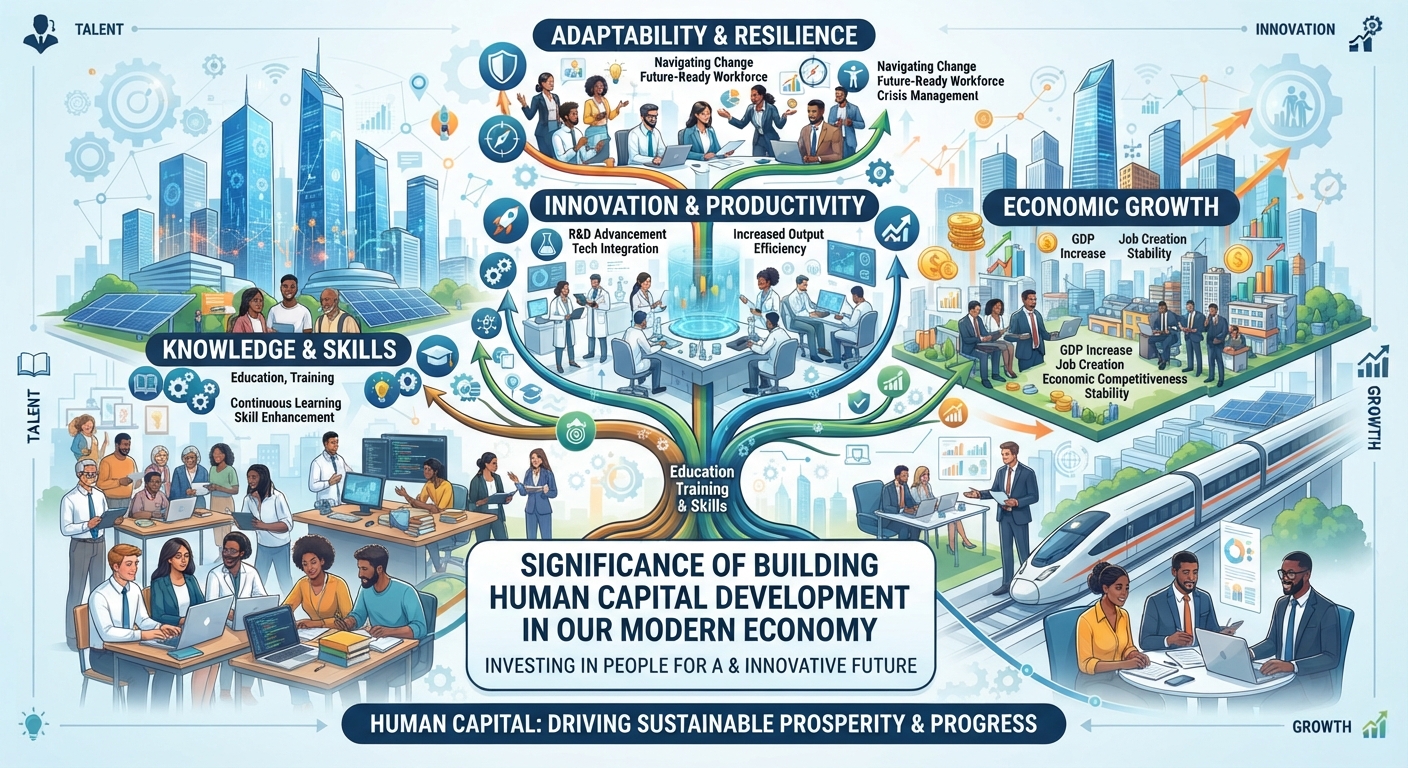
COMPREHENSIVE THESIS
The architecture, science, mathematics, technology, education, innovation and strategic importance of developing human intelligence, skills and productive capabilities
Les stéréotypes de genre continuent de peser fortement sur les choix des métiers | TF1 Info
A national skills ambition | Public Sector News
12
Abstract
Human capital development is one of the most important foundations of a successful modern economy. It is the continuous process of developing people’s knowledge, intelligence, education, technical abilities, creativity, experience, health, problem-solving capabilities and professional competencies to increase their contribution to economic and social development.
In the modern world, economic development is no longer determined exclusively by the availability of land, minerals, natural resources, financial capital or physical infrastructure. It is increasingly determined by the quality of human intelligence and the ability of people to transform knowledge into productive economic activities.
A country can possess enormous mineral resources, advanced machinery, modern infrastructure and substantial financial capital. However, without sufficiently educated, skilled and innovative people, these resources cannot reach their full economic potential.
This thesis examines the architecture of human capital development, its relationship with mathematics, physics, science, artificial intelligence, industrial productivity, entrepreneurship and modern economic growth.
The central argument is that developing human intelligence is one of the most important long-term investments a nation can make.
PART ONE: UNDERSTANDING HUMAN CAPITAL
Chapter 1. What is human capital?
Human capital refers to the accumulated knowledge, capabilities, skills, experience and productive abilities embodied in individuals.
It represents the economic value of human knowledge and competencies.
Just as a company invests in machinery to increase production, a country invests in human beings through education, scientific research, professional training and technological development.
1.1 The five fundamental components
O-Level Subject Combinations: Which Ones Need Tuition Most? | Singapore Tuition Land
1. Intellectual capital
Mathematical reasoning, scientific understanding, analytical thinking, logic, critical thinking and knowledge acquisition.
Unique ITI – Build Your Future with Skill-Based Technical Education | Siliguri
2. Technical capital
Engineering, computer programming, electronics, industrial machinery, agriculture, manufacturing and digital technology skills.
2026 Cosmetology School Student Loans and Financial Aid | Research.com
3. Organisational and managerial capital
Leadership, strategic planning, financial management, communication, coordination and decision-making.
4. Innovation capital
Research, experimentation, invention, entrepreneurship, creativity and the ability to develop new solutions.
Tier 2 Plus- TOTAL BODY RESET & LIFESTYLE CHANGE PROGRAM – Vivo Nutrients
5. Health and functional capital
Physical and cognitive wellbeing, nutrition, healthcare, mental development and the capacity to participate productively in society.
These five components interact to determine the productive capabilities of a population.
For example, an engineer needs mathematical knowledge, technical competence, problem-solving ability, communication and practical experience to design and manage an industrial system successfully.
Chapter 2. The difference between human capital and other forms of capital
Understanding human capital requires distinguishing it from the other resources that support economic development.
| Capital category | Meaning | Economic contribution |
|---|---|---|
| Human capital | Knowledge and skills | Creates productive capabilities |
| Financial capital | Money and investment | Funds economic activities |
| Physical capital | Machinery and buildings | Supports production |
| Natural capital | Minerals, land and water | Supplies resources |
| Technological capital | Digital and industrial technology | Improves production methods |
| Social capital | Trust and networks | Facilitates cooperation |
| Intellectual property | Patents and inventions | Protects and commercialises knowledge |
The important relationship is that human capital enables society to use the other forms of capital more effectively.
For instance, purchasing an advanced manufacturing machine does not automatically create manufacturing expertise.
People must understand its engineering, software, maintenance requirements, operating procedures and production economics.
Human capital converts physical and technological investments into productive economic output.
PART TWO: THE ARCHITECTURE OF HUMAN CAPITAL DEVELOPMENT
Chapter 3. How human capital is developed
Human capital is not created through one educational qualification or a single training programme.
It develops through a continuous system of learning, application, experience and innovation.
Battery Workforce Challenge Programs | Argonne National Laboratory
The architecture can be represented as follows:
STAGE 1: Early childhood development
Language, curiosity, numeracy, observation and foundational thinking
STAGE 2: Primary and secondary education
Mathematics, science, literacy, technology, logic and problem-solving
STAGE 3: Higher and technical education
University degrees, engineering, vocational training and specialisation
STAGE 4: Professional development
Work experience, industry knowledge and professional competence
STAGE 5: Research and innovation
New discoveries, inventions, entrepreneurship and industrial development
STAGE 6: Economic transformation
Higher productivity, employment, business creation and national competitiveness
The system is circular rather than purely linear. Research creates new knowledge, which changes educational programmes and generates demand for new professional skills.
Chapter 4. The importance of early intellectual development
The foundation of human capital begins during childhood.
Children develop fundamental cognitive abilities through:
- Language and communication.
- Mathematical reasoning.
- Scientific observation.
- Memory and understanding.
- Logical thinking.
- Creativity and imagination.
- Curiosity and experimentation.
The objective is not simply to produce people who memorise information.
It is to develop individuals who can understand relationships, identify patterns, investigate problems and formulate solutions.
For example, a child learning mathematics should understand not only how to calculate numbers but also how mathematics describes quantities, relationships, measurements and patterns in the physical world.
This foundation becomes essential in engineering, medicine, economics, computer science and scientific research.
PART THREE: THE ROLE OF MATHEMATICS AND PHYSICS
Chapter 5. Mathematics as the infrastructure of human capital
Mathematics is one of the most important intellectual instruments in modern economic development.
It enables individuals to measure, calculate, model, predict and optimise complex systems.
5.1 Seven important mathematical disciplines
| Mathematical discipline | Economic application |
|---|---|
| Arithmetic | Accounting, finance and transactions |
| Algebra | Engineering and economic modelling |
| Geometry | Construction and industrial design |
| Calculus | Optimisation and changing systems |
| Statistics | Data analysis and forecasting |
| Probability | Risk assessment and decision-making |
| Linear algebra | Artificial intelligence and computer graphics |
5.2 Mathematics and economic productivity
Consider a manufacturing business.
The company needs to determine:
- How many products can be manufactured?
- How much raw material is required?
- What is the cost per unit?
- How many employees are needed?
- What is the optimal production capacity?
- How can waste be reduced?
These questions require mathematical thinking.
An example of a simplified productivity equation is:
\[ P=\frac{Q}{H} \]
Where:
- \(P\) = labour productivity.
- \(Q\) = quantity of output.
- \(H\) = labour hours.
Suppose a factory produces 1,000 units in 200 working hours.
\[ P=\frac{1000}{200}=5 \]
The factory produces five units per labour hour.
If employee training, improved machinery and better production methods increase output to 1,400 units using the same hours:
\[ P=\frac{1400}{200}=7 \]
Productivity has increased by 40%.
This demonstrates how human skills and technological improvements can contribute to economic efficiency.
Chapter 6. Physics and engineering knowledge
Physics helps human beings understand the natural principles governing energy, matter, motion, electricity and forces.
It provides the scientific foundation for many modern industries.
Product Design & Development Services | Accenture
Sun Touch Solar Solutions | Solar Company in Puducherry
5
Examples include:
| Physics discipline | Human capital application |
|---|---|
| Mechanics | Mechanical engineering |
| Thermodynamics | Energy and manufacturing |
| Electromagnetism | Electrical engineering |
| Optics | Cameras, lasers and telecommunications |
| Quantum physics | Semiconductor technology |
| Fluid mechanics | Water systems and aviation |
| Materials science | Advanced manufacturing |
A country that develops strong physics and engineering capabilities can increase its ability to design, manufacture, maintain and improve advanced technologies.
This reduces dependence on importing every sophisticated technological product.
PART FOUR: HUMAN CAPITAL AND THE MODERN TECHNOLOGICAL ECONOMY
Chapter 7. Artificial intelligence and human capital
Greece Ranks 5th in EU for AI Research & Funding — The AI Chronicle
Artificial intelligence is transforming the relationship between human knowledge and economic production.
AI systems can assist with:
- Data analysis.
- Scientific research.
- Financial modelling.
- Software development.
- Industrial automation.
- Agricultural monitoring.
- Medical research.
- Engineering simulations.
- Business forecasting.
However, AI does not eliminate the importance of human capital.
It changes the types of human capabilities that are valuable.
For example, an individual who understands mathematics, programming, economics and scientific reasoning can use AI more effectively than someone who simply knows how to enter instructions into an AI system.
7.1 The new human capital competencies
- AI literacy.
- Data literacy.
- Computational thinking.
- Mathematical modelling.
- Cybersecurity awareness.
- Digital communication.
- Critical thinking.
- Systems engineering.
- Research and experimentation.
- Ethical and responsible technology use.
7.2 The relationship between humans and AI
A useful economic framework is:
\[ Y=f(K,L,H,A,T) \]
Where:
- \(Y\) = Economic output.
- \(K\) = Physical capital.
- \(L\) = Labour.
- \(H\) = Human capital.
- \(A\) = Technological capability.
- \(T\) = Institutional and organisational efficiency.
This simplified production framework illustrates that economic output depends on the interaction of several factors.
AI can increase the productive capabilities of skilled workers, particularly when organisations redesign their processes to use it effectively.
Chapter 8. Human capital in the semiconductor industry
The semiconductor industry provides an excellent example of why human capital is essential.
Producing modern semiconductor chips requires highly specialised professionals.
| Professional expertise | Responsibility |
|---|---|
| Semiconductor physicists | Understand electronic properties of materials |
| Electrical engineers | Design electronic circuits |
| Computer engineers | Develop chip architectures |
| Materials scientists | Research semiconductor materials |
| Chemical engineers | Develop manufacturing processes |
| Software engineers | Develop chip-design software |
| Industrial engineers | Optimise manufacturing productivity |
| Robotics engineers | Automate manufacturing operations |
The semiconductor industry demonstrates how mathematics, physics, chemistry, engineering, computing and management must work together.
A country cannot build a globally competitive semiconductor ecosystem simply by purchasing manufacturing equipment.
It must develop the human expertise required to operate, maintain, improve and innovate within that ecosystem.
PART FIVE: HUMAN CAPITAL AND THE MAIN SECTORS OF THE ECONOMY
Chapter 9. Agriculture and food security
مينا الجبوري لـ النبأ: المشكلة ليست في الآلات… بل في طريقة تفكيرنا بالزراعة
Modern agriculture is becoming increasingly scientific and technologically advanced.
Human capital development enables agricultural producers to understand:
- Soil chemistry.
- Plant biology.
- Water management.
- Agricultural economics.
- Genetics and crop science.
- Irrigation engineering.
- Farm automation.
- Artificial intelligence.
- Supply-chain management.
Consider ginger production.
Successful commercial ginger farming requires knowledge of soil composition, drainage, organic matter, minerals, temperature, irrigation, plant disease and post-harvest handling.
The farmer who develops scientific agricultural knowledge can make better production decisions.
This transforms agriculture from an activity based entirely on traditional experience into a knowledge-driven productive industry.
Chapter 10. Manufacturing and industrialisation
Industry 4.0 | Skilled Teams & Assembly | amd
Manufacturing is one of the sectors where technical human capital has a direct influence on national economic capacity.
Industrial human capital includes:
- Mechanical engineering.
- Electrical engineering.
- Industrial automation.
- Quality-control management.
- Materials science.
- Production planning.
- Industrial economics.
- Maintenance engineering.
A country that develops these capabilities can increase domestic production, create skilled employment and strengthen its industrial supply chains.
Chapter 11. Banking, finance and digital economic systems
How AI and Generative AI Are Transforming Banking: Fraud, Risk & Personalization
Modern financial systems require specialised knowledge in:
- Accounting.
- Economics.
- Financial mathematics.
- Risk management.
- Data analytics.
- Cybersecurity.
- Digital payment infrastructure.
- Artificial intelligence.
- Regulatory compliance.
- Financial technology.
The development of financial human capital improves the ability of financial institutions to evaluate risk, allocate capital, manage digital transactions and support businesses.
Chapter 12. Healthcare and biotechnology
2026 Biological Sciences Degree Master’s Programs Accepting Students Now | Research.com
Healthcare is also a major human capital investment.
Developing doctors, nurses, biomedical scientists, pharmacists, laboratory technicians, health administrators and biotechnology researchers contributes to the quality of healthcare systems.
A healthier population can generally participate more effectively in education, employment and economic activity.
There is therefore a two-way relationship:
- Education and income can improve access to healthcare.
- Healthcare supports people’s ability to learn and work.
PART SIX: HUMAN CAPITAL AND ECONOMIC GROWTH
Chapter 13. How human capital increases national productivity
Human capital contributes to economic growth through several interconnected mechanisms.
The economic productivity mechanism
Investment in education and training
Improved knowledge and professional skills
Higher productive capabilities
Innovation and improved production
Business expansion and economic competitiveness
Higher potential national economic output
Human capital influences economic growth through:
1. Labour productivity: Skilled employees can produce more value using available resources.
2. Innovation: Educated people can discover new technologies and improve existing products.
3. Entrepreneurship: Knowledgeable individuals can identify opportunities and establish businesses.
4. Industrial competitiveness: Technical expertise helps industries improve quality, efficiency and international competitiveness.
5. Institutional development: Skilled professionals improve the management of government departments, companies and public institutions.
6. Economic diversification: A skilled workforce enables a country to develop industries beyond its traditional economic sectors.
Chapter 14. Human capital and national GDP
Gross Domestic Product (GDP) measures the monetary value of final goods and services produced within an economy during a specified period.
Human capital can contribute to GDP by increasing the quantity and quality of production.
A simplified production function is:
\[ Y=A K^\alpha (HL)^{1-\alpha} \]
Where:
- \(Y\) = Total economic output.
- \(A\) = Total factor productivity.
- \(K\) = Physical capital.
- \(H\) = Human capital per worker.
- \(L\) = Number of workers.
- \(\alpha\) = Capital’s output elasticity.
This is a simplified Cobb-Douglas production model.
It demonstrates how human capital can influence economic production alongside machinery, technology and labour.
However, education spending alone does not guarantee GDP growth. Skills must be relevant, employment opportunities must exist, and institutions must enable productive investment.
PART SEVEN: SOUTH AFRICA AND HUMAN CAPITAL TRANSFORMATION
Chapter 15. The strategic importance of human capital development in South Africa
Master’s degree in Engineering Management draws students from across the world to Stellenbosch
South Africa has significant economic assets, including:
- Mineral resources.
- Agricultural land.
- Financial institutions.
- Industrial infrastructure.
- Universities and research institutions.
- Telecommunications infrastructure.
- Manufacturing capabilities.
- Renewable energy potential.
- A developing digital economy.
The strategic challenge is ensuring that these assets are supported by sufficiently developed human capabilities.
15.1 Five priority areas
| Priority | Required human capital | Economic objective |
|---|---|---|
| Education | Mathematics, science and literacy | Build intellectual foundations |
| Manufacturing | Engineering and technical skills | Increase industrial production |
| Agriculture | Agricultural science and technology | Improve food security |
| Digital economy | AI, software and cybersecurity | Develop digital industries |
| Business | Accounting, economics and management | Expand productive enterprises |
15.2 Addressing the skills mismatch
A skills mismatch occurs when the knowledge and capabilities of the available workforce do not adequately correspond to the skills required by employers and industries.
For example:
- Industries need qualified technicians, but training institutions may produce insufficient numbers.
- Businesses need data analysts, but graduates may lack practical data skills.
- Agricultural businesses need scientific knowledge, but farmers may have limited access to technical training.
- Manufacturing companies need specialised engineers, but the supply of relevant expertise may be inadequate.
The solution requires cooperation between schools, universities, technical colleges, government and private industry.
15.3 Building a stronger vocational education system
Technical and vocational education should be treated as a strategic economic investment.
Important disciplines include:
- Electrical installation.
- Mechanical engineering.
- Welding and fabrication.
- Industrial maintenance.
- Plumbing.
- Computer networking.
- Renewable energy.
- Robotics.
- Agricultural machinery.
- Industrial automation.
A successful modern economy requires both university-trained professionals and highly competent technical workers.
Neither group can replace the other.
PART EIGHT: HUMAN CAPITAL, ENTREPRENEURSHIP AND WEALTH CREATION
Chapter 16. Transforming knowledge into economic value
One of the most important functions of human capital development is transforming knowledge into commercially useful products and services.
The process can be understood through five stages:
01
Knowledge acquisition
Learn mathematics, science, technology, economics and business.
02
Problem identification
Identify problems affecting individuals, companies, industries or communities.
03
Innovation and development
Apply knowledge to design a product, process, technology or service.
04
Commercialisation
Establish a viable business model, production system and market.
05
Economic value creation
Generate products, services, employment, income and productive capacity.
For example, a person who understands agriculture, software development and business management could develop an intelligent farm-management platform.
The knowledge becomes an economic asset when it is converted into a useful solution that people or businesses are willing to adopt.
Chapter 17. Human capital and small business development
Small businesses are important contributors to employment, innovation and economic participation.
However, business success requires more than a good idea.
Entrepreneurs need competencies in:
- Financial accounting.
- Cash-flow management.
- Marketing.
- Customer research.
- Supply-chain management.
- Business strategy.
- Digital technology.
- Quality control.
- Risk assessment.
A business owner who develops these capabilities can make better decisions and improve the probability of business sustainability.
PART NINE: THE MATHEMATICAL MEASUREMENT OF HUMAN CAPITAL
Chapter 18. How can a country measure human capital development?
Human capital cannot be measured through one number alone.
A country needs a collection of indicators.
| Indicator | What it measures |
|---|---|
| Literacy rate | Basic reading and writing |
| Numeracy | Mathematical competence |
| School completion | Educational attainment |
| Learning outcomes | Actual knowledge acquired |
| Technical qualifications | Professional skills |
| Labour productivity | Economic output per worker |
| Employment rate | Labour-market participation |
| Research expenditure | Investment in knowledge creation |
| Patents and innovation | Commercial and technological invention |
| Digital literacy | Ability to use digital systems |
18.1 A conceptual human capital index
A country could construct a composite index using weighted indicators:
\[ HCI=w_1E+w_2S+w_3T+w_4D+w_5I \]
Where:
- \(HCI\) = Human Capital Index.
- \(E\) = Education quality.
- \(S\) = Scientific and mathematical competence.
- \(T\) = Technical skills.
- \(D\) = Digital capabilities.
- \(I\) = Innovation capacity.
- \(w_1,\ldots,w_5\) = Indicator weights.
The weights must be determined through a transparent statistical methodology.
This is a proposed conceptual framework, not an official international index.
18.2 Measuring the return on investment
Education and training programmes require financial resources.
Their economic benefits should be evaluated.
A simplified return-on-investment calculation is:
\[ ROI=\frac{B-C}{C}\times100 \]
Where:
- \(B\) = Measured economic benefits.
- \(C\) = Investment cost.
Suppose a technical training programme costs R2 million and generates R3 million in measurable economic benefits over the evaluation period.
\[ ROI=\frac{3-2}{2}\times100=50\% \]
The calculated return is 50%.
Real evaluations should also account for the time value of money, programme duration, wider social benefits and the possibility that benefits would have occurred without the programme.
PART TEN: STRATEGIC FRAMEWORK FOR DEVELOPING HUMAN CAPITAL
Chapter 19. A national human capital development strategy
A successful human capital development system needs coordination across education, industry, government and research institutions.
The following ten-pillar strategy provides a possible framework.
1. Foundational education
Strengthen literacy, numeracy, mathematics, science and logical reasoning.
2. Scientific development
Expand access to physics, chemistry, biology and scientific experimentation.
3. Technical education
Develop vocational training and practical engineering competencies.
4. Digital transformation
Teach AI, programming, data analysis and cybersecurity.
5. University research
Strengthen scientific research and postgraduate development.
6. Industry partnerships
Connect educational institutions with real industrial requirements.
7. Entrepreneurship
Develop business management, financial literacy and commercialisation skills.
8. Continuous learning
Provide opportunities for workers to update their competencies throughout their careers.
9. Health and wellbeing
Support the physical and cognitive capabilities of the population.
10. Innovation infrastructure
Develop research laboratories, technology centres and industrial innovation hubs.
Chapter 20. The relationship between education, industry and government
Human capital development cannot be left exclusively to educational institutions.
It requires an integrated national system.
Three major institutions must cooperate.
Government
- Establish education and training policies.
- Finance public education and research.
- Develop infrastructure.
- Encourage industrial investment.
- Monitor educational outcomes.
Educational institutions
- Produce scientific and technical knowledge.
- Develop professional competencies.
- Conduct research.
- Train future professionals.
- Support innovation.
Private industry
- Identify emerging skills requirements.
- Provide workplace training.
- Invest in research and development.
- Create employment.
- Commercialise innovation.
Their combined activities create a stronger relationship between education and economic production.
PART ELEVEN: THE FUTURE OF HUMAN CAPITAL DEVELOPMENT, 2026–2050
Chapter 21. Emerging human capital requirements
Top 15 skills for the future for AI and robots [Guide]
2026 Bioinformatics Degree Coursework Explained: What Classes Can You Expect to Take? | Research.com
5
The next decades will introduce new economic opportunities and new professional requirements.
Some important areas include:
| Emerging industry | Future human capital requirements |
|---|---|
| Artificial intelligence | AI engineering and machine learning |
| Quantum computing | Quantum physics and advanced mathematics |
| Biotechnology | Genetics and molecular biology |
| Semiconductor manufacturing | Materials science and chip engineering |
| Robotics | Mechanical and software engineering |
| Renewable energy | Electrical and energy engineering |
| Space technology | Aerospace engineering and physics |
| Cybersecurity | Computer science and information security |
| Advanced agriculture | Agricultural biotechnology and automation |
| Financial technology | Financial mathematics and software engineering |
These industries will require a combination of scientific understanding, practical skills, interdisciplinary thinking and continuous learning.
21.1 The future worker
The future worker will increasingly need to combine four capabilities:
- Scientific understanding.
- Digital and technological competence.
- Critical and analytical thinking.
- Practical problem-solving and communication.
The most valuable professional will not necessarily be the person who memorises the most information.
It will increasingly be the person who can understand complex systems, evaluate evidence, learn new technologies and apply knowledge to real problems.
PART TWELVE: RESEARCH QUESTIONS AND HYPOTHESES
Chapter 22. Academic research framework
A comprehensive study of human capital development should investigate the following questions.
Research question 1: How does the quality of education influence national economic productivity?
Research question 2: What is the relationship between mathematics and scientific education and industrial development?
Research question 3: How does artificial intelligence change the demand for human competencies?
Research question 4: What role does vocational training play in reducing skills shortages?
Research question 5: How can developing economies convert human capital into sustainable employment and innovation?
Research hypotheses
- H1: Higher-quality education contributes positively to labour productivity.
- H2: Scientific and technical competencies contribute to industrial innovation.
- H3: Effective AI adoption can increase the productivity of appropriately trained workers.
- H4: Stronger cooperation between industry and education improves the relevance of workforce skills.
- H5: Continuous professional development helps workers adapt to technological change.
Suggested research methodology
A comprehensive investigation could combine:
- Quantitative analysis of education and employment statistics.
- Economic modelling of productivity and GDP.
- Surveys of employers and employees.
- Interviews with education and industry leaders.
- Comparative studies across countries.
- Longitudinal studies tracking educational outcomes and employment.
This would help distinguish correlation from actual causal relationships.
PART THIRTEEN: CONCLUSION
Chapter 23. Human intelligence as the foundation of modern economic civilisation
The development of human capital is much more than an education policy. It is a long-term national economic strategy.
Modern economic civilisation depends on the ability of human beings to understand the physical world, develop mathematical models, discover scientific principles, build technological systems, establish productive organisations and solve increasingly complex problems.
Natural resources can provide economic opportunities, but human knowledge determines how effectively those opportunities are developed.
Financial capital can fund infrastructure, but engineers, technicians and managers are needed to design, construct and operate it.
Artificial intelligence can process enormous quantities of information, but knowledgeable people are required to interpret its outputs, identify appropriate applications and make responsible decisions.
The most important strategic lesson is that human capital development must be continuous.
A nation should not educate its population merely to fill existing employment positions. It should also develop the scientific, mathematical, technological and entrepreneurial capabilities needed to create future industries and employment opportunities.
The modern economy is increasingly an economy of knowledge, intelligence, innovation and productive human capabilities.
A country that systematically develops these capabilities strengthens its potential to achieve industrialisation, economic diversification, technological independence and sustainable prosperity.
PART FOURTEEN: RECOMMENDED KNOWLEDGE FOUNDATIONS
Chapter 24. Major academic disciplines supporting human capital development
The following disciplines provide a strong foundation for understanding this subject.
| Discipline | Its contribution |
|---|---|
| Economics | Human capital and economic growth |
| Mathematics | Quantitative reasoning and modelling |
| Physics | Scientific and engineering knowledge |
| Biology | Human development and health |
| Psychology | Learning and cognitive development |
| Sociology | Social development and institutions |
| Accounting | Measurement of economic resources |
| Statistics | Evidence-based decision-making |
| Computer science | Digital and computational capabilities |
| Management science | Organisational productivity |
| Education science | Teaching and learning systems |
| Innovation studies | Research and commercialisation |
Chapter 25. Recommended international research institutions
These organisations provide valuable research on human capital, education, labour markets and economic development.
World Bank approves funding for two projects in Punjab, Maharashtra – The Economic Times
World Bank
Human Capital Project, education, productivity and economic development.Human Capital Project
Excess Deaths in OECD Countries during COVID-19 | Ísland.is
OECD
Skills development, education, employment and productivity research.OECD Skills
UNESCO: ‘In moments of crisis, people need culture’ – European Heritage Tribune
UNESCO
Education, scientific knowledge and lifelong learning.UNESCO Education
PRSP – Punjab Rural Support Programme
International Labour Organization
Employment, labour productivity, occupational skills and workforce development.ILO Research
Final strategic proposition
The Human Capital Development Equation
Knowledge + Skills + Technology + Innovation + Opportunity
= Greater Productive Capacity
A conceptual framework for national economic development, not a literal mathematical identity.
The ultimate objective should be to develop a population capable of doing five things:
- Understand: Acquire deep scientific, mathematical and economic knowledge.
- Analyse: Investigate problems using logic, evidence and quantitative methods.
- Create: Develop inventions, technologies, businesses and new solutions.
- Produce: Convert knowledge into useful goods and services.
- Improve: Continuously advance the productivity and competitiveness of the economy.
Human capital is therefore not simply a resource that supports an economy. It is a fundamental capability through which an economy learns, adapts, innovates and develops.

Be First to Comment