
COMPREHENSIVE SCIENTIFIC THESIS
HUMAN ANATOMY • PHYSIOLOGY • BIOCHEMISTRY • BIOPHYSICS • SYSTEMS SCIENCE
1. Introduction: Understanding the human body as one living system
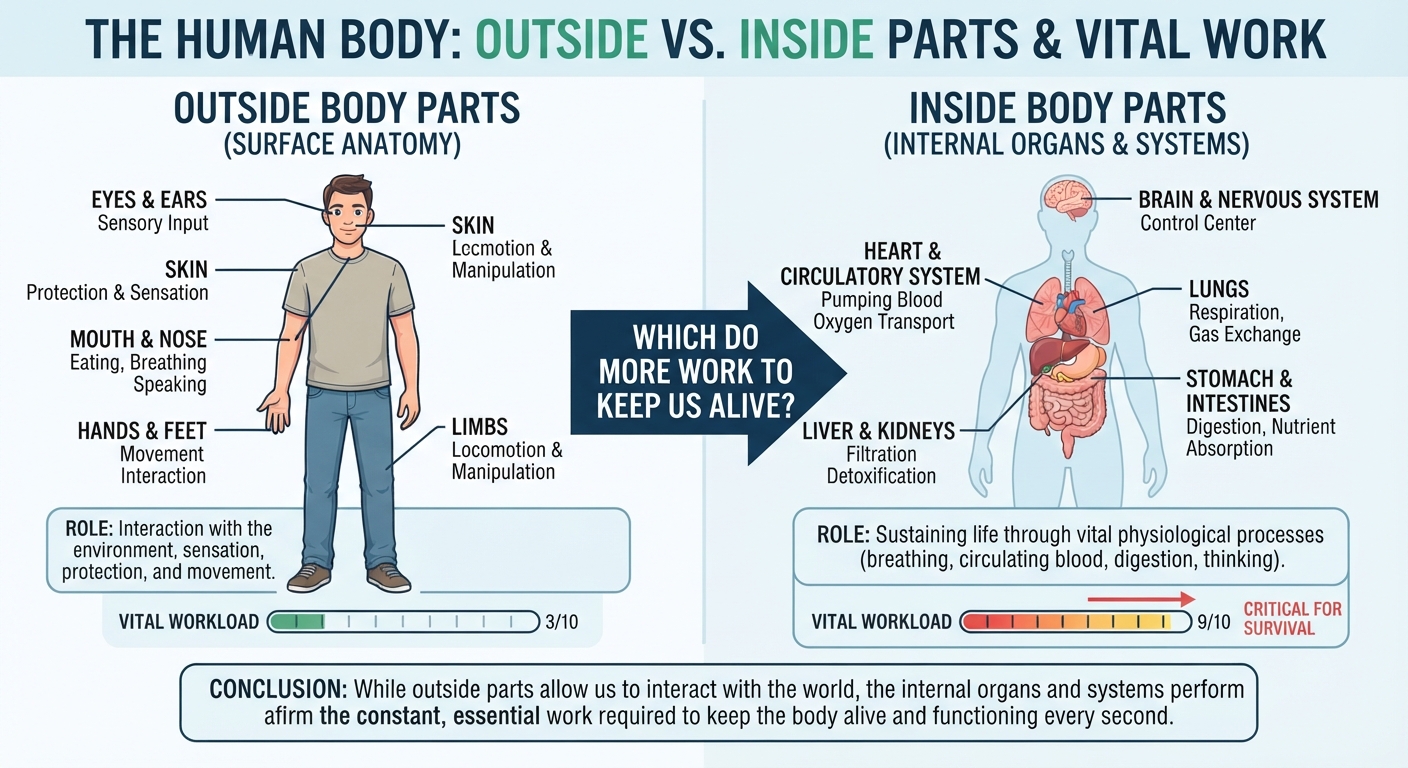
The human body is one of the most sophisticated biological systems known to science. It consists of two broad architectural divisions:
- External body structures: The parts we can see, touch and observe from outside.
- Internal body structures: The organs, tissues, cells, blood vessels, nerves, chemical processes and microscopic machinery operating inside us.
Both divisions are essential for survival. However, they do not perform identical responsibilities.
The internal structures perform most of the continuous work required to maintain life, including breathing, circulating blood, producing energy, controlling body temperature, regulating chemicals and maintaining brain function.
The external structures protect the body, provide movement, receive information from the environment and help us interact with the world.
The central scientific conclusion is that the internal systems perform the majority of the body’s life-maintaining physiological work, while the external structures provide essential protection, access, movement and environmental interaction. Neither can function properly as an isolated system.
Human Full Body Anatomy Diagram | Educational Resources | AI Art Generator | Easy-Peasy.AI
Basic Anatomy | Spinal Cord Injury Canada
9
PART I: THE EXTERNAL ARCHITECTURE OF THE HUMAN BODY
2. Understanding the outside parts of the human body
The external body is the biological interface between the human organism and its environment.
It allows us to:
- Walk and run.
- See, hear and communicate.
- Touch and feel objects.
- Protect internal organs.
- Maintain body temperature.
- Detect environmental changes.
- Obtain food and water.
- Interact with other people.
The external architecture consists of several major structures.
3. The major external body structures and their responsibilities
| External structure | Main responsibilities | Survival importance |
|---|---|---|
| Skin | Protection, temperature regulation, sensation | Very high |
| Eyes | Vision and light detection | High |
| Ears | Hearing and balance | High |
| Nose | Smell and air conditioning | High |
| Mouth | Food intake, speech and breathing assistance | Very high |
| Hands | Touch, gripping and manipulation | Important |
| Arms | Movement and interaction | Important |
| Legs | Walking, standing and mobility | Important |
| Feet | Balance and weight support | Important |
| Hair | Limited protection and temperature-related functions | Supportive |
| External muscles | Movement, posture and heat production | Very high |
Let us examine the most important external structures.
3.1 Skin: The body’s protective biological wall
Anatomical human skin cross section diagram for educational use with dermatology | Premium Photo
The skin is the largest organ of the human body by surface area.
It contains three principal layers:
- Epidermis – the outer protective layer.
- Dermis – contains blood vessels, nerves, sweat glands and structural fibres.
- Hypodermis – the deeper layer containing connective tissue and variable amounts of fat.
Its major responsibilities include:
- Protecting the body against microorganisms.
- Reducing water loss.
- Detecting heat, cold, pressure and pain.
- Helping regulate body temperature.
- Participating in vitamin D production through sunlight exposure.
The skin is not simply a covering. It is an active organ connected to the immune, nervous and circulatory systems.
3.2 Eyes: The external visual sensors
eye.html 50_18VertEyeStructure-L.jpg
The eyes detect light and convert it into electrical signals.
The process works as follows:
- Light enters through the cornea.
- The pupil regulates the amount of light entering.
- The lens focuses light onto the retina.
- Photoreceptors detect light.
- The optic nerve carries electrical signals to the brain.
- The brain processes these signals into visual information.
The eyes depend on internal systems, particularly the brain, blood circulation and nervous system.
3.3 Ears: Hearing and balance
How You Hear • Hearing Healthcare Center
The ears perform two major functions:
- Hearing: detecting sound vibrations.
- Balance: detecting head movement and orientation.
The inner ear contains specialised structures that communicate with the brain to help coordinate posture, movement and balance.
3.4 Nose: The chemical detection system
The nose performs several important functions:
- Detects smells.
- Filters incoming air.
- Warms and humidifies air.
- Helps protect the respiratory system.
Its smell receptors communicate with the brain, allowing us to recognise environmental chemicals.
3.5 Mouth: The entrance to the digestive system
The mouth is responsible for:
- Receiving food and liquids.
- Breaking food into smaller pieces.
- Mixing food with saliva.
- Beginning carbohydrate digestion.
- Helping produce speech.
- Supporting taste detection.
It is the entrance to an extensive internal digestive system.
3.6 Arms, hands, legs and feet
These structures provide mechanical capabilities.
Their responsibilities include:
- Movement.
- Walking.
- Gripping objects.
- Maintaining posture.
- Supporting body weight.
- Performing physical activities.
They work through coordination between bones, muscles, joints, nerves and blood circulation.
PART II: THE INTERNAL ARCHITECTURE OF THE HUMAN BODY
4. Why internal organs perform the majority of life-maintaining work
The internal architecture contains the biological machinery responsible for keeping the organism alive.
Most internal organs work continuously, including during sleep.
For example:
- The heart continues circulating blood.
- The lungs continue exchanging oxygen and carbon dioxide.
- The kidneys continuously filter blood.
- The liver processes nutrients and chemicals.
- The brain regulates body functions.
- The digestive system processes nutrients.
- Cells continually produce and use energy.
Organes Du Corps Humain Dessin
Let’s examine the major internal systems.
5. The brain: The central biological control and coordination system
The brain is one of the most important organs for survival.
It receives information, processes signals, coordinates behaviour and regulates many internal processes.
Its responsibilities include:
- Consciousness and awareness.
- Memory and learning.
- Movement coordination.
- Sensory processing.
- Regulation of breathing.
- Regulation of heart activity.
- Temperature regulation.
- Hormonal coordination.
- Sleep and wakefulness.
The brain communicates through billions of neurons and extensive networks of electrical and chemical signalling.
Scientific significance: The brain coordinates many systems, but it does not operate independently. It requires oxygen, glucose, blood circulation and stable chemical conditions.
6. The heart: The central blood-pumping organ
Heart – ms. gallagher’s classroom
The heart is a muscular pump that maintains blood circulation.
It has four chambers:
- Right atrium.
- Right ventricle.
- Left atrium.
- Left ventricle.
The right side sends blood towards the lungs.
The left side sends oxygen-rich blood to the rest of the body.
Its importance is enormous because blood transports:
- Oxygen.
- Glucose.
- Amino acids.
- Hormones.
- Electrolytes.
- Immune cells.
It also helps transport carbon dioxide and other waste products away from tissues.
Without adequate circulation, cells cannot maintain their normal activities.
7. The lungs: The oxygen-exchange system
Mengapa Bernapas Dapat Menghasilkan Energi untuk Tubuh?
The lungs provide the oxygen needed for cellular energy production.
The respiratory process involves:
- Air enters through the nose or mouth.
- Air passes through the trachea.
- It travels into the bronchi.
- Smaller bronchioles distribute the air.
- Oxygen reaches microscopic alveoli.
- Oxygen moves into surrounding blood capillaries.
- Carbon dioxide moves from blood into the alveoli.
- Carbon dioxide leaves during exhalation.
The lungs and heart work together as one integrated oxygen-delivery system.
8. The liver: The body’s chemical processing centre
Liver Treatment | Liver Surgery Perth | Perth Liver Specialists & Surgeons
The liver performs hundreds of important metabolic and biochemical functions.
Its responsibilities include:
- Processing nutrients absorbed from the intestine.
- Regulating blood glucose.
- Producing important blood proteins.
- Producing bile for fat digestion.
- Processing medications and other chemicals.
- Storing certain vitamins and minerals.
- Converting ammonia into urea.
The liver is particularly important because it helps maintain the chemical stability of the internal environment.
9. The kidneys: The blood filtration and chemical regulation system
Kidney Diagram Nephron at Leona Grooms blog
The kidneys are two major filtration organs.
Their responsibilities include:
- Removing metabolic waste.
- Regulating water levels.
- Controlling electrolyte concentrations.
- Helping regulate blood pressure.
- Maintaining acid-base balance.
- Producing hormones involved in red blood cell production.
- Activating vitamin D.
Their microscopic functional units are called nephrons.
Each kidney contains approximately one million nephrons, although the number varies between individuals.
10. The digestive system: The body’s nutrient-processing factory
The digestive system converts food into substances that the body can absorb and use.
Its main organs include:
- Mouth.
- Oesophagus.
- Stomach.
- Small intestine.
- Large intestine.
- Rectum.
Supporting organs include the liver, pancreas and gallbladder.
The small intestine is particularly important because it absorbs most dietary nutrients.
These nutrients enter the circulation and become available to cells throughout the body.
11. The pancreas: The digestive and blood-glucose regulator
Pancreas – Integrated Human Anatomy and Physiology
The pancreas has two major responsibilities.
Exocrine function:
Produces digestive enzymes that help break down carbohydrates, proteins and fats.
Endocrine function:
Produces hormones, particularly:
- Insulin.
- Glucagon.
These hormones help regulate blood glucose concentrations.
12. The immune system: The biological defence network
Ways to Improve your Immune System | LloydsPharmacy
The immune system protects the body against harmful microorganisms and abnormal cellular activity.
It involves:
- White blood cells.
- Bone marrow.
- Lymph nodes.
- Spleen.
- Thymus.
- Lymphatic vessels.
- Antibodies.
- Chemical signalling molecules.
The immune system is distributed throughout the body rather than being located in one single organ.
It also works closely with the skin, digestive tract and respiratory system.
PART III: THE MICROSCOPIC MACHINERY THAT KEEPS US ALIVE
13. Cells: The fundamental units of human life
Animal Cell Diagram Generator — Labeled & Unlabeled | SciFig
The human body is made up of trillions of cells.
Organs cannot operate without cells, and cells cannot survive without their internal molecular machinery.
A typical human cell contains:
| Cell component | Main responsibility |
|---|---|
| Cell membrane | Controls what enters and leaves |
| Nucleus | Stores most cellular DNA |
| Mitochondria | Produce most cellular ATP |
| Ribosomes | Manufacture proteins |
| Endoplasmic reticulum | Produces and processes proteins and lipids |
| Golgi apparatus | Modifies and distributes molecules |
| Lysosomes | Break down cellular materials |
| Cytoskeleton | Maintains structure and supports movement |
14. Mitochondria: The cellular energy-producing machinery
Top Mitochondrial Health Supplements for Longevity in 2026
Mitochondria are particularly important because they produce much of the ATP used by human cells.
ATP stands for adenosine triphosphate.
It is the main energy-transfer molecule used by cells.
ATP supports:
- Muscle contraction.
- Nerve signalling.
- Protein production.
- Active transport.
- Cellular repair.
- Maintaining ion concentrations.
The mitochondria use energy from nutrients and oxygen through cellular respiration to produce ATP.
This creates an important relationship:
Food + oxygen → cellular energy production → ATP → biological work.
15. DNA: The biological information storage system
2.1: Genetics and Environment – Social Sci LibreTexts
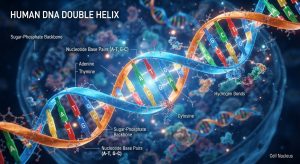
DNA contains genetic instructions used by cells.
It helps determine how proteins are produced and how cells develop, function and reproduce.
The relationship is:
DNA → RNA → Proteins → Cellular structures and functions.
Proteins are essential for:
- Enzyme activity.
- Cellular communication.
- Tissue structure.
- Immune defence.
- Muscle contraction.
- Transporting substances.
DNA therefore provides a fundamental information architecture underlying human biology.
PART IV: COMPARING THE OUTSIDE AND INSIDE
16. Which division performs more work?
Here is a direct scientific comparison.
| Biological responsibility | External structures | Internal structures |
|---|---|---|
| Protection | Major role | Supporting role |
| Breathing | Provides air entry | Performs gas exchange |
| Blood circulation | Limited direct role | Major role |
| Nutrient processing | Receives food | Digests and absorbs nutrients |
| Energy production | Uses ATP | Produces ATP within cells |
| Movement | Limbs and joints | Muscles, nerves and energy systems |
| Thinking | Sensory input | Brain processing |
| Waste removal | Skin contributes | Kidneys, liver, lungs and intestines |
| Temperature regulation | Skin and sweat | Brain, circulation and metabolism |
| Immune defence | Skin barrier | Internal immune networks |
Scientific conclusion
The internal architecture performs more of the continuous physiological work necessary for survival.
However, external structures are not less important. For example, extensive skin damage can threaten life because the protective barrier, fluid regulation and immune defence become compromised.
PART V: HOW THE ENTIRE BODY WORKS AS ONE NETWORK
17. The integrated survival architecture
The most important scientific discovery is that the body does not operate as independent organs.
It operates as an interconnected biological network.
Consider what happens when you walk.
For Sponsors and CROs — Physicians Research Group
- The brain plans and coordinates movement.
- The nervous system sends electrical signals.
- Muscles receive signals and contract.
- Bones and joints provide mechanical support.
- The heart increases blood delivery as needed.
- The lungs increase oxygen exchange.
- Mitochondria use oxygen and nutrients to produce ATP.
- The kidneys and other organs help maintain the internal chemical environment.
This is an extraordinary example of biological cooperation.
18. The mathematical architecture of human survival
We can use systems mathematics to understand the relationship between external and internal structures.
A simplified model is:
\[ H = f(E,I,C) \]
Where:
- \(H\) = overall human physiological function.
- \(E\) = external structures.
- \(I\) = internal structures.
- \(C\) = coordination between systems.
A more useful conceptual model of survival is:
\[ S = \min(L_1,L_2,L_3,\ldots,L_n) \]
Here, each \(L\) represents the functional condition of an essential life-supporting system, expressed on a comparable scale.
This illustrates an important principle: the failure of one critical system can threaten the whole organism.
18.1 The importance of homeostasis
Biology: Homeostasis and Feedback Loops Infographic | LivePhysics™
Homeostasis is the ability of the body to maintain relatively stable internal conditions despite external changes.
Examples include:
- Body temperature regulation.
- Blood glucose regulation.
- Blood pressure regulation.
- Water balance.
- Blood pH regulation.
- Oxygen and carbon dioxide regulation.
Homeostasis is maintained through feedback systems involving sensors, control centres and organs that produce responses.
For example:
\[ \text{Change} \rightarrow \text{Detection} \rightarrow \text{Processing} \rightarrow \text{Response} \]
This is one of the most important organisational principles in human physiology.
PART VI: WHICH ORGANS ARE MOST CRITICAL FOR SURVIVAL?
19. The major life-supporting systems
The following table ranks systems by their direct importance to maintaining immediate physiological survival. It is an educational comparison, not a universal clinical ranking.
| System | Essential survival responsibility |
|---|---|
| Nervous system | Coordinates vital functions |
| Cardiovascular system | Maintains blood circulation |
| Respiratory system | Supplies oxygen and removes carbon dioxide |
| Renal system | Maintains fluid and chemical balance |
| Liver | Performs essential metabolic functions |
| Endocrine system | Regulates metabolism and other body functions |
| Digestive system | Supplies nutrients and water |
| Immune system | Protects against infection |
| Musculoskeletal system | Enables movement and protects organs |
| Integumentary system | Provides external protection and temperature regulation |
An important distinction: the brain, heart and lungs are particularly critical in the short term, but the kidneys, liver and other systems are also indispensable for long-term survival.
20. What happens when one system stops working?
The body responds through interconnected mechanisms.
For example:
- If breathing becomes inadequate, oxygen delivery decreases.
- If circulation fails, oxygen and nutrient delivery to tissues is disrupted.
- If kidney function is severely impaired, waste and fluid imbalances develop.
- If liver function is severely impaired, metabolic and chemical regulation becomes compromised.
- If the nervous system is seriously damaged, essential coordination may be lost.
This demonstrates that survival depends on cooperation rather than one organ working alone.
PART VII: THE FIVE FUNDAMENTAL PRINCIPLES OF HUMAN SURVIVAL
I would summarise the entire architecture through five fundamental principles.
Human Brain: Facts, Functions & Anatomy | Live Science
1. Information and control
The brain and nervous system coordinate the body’s activities.
What is the Difference Between Anatomy and Physiology? | Blog
2. Transportation
The heart and blood vessels distribute oxygen, nutrients and chemical signals.
Lungs Anatomy. Trachea, Right lung and Left lung. Human respiratory system.
3. Energy and oxygen
The lungs supply oxygen while cells use nutrients to generate ATP.
Nghiên cứu: Loại dầu ăn quen thuộc không ngờ tốt cho tim, não, gan, thận
4. Chemical stability
The liver, kidneys and endocrine system maintain essential biochemical conditions.
Anatomy of human male muscular and skeletal systems, front and rear views.
5. Protection and interaction
The skin, skeleton, muscles and sensory organs protect the body and connect it to the environment.
PART VIII: THE BIGGEST SCIENTIFIC LESSON
21. The human body is an interconnected biological economy
One interesting way to understand the human body is to compare it with a modern industrial economy.
| Human body | Modern economy |
|---|---|
| Brain | Central management and coordination |
| DNA | Information and design instructions |
| Heart | Distribution and transportation infrastructure |
| Blood vessels | Logistics network |
| Lungs | Oxygen supply infrastructure |
| Digestive system | Raw-material processing |
| Liver | Chemical processing and quality control |
| Kidneys | Waste management and filtration |
| Mitochondria | Energy production facilities |
| Immune system | Security and defence |
| Skin | Protective infrastructure |
| Muscles | Mechanical workforce |
| Nervous system | Communication network |
This comparison helps us understand why the human body is so remarkable.
Every organ contributes to a larger coordinated system. A problem in one area can affect several other areas.
22. Final conclusion: Outside versus inside
The answer to your original question is:
The inside parts of the human body perform more of the continuous work that keeps us alive. The outside parts provide essential protection, movement, sensory information and interaction with the environment.
But the deeper scientific principle is that the human body is one integrated biological machine.
The outside cannot survive without the inside, and the inside depends on the outside for protection, oxygen access, food intake, sensory information and interaction with the environment.
The greatest lesson is not that one side is more important than the other. It is that millions of biological structures, from visible organs down to microscopic molecules, cooperate to maintain one living human organism.
23. Recommended advanced study: Six interconnected subjects
To develop an even deeper understanding, these six subjects provide a logical progression:
- Gross anatomy: The complete physical architecture of the body.
- Human physiology: How organs and systems perform their functions.
- Cell biology: How microscopic cells operate.
- Biochemistry: How chemical reactions sustain life.
- Biophysics: How electricity, pressure, energy and mechanical forces operate inside the body.
- Systems biology: How all biological networks communicate and cooperate.
These subjects together provide a scientific understanding of the human body from its external structures to its smallest living components.

Be First to Comment