
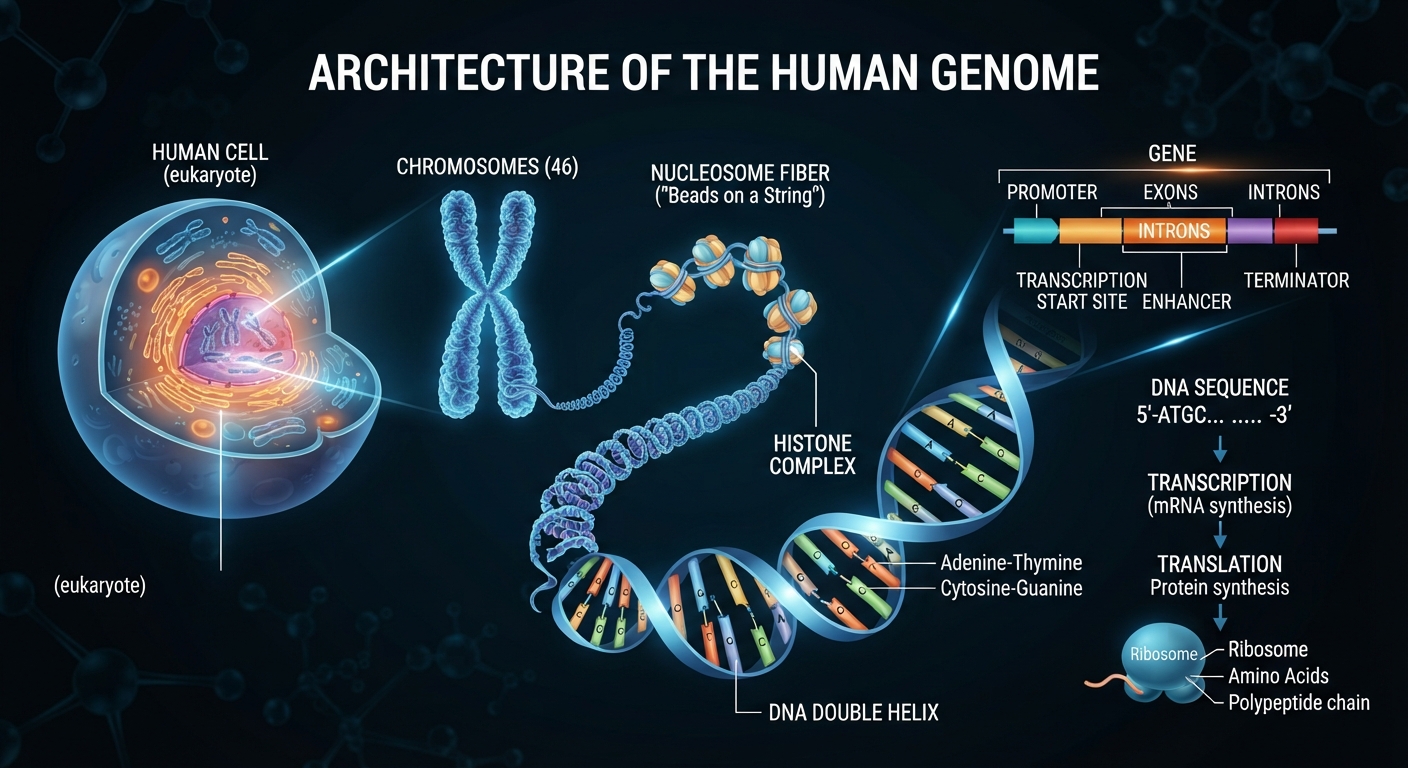
COMPREHENSIVE SCIENTIFIC THESIS
Understanding the complete biological information system, its molecular structure, genetic organisation, replication, functions and significance in modern science and the economy
File:DNA Structure+Key+Labelled.png – Wikimedia Commons
EL ARTE DE LA VIDA ES LA BIOLOGÍA : 2019
7
Abstract
The human genome is one of the most sophisticated biological information systems known to science. It contains the complete set of DNA instructions that contribute to the development, operation, maintenance and reproduction of the human organism.
The genome is not simply a collection of genes. It is an extraordinarily organised molecular information architecture containing genes, regulatory sequences, structural DNA, repetitive sequences, chromosome structures and instructions that control when and where biological information is used.
Understanding the human genome requires knowledge from several scientific disciplines:
- Molecular biology.
- Genetics and genomics.
- Biochemistry.
- Cell biology.
- Molecular physics.
- Bioinformatics and computational mathematics.
- Evolutionary biology.
- Biotechnology and medical science.
The central scientific question is:
How can an extremely small molecular structure contain, organise, protect, copy and communicate the biological information needed to construct and maintain a human organism?
This thesis examines that question from the molecular level to the complete human biological system.
CHAPTER 1: Understanding the human genome
1.1 What is the human genome?
The human genome is the complete collection of genetic material in a human cell.
It is primarily made of deoxyribonucleic acid (DNA), a molecule that stores biological information through sequences of four chemical bases.
These four bases are:
| DNA base | Scientific abbreviation | Chemical classification |
|---|---|---|
| Adenine | A | Purine |
| Thymine | T | Pyrimidine |
| Guanine | G | Purine |
| Cytosine | C | Pyrimidine |
These four chemical letters form the language through which genetic information is encoded.
For example, a DNA sequence might look like:
ATGCCGTTAAGC
This sequence is not random decoration. Its arrangement contributes to the information stored in the DNA molecule.
The order, length and organisation of DNA sequences influence the biological instructions that cells can interpret.
1.2 How much information does the human genome contain?
The human nuclear genome contains approximately:
- 3.2 billion DNA base pairs in one haploid set.
- Approximately 6.4 billion base pairs in a typical diploid nuclear cell.
- 23 chromosomes in one haploid set.
- 46 chromosomes in most human body cells.
- Approximately 20,000 protein-coding genes.
An important distinction:
A base pair is a pair of complementary DNA bases connected across the two strands of the double helix.
A typical human body cell contains two sets of chromosomes, one inherited from each biological parent.
Not all DNA sequences encode proteins. A substantial portion participates in regulation, chromosome organisation, RNA production and other biological functions.
1.3 The genome versus the gene
These two concepts must be distinguished.
| Concept | Meaning |
|---|---|
| Genome | The complete genetic material of an organism |
| Gene | A DNA region that produces a functional RNA or contributes to a protein product |
| Chromosome | An organised DNA molecule associated with proteins |
| DNA | The molecule that stores genetic information |
| RNA | A molecule involved in expressing and regulating genetic information |
| Genome sequencing | Determining the order of DNA bases |
Think of the genome as an entire library, chromosomes as the library’s organised volumes, genes as particular instructions, and DNA bases as the letters used to write those instructions.
CHAPTER 2: The microscopic molecular architecture of DNA
watson and crick model of DNA(molecular biology) | PPTX
nnhsbiology / DNA Synthesis Explained
7
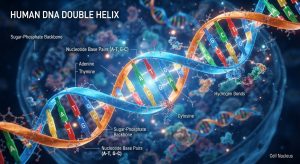
2.1 The DNA double helix
DNA has a characteristic double-helical structure.
It consists of two long molecular strands twisted around one another.
Each strand contains a repeating chemical backbone made from:
- Deoxyribose sugar.
- Phosphate groups.
- Nitrogenous bases.
The sugar and phosphate form the outer backbone, while the bases project inward and pair with complementary bases on the opposite strand.
The complementary pairing rules are:
- Adenine pairs with thymine.
- Guanine pairs with cytosine.
This complementary architecture is fundamental to DNA stability and replication.
2.2 The nucleotide: the fundamental DNA building block
A nucleotide is the basic repeating unit of DNA.
Each DNA nucleotide consists of three components:
Free DNA Structure Diagram Generator | Figviz
- A phosphate group.
- A five-carbon deoxyribose sugar.
- One nitrogenous base.
Nucleotides connect through phosphodiester bonds to create the DNA backbone.
The direction of a DNA strand is described using two chemical ends:
- 5′ end.
- 3′ end.
The two strands of DNA run in opposite directions. This is called antiparallel organisation.
2.3 Hydrogen bonding and molecular stability
The complementary DNA bases are held together through hydrogen bonding.
- A–T pairs have two hydrogen bonds.
- G–C pairs have three hydrogen bonds.
However, DNA stability does not depend on hydrogen bonds alone. Base stacking interactions between neighbouring bases also contribute substantially to the stability of the double helix.
This architecture allows DNA to remain sufficiently stable to preserve information while also allowing its strands to separate during replication and transcription.
2.4 DNA as a biological information storage system
DNA has several characteristics that make it an effective information-storage molecule:
| Characteristic | Biological significance |
|---|---|
| Chemical stability | Helps preserve genetic information |
| Complementary pairing | Supports accurate copying |
| Linear sequence | Stores information in an ordered format |
| Molecular packaging | Allows DNA to fit inside the nucleus |
| Repair mechanisms | Help correct certain forms of DNA damage |
| Regulatory sequences | Help control gene activity |
The remarkable principle is that a limited chemical alphabet can produce enormous biological complexity through different sequences and patterns of organisation.
CHAPTER 3: The complete chromosome architecture
Karotyping, Chromosomal Disorders & Epigenetics in Gene Expression | Study.com
Telomere Length and Cellular Aging | Healthy Living Benefits
8
3.1 What is a chromosome?
A chromosome is a highly organised structure consisting of DNA associated with proteins.
In human cells, chromosomes package extremely long DNA molecules into manageable structures.
Most human body cells contain 46 chromosomes arranged into 23 pairs.
These consist of:
- 22 pairs of autosomes.
- One pair of sex chromosomes, commonly XX or XY.
Chromosome inheritance is a central component of human heredity.
3.2 The four important chromosome regions
A chromosome has several structural components.
1. Short arm (p arm)
The shorter section of a chromosome.
2. Long arm (q arm)
The longer section of a chromosome.
3. Centromere
A specialised chromosome region involved in organising the kinetochore, which allows chromosomes to attach to the cell division machinery.
4. Telomeres
Protective repetitive DNA-protein structures at chromosome ends.
3.3 The significance of telomeres
Telomeres protect chromosome ends and help prevent them from being mistaken for broken DNA.
During many rounds of cell division, telomeres can shorten because of the way conventional DNA replication works.
An enzyme called telomerase can extend telomeres in certain cell types.
Telomere biology is important in:
- Cellular ageing research.
- Stem cell biology.
- Cancer research.
- Chromosome stability.
- Human development.
Telomere length is not a simple or reliable measure of an individual’s biological age because many biological and environmental factors influence it.
3.4 The significance of centromeres
The centromere plays a critical role during cell division.
It helps organise the kinetochore, a protein structure that connects chromosomes to spindle microtubules.
This allows chromosomes to be distributed into daughter cells.
Without accurate chromosome separation, cells may receive abnormal numbers of chromosomes.
CHAPTER 4: DNA packaging — from microscopic molecules to chromosomes
One of the greatest engineering achievements of biological evolution is the ability to package approximately two metres of DNA into a microscopic cell nucleus.
How does this happen?
DNA does not float freely inside the nucleus. It is organised through a sophisticated combination of proteins and molecular structures.
This organisation is called chromatin architecture.
Niveles de organización de la cromatina. Imagen: Paco Antequera.
Chromosomes and DNA Replication Review Flashcards | Quizlet
Lingbin Ni | Pan-3D genome analysis
7
4.1 Histone proteins
Histones are specialised proteins that help organise DNA.
The four principal core histones are:
| Histone | Function |
|---|---|
| H2A | Contributes to nucleosome structure |
| H2B | Supports DNA packaging |
| H3 | Helps organise chromatin and regulate gene activity |
| H4 | Helps stabilise nucleosome structure |
Two copies of each form a histone octamer.
DNA wraps around this protein complex to create a nucleosome.
4.2 The nucleosome: the fundamental packaging unit
A nucleosome consists of approximately 147 base pairs of DNA wrapped around a histone octamer.
The nucleosome is the fundamental structural unit of chromatin.
Its importance extends beyond packaging.
It also controls how accessible DNA is to the molecular machinery responsible for:
- Reading genes.
- Copying DNA.
- Repairing damaged DNA.
- Regulating gene expression.
- Maintaining chromosome structure.
4.3 Higher-order chromatin organisation
The packaging hierarchy can be understood as follows:
Human genome packaging hierarchy
1. DNA double helixTwo complementary molecular strands.
2. NucleosomesDNA wrapped around histone proteins.
3. ChromatinOrganised DNA-protein material.
Epimutations and Their Effect on Chromatin Organization: Exciting Avenues for Cancer Treatment
4. Chromatin loops and domainsThree-dimensional organisation of DNA.
Chromosome And Microtubules #1 by Science Photo Library
5. Condensed chromosomeHighly compacted DNA during cell division.
Chromatin exists in different degrees of organisation. It is not simply a permanently coiled fibre.
Its structure is dynamic, allowing different regions to become accessible when the cell needs to read or maintain its DNA.
4.4 Euchromatin and heterochromatin
Two important chromatin states are:
Euchromatin: Generally less compact and more accessible to transcription machinery. It often contains actively expressed genes.
Heterochromatin: Generally more compact and less accessible. It helps maintain chromosome structure and can suppress the activity of particular genes.
These are broad descriptions. Some regions can change their organisation depending on cell type and biological conditions.
The relationship between DNA packaging and gene activity is essential to understanding how cells develop different identities.
Source: NCBI+2
CHAPTER 5: The internal architecture of a human gene
File:Gene structure eukaryote 2 annotated.svg – Wikimedia Commons
5.1 What is a gene?
A gene is a region of DNA that produces a functional biological product, usually an RNA molecule.
Some genes produce messenger RNA, which can subsequently be translated into proteins.
Other genes produce functional RNA molecules that perform biological tasks without becoming proteins.
Examples include:
- Ribosomal RNA.
- Transfer RNA.
- MicroRNA.
- Small nuclear RNA.
- Long noncoding RNA.
A gene is therefore not merely a section that produces a protein. It is a functional unit of genetic information.
5.2 The principal components of a protein-coding gene
| Component | Biological function |
|---|---|
| Promoter | Helps initiate transcription |
| Enhancer | Increases gene transcription in appropriate contexts |
| Silencer | Reduces gene transcription |
| Transcription start site | Position where RNA synthesis begins |
| Exons | Sequences retained in mature RNA |
| Introns | Sequences removed during RNA splicing in many genes |
| Untranslated regions | Help regulate RNA stability, localisation and translation |
| Polyadenylation signal | Helps determine RNA processing and termination |
An important distinction: enhancers and silencers can be located far away from the gene they regulate, including within introns or other intergenic regions.
5.3 Exons and introns
Genes often contain two types of sequence:
Exons: Regions retained in the mature RNA following RNA processing.
Introns: Regions removed from the initial RNA transcript during splicing.
This process is important because one gene can sometimes produce different RNA products.
5.4 Alternative splicing
Alternative splicing is a molecular process through which different combinations of exons are joined together.
Glossary | Genome Sciences Centre
For example:
- One initial RNA transcript is produced.
- The RNA is processed.
- Different combinations of exons are retained.
- Different mature RNA molecules can result.
- Different protein versions may be produced.
This increases the functional diversity that can be generated from the human gene catalogue.
5.5 Why the genome has only approximately 20,000 protein-coding genes
A common misconception is that every complex organism must have an enormous number of genes.
Human biological complexity does not depend exclusively on gene quantity.
It also depends on:
- Gene regulation.
- Alternative splicing.
- RNA processing.
- Protein modifications.
- Interactions between proteins.
- Epigenetic regulation.
- Cell-to-cell communication.
- Three-dimensional genome organisation.
The human genome is therefore better understood as a coordinated information network rather than a simple list of instructions.
CHAPTER 6: The 98–99% of DNA that does not directly encode proteins
PPT – SGN23 The Organization of the Human Genome PowerPoint Presentation – ID:337165
One of the most interesting discoveries in modern genomics is that protein-coding DNA represents only a small fraction of the human genome.
Depending on the definition used, approximately 1–2% directly encodes proteins.
What about the rest?
It contains numerous different types of sequences.
6.1 Major categories of noncoding DNA
| DNA category | Significance |
|---|---|
| Introns | Participate in gene organisation and RNA processing |
| Promoters | Help initiate gene transcription |
| Enhancers | Help increase gene expression |
| Silencers | Help suppress gene expression |
| Telomeric DNA | Supports chromosome-end protection |
| Centromeric DNA | Supports chromosome segregation |
| Noncoding RNA genes | Produce functional RNA molecules |
| Repetitive DNA | Includes several families of repeated sequences |
| Intergenic DNA | DNA between annotated genes |
Not every noncoding DNA sequence has an established biological function. Some sequences have important known functions, while others remain incompletely understood.
It is scientifically inaccurate to call all noncoding DNA either useless or functional.
6.2 Repetitive DNA
The human genome contains many repeated DNA sequences.
Important examples include:
- LINEs.
- SINEs.
- Satellite DNA.
- Tandem repeats.
- Endogenous retroviral sequences.
Some repetitive sequences influence chromosome structure, gene regulation and genome evolution.
Others are molecular remnants of earlier evolutionary processes.
6.3 Regulatory DNA: the control system
Regulatory DNA determines how genetic information is used.
Consider two cells:
- A nerve cell.
- A liver cell.
Both usually contain essentially the same inherited nuclear genome.
However, their functions are dramatically different.
A nerve cell requires particular genes associated with electrical signalling and communication.
A liver cell requires genes associated with metabolism, detoxification and protein production.
Their different identities arise largely because different combinations of genes are active or inactive.
This is one of the most important principles in molecular biology:
The identity of a cell is determined not simply by which genes it possesses, but also by which genes it expresses and when it expresses them.
Source: MedlinePlus+2
CHAPTER 7: The biological information-processing system — DNA to RNA to protein
Chapter: The Cell — The Biology Primer
This is one of the fundamental mechanisms through which genetic information becomes biological activity.
The process is commonly called the central dogma of molecular biology.
It involves three major stages:
- DNA storage.
- RNA production.
- Protein synthesis.
7.1 Stage one: DNA stores the information
The DNA sequence contains the genetic instructions.
However, DNA does not independently perform every biological operation.
It interacts with specialised enzymes and other molecular machinery.
7.2 Stage two: transcription
Transcription is the process through which a DNA sequence is copied into RNA.
The principal enzyme involved in producing messenger RNA is RNA polymerase II.
The basic process is:
- Regulatory proteins help identify the appropriate gene.
- Transcription machinery assembles at the gene.
- RNA polymerase reads the DNA template.
- An RNA molecule is synthesised.
- The RNA undergoes processing.
The resulting mature messenger RNA can then leave the nucleus.
7.3 Stage three: translation
Researchers clear major obstacle in genetic engineering of proteins
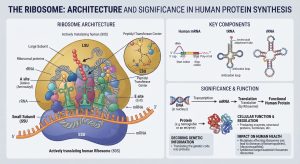
Translation occurs at ribosomes.
Ribosomes read messenger RNA in groups of three bases called codons.
Each codon corresponds to an amino acid or a translation signal.
Transfer RNA molecules help deliver amino acids to the ribosome.
The amino acids are joined together to form a polypeptide chain.
This chain subsequently folds and may undergo further chemical modifications to become a functional protein.
7.4 The significance of proteins
Proteins are among the most important working molecules in the human body.
They perform numerous functions:
| Protein category | Function |
|---|---|
| Enzymes | Accelerate biochemical reactions |
| Receptors | Receive biological signals |
| Transport proteins | Move substances |
| Structural proteins | Support cells and tissues |
| Antibodies | Participate in immune defence |
| Motor proteins | Generate molecular movement |
| Hormones | Coordinate biological activities |
For example, haemoglobin transports oxygen in the blood, insulin regulates glucose metabolism, and collagen contributes to the structural integrity of connective tissues.
The genome therefore influences the production of molecular machinery that supports the entire human organism.
CHAPTER 8: DNA replication — how the genome copies itself
DNA Replication for the DAT: Enzymes, Directionality, and Key Concepts — King of the Curve
DNA replication is the biological process through which DNA is copied before cell division.
It is essential for growth, tissue maintenance and the production of new cells.
8.1 The principle of semiconservative replication
Each newly produced DNA double helix contains:
- One original parental strand.
- One newly synthesised strand.
This is called semiconservative replication.
The complementary nature of DNA makes this process possible.
8.2 Important molecular components
| Component | Main function |
|---|---|
| Helicase | Separates the DNA strands |
| Primase | Produces RNA primers |
| DNA polymerase | Synthesises new DNA |
| DNA ligase | Joins DNA fragments |
| Topoisomerase | Helps manage DNA twisting and tension |
| Sliding clamp | Helps DNA polymerase remain associated with DNA |
8.3 Leading and lagging strands
DNA polymerases synthesise DNA in the 5′ to 3′ direction.
Because the original strands run in opposite directions, replication occurs differently on each template.
Leading strand: Synthesised continuously in the direction of replication-fork movement.
Lagging strand: Synthesised discontinuously as short Okazaki fragments, which are subsequently joined.
8.4 Why replication accuracy matters
The human genome contains billions of base pairs.
A copying error can introduce a DNA sequence variation.
Cells have proofreading and DNA repair mechanisms that help reduce these errors.
These mechanisms are essential because accumulated DNA damage or mutations can affect normal cellular functions.
CHAPTER 9: DNA repair and genomic stability
The genome is constantly exposed to biological and environmental influences that can damage DNA.
Cells therefore maintain specialised repair systems.
9.1 Important DNA repair mechanisms
| Repair system | General function |
|---|---|
| Mismatch repair | Corrects certain copying errors |
| Base excision repair | Repairs particular damaged DNA bases |
| Nucleotide excision repair | Removes certain bulky DNA lesions |
| Homologous recombination | Repairs some double-strand breaks using a matching DNA template |
| Non-homologous end joining | Repairs certain DNA double-strand breaks |
9.2 Why DNA repair is important
DNA repair contributes to:
- Maintaining genetic stability.
- Preventing the accumulation of harmful mutations.
- Protecting normal cell function.
- Supporting healthy tissue development.
- Reducing the risk of certain cancers.
However, DNA repair is not perfect.
Some DNA changes remain after repair attempts or arise through other biological processes.
These changes contribute to genetic variation, evolution and disease.
CHAPTER 10: Epigenetics — controlling genetic activity without changing the DNA sequence
Epigenetics is the study of mechanisms that influence gene activity without changing the underlying DNA sequence.
It provides another level of genome organisation.
10.1 DNA methylation
DNA methylation involves the addition of chemical methyl groups to DNA, commonly at cytosine bases in particular sequence contexts.
It can influence whether certain genes are expressed.
Its effects depend on the genomic location and cellular context.
10.2 Histone modification
Histone proteins can undergo chemical modifications.
Examples include:
- Acetylation.
- Methylation.
- Phosphorylation.
- Ubiquitination.
These modifications influence chromatin structure and the accessibility of genetic information.
10.3 Why epigenetics matters
Epigenetic regulation helps explain:
- How cells develop specialised functions.
- How tissues maintain their identities.
- How developmental processes are coordinated.
- How certain environmental conditions influence gene activity.
- How abnormal gene regulation contributes to disease.
An important distinction is that epigenetic changes are not necessarily permanent, and not all are inherited between generations.
CHAPTER 11: Genetic inheritance and human variation
PPT – Figure 9.4 PowerPoint Presentation, free download – ID:4144791
Humans inherit genetic information from their biological parents.
In typical sexual reproduction:
- The egg contributes one set of 23 chromosomes.
- The sperm contributes one set of 23 chromosomes.
- Fertilisation combines the two sets.
- The resulting embryo typically begins with 46 nuclear chromosomes per cell.
11.1 Dominant and recessive inheritance
Dominant and recessive describe particular patterns of inheritance.
A dominant variant may influence a trait when only one copy is present.
A recessive condition typically requires relevant variants in both copies of a gene, although actual inheritance can be more complicated.
11.2 Genetic variation
No two unrelated individuals generally have identical nuclear genome sequences.
Genetic variation can involve:
- Single nucleotide variants.
- Insertions.
- Deletions.
- Duplications.
- Larger structural rearrangements.
- Differences in chromosome number.
Some variants have no noticeable biological consequences.
Others influence physical characteristics, disease susceptibility, drug responses or biological development.
11.3 The importance of environmental interaction
Human characteristics do not emerge from DNA alone.
They are influenced by interactions between:
- Genetic inheritance.
- Development.
- Nutrition.
- Environmental exposure.
- Cellular regulation.
- Social and physical conditions.
This is why genomics must be studied together with physiology, biochemistry, environmental science and medicine.
CHAPTER 12: Mitochondrial DNA — the second human genome
Most discussions of the human genome concentrate on nuclear DNA.
However, human cells also contain mitochondrial DNA.
Mitochondria are specialised cellular structures that contribute to energy production.
They contain their own genetic material.
12.1 Architecture of mitochondrial DNA
Human mitochondrial DNA is:
- Circular.
- Approximately 16,569 base pairs long.
- Relatively compact.
- Organised into 37 genes.
These genes include:
- 13 protein-coding genes.
- 22 transfer RNA genes.
- 2 ribosomal RNA genes.
12.2 The function of mitochondrial genes
Mitochondrial DNA contributes to the production of proteins involved in oxidative phosphorylation, the process through which cells generate much of their ATP.
ATP is the principal energy-transfer molecule used by cells.
12.3 Mitochondrial inheritance
Human mitochondrial DNA is generally inherited through the maternal line.
This makes mitochondrial DNA particularly useful in certain types of evolutionary and population research.
However, mitochondrial DNA represents only a small portion of the total human genetic information.
The nuclear genome contains the overwhelming majority of human genetic material.
Source: Genome.gov+1
CHAPTER 13: The three-dimensional architecture of the genome
The human genome is not organised only as a linear DNA sequence.
It also has a three-dimensional structure inside the cell nucleus.
This is an important area of modern genomic research because the physical arrangement of DNA influences how genes interact and function.
Lingbin Ni | Pan-3D genome analysis
3D or Not 3D: Shaping the Genome during Development
10
13.1 Chromosome territories
Each chromosome occupies a preferential region within the nucleus.
These regions are called chromosome territories.
Although chromosomes can interact with one another, their spatial organisation is not completely random.
13.2 Chromatin loops
DNA can form loops that bring distant regulatory sequences close to the genes they control.
For example, an enhancer located far away along the DNA sequence can interact with a promoter through three-dimensional folding.
This makes it possible for distant DNA sequences to participate in coordinated gene regulation.
13.3 Topologically associating domains
Topologically associating domains, or TADs, are regions of the genome in which DNA sequences interact more frequently with one another than with sequences outside the region.
They help organise the genome into functional neighbourhoods.
Some important proteins involved in genome organisation include:
- CTCF.
- Cohesin.
- Histone proteins.
- Chromatin-remodelling proteins.
The importance of three-dimensional genome architecture is that DNA sequence and DNA spatial organisation work together.
A gene’s activity can depend not only on its sequence but also on its position, regulatory environment and interactions with distant genomic regions.
CHAPTER 14: Mutations and genetic disorders
A mutation is a change in the DNA sequence.
Mutations can arise during DNA replication, through spontaneous chemical changes or through exposure to certain environmental agents.
They can also be inherited from biological parents.
14.1 Types of genetic mutations
| Mutation | Description |
|---|---|
| Substitution | One DNA base is replaced by another |
| Insertion | Additional DNA bases are introduced |
| Deletion | DNA bases are removed |
| Duplication | A DNA segment is copied |
| Inversion | A DNA segment is reversed |
| Translocation | DNA segments become rearranged between chromosomes |
14.2 How mutations affect proteins
A mutation can affect the biological product of a gene in several ways.
For example:
- A protein may remain unchanged.
- An amino acid may be substituted.
- A protein may become shorter.
- Protein production may be reduced.
- A protein may become more active.
- Gene regulation may change.
Not every mutation causes disease. Some are neutral, some have beneficial effects in particular environments, and others can be harmful.
14.3 Examples of genetic conditions
| Condition | Genetic relationship |
|---|---|
| Sickle cell disease | Variants in the HBB gene |
| Cystic fibrosis | Disease-causing variants in CFTR |
| Huntington disease | Expanded CAG repeats in HTT |
| Duchenne muscular dystrophy | Disease-causing variants in DMD |
| Some forms of inherited breast cancer susceptibility | Variants in BRCA1 or BRCA2 |
Understanding genetic disorders requires examining the relationship between a DNA variant, the affected protein or biological pathway, and the resulting cellular effects.
CHAPTER 15: How scientists decode the human genome
Why Genome Sequencing May Hold the Key to Preventing Genetic Diseases
Uniwersytet Medyczny w Białymstoku. O Centrum.
Analysing Oxford Nanopore data: a beginner’s guide to file formats
9
Genomics has developed into a major computational and technological discipline.
Scientists now have tools to investigate billions of DNA bases, compare genetic sequences and identify variations associated with biological characteristics.
15.1 DNA sequencing
DNA sequencing determines the order of nucleotide bases.
The main objective is to identify the arrangement of:
A, T, G and C.
There are several major sequencing approaches.
| Technology | Main characteristics |
|---|---|
| Sanger sequencing | Traditional sequencing method, useful for relatively short DNA regions |
| Short-read sequencing | Produces many relatively short DNA reads |
| Long-read sequencing | Produces much longer DNA reads |
| Whole-genome sequencing | Examines DNA across the genome |
| Whole-exome sequencing | Focuses on protein-coding regions |
| RNA sequencing | Examines RNA molecules and gene-expression patterns |
15.2 Next-generation sequencing
Next-generation sequencing allows scientists to analyse enormous numbers of DNA fragments simultaneously.
Its significance includes:
- Increased sequencing throughput.
- More comprehensive genetic investigations.
- Large-scale research.
- Identification of genetic variation.
- Medical genomics.
15.3 Long-read sequencing
Long-read technologies help scientists examine DNA regions that are difficult to assemble using short reads.
They are particularly useful for investigating:
- Repetitive DNA.
- Structural variants.
- Complex genomic regions.
- Large insertions and deletions.
- Previously difficult-to-resolve chromosome regions.
15.4 Bioinformatics: the computational brain of genomics
Bioinformatics combines biology, mathematics, statistics and computer science to analyse biological information.
A typical genomic data workflow involves:
- Collecting DNA samples under appropriate consent and ethical safeguards.
- Extracting genetic material.
- Sequencing DNA.
- Processing sequencing data.
- Aligning reads against a reference genome.
- Identifying genetic variants.
- Interpreting biological significance.
- Validating findings.
Modern genomics depends on high-performance computing, cloud infrastructure, data storage and sophisticated analytical algorithms.
CHAPTER 16: The Human Genome Project — a turning point in scientific history
Human Genome Project Fact Sheet
The Human Genome Project was one of the most significant international scientific collaborations in modern history.
It formally began in 1990 and its principal sequencing goals were announced as completed in 2003.
Its primary objective was to determine a reference sequence for the human genome and develop technologies for analysing genetic information.
16.1 Major achievements
The project contributed to:
- Mapping human chromosomes.
- Identifying genes.
- Developing DNA sequencing technologies.
- Establishing reference genome resources.
- Advancing bioinformatics.
- Improving genetic research.
- Supporting modern biomedical science.
16.2 Why the project transformed science
Before large-scale genome sequencing, scientists frequently investigated individual genes or small DNA regions.
The Human Genome Project made it possible to study the genome as an integrated system.
This helped establish modern genomics as a major scientific discipline.
16.3 The development beyond 2003
The original reference genome was not the final word on human genetic diversity.
Subsequent work improved the representation of difficult genomic regions and expanded the diversity of reference sequences.
Important developments include:
- Improved reference genome assemblies.
- Telomere-to-Telomere sequencing.
- The Human Pangenome Reference Consortium.
- Single-cell genomics.
- Single-cell gene-expression analysis.
- Advanced long-read sequencing.
A pangenome approach recognises that one reference sequence cannot fully represent the genetic diversity of all human populations.
CHAPTER 17: The human genome and artificial intelligence
Partek Flow software | Intuitive multiomic data analysis & visualization
OpenFold3 Challenges AlphaFold3 in Protein Folding | TechLife
10
Artificial intelligence is increasingly important in biological research.
The human genome produces enormous amounts of data that require sophisticated computational methods.
AI can help scientists identify patterns, predict biological relationships and analyse complex molecular systems.
17.1 AI applications in genomics
| AI application | Scientific significance |
|---|---|
| DNA sequence analysis | Identifies patterns in genetic sequences |
| Variant interpretation | Helps investigate possible effects of DNA changes |
| Gene-expression analysis | Identifies patterns of gene activity |
| Protein structure prediction | Helps predict molecular structures |
| Disease research | Supports investigations into biological mechanisms |
| Drug discovery | Helps identify and evaluate possible drug targets |
| Single-cell analysis | Helps classify different cell populations |
17.2 Machine learning and genomic patterns
Machine learning systems can be trained using biological datasets.
For example, a model can examine DNA sequences and learn statistical patterns associated with particular biological functions.
The general computational architecture is:
AI genomic analysis architecture
1
Genomic data
DNA sequences, RNA data and biological measurements
2
Data processing
Quality control, alignment and data preparation
3
Machine learning
Models identify patterns and relationships
4
Scientific interpretation
Researchers assess predictions against biological evidence
5
Experimental validation
Laboratory investigations test the findings
17.3 The importance of AI limitations
AI predictions are not automatically scientific facts.
A model can identify statistical associations without establishing biological causation.
Its findings must be assessed through:
- Scientific literature.
- Independent datasets.
- Laboratory experiments.
- Clinical evidence where appropriate.
- Reproducibility.
- Expert evaluation.
The combination of genomics and AI represents a major frontier in modern computational science.
CHAPTER 18: The significance of the human genome in modern medicine
The study of the human genome is transforming the understanding of disease, diagnosis and medical research.
18.1 Precision medicine
Precision medicine uses information about genetic, environmental and lifestyle factors to improve the understanding and management of disease.
It recognises that patients can respond differently to the same medical treatment.
18.2 Pharmacogenomics
Pharmacogenomics studies how genetic variation can influence responses to medicines.
Some genetic variants affect:
- Drug metabolism.
- Drug transport.
- Drug targets.
- The likelihood of adverse reactions.
This information can sometimes help clinicians select more appropriate treatments.
18.3 Cancer genomics
Cancer involves changes in the genetic and regulatory systems of cells.
Genomic analysis can help researchers investigate:
- Mutations in cancer cells.
- Abnormal signalling pathways.
- Changes in gene expression.
- Tumour development.
- Treatment resistance.
Cancer genomics has become an important component of modern oncology research.
18.4 Genomics and infectious diseases
Genomic technology is also used to study microorganisms.
Scientists can examine the genomes of bacteria and viruses to understand their evolution, genetic characteristics and transmission patterns.
This has important applications in public health and infectious-disease research.
CHAPTER 19: The economic significance of genome science
The human genome is not only a biological discovery. It is also an important foundation for a growing scientific and technological economy.
Genomics connects research institutions, universities, biotechnology companies, medical laboratories, pharmaceutical industries and computing infrastructure.
19.1 Major economic sectors
2026 Biological Sciences Degree Master’s Programs Accepting Students Now | Research.com
1. Biotechnology
Develops technologies and products based on biological systems, including genetic research tools.
AstraZeneca stock falls as Etcamah trial setback clouds oncology outlook
2. Pharmaceutical research
Uses genetic and molecular information to investigate drug targets and treatment responses.
Why Genome Sequencing May Hold the Key to Preventing Genetic Diseases
3. Medical diagnostics
Provides genetic testing and genomic analysis services.
High-Performance Computing – a cross-cutting research area
4. Computing infrastructure
Supports genomic data storage, processing, analysis and secure management.
Michael Zhang Computational Biology Laboratory – UT Dallas Research
5. Education and research
Develops scientific knowledge, research expertise and highly skilled human capital.
19.2 Opportunities for South Africa
South Africa has opportunities to develop its scientific and technological capacity in:
- Genomic research.
- Biotechnology education.
- Bioinformatics.
- Medical laboratory science.
- Computational biology.
- Agricultural genomics.
- Public-health research.
- Scientific data infrastructure.
A strong genomics ecosystem requires investment in education, research laboratories, computing infrastructure, ethical governance and skilled scientific personnel.
19.3 The relationship between genomics and other industries
| Industry | Potential contribution of genomics |
|---|---|
| Healthcare | Genetic disease research and diagnostics |
| Agriculture | Plant and animal genetic research |
| Pharmaceuticals | Drug development |
| Computing | Biological data analytics |
| Artificial intelligence | Molecular pattern recognition |
| Education | Advanced biological science |
| Public health | Population-level genetic research |
This creates an interdisciplinary economic ecosystem in which biology, engineering, mathematics, medicine and computing work together.
CHAPTER 20: Mathematical architecture of the human genome
Understanding the human genome requires mathematical thinking.
The genome can be examined using probability, statistics, information theory, graph theory and computational modelling.
20.1 DNA sequence as a mathematical sequence
DNA can be represented as a sequence:
\[ D=(d_1,d_2,d_3,\ldots,d_n) \]
Where:
- \(D\) represents the DNA sequence.
- \(d_i\) represents a nucleotide at position \(i\).
- \(n\) represents the sequence length.
Each nucleotide belongs to the set:
\[ \Sigma=\{A,T,G,C\} \]
Therefore, DNA can be mathematically represented as a string over a four-character alphabet.
20.2 Genetic information and probability
If four DNA bases were equally probable and independently distributed, the theoretical information content per base would be:
\[ H=\log_2(4)=2\text{ bits} \]
For a sequence of \(n\) bases:
\[ I=2n\text{ bits} \]
For three billion bases, this simplified theoretical calculation gives approximately six billion bits.
Real DNA is not a perfectly random sequence. Base frequencies, repetitive sequences and biological dependencies influence its actual information characteristics.
20.3 Genetic variation as a statistical problem
Scientists compare DNA sequences to identify differences.
A simplified measure of sequence similarity is:
\[ S=\frac{\text{Matching positions}}{\text{Total compared positions}}\times100 \]
More sophisticated analyses account for insertions, deletions, structural variants and uncertainty in sequence alignment.
20.4 Genome networks
The genome can also be represented as a network.
- Nodes can represent genes or regulatory elements.
- Connections can represent regulatory relationships.
- Network clusters can represent biological pathways.
- Mathematical models can investigate how changes in one component influence other components.
This approach connects molecular biology with systems engineering and computational mathematics.
CHAPTER 21: The future of human genome science
The human genome is still an active area of scientific discovery.
Although scientists have sequenced and studied large portions of human DNA, many biological mechanisms remain incompletely understood.
The next generation of research is likely to focus on several important areas.
21.1 Human pangenome research
A pangenome represents genetic diversity across multiple individuals rather than relying on one reference genome.
This is particularly important for ensuring that genomic research better represents different human populations.
21.2 Single-cell genomics
Traditional genomic studies often examine collections of cells.
Single-cell genomics allows researchers to investigate genetic activity in individual cells.
This can help explain differences between:
- Brain cells.
- Immune cells.
- Liver cells.
- Muscle cells.
- Stem cells.
- Cancer cells.
21.3 Multi-omics
Multi-omics combines several layers of biological information.
Other Resources – Computational Multi-Omics
| Scientific discipline | What it studies |
|---|---|
| Genomics | DNA |
| Transcriptomics | RNA |
| Proteomics | Proteins |
| Metabolomics | Small biological molecules |
| Epigenomics | Genome-wide epigenetic modifications |
| Metagenomics | Genetic material from microbial communities |
Combining these disciplines provides a broader understanding of how biological systems operate.
21.4 Genome editing research
Genome editing technologies allow scientists to investigate how specific DNA sequences influence biological functions.
CRISPR-based technologies are particularly important in modern molecular biology.
Their research applications include understanding genetic disorders, investigating biological pathways and developing potential treatments.
However, genome editing raises important scientific, ethical and safety questions, especially concerning changes that could be inherited by future generations.
CHAPTER 22: The complete human genome architecture — scientific systems map
The following diagram summarises how the major components connect.
Human genome: integrated biological architecture
HUMAN GENOMEComplete genetic information
Nuclear DNA23 chromosome pairs in typical diploid cells
Mitochondrial DNASmall circular mitochondrial genome
DNA molecular organisationNucleotides → double helix → nucleosomes → chromatin
Genetic sequencesProtein-coding and functional RNA genes
Regulatory sequencesPromoters, enhancers and silencers
GENE EXPRESSIONDNA → RNA → Protein
CELLULAR BIOLOGICAL ACTIVITIESMetabolism, communication, energy production, growth and maintenance
HUMAN DEVELOPMENT AND PHYSIOLOGYCoordinated functions of cells, tissues, organs and organ systems
CHAPTER 23: Essential scientific terminology
| Term | Meaning |
|---|---|
| Genome | Complete genetic material |
| Genomics | Study of genomes |
| Genotype | Genetic constitution |
| Phenotype | Observable characteristics |
| Nucleotide | Basic building block of DNA and RNA |
| Gene | Functional genetic sequence |
| Chromatin | DNA associated with proteins |
| Chromosome | Organised DNA-protein structure |
| Nucleosome | DNA wrapped around histone proteins |
| Transcription | Production of RNA from a DNA template |
| Translation | Production of proteins using RNA instructions |
| Replication | Copying DNA |
| Mutation | Change in a DNA sequence |
| Epigenetics | Regulation of biological activity without changing the underlying DNA sequence |
| Bioinformatics | Computational analysis of biological information |
| Proteomics | Study of proteins |
| Transcriptomics | Study of RNA transcripts |
| Pangenome | Representation of genomic diversity across individuals |
CHAPTER 24: Final scientific conclusions
The human genome is an integrated molecular information system.
Its architecture extends from the smallest chemical components to the organisation of chromosomes and the regulation of biological activities across the entire human body.
Five fundamental principles emerge from this study.
1. Information storage: DNA stores biological information through the arrangement of four nucleotide bases.
2. Molecular organisation: Histones, nucleosomes and chromatin organise DNA into a structure that fits within the cell nucleus.
3. Biological communication: Transcription and translation convert genetic information into functional RNA and proteins.
4. Biological regulation: Regulatory DNA, epigenetics and three-dimensional chromosome organisation help determine when and where genetic information is used.
5. Biological continuity: DNA replication, repair and inheritance preserve genetic information across cell generations and between generations of humans.
The most important conclusion is that the genome does not operate independently. It functions through continuous interactions with proteins, RNA molecules, cellular structures, biochemical reactions and environmental influences.
Understanding this architecture is fundamental to modern medicine, biotechnology, artificial intelligence, pharmaceutical research and the future scientific economy.
Recommended scientific reference library
These are valuable authoritative resources for further university-level study.
- National Human Genome Research Institute (NHGRI) — A Brief Guide to Genomics.
- NHGRI — Human Genomic Variation.
- National Center for Biotechnology Information (NCBI) — Chromosomal DNA and Its Packaging in Chromatin.
- NCBI Bookshelf — Genetics: DNA Packaging.
- MedlinePlus Genetics — Understanding Noncoding DNA.
- NCBI Bookshelf — The Human Genome.
- NHGRI — Deoxyribonucleic Acid (DNA) Fact Sheet.
Suggested advanced learning programme
To develop a deeper understanding, I recommend studying the human genome through these seven interconnected scientific disciplines:
Human genome mastery curriculum
Study progress
0/7 completed
01. Molecular genetics
DNA, RNA, genes and nucleotides
02. Chromosome architecture
Histones, nucleosomes, chromatin and telomeres
03. Biochemistry
Proteins, enzymes, amino acids and ATP
04. Cellular biology
Cell division, replication and gene expression
05. Epigenetics
Methylation and gene regulation
06. Computational genomics
Mathematics, algorithms and AI
07. Medical biotechnology
Genetic research and precision medicine
A final thought: The human genome is not merely a biological blueprint. It is a dynamic, chemically encoded information architecture. Studying it connects molecular science with mathematics, physics, computing and the future of human medical innovation.


Be First to Comment