
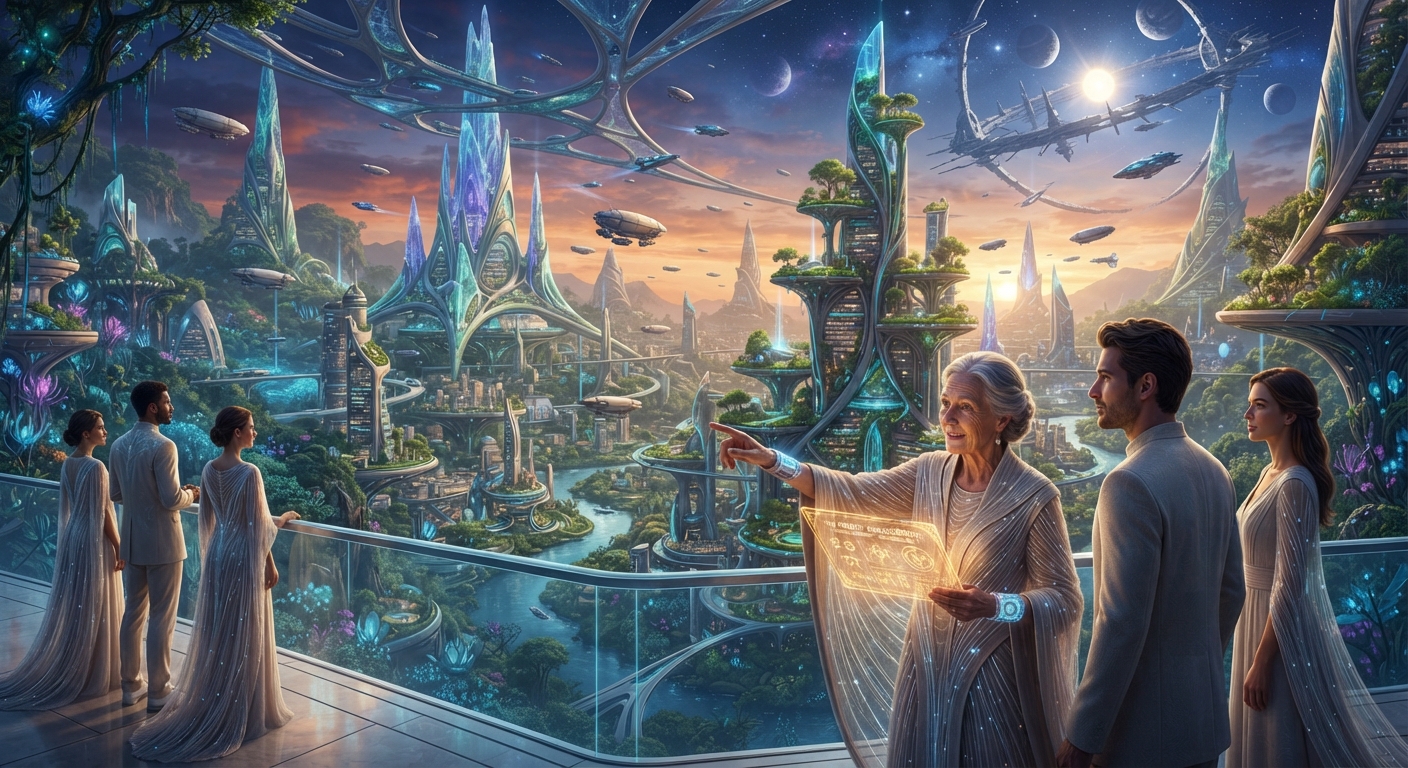
A futuristic exploration of the fourth technological advancement, human civilisation, artificial intelligence, quantum science, biotechnology, energy systems and the architecture of a highly advanced technological civilisation in the year 4004.
Futuristic research and conceptual thesis
Year 4004
The Future Unveiled: Life in 2500 | by Sven Piper | Medium
QAI – artificial intelligence running on a quantum computer
14
Abstract
What might the fourth major advancement of technology mean for humanity in the year 4004?
Imagine a civilisation in which artificial intelligence, quantum computing, advanced materials, biological sciences, autonomous infrastructure and space engineering have developed into one interconnected technological ecosystem.
By 4004, humanity might have progressed beyond today’s conventional understanding of computers, communication networks, industrial production, transportation and medicine.
However, there is an important distinction: 4004 is a speculative future, not a scientifically established prediction. We cannot know precisely what technology will exist almost two thousand years from now.
This thesis therefore develops a scientifically informed futuristic model, using existing scientific principles and plausible technological trajectories to explore what a fourth major technological advancement could look like.
The central argument is that the fourth advancement could represent a transition:
From intelligent machines to an integrated civilisation in which biological intelligence, artificial intelligence, physical systems and planetary infrastructure operate as one coordinated knowledge ecosystem.
PART I: Understanding the Four Major Technological Advancements
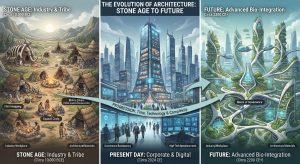
Chapter 1. The historical evolution of technology
To understand the possible fourth advancement, we must first understand the previous technological transformations.
mesopotamia at emaze Presentation
Weaving on Power Looms, Cotton Factory Floor, engraved by James Tingle c.1830
1800-1900 History Timeline and Biographies | History Timeline Generator
8
First advancement: Agricultural civilisation
Approximate period: 10,000 BCE onwards.
The first major transformation was the development of organised agriculture.
Its technological foundations included:
- Land cultivation.
- Irrigation systems.
- Animal domestication.
- Food storage.
- Early mathematics and accounting.
- Permanent settlements.
- Organised construction.
Its significance was the transformation of humanity from predominantly mobile communities into settled agricultural societies.
Second advancement: Industrial civilisation
Approximate period: 18th–20th centuries.
This advancement introduced mechanical production and large-scale industrialisation.
Its foundations included:
- Steam engines.
- Mechanical manufacturing.
- Electricity.
- Internal combustion engines.
- Railways.
- Chemical engineering.
- Mass production.
Its significance was the ability to produce goods at a scale that individual human labour could not achieve.
Third advancement: Digital and intelligent civilisation
Approximate period: 20th–21st centuries and beyond.
This advancement introduced the ability to process, store, transmit and analyse information electronically.
Its foundations include:
- Semiconductor processors.
- Computers.
- The internet.
- Artificial intelligence.
- Robotics.
- Cloud computing.
- Quantum computing research.
- Biotechnology and genetic engineering.
Its significance is that machines can increasingly process information, recognise patterns, automate tasks and assist scientific discovery.
Fourth advancement: Integrated intelligence civilisation
Hypothetical period: Future centuries through the year 4004.
This is the central subject of our thesis.
The proposed fourth advancement would integrate:
- Biological intelligence.
- Artificial intelligence.
- Quantum information processing.
- Advanced materials.
- Autonomous industrial systems.
- Advanced energy infrastructure.
- Planetary and space engineering.
- Scientific knowledge networks.
The important distinction is that these technologies would not simply exist independently. They would be designed to cooperate as a unified technological ecosystem.
PART II: The Architecture of Technology in 4004
Chapter 2. The proposed fourth technological ecosystem
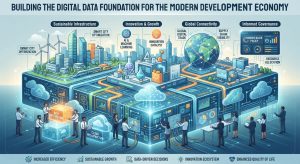
Imagine a civilisation organised around eight interconnected technological layers.
| Layer | Proposed technological function |
|---|---|
| 1. Intelligence | AI and advanced reasoning systems |
| 2. Computation | Quantum, optical and advanced computing |
| 3. Communication | High-capacity global and interplanetary networks |
| 4. Biology | Advanced medicine and biological engineering |
| 5. Energy | Highly efficient and sustainable energy systems |
| 6. Manufacturing | Autonomous molecular and advanced materials production |
| 7. Infrastructure | Intelligent cities and transportation |
| 8. Space systems | Planetary exploration and space infrastructure |
These layers would create a technological network in which information, energy, materials and knowledge could move between interconnected systems.
Chapter 3. Artificial intelligence: The central intelligence infrastructure
Claude Opus 5.5 costa il 40% in meno, va come Fable 5.1 – Tom’s Hardware
In the year 4004, artificial intelligence could potentially become the principal coordination technology across scientific, industrial and administrative systems.
Today’s AI systems can analyse information, recognise patterns, generate content and assist with complex reasoning.
Future systems might advance towards:
1. Scientific intelligence
- Discovering previously unknown mathematical relationships.
- Developing new scientific hypotheses.
- Simulating complex physical systems.
- Analysing astronomical observations.
- Supporting research into new materials.
2. Industrial intelligence
AI could coordinate manufacturing facilities, supply chains, energy distribution and infrastructure maintenance.
3. Environmental intelligence
Advanced systems could continuously analyse environmental conditions, biodiversity, water resources and climate patterns.
4. Educational intelligence
Education might become highly adaptive, with intelligent systems helping individuals understand mathematics, physics, engineering, economics and biological sciences.
5. Administrative intelligence
Intelligent infrastructure could support public administration, accounting, transportation planning and resource management.
An important principle would remain: AI should operate under appropriate human oversight, transparent governance and accountability.
Chapter 4. Quantum computing and the future of computation
Quantum computing is based on quantum mechanics, the science describing physical behaviour at atomic and subatomic scales.
Today’s conventional computers use bits, represented by 0 and 1.
Quantum computers use quantum bits, called qubits, which can exhibit superposition and entanglement.
A future civilisation might develop several complementary computing technologies:
| Computing technology | Potential purpose |
|---|---|
| Classical computing | General-purpose calculations |
| Quantum computing | Specialised quantum simulations and algorithms |
| Optical computing | Information processing using light |
| Neuromorphic computing | Brain-inspired information processing |
| Distributed computing | Coordinating large networks of computers |
By 4004, entirely new computing architectures might exist.
Possible applications include:
- Advanced molecular simulation.
- Complex mathematical modelling.
- Materials science.
- Scientific optimisation.
- Fundamental physics research.
However, quantum computers would not automatically replace classical computers. Different computing architectures would likely remain useful for different problems.
Chapter 5. The fourth communication revolution
深宇宙光通信:O2OがArtemis IIのデータリンクをどう変えたのか-ベッケ・テルコム
Communication is the nervous infrastructure of technological civilisation.
Consider the historical progression:
| Period | Communication technology |
|---|---|
| Ancient civilisation | Messengers, writing and signalling |
| 19th century | Telegraph and telephone |
| 20th century | Radio, television and satellites |
| 21st century | Internet, fibre optics, mobile networks |
| Hypothetical 4004 | Planetary and interstellar communication networks |
Possible technologies could include:
- Advanced optical communication.
- Autonomous communication satellites.
- Quantum communication networks for specialised applications.
- Planetary-scale information systems.
- Communication infrastructure between distant space settlements.
One fundamental physical limitation will remain important: information cannot travel faster than light through ordinary space.
Consequently, communication between distant star systems could involve significant delays, even in a highly advanced civilisation.
Chapter 6. Biotechnology and the future of biological science
MajesTEC-3 Results: A New Paradigm in Multiple Myeloma Therapy · Cancer Treatment Bulletin
Biotechnology could become one of the most important scientific foundations of the fourth advancement.
Its future development might involve:
A. Molecular biology
Understanding how molecules interact inside living systems.
B. Genetic research
Understanding genetic information, inherited characteristics and biological development.
C. Regenerative medicine
Developing improved approaches to tissue repair and treatment of damaged biological structures.
D. Cellular engineering
Studying how cells communicate, organise themselves and perform specialised functions.
E. Computational biology
Combining AI, mathematical modelling and biological data to understand complex living systems.
By 4004, medical science might have technologies that today’s researchers cannot yet imagine.
Nevertheless, future biological technologies would still need to respect biological complexity, safety and ethical principles.
Chapter 7. Energy architecture in the year 4004
Energy is the foundation of every technological civilisation.
Computers require electricity. Factories require energy. Transportation requires power. Communication systems require continuous energy supplies.
A future energy ecosystem might combine:
- Advanced solar energy.
- Nuclear fusion, if engineering challenges are overcome.
- Advanced nuclear fission.
- Geothermal energy.
- Energy storage systems.
- High-efficiency electrical transmission.
- Space-based energy collection.
The central challenge would not simply be generating more electricity. It would be managing energy production, storage, transmission, safety and environmental effects.
Chapter 8. Advanced materials and manufacturing
Manufacturing in 4004 might be fundamentally different from today’s industrial factories.
Possible developments include:
- Self-monitoring materials.
- Advanced composites.
- Programmable materials.
- Highly precise robotic manufacturing.
- Automated quality-control systems.
- Advanced recycling technologies.
- Materials designed through computational simulation.
The scientific foundations would include:
| Science | Manufacturing contribution |
|---|---|
| Chemistry | Molecular composition |
| Physics | Material properties |
| Mathematics | Structural calculations |
| Computer science | Design and simulation |
| Materials science | Strength, durability and functionality |
| Robotics | Automated production |
The greatest breakthrough might be the ability to design materials for specific purposes before producing them.
PART III: The Architecture of a Future Civilisation
Chapter 9. Intelligent cities and planetary infrastructure
SUGi Pocket Forests London | 2024 Impact Report | SUGi
Imagine a city in which its major infrastructure systems communicate and coordinate with one another.
Its architecture might include:
Transportation: Autonomous transport networks, advanced electric infrastructure and potentially new propulsion technologies.
Water: Intelligent monitoring, purification, recycling and distribution.
Agriculture: Highly controlled growing environments, precision agriculture and automated food production.
Construction: Advanced materials and automated building systems.
Public services: Integrated systems for education, health, emergency planning and administration.
Environmental management: Monitoring of air, water, soil and biodiversity.
The city would operate as a coordinated system rather than a collection of disconnected departments.
Chapter 10. Space exploration and interplanetary civilisation
Conquista Espacial Parte 1: 7 Tecnologias Espaciais que nos Separam da Exploração Interplanetária
By 4004, humanity might have established permanent settlements beyond Earth.
Potential developments include:
- Permanent lunar settlements.
- Research facilities on Mars.
- Large orbital habitats.
- Advanced space manufacturing.
- Robotic exploration of other planets.
- Long-duration space transportation.
- Scientific observation stations beyond the Solar System.
These are possibilities rather than established forecasts.
A major challenge would be protecting human life in environments with different gravity, radiation exposure, atmospheric conditions and resource limitations.
Chapter 11. The future of education and human capital
Your Next Teacher Might Be an AI Agent: How ChatGPT, Claude and Gemini Are Replacing Instructors
A highly advanced civilisation would require highly developed human knowledge.
Technology alone cannot guarantee civilisation’s progress. People need the intellectual ability to understand, govern, maintain and improve technological systems.
A future educational architecture might include ten foundational disciplines:
- Advanced mathematics.
- Physics and quantum science.
- Artificial intelligence.
- Computer engineering.
- Biological sciences.
- Chemistry and materials science.
- Economics and accounting.
- Logic and critical thinking.
- Ethics and governance.
- Environmental and planetary science.
Education might become continuous throughout life, with advanced learning systems adapting to individual knowledge and research interests.
The most important principle: technological advancement must be accompanied by human capital development.
PART IV: The Economic Architecture of 4004
Chapter 12. The transition towards an intelligent economy
Automation and Autonomous Supply Chains: The Future of Global Trade
The economy of 4004 might operate very differently from the economies of the 21st century.
Today’s economic systems depend on:
- Labour.
- Capital.
- Land.
- Technology.
- Natural resources.
- Manufacturing.
- Trade.
- Financial institutions.
- Knowledge.
In a hypothetical advanced civilisation, automated production and computational intelligence might significantly change how these resources are allocated.
Five possible economic transformations
1. Knowledge-based production
Scientific knowledge and intellectual innovation could become increasingly important economic resources.
2. Autonomous manufacturing
Factories could perform many production and quality-control functions with minimal direct intervention.
3. Advanced resource management
Mathematical optimisation could improve the allocation of materials, energy and infrastructure.
4. Interplanetary trade
If permanent space settlements become economically viable, trade could extend beyond Earth.
5. New economic institutions
Future societies might develop entirely new systems for ownership, resource distribution, taxation and economic accountability.
These changes would depend on political, legal and social decisions, not technology alone.
PART V: The Scientific Foundations of the Fourth Advancement
Chapter 13. The seven scientific disciplines behind the year 4004
The Fascinating World of Nihonium (Nh)
The fourth advancement would depend on the integration of several fundamental sciences.
| Scientific discipline | Contribution to civilisation |
|---|---|
| Mathematics | Measurement, prediction and optimisation |
| Physics | Understanding matter, energy and motion |
| Chemistry | Understanding molecular structures |
| Biology | Understanding living systems |
| Computer science | Information processing and automation |
| Engineering | Designing physical infrastructure |
| Astronomy | Understanding planets, stars and the universe |
These disciplines are interconnected.
For example, developing a future energy system would require physics to understand energy, chemistry to develop materials, mathematics to calculate performance, computer science to coordinate operations and engineering to construct the infrastructure.
This is the scientific foundation of technological integration.
Chapter 14. Mathematical methodology for predicting technological progress
Can mathematics help us think about technological advancement over thousands of years?
Yes. Although mathematics cannot reliably predict the exact inventions of 4004, it can help us model possible development patterns.
One useful model is technological capability growth:
\[ T(t)=T_0e^{kt} \]
Where:
- \(T(t)\) = technological capability at time \(t\).
- \(T_0\) = initial technological capability.
- \(k\) = assumed growth parameter.
- \(t\) = elapsed time.
However, exponential growth cannot continue indefinitely in every technological field. Physical limitations, economic resources, materials, energy requirements and social institutions constrain development.
A more realistic illustrative model is logistic growth:
\[ T(t)=\frac{K}{1+Ae^{-kt}} \]
Where:
- \(K\) = theoretical capability limit within the model.
- \(A\) = initial-condition parameter.
- \(k\) = assumed growth rate.
This model illustrates how a technology might develop rapidly before approaching practical limitations.
It is not a forecast of humanity’s actual technological capability in 4004.
Chapter 15. The four major challenges of an advanced civilisation
An advanced technological civilisation would not automatically be a successful civilisation.
It would face fundamental challenges.
1. Technological governance
Who controls powerful artificial intelligence systems? How are decisions audited? How are errors corrected?
2. Energy and resource sustainability
How can advanced infrastructure operate without exhausting the resources upon which civilisation depends?
3. Cybersecurity and system resilience
How can interconnected infrastructure remain reliable when individual components fail?
4. Human responsibility
How can societies ensure that technological progress improves education, opportunity, dignity and human wellbeing?
The quality of civilisation would depend not only on technological capability but also on how responsibly that capability is used.
PART VI: A Hypothetical Timeline Towards 4004
Chapter 16. The long technological journey
The following is an illustrative scenario, not a prediction of specific discoveries.
A possible technological development timeline
- 2026–2100: Advanced digital civilisationAI, robotics, biotechnology, quantum computing research, clean energy and advanced semiconductor systems.
- 2100–2300: Integrated industrial intelligencePotentially extensive autonomous manufacturing, advanced medicine and interconnected infrastructure.
- 2300–2600: Advanced planetary civilisationPossible development of sophisticated planetary infrastructure, large-scale space settlements and advanced resource management.
- 2600–3000: Expanded space civilisationPotentially permanent settlements beyond Earth and new scientific and industrial capabilities.
- 3000–3500: Advanced scientific integrationPossible convergence of advanced computation, biological research, materials science and planetary engineering.
- 3500–4004: Hypothetical fourth technological advancementAn integrated civilisation built around intelligence, scientific knowledge, energy, autonomous infrastructure and potentially interplanetary or interstellar activities.
PART VII: The Ten Most Important Innovations That Could Define 4004
Hybrid Quantum Computing in 2026: The Future of Enterprise AI
Commercial Breakthrough: Helion Energy Achieves Sustained… | FuturEdge
Technospheres: Alien technology revealed by exoplanet oxygen – Earth.com
6
| No. | Hypothetical innovation | Potential significance |
|---|---|---|
| 1 | Advanced artificial intelligence | Scientific and administrative intelligence |
| 2 | New computing architectures | Advanced information processing |
| 3 | Autonomous scientific laboratories | Accelerated research |
| 4 | Advanced biological medicine | Improved understanding and treatment of disease |
| 5 | High-performance energy systems | Sustainable industrial development |
| 6 | Programmable materials | New engineering capabilities |
| 7 | Planetary infrastructure | Integrated environmental and industrial management |
| 8 | Advanced space transportation | Exploration beyond Earth |
| 9 | Interplanetary communication | Information exchange across space settlements |
| 10 | Integrated knowledge networks | Coordinated scientific and educational development |
PART VIII: The Fundamental Difference Between Today’s Technology and the Fourth Advancement
Chapter 17. From individual machines to integrated intelligence
Consider the following comparison:
21st-century technological architecture
ComputersInformation processing
FactoriesIndustrial production
NetworksCommunication
LaboratoriesScientific research
Hypothetical 4004 architecture
Integrated intelligence ecosystem
A coordinated architecture connecting scientific knowledge, computation, biological systems, energy, manufacturing and infrastructure.
Scientific discovery
Advanced production
Planetary infrastructure
Space exploration
The fundamental difference would be the degree of integration.
Today’s technology often requires separate systems to perform separate functions. A future integrated architecture might coordinate multiple scientific and industrial systems through shared information and intelligent management.
PART IX: Research Questions for the Millennium 4004
A serious futuristic research programme should investigate the following questions:
- Can artificial intelligence eventually develop new scientific theories independently of existing human knowledge?
- What physical limitations will determine the future of computation?
- Can humanity develop sustainable energy infrastructure on a planetary scale?
- How will biological science change our understanding of living systems?
- Could advanced materials transform construction and manufacturing?
- How might intelligent cities coordinate millions of interconnected systems?
- Could humanity establish sustainable settlements on other planets?
- What economic systems might emerge when automation becomes highly advanced?
- How can technological governance protect human rights and accountability?
- What new scientific discoveries could fundamentally change civilisation?
These questions form the basis of a long-term scientific research agenda.
Conclusion: The Fourth Advancement as a New Era of Human Civilisation
The hypothetical fourth advancement of technology in the Millennium 4004 represents an ambitious vision of civilisation.
Its most important characteristic would not necessarily be the invention of a more powerful computer, a faster spacecraft or a more advanced robot.
It would be the integration of scientific knowledge into a coordinated technological ecosystem.
Artificial intelligence could support scientific discovery. Quantum and optical computing could contribute specialised computational capabilities. Biotechnology could deepen our understanding of living systems. Advanced energy infrastructure could support industrial development. Space engineering could potentially extend human activity beyond Earth.
But one principle must remain central:
Technology is a means of advancing civilisation, not the ultimate purpose of civilisation.
A genuinely advanced civilisation should be measured by its scientific knowledge, educational development, economic sustainability, environmental responsibility, ethical standards and ability to improve human wellbeing.
The year 4004 is therefore an opportunity to think beyond today’s technological limitations and ask what humanity could responsibly build over many centuries.
Recommended scientific foundation for further research
These existing scientific and historical works provide a starting point for investigating the technologies discussed:
- The Structure of Scientific Revolutions — Thomas Kuhn.
- The Feynman Lectures on Physics — Richard Feynman and colleagues.
- The Computer and the Brain — John von Neumann.
- The Information — James Gleick.
- Life 3.0 — Max Tegmark.
- The Singularity Is Near — Ray Kurzweil.
Final research proposition: The most significant invention of the Millennium 4004 might not be a single machine. It might be an entirely new architecture for organising intelligence, scientific knowledge, energy, materials and civilisation.

Be First to Comment