
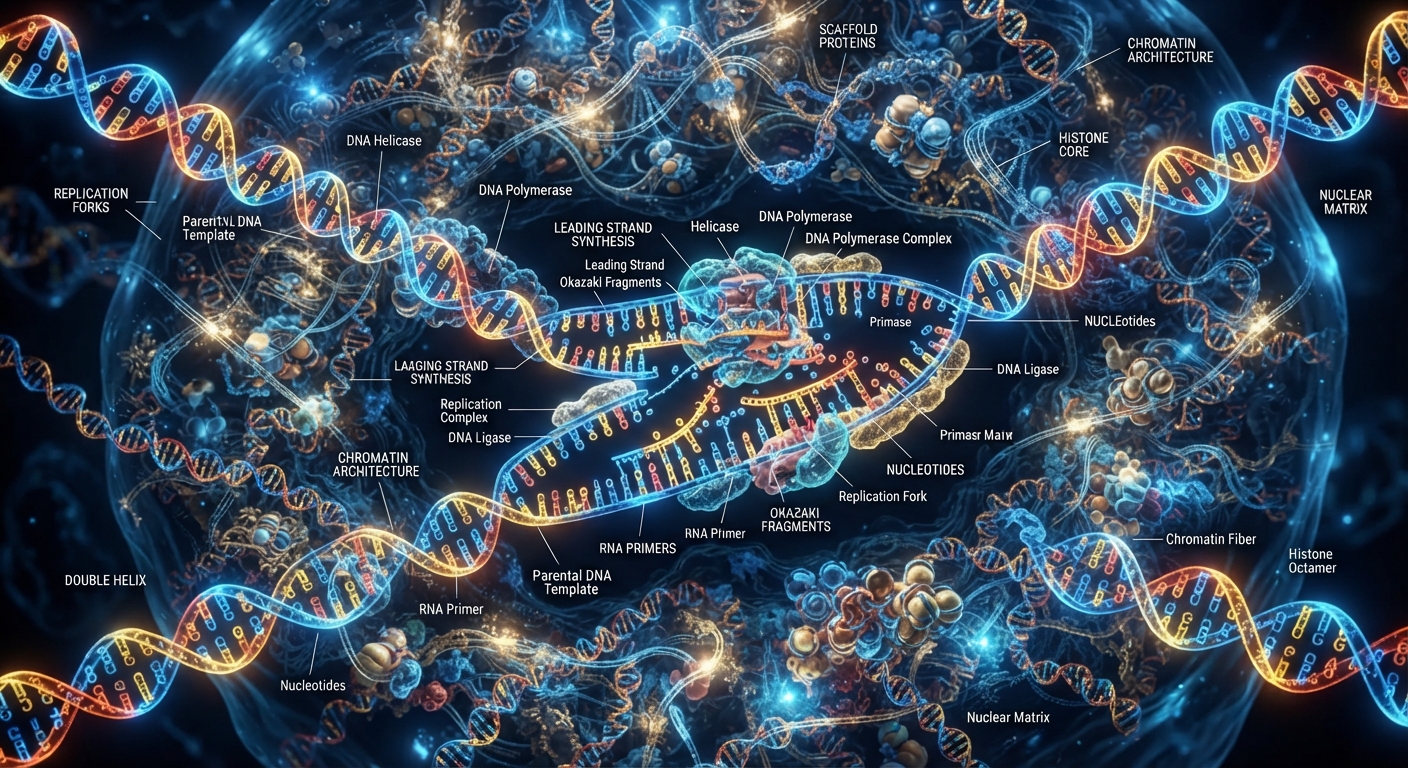
COMPREHENSIVE SCIENTIFIC THESIS
File:DNA Structure+Key+Labelled.png – Wikimedia Commons
Cell to Nucleus to Chromosome to DNA Representation | AI Art Generator | Easy-Peasy.AI
Biochemistry Series Part 9: Nucleic Acids & Gene Expression – Wasil Zafar
8
1. Introduction: Understanding the microscopic architecture of human DNA
Human DNA (Deoxyribonucleic Acid) is one of the most sophisticated biological information-storage systems known to science.
It carries the genetic instructions required to construct, maintain, repair and reproduce the cells that make up the human body.
Every day, enormous numbers of cells in the human body perform activities that depend on DNA. Some cells divide to replace old or damaged cells, while others remain specialised and perform their functions without dividing frequently.
The remarkable feature of DNA is that it can be copied with extraordinary accuracy through a molecular process called DNA replication.
DNA replication is the biological process through which a cell makes a copy of its genetic material before cell division.
To understand this process, we must investigate several levels of biological architecture:
- The chemical structure of DNA.
- The microscopic organisation of chromosomes.
- The molecular machinery responsible for replication.
- The sequence of events during DNA copying.
- The mechanisms that detect and correct errors.
- The relationship between DNA replication and human survival.
- The importance of DNA replication in medicine, biotechnology and modern scientific research.
The central scientific question is:
How can microscopic molecular machines accurately reproduce approximately three billion DNA base pairs in a human cell?
2. The complete architecture of human DNA
What’s new in biology: September 2025
DNA is organised hierarchically, from extremely small chemical components into large structures visible under specialised microscopes.
The organisation follows this sequence:
Nucleotide
Individual chemical building block
DNA double helix
Two complementary strands
Nucleosomes
DNA wrapped around histone proteins
Chromatin
Organised DNA and protein material
Chromosome
Highly organised genetic structure
Cell nucleus
Contains most of the human cell’s DNA
A typical human body cell contains:
- 46 chromosomes arranged into 23 pairs.
- Approximately 3.2 billion DNA base pairs in its haploid genome.
- Approximately 6.4 billion base pairs across its two chromosome sets.
- Thousands of genes, alongside extensive regulatory and other non-coding DNA sequences.
There are also small amounts of DNA inside mitochondria, the energy-producing structures of cells.
3. The chemical architecture: What is DNA made of?
3 Parts of a Nucleotide and How They Are Connected
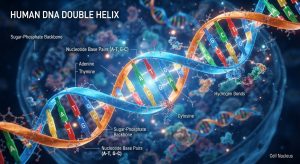
DNA is a biological polymer constructed from repeating units called nucleotides.
Each nucleotide consists of three components:
| Component | Function |
|---|---|
| Phosphate group | Connects neighbouring nucleotides |
| Deoxyribose sugar | Forms part of the DNA structural backbone |
| Nitrogenous base | Stores genetic information |
There are four principal nitrogenous bases.
| Base | Letter | Complementary partner |
|---|---|---|
| Adenine | A | Thymine (T) |
| Thymine | T | Adenine (A) |
| Guanine | G | Cytosine (C) |
| Cytosine | C | Guanine (G) |
These complementary relationships are fundamental to DNA replication.
For example:
Original DNA sequence:
A – T – G – C – C – A
Complementary sequence:
T – A – C – G – G – T
The complementary structure allows each original strand to act as a template for building a new strand.
This is the foundation of biological DNA copying.
4. The double-helix architecture
SciFig Tutorials: Learn the AI Scientific Figure Generator
The DNA molecule has a double-helical structure, famously described by James Watson and Francis Crick in 1953, building on crucial experimental evidence produced by Rosalind Franklin, Maurice Wilkins and others.
Its two strands have three important characteristics:
A. Complementary: Adenine pairs with thymine, while guanine pairs with cytosine.
B. Antiparallel: The two strands run in opposite chemical directions, one 5′ to 3′ and the other 3′ to 5′.
C. Helical: The two strands twist around one another to form a stable molecular structure.
The chemical bonds along each strand form a strong structural backbone, while hydrogen bonds between complementary bases help hold the two strands together.
The double helix is particularly important because its two complementary strands make accurate genetic copying possible.
5. Microscopic DNA replication: The biological copying system
Biology: DNA Replication Infographic | LivePhysics™
DNA replication is the process by which a cell duplicates its DNA before it divides.
It is called semiconservative replication because each newly produced DNA molecule contains:
- One original DNA strand.
- One newly synthesised complementary DNA strand.
This means the original genetic information is preserved in both resulting DNA molecules.
5.1 The three major stages of DNA replication
DNA replication can be divided into three broad stages:
PCR (Polymerase Chain Reaction), bukan pacar!
Stage 1: Initiation
The replication machinery assembles at specific DNA regions called origins of replication. The DNA strands become separated.
File:DNA replication en.svg – Wikimedia Commons
Stage 2: Elongation
DNA polymerases construct new complementary DNA strands using the original strands as templates.
DNA Structure & Replication: The Code of Life and How It Copies Itself — Texas CBE™
Stage 3: Termination
Replication is completed, remaining discontinuities are processed, and the resulting DNA molecules are separated and organised.
Let’s examine the microscopic machinery responsible for these processes.
6. The molecular machinery: The biological replication factory
DNA replication is not performed by one molecule. It requires a coordinated collection of specialised proteins and enzymes.
These molecular components operate together as a sophisticated biological production system.
Organization of DNA Replication
6.1 Helicase: The DNA strand separator
Helicase is an enzyme responsible for separating the two DNA strands.
Its importance is that DNA cannot be copied accurately while the original complementary strands remain tightly paired.
Helicase uses energy from ATP hydrolysis to support DNA unwinding.
Its main functions include:
- Separating the two DNA strands.
- Creating the replication fork.
- Allowing other replication proteins to access the exposed DNA.
- Supporting the progression of the replication machinery.
Think of helicase as the opening mechanism of a biological information-storage system.
6.2 Topoisomerase: Managing DNA twisting
When DNA is unwound, twisting tension develops in the DNA ahead of the replication machinery.
Topoisomerases help manage this mechanical tension.
They temporarily alter DNA connectivity to relieve excessive twisting and prevent damaging structural stress.
Their importance is maintaining the physical organisation of DNA during replication.
6.3 Single-strand binding proteins
After the DNA strands separate, they can naturally rejoin or form unwanted structures.
Replication protein A (RPA), the major single-strand DNA-binding protein in human cells, stabilises exposed DNA.
Its functions include:
- Protecting single-stranded DNA.
- Preventing premature re-pairing.
- Supporting replication proteins.
- Helping coordinate DNA repair responses.
6.4 Primase: Establishing a starting point
DNA polymerases cannot normally begin constructing a DNA strand entirely from nothing.
They require an existing starting point.
The enzyme primase helps solve this problem by producing a short RNA primer.
In human cells, DNA polymerase alpha works with primase to produce an RNA-DNA starter segment.
This provides a suitable starting structure for further DNA synthesis.
6.5 DNA polymerase: The genetic copying enzyme
Ch. 16 The Molecular Basis of Inheritance Dynamic Study Module Flashcards – Easy Notecards
DNA polymerase is one of the most important enzymes in molecular biology.
Its primary responsibility is to construct new DNA strands by adding complementary nucleotides.
For example:
- If the template contains A, the new strand receives T.
- If the template contains T, the new strand receives A.
- If the template contains G, the new strand receives C.
- If the template contains C, the new strand receives G.
In human nuclear DNA replication, the principal polymerases include:
| Polymerase | Principal function |
|---|---|
| DNA polymerase alpha | Initiates new DNA synthesis with primase |
| DNA polymerase epsilon | Primarily synthesises the leading strand |
| DNA polymerase delta | Primarily synthesises the lagging strand |
| DNA polymerase gamma | Replicates mitochondrial DNA |
These enzymes have different responsibilities, although their activities are coordinated.
6.6 Sliding clamp: Maintaining polymerase attachment
The human sliding clamp is called PCNA (Proliferating Cell Nuclear Antigen).
It forms a ring-like structure around DNA and helps keep DNA polymerases associated with the DNA template.
This increases the efficiency and continuity of DNA synthesis.
PCNA also participates in coordinating other processes, including DNA repair.
6.7 RNase H and FEN1: Removing RNA primers
RNA primers are temporary starting materials.
They must be removed and replaced with DNA.
Human cells use several proteins to process these primer-containing regions.
Important examples include:
- RNase H enzymes.
- Flap endonuclease 1 (FEN1).
- DNA polymerase delta.
Together, they help process primer-containing DNA intermediates.
6.8 DNA ligase: Connecting DNA fragments
The Structure of DNA | by Ron Vale
DNA ligase is responsible for sealing breaks in the DNA sugar-phosphate backbone.
It is particularly important during lagging-strand synthesis, where separate DNA fragments must become one continuous strand.
The enzyme helps form the necessary chemical bonds to join these fragments.
Without proper ligation, the newly synthesised DNA would contain unfinished connections.
7. Leading and lagging strands: Two different copying arrangements
One of the most interesting characteristics of DNA replication is that the two strands are copied differently.
This happens because DNA polymerases synthesise DNA only in the 5′ to 3′ direction.
File:DNA replication en.svg – Wikimedia Commons
7.1 Leading strand
The leading strand is synthesised continuously in the direction of replication-fork movement.
Its copying process requires an initial primer, after which DNA polymerase can continue adding nucleotides.
7.2 Lagging strand
The lagging strand is synthesised discontinuously.
It is produced as short sections called Okazaki fragments.
These fragments are subsequently processed and joined together.
| Characteristic | Leading strand | Lagging strand |
|---|---|---|
| Synthesis | Continuous | Discontinuous |
| DNA direction | 5′ to 3′ | 5′ to 3′ |
| Priming | Generally one initial primer per replication unit | Multiple primers |
| Fragments | No Okazaki fragments | Okazaki fragments |
| Joining | No repeated fragment joining | Requires DNA ligase |
An important distinction: both new strands are always synthesised in the 5′ to 3′ direction. Their different arrangements arise from the antiparallel structure of the original DNA.
8. The replication origins: Where copying begins
Human DNA molecules are extremely long.
A human chromosome cannot efficiently be replicated by relying on a single starting location.
Instead, multiple origins of replication are activated across chromosomes.
PPT – DNA Structure: Nucleotides and Replication Mechanism PowerPoint Presentation – ID:6102287
Each activated origin can establish a replication bubble.
Two replication forks generally develop from an activated origin and progress in opposite directions.
This arrangement allows large quantities of DNA to be copied during the limited time available in the cell cycle.
The process is carefully controlled so that each region of the nuclear genome is normally replicated once during a cell cycle.
9. The cell cycle: When DNA replication happens
DNA replication is part of a larger biological process called the cell cycle.
Cell Cycle | BioRender Science Templates
The cell cycle contains four principal stages.
| Stage | Biological activity |
|---|---|
| G1 phase | Cell grows and performs normal functions |
| S phase | DNA replication takes place |
| G2 phase | Cell prepares for division and checks its DNA |
| M phase | Cell divides through mitosis and cytokinesis |
The S phase is particularly important because this is when the nuclear DNA is duplicated.
The cell does not simply copy its DNA without regulation. Complex molecular control systems help coordinate replication with cell growth, DNA integrity and eventual cell division.
10. Microscopic accuracy: How DNA corrects copying mistakes
PPT – Nucleic Acids and Protein Synthesis PowerPoint Presentation, free download – ID:2972840
DNA replication is highly accurate, but it is not absolutely perfect.
Mistakes can occur when incorrect nucleotides are incorporated or when DNA becomes damaged.
Human cells have several protective mechanisms.
10.1 Polymerase proofreading
Some DNA polymerases can recognise an incorrectly incorporated nucleotide.
They use an exonuclease activity to remove the incorrect nucleotide and allow synthesis to continue.
10.2 Mismatch repair
Mismatch repair detects certain errors that remain after DNA synthesis.
It helps identify and correct incorrectly paired bases and small insertion or deletion errors.
Important human mismatch-repair proteins include:
- MSH2.
- MSH6.
- MLH1.
- PMS2.
These proteins work together in recognising and coordinating the repair of DNA mismatches.
10.3 DNA damage repair
DNA can also be damaged by ordinary cellular metabolism and environmental factors.
Cells possess several repair pathways, including:
- Base excision repair.
- Nucleotide excision repair.
- Double-strand break repair.
- Homologous recombination.
These mechanisms help maintain the stability of genetic information.
10.4 Cell-cycle checkpoints
Cells also use regulatory systems to detect replication problems and DNA damage.
These checkpoints can delay cell-cycle progression while the cell coordinates appropriate responses.
This is essential because copying damaged DNA without appropriate control can contribute to genomic instability.
11. The microscopic mathematics of DNA replication
DNA replication is not only a biological process. It can also be understood through mathematics, physics, chemistry and information theory.
These disciplines help explain how DNA stores information, how quickly it is copied and how accurately genetic information is preserved.
11.1 The mathematical scale of human DNA
Consider a typical diploid human cell.
| Measurement | Approximate value |
|---|---|
| Haploid genome | 3.2 billion base pairs |
| Diploid genome | 6.4 billion base pairs |
| Chromosomes in a typical diploid cell | 46 |
| DNA strands in a diploid genome | 92 |
| DNA bases in a diploid genome | 12.8 billion |
These are approximate figures. Actual genome size varies slightly between individuals and depends on the cell type.
11.2 The information-storage capacity
DNA stores information using four chemical letters:
A, T, G and C.
Mathematically, four possible symbols can represent:
\[ \log_2(4)=2\text{ bits} \]
Therefore, a simplified representation of a 3.2-billion-base-pair haploid genome contains:
\[ 3.2 \times 10^9 \times 2 \]
\[ =6.4 \times 10^9 \text{ bits} \]
This is approximately 800 megabytes of theoretical base-sequence information.
This calculation describes the sequence itself, not the complete biological information system. It does not capture all the regulatory, chemical and structural mechanisms that determine how genes operate.
11.3 DNA replication speed
DNA replication occurs through many simultaneously operating replication forks.
This parallel arrangement is important because a human genome contains billions of base pairs.
A simplified mathematical relationship is:
\[ T=\frac{N}{R} \]
Where:
- \(T\) = replication time.
- \(N\) = quantity of DNA to be copied.
- \(R\) = combined copying rate of all active replication machinery.
In reality, replication is more complicated because replication origins activate at different times, replication forks encounter obstacles, and different genomic regions have different replication characteristics.
11.4 The physical dimensions of DNA
The diameter of the standard DNA double helix is approximately 2 nanometres.
One complete turn of the helix is approximately 3.4 nanometres long and contains approximately 10 base pairs.
Omega deoxyribonucleic acid cryptography key-based authentication | Scientific Reports
This is a remarkable example of how an extremely small molecular structure can store enormous quantities of biological information.
12. Telomeres: Protecting chromosome ends
Telomere Biology and Chromosomal End Protection in Cellular Research
Human chromosomes have specialised structures called telomeres at their ends.
Telomeres contain repeated DNA sequences and associated proteins.
Their principal functions include:
- Protecting chromosome ends.
- Preventing chromosome ends from being incorrectly recognised as broken DNA.
- Supporting chromosome stability.
- Participating in cellular ageing mechanisms.
12.1 Why telomeres matter during replication
The replication machinery cannot completely reproduce the very ends of linear chromosomes using ordinary DNA replication mechanisms.
This is known as the end-replication problem.
Over many cell divisions, telomeres can become shorter in many types of human cells.
12.2 Telomerase
Telomerase is an enzyme complex that helps extend telomeric DNA.
It contains:
- A protein component called TERT.
- An RNA component called TERC.
The RNA provides a template used by telomerase to extend telomere DNA.
Telomerase activity is particularly important in certain stem cells and reproductive cells. It is also frequently reactivated in cancer cells.
This makes telomere biology an important field in research on ageing, cellular reproduction and cancer.
13. Mitochondrial DNA replication: A second genetic system
Biological anatomy of mitochondria
Most human DNA is stored inside the nucleus, but mitochondria also contain their own genetic material.
Mitochondrial DNA (mtDNA) differs from nuclear DNA in several important ways.
| Characteristic | Nuclear DNA | Mitochondrial DNA |
|---|---|---|
| Location | Cell nucleus | Mitochondria |
| Structure | Linear chromosomes | Usually circular DNA |
| Genome size | Approximately 3.2 billion base pairs per haploid set | Approximately 16,569 base pairs |
| Main replication polymerase | Several specialised nuclear polymerases | DNA polymerase gamma |
| Inheritance | From both parents | Usually maternal |
Mitochondrial DNA contains 37 genes:
- 13 genes encoding proteins involved in oxidative phosphorylation.
- 22 transfer RNA genes.
- 2 ribosomal RNA genes.
These genes help mitochondria perform their energy-related functions.
Why mitochondrial replication is important
Mitochondria must maintain and reproduce their genetic material as the cell grows and mitochondria divide.
Defects in mitochondrial DNA maintenance can affect energy production, particularly in tissues with high energy requirements.
Examples include muscle tissue, heart tissue and parts of the nervous system.
14. DNA replication versus DNA transcription
These two processes are related, but they perform different functions.
DNA Replication vs. Transcription: MCAT Key Differences You Must Know — King of the Curve
| Feature | DNA replication | DNA transcription |
|---|---|---|
| Purpose | Copies DNA | Produces RNA |
| Main enzyme | DNA polymerases | RNA polymerases |
| Product | DNA | RNA |
| Template | Both original DNA strands in replication | A selected DNA strand for a particular gene |
| Biological significance | Genome duplication | Gene expression |
Replication copies the genome before cell division.
Transcription uses selected sections of DNA to produce RNA molecules that participate in gene expression and other cellular processes.
This distinction is fundamental to understanding molecular biology.
15. DNA replication and protein production
DNA does not directly manufacture proteins by itself.
Instead, genetic information is used through a coordinated biological process.
Chapter: Transcription & Translation — The Biology Primer
The process is often represented as:
DNA
Stores genetic instructions
TRANSCRIPTION
Messenger RNA (mRNA)
Carries a genetic message
TRANSLATION
Protein
Performs a biological function
Proteins are essential components of human life.
They contribute to:
- Muscle structure and movement.
- Enzyme activity.
- Immune-system functions.
- Hormone signalling.
- Cellular transport.
- Tissue repair.
- Communication between cells.
DNA replication preserves the genetic instructions needed for the continuity of these biological systems.
16. Epigenetics: Why identical DNA can produce different cells
An especially interesting scientific discovery is that almost all ordinary nucleated cells in one person’s body contain essentially the same nuclear DNA, yet they perform very different functions.
For example:
- A neuron transmits electrical and chemical signals.
- A muscle cell contracts.
- A liver cell processes nutrients and chemicals.
- A skin cell contributes to the protective outer barrier.
How can cells with almost identical DNA behave so differently?
One major explanation is epigenetics.
Frontiers | A review of cytokine-based pathophysiology of Long COVID symptoms
Epigenetics involves chemical and structural modifications that influence gene activity without changing the underlying DNA sequence.
Important mechanisms include:
- DNA methylation.
- Histone modifications.
- Chromatin organisation.
- Regulatory RNA molecules.
These systems influence which genes are active, when they are active and how strongly they are expressed.
Some epigenetic information is maintained through cell divisions, helping specialised cells preserve their identity.
This is why DNA replication is not simply copying chemical letters. The cell must also manage the organisation and regulation of its genetic material.
17. What happens when DNA replication goes wrong?
DNA replication must be carefully controlled.
Errors that escape correction can become permanent mutations.
A mutation is a change in the DNA sequence.
Mutations can have different consequences:
| Mutation category | Possible consequence |
|---|---|
| Silent mutation | No change to the encoded amino acid |
| Missense mutation | Changes an amino acid |
| Nonsense mutation | Introduces an early stop signal |
| Insertion | Adds DNA sequence |
| Deletion | Removes DNA sequence |
| Structural rearrangement | Changes chromosome organisation |
Not every mutation is harmful.
Some have little or no detectable effect. Others can alter protein function or gene regulation, while a small proportion can contribute to inherited disorders or cancer.
17.1 DNA replication and cancer
Cancer is a complex disease involving changes in cellular growth regulation.
Mutations affecting genes that control cell division, DNA repair and cellular survival can contribute to cancer development.
Three important categories of genes are:
- Proto-oncogenes: genes that normally help regulate cell growth.
- Tumour suppressor genes: genes that help control cell division and maintain cellular stability.
- DNA repair genes: genes that help maintain the integrity of genetic information.
When critical regulatory systems become disrupted, cells may acquire abnormal growth characteristics.
This explains why accurate DNA replication and DNA repair are so important to human health.
18. DNA replication and human survival
DNA replication is fundamental to the maintenance and development of the human body.
It supports several major biological activities.
Human embryonic development in human
Ciltacabtagene Autoleucel in High-Risk Smoldering Myeloma – Be part of the knowledge – ReachMD
7
18.1 Growth and development
From the earliest stages of embryonic development, cells divide repeatedly.
Each division requires the genetic material to be copied and distributed to the resulting cells.
This supports the development of organs, tissues and body structures.
18.2 Tissue maintenance
Many tissues continually replace cells.
Examples include:
- Skin.
- Intestinal lining.
- Blood-forming tissues in bone marrow.
DNA replication enables the production of new cells needed for tissue maintenance.
18.3 Wound healing
When tissue is injured, cellular repair processes become active.
Depending on the tissue, cell division contributes to replacing damaged or lost cells.
DNA replication makes these new cells possible.
18.4 Immune-system development
DNA replication supports the multiplication of immune cells.
For example, when certain lymphocytes recognise an appropriate immune target, they can undergo clonal expansion, producing many cells with related recognition properties.
18.5 Reproductive biology
DNA replication is necessary for the production of cells involved in reproduction.
However, reproductive cells undergo specialised processes, including meiosis, which reduces chromosome number and introduces genetic variation.
19. Scientific technologies that study DNA replication
Modern science has developed several technologies to investigate DNA at microscopic and molecular levels.
PPT – DNA replication PowerPoint Presentation, free download – ID:3696684
Sequencing Analysis and Resource Dissemination (SARD) Core | TMC-GCID
8
| Technology | What it helps scientists investigate |
|---|---|
| Electron microscopy | Visualising extremely small biological structures |
| Cryo-electron microscopy | Investigating the structures of molecular machines |
| DNA sequencing | Reading the order of DNA bases |
| PCR | Amplifying selected DNA sequences |
| Fluorescence microscopy | Observing labelled molecules inside cells |
| X-ray crystallography | Determining molecular structures |
| Mass spectrometry | Analysing proteins and other molecules |
| Single-cell sequencing | Studying genetic differences between individual cells |
19.1 PCR: An important DNA-copying technology
Polymerase chain reaction (PCR) is a laboratory technique that produces many copies of a selected DNA region.
It uses repeated temperature-controlled stages and a DNA polymerase enzyme.
PCR is different from natural DNA replication:
- Natural replication duplicates the genome inside cells.
- PCR amplifies selected DNA sequences in laboratory equipment.
PCR has important applications in medical diagnostics, biological research, forensic science and infectious disease investigations.
19.2 DNA sequencing
DNA sequencing determines the order of nucleotide bases.
It enables researchers to investigate:
- Genetic variation.
- Inherited conditions.
- Evolutionary relationships.
- Cancer-associated mutations.
- Gene structure.
- Population genetics.
Sequencing has transformed modern biological research because scientists can examine genetic information at increasingly large scales.
20. The relationship between DNA replication and other scientific disciplines
Understanding DNA replication requires knowledge from several branches of science.
| Scientific discipline | Contribution to DNA replication |
|---|---|
| Molecular biology | Studies DNA and replication proteins |
| Biochemistry | Explains enzymes and chemical reactions |
| Genetics | Explains inheritance and genetic variation |
| Physics | Explains molecular forces and movement |
| Mathematics | Models copying rates and error frequencies |
| Information theory | Explains genetic information storage |
| Computer science | Supports genome analysis and sequence comparison |
| Biotechnology | Applies DNA knowledge to scientific and medical technologies |
| Cell biology | Explains replication within the cell cycle |
20.1 Physics and DNA
DNA replication depends on physical interactions.
Examples include:
- Hydrogen bonding between complementary bases.
- Molecular recognition between enzymes and DNA.
- Electrostatic interactions.
- Thermal motion of molecules.
- Mechanical forces associated with DNA unwinding.
- Chemical energy from ATP hydrolysis.
These interactions enable molecular components to coordinate their activities.
20.2 Biochemistry and DNA
Biochemistry explains how enzymes accelerate reactions.
DNA polymerases, helicases, ligases and other replication proteins depend on carefully controlled chemical environments.
The cell supplies energy and chemical building blocks to support these reactions.
20.3 Mathematics and DNA
Mathematical models allow scientists to investigate:
- Genome size.
- Replication timing.
- DNA sequence variation.
- Mutation frequencies.
- Replication-fork behaviour.
- Genetic inheritance.
This creates an opportunity to combine biological knowledge with computational mathematics.
21. The future of DNA replication research
Công nghệ gen đã giúp người Việt tốt hơn như thế nào?
CRISPR-Cas9: Transformations in Gene Editing | AmBioTech
Generative AI Protein Design: RFdiffusion and ProteinMPNN | Technology Networks
8
Several research areas are expanding our understanding of DNA and its replication.
1. Artificial intelligence in genomics
AI can help researchers analyse enormous genetic datasets, identify patterns and investigate relationships between genetic variations and biological characteristics.
2. DNA repair research
Scientists are investigating how cells identify DNA damage and how repair systems maintain genomic stability.
3. Cancer research
Understanding replication errors and DNA repair deficiencies helps researchers investigate cancer development and treatment responses.
4. Regenerative medicine
Stem-cell research investigates how specialised cells can develop and how tissues maintain or restore their functions.
5. Genome sequencing
Increasingly sophisticated sequencing technologies allow scientists to investigate genetic variation at unprecedented scales.
6. Molecular medicine
Research into DNA replication proteins may help identify new therapeutic targets for certain diseases.
An important distinction is that understanding or modifying DNA does not automatically guarantee a safe or successful medical outcome. Genetic interventions require extensive scientific validation and appropriate medical oversight.
22. Complete architecture of DNA replication: Master summary
DNA Replication Diagram Generator — Labeled & Blank | SciFig
The following table brings together the major molecular components and their biological responsibilities.
| Molecular component | Primary responsibility |
|---|---|
| DNA | Stores genetic information |
| Nucleotide | Provides DNA building blocks |
| Helicase | Separates DNA strands |
| Topoisomerase | Manages DNA twisting tension |
| RPA | Stabilises exposed DNA strands |
| Primase | Produces RNA primers |
| DNA polymerase alpha | Initiates DNA synthesis |
| DNA polymerase epsilon | Primarily copies the leading strand |
| DNA polymerase delta | Primarily copies the lagging strand |
| PCNA | Supports polymerase attachment |
| RNase H | Participates in RNA primer removal |
| FEN1 | Processes primer-associated DNA structures |
| DNA ligase | Joins DNA fragments |
| Mismatch repair proteins | Correct certain copying errors |
| Telomerase | Extends chromosome telomeres |
| DNA polymerase gamma | Replicates mitochondrial DNA |
23. Essential scientific vocabulary
These terms are important when studying molecular biology.
| Term | Meaning |
|---|---|
| Genome | Complete genetic material of an organism |
| Gene | DNA sequence contributing to a functional product |
| Chromosome | Organised DNA-protein structure |
| Chromatin | DNA and associated proteins |
| Nucleotide | Basic building block of DNA |
| Double helix | Twisted two-strand DNA structure |
| Replication | DNA copying process |
| Replication fork | Region where DNA strands are separated |
| Replication origin | Location where DNA replication begins |
| Polymerase | Enzyme that builds DNA or RNA |
| Primer | Starting segment needed for DNA synthesis |
| Okazaki fragment | Short DNA section produced on the lagging strand |
| Mutation | Change in DNA sequence |
| Telomere | Protective chromosome-end structure |
| Telomerase | Enzyme that extends telomeres |
| Epigenetics | Regulation of gene activity without changing the underlying DNA sequence |
24. Recommended scientific learning sequence
To achieve a deeper understanding of human DNA, I recommend studying the subject in the following order.
Molecular biology curriculum
- Level 1 – Chemical foundationsAtoms, molecules, chemical bonds, proteins, carbohydrates and nucleotides.
- Level 2 – DNA architectureDouble helix, nitrogenous bases, chromosomes, chromatin and genes.
- Level 3 – Molecular machineryEnzymes, helicase, polymerases, primase, ligase and replication proteins.
- Level 4 – DNA replicationInitiation, elongation, termination, leading strands and lagging strands.
- Level 5 – Genetic protectionProofreading, mismatch repair, mutations and chromosome stability.
- Level 6 – Cellular geneticsTranscription, translation, epigenetics, cell division and inheritance.
- Level 7 – Advanced biotechnologyDNA sequencing, PCR, genomics, computational biology and AI.
25. Scientific reference books and learning resources
For further study, these are valuable scientific references:
- Molecular Biology of the Cell – Bruce Alberts and colleagues.
- Molecular Biology of the Gene – James D. Watson and colleagues.
- The Cell: A Molecular Approach – Geoffrey M. Cooper and Robert E. Hausman.
- Lewin’s GENES – A comprehensive molecular genetics reference.
- Nature Reviews Molecular Cell Biology – Research on molecular and cellular biology.
26. Final scientific conclusion
Human DNA replication is one of the most important molecular processes sustaining biological life.
At the microscopic level, it represents a highly coordinated system involving chemical information, specialised enzymes, molecular recognition, energy utilisation and genetic quality control.
Its architecture can be understood through five interconnected systems:
- Information storage: DNA preserves the genetic instructions.
- Molecular machinery: Enzymes coordinate the copying process.
- Information duplication: Complementary base pairing enables accurate DNA synthesis.
- Quality control: Proofreading and repair mechanisms help preserve genetic stability.
- Biological continuity: Replication enables cells to divide, develop and maintain tissues.
The most remarkable principle is that the human body depends on microscopic molecular machinery to maintain genetic continuity across trillions of cells.
DNA is therefore not merely a chemical molecule. It is the foundation of a highly organised biological information system, continuously interacting with cellular structures, proteins, energy systems and regulatory networks.
Understanding DNA replication provides a scientific foundation for understanding human development, inheritance, ageing, disease, biotechnology and the future of medical innovation.
The deeper lesson is that human survival depends not only on the organs we can observe, but also on billions of microscopic chemical and molecular interactions operating inside our cells.



Be First to Comment