
A Comprehensive Thesis on Unity of Purpose, Work Ethics, Communication, Coordination, and Organizational Intelligence
Abstract
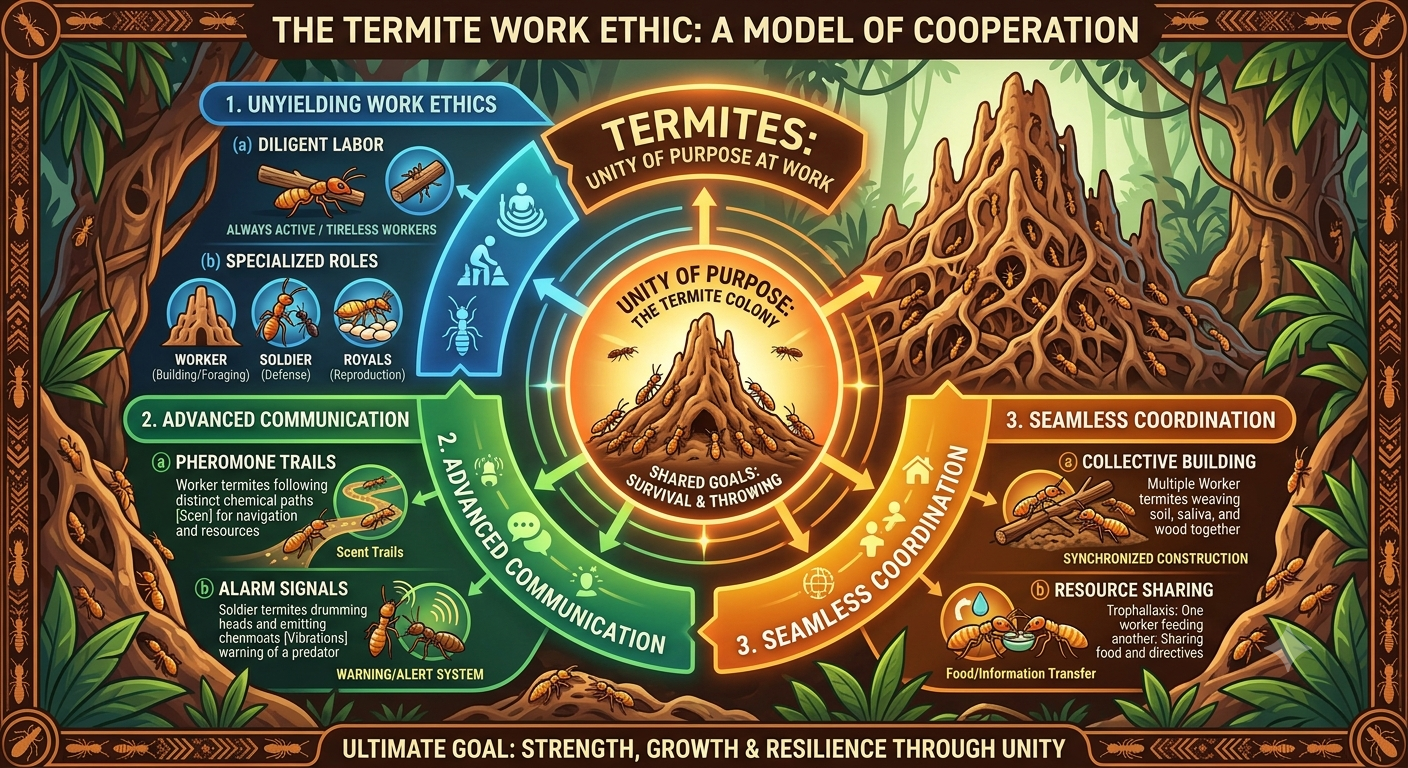
Among all social organisms on Earth, termites represent one of the greatest examples of collective intelligence. Although each termite possesses only a tiny brain and limited individual intelligence, millions of termites working together create one of nature’s most sophisticated societies. Their colonies construct towering architectural masterpieces, regulate temperature without electricity, farm fungi, defend themselves against predators, raise young collectively, recycle dead plant material, and survive for decades or even centuries.
The success of termite civilization is founded upon five pillars:
- Unity of purpose
- Exceptional work ethics
- Advanced communication
- Precise coordination
- Selfless cooperation
Modern organizations, governments, military institutions, businesses, and engineering projects increasingly study termite colonies because they demonstrate principles that artificial intelligence, robotics, organizational management, and distributed computing seek to replicate.
Chapter 1: The Termite Civilization
Termites evolved approximately 150–170 million years ago during the Jurassic period. They are ancient relatives of cockroaches but evolved into highly organized social insects.
Today scientists estimate there are over 3,000 known termite species worldwide.
Every colony functions as a superorganism, where the colony itself behaves like one living body.
Just as the human body has:
- brain
- heart
- lungs
- immune system
- blood vessels
the termite colony possesses equivalent functional systems.
Instead of one brain directing everything, millions of termites collectively perform specialized roles.
Chapter 2: Unity of Purpose
Perhaps the greatest lesson termites teach humanity is that every individual exists to strengthen the colony rather than themselves.
Each termite has one overriding objective:
Ensure the survival, growth, and prosperity of the colony.
Unlike humans, termites never compete for promotions, wealth, fame, or recognition.
Every action contributes toward a common mission.
Examples include:
- gathering food
- feeding larvae
- expanding tunnels
- repairing damage
- defending entrances
- cleaning waste
- maintaining humidity
- caring for the queen
No effort is considered too small.
Small contributions accumulate into extraordinary achievements.
Chapter 3: Division of Labor
Every colony is organized into specialized castes.
Queen
The queen is responsible for reproduction.
Large queens may produce thousands of eggs every day for many years.
King
Unlike many ants, termite kings remain with the queen throughout her life.
The king continually fertilizes the queen.
Workers
Workers perform almost every task:
- food collection
- tunnel excavation
- feeding others
- cleaning
- nursery care
- fungus farming
- repairing structures
Workers form over 80–90% of many colonies.
Soldiers
Soldiers protect the colony.
Their specialized heads and jaws defend against:
- ants
- beetles
- spiders
- reptiles
- mammals
They sacrifice themselves if necessary.
Chapter 4: Extraordinary Work Ethics
Workers never wait for instructions.
Instead they respond instantly to local environmental conditions.
Characteristics include:
Continuous productivity
Termites operate:
- day
- night
- rainy season
- dry season
The colony never sleeps.
No unemployment
Every healthy termite has work.
Idle behavior rarely exists.
Zero ego
Workers never seek recognition.
No termite claims:
“I built this tunnel.”
“I deserve more food.”
Everything belongs to the colony.
Lifetime commitment
Termites dedicate their entire lives to collective service.
Chapter 5: Communication Systems
Despite lacking spoken language, termites communicate remarkably well.
1. Chemical communication
The primary language is pheromones.
Chemical messages indicate:
- food
- danger
- repair locations
- queen presence
- colony identity
- migration
- reproduction
2. Antenna communication
Termites constantly touch antennae.
This exchanges information almost instantly.
3. Vibrational communication
When danger appears:
Soldiers bang their heads against tunnel walls.
These vibrations spread rapidly.
Thousands of termites immediately respond.
4. Behavioral communication
Movement itself communicates:
- direction
- urgency
- workload
- environmental conditions
Chapter 6: Coordination Without a Central Commander
Perhaps the most astonishing feature is that there is no general directing every worker.
Instead coordination emerges from:
- local information
- simple behavioral rules
- chemical signals
- environmental feedback
Scientists call this swarm intelligence.
Each termite follows simple rules, yet together they produce highly organized outcomes.
Chapter 7: Architectural Excellence
Some termite mounds exceed 8 meters in height.
Relative to body size, this is comparable to humans constructing structures several kilometers tall.
These mounds include:
- ventilation shafts
- nurseries
- fungal gardens
- food storage
- royal chambers
- defensive passages
- waste chambers
The internal climate remains remarkably stable despite changing outdoor temperatures.
Chapter 8: Quality Control
Every worker constantly inspects:
- tunnels
- walls
- humidity
- airflow
- fungus gardens
- eggs
Any defect is repaired immediately.
There is no maintenance department.
Everyone performs maintenance.
Chapter 9: Collective Decision-Making
When selecting:
- new tunnels
- food sources
- expansion areas
thousands of workers independently explore.
Successful discoveries attract more workers through pheromone reinforcement.
Poor options gradually disappear.
This decentralized process often produces highly efficient solutions without centralized planning.
Chapter 10: Crisis Management
When predators attack:
- soldiers defend entrances
- workers move eggs
- damaged tunnels are sealed
- food stores are protected
- emergency repairs begin immediately
The colony responds as one coordinated organism.
Chapter 11: Lessons for Human Organizations
Termite societies offer valuable insights for human institutions:
| Human Institution | Lesson from Termites |
|---|---|
| Businesses | Shared mission and coordinated teamwork improve productivity. |
| Governments | Long-term planning and infrastructure maintenance are essential. |
| Engineering | Build resilient, self-regulating systems. |
| Education | Encourage specialization while maintaining collaboration. |
| Healthcare | Coordinate many specialists around a common goal. |
| Military | Clear communication and role clarity enable rapid response. |
| AI & Robotics | Swarm intelligence can solve complex problems through simple local interactions. |
Chapter 12: Why Termites Rarely Fail
Their societies remain resilient because they minimize common organizational weaknesses:
- shared purpose over individual ambition
- continuous communication
- clear division of labor
- decentralized decision-making
- rapid adaptation
- constant maintenance
- efficient resource recycling
- resilience through redundancy
These principles reduce the risk of systemic failure.
Conclusion
Termites demonstrate that remarkable achievements do not always require powerful individuals or centralized control. Their colonies function because millions of small, specialized actions are aligned toward a common purpose. Through disciplined work, efficient communication, adaptive coordination, and unwavering cooperation, termites construct complex societies that have persisted for millions of years.
For leaders in business, government, engineering, artificial intelligence, and organizational design, termite colonies provide a powerful natural model: enduring success often emerges from clear shared goals, distributed responsibility, continuous communication, and the consistent contribution of every member rather than from individual brilliance alone.



Be First to Comment