
Introduction
Among the most extraordinary organisms on Earth, siphonophores are not single animals in the traditional sense. They are colonial marine organisms made up of hundreds to thousands of highly specialized individuals called zooids, all genetically identical and working together as one integrated superorganism.
A siphonophore is often described as nature’s floating city, living spacecraft, or biological megastructure, because every zooid performs only one specific function while depending entirely on the rest of the colony for survival.
Some species measure only a few centimeters, while others exceed 40–50 meters, making them among the longest animals ever recorded.
1. Scientific Classification
| Classification | Name |
|---|---|
| Kingdom | Animalia |
| Phylum | Cnidaria |
| Class | Hydrozoa |
| Order | Siphonophorae |
They belong to the same phylum as:
- Jellyfish
- Corals
- Sea anemones
- Hydroids
Unlike jellyfish, siphonophores function as one integrated colony.
2. Discovery and Scientific History
Ancient Observations
Sailors have encountered siphonophores for thousands of years.
The best-known species is the Portuguese man o’ war, often mistaken for a jellyfish.
18th Century
European naturalists first began documenting siphonophores.
Scientists realized they were unlike any known animal.
19th Century
Naturalists discovered:
- They are colonial animals.
- Every section is alive.
- Different parts perform different jobs.
This revolutionized zoology.
Modern Era
Modern technologies include:
- Deep-sea submarines
- High-definition cameras
- DNA sequencing
- Autonomous underwater vehicles (AUVs)
- Remotely operated vehicles (ROVs)
These have revealed numerous previously unknown species living thousands of meters below the ocean surface.
3. Evolution
Siphonophores evolved roughly 500 million years ago, during the early diversification of complex marine animals.
Evolution favored:
- Division of labor
- Cooperation
- Functional specialization
- Increased feeding efficiency
4. What Makes a Siphonophore Unique?
Unlike ordinary animals:
One fertilized egg develops into:
- feeding zooids
- reproductive zooids
- swimming zooids
- defensive zooids
- digestive zooids
Each zooid loses the ability to survive independently.
This resembles:
- cells in a human body
- departments in a corporation
- components in a spacecraft
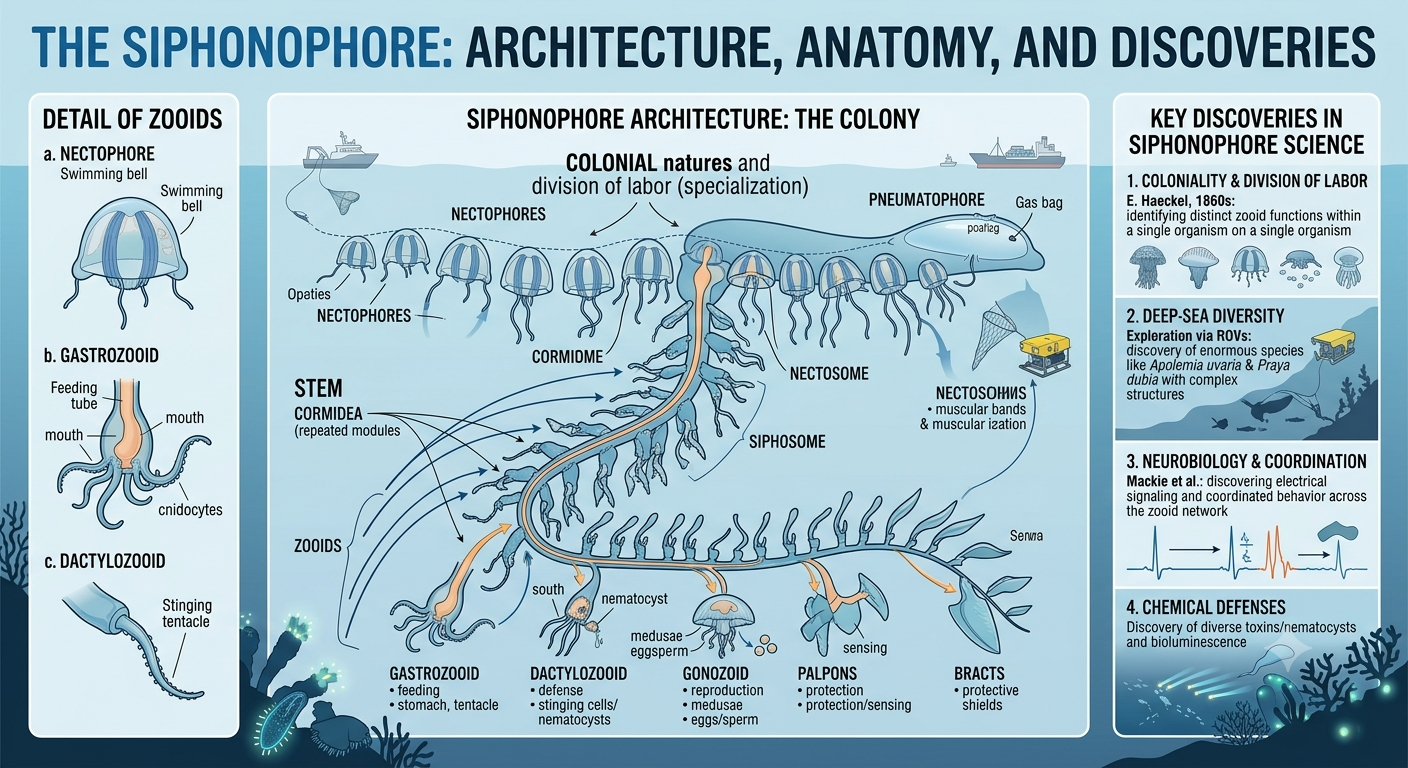
5. Overall Architecture
Imagine a train.
The central stem acts as the railway.
Attached to it are hundreds or thousands of living modules.
Float

↓

Swimming bells

↓

Central stem

↓

Feeding zooids

↓

Digestive zooids

↓

Defensive tentacles

↓

Reproductive zooids
Everything remains connected.
6. The Main Structural Components
A. Pneumatophore (Float)
The gas-filled float:
- provides buoyancy
- stabilizes orientation
- may help position the colony
In the Portuguese man o’ war, the float projects above the water surface.
B. Stem
The stem functions like:
- backbone
- nervous highway
- transport pipeline
It connects every zooid.
C. Nectophores
These are swimming bells.
Their contractions propel the colony.
Comparable to:
- jet engines
- rocket thrusters
D. Gastrozooids
These are feeding zooids.
Functions:
- capture prey
- ingest food
- begin digestion
E. Dactylozooids
These specialize in defense.
Their tentacles carry thousands of stinging cells.
F. Gonozooids
These produce:
- eggs
- sperm
They are responsible for reproduction.
G. Bracts
Protective leaf-like structures that:
- shield zooids
- improve buoyancy
- reduce damage
7. Internal Anatomy
Although colonial, siphonophores share:
Digestive system
Food captured by feeding zooids enters a common gastrovascular canal.
Nutrients circulate throughout the colony.
Nervous System
Rather than a centralized brain:
they possess
- diffuse nerve nets
- signaling pathways
- coordinated contractions
Muscular System
Muscles power:
- swimming bells
- tentacle movement
- feeding actions
Circulation
Instead of blood,
nutrients move through the shared gastrovascular cavity.
8. Hunting Architecture
Siphonophores are among the ocean’s most efficient predators.
Their tentacles may extend:
- 10 m
- 20 m
- over 30 m
The tentacles resemble enormous fishing nets.
Hunting Steps
- Float silently.
- Extend tentacles.
- Detect prey.
- Fire microscopic harpoons (nematocysts).
- Inject venom.
- Retract prey.
- Digest food.
- Share nutrients.
9. Venom System
Each tentacle carries thousands of:
nematocysts
These microscopic capsules:
- fire instantly
- inject toxins
- immobilize prey
Among cnidarians, this is one of nature’s fastest cellular mechanisms.
10. Feeding
Common prey:
- fish
- shrimp
- krill
- squid larvae
- copepods
- zooplankton
Large species may capture surprisingly large prey relative to their own diameter.
11. Deep-Sea Architecture
Many siphonophores inhabit:
- 500 m
- 1,000 m
- 3,000 m
- 5,000 m
Adaptations include:
- transparent bodies
- bioluminescence
- energy-efficient movement
- elongated feeding structures
12. Bioluminescence
Many species generate blue-green light.
Purposes include:
- attracting prey
- communication within the colony
- confusing predators
- camouflage in dim ocean light
13. Reproduction
The colony releases:
- sperm
- eggs
After fertilization:
- larvae develop
- a primary zooid forms
- repeated budding creates the mature colony
All zooids originate from the same embryo and share the same DNA.
14. Growth
Growth occurs continuously by:
- stem elongation
- budding new zooids
- replacing damaged parts
Some colonies may contain thousands of zooids.
15. Largest Known Species
Among the longest are species in the genus Apolemia, with some observed colonies estimated at around 40–50 meters in length. Apolemia
The Praya dubia is another exceptionally long deep-sea siphonophore and has often been cited as one of the world’s longest animals.
16. Ecological Importance
Siphonophores play major roles by:
- controlling zooplankton populations
- feeding larger predators
- transferring energy through ocean food webs
- contributing to carbon cycling as organic matter sinks to the deep sea
17. Engineering Lessons from Siphonophores
Researchers study siphonophores as inspiration for:
- modular robotics
- swarm intelligence
- distributed computing
- fault-tolerant systems
- autonomous underwater vehicles
- self-organizing architectures
Their decentralized organization shows how complex behavior can emerge without a central brain.
18. Comparison with the Human Body
| Human Body | Siphonophore Colony |
|---|---|
| Brain | Distributed nerve net |
| Heart | No heart; shared fluid circulation |
| Blood vessels | Gastrovascular canals |
| Organs | Specialized zooids |
| Immune protection | Defensive zooids and venom |
| Muscles | Swimming bells and contractile tissues |
19. Fascinating Facts
- They are colonies, not solitary animals.
- Every zooid has the same genetic origin.
- Individual zooids cannot usually survive on their own.
- Some species are among the longest animals on Earth.
- Many are transparent, making them difficult to detect.
- They inhabit nearly every ocean, from the surface to the deep sea.
Conclusion
Siphonophores challenge our understanding of what it means to be an individual organism. Rather than relying on a single body with many organs, they consist of hundreds or thousands of genetically identical zooids that function together as a single living system. Their elegant architecture—combining specialized feeding, swimming, defense, digestion, and reproduction—allows them to thrive from sunlit surface waters to the deepest reaches of the ocean.
From an evolutionary perspective, siphonophores demonstrate the power of cooperation and specialization. From an engineering perspective, they inspire designs for modular robots, distributed networks, and resilient systems. As deep-sea exploration continues, scientists are likely to discover even more remarkable siphonophore species, further revealing the extraordinary diversity and ingenuity of life in Earth’s oceans.



Be First to Comment