
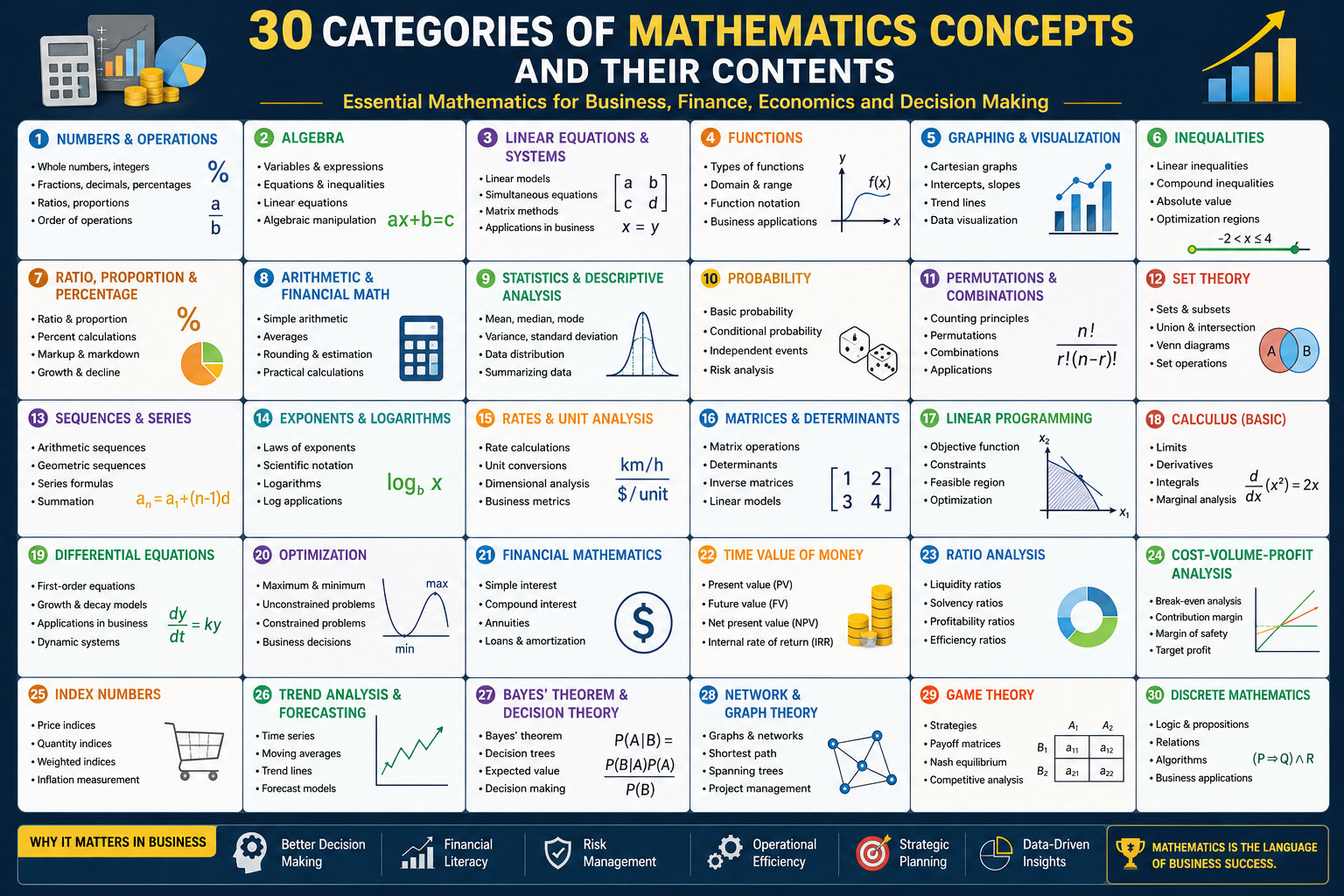
Mathematics is not one subject. It’s 30+ different toolkits that we mix depending on the problem. For business, we mostly live in 6-8 of them, but knowing the full map helps you see where business math connects.
Here is a comprehensive overview:
The 30 Categories
1. Arithmetic
Contents: Whole numbers, fractions, decimals, percentages, ratios, proportions.
Business use: Discounts, markups, VAT, currency conversion, basic costing.
2. Algebra
Contents: Variables, equations, inequalities, functions, polynomials.
Business use: Cost functions, revenue functions, break-even formulas.
3. Geometry
Contents: Shapes, area, volume, perimeter, angles.
Business use: Packaging, warehouse space, floor planning, logistics.
4. Trigonometry
Contents: Sine, cosine, tangent, periodic functions.
Business use: Signal processing, seasonal sales patterns, engineering projects.
5. Calculus – Differential
Contents: Limits, derivatives, rates of change.
Business use: Marginal cost, marginal revenue, profit maximization.
6. Calculus – Integral
Contents: Integration, area under curves.
Business use: Consumer surplus, total cost from marginal cost, continuous growth.
7. Linear Algebra
Contents: Matrices, vectors, systems of equations, eigenvalues.
Business use: Input-output models, data science, portfolio optimization.
8. Probability
Contents: Events, rules, distributions, Bayes theorem.
Business use: Risk assessment, insurance, A/B testing.
9. Statistics
Contents: Mean, median, variance, sampling, hypothesis testing.
Business use: Market research, quality control, forecasting demand.
10. Financial Mathematics
Contents: Simple interest, compound interest, annuities, amortization.
Business use: Loans, investments, bonds, retirement planning. Core to business math.
11. Actuarial Mathematics
Contents: Life tables, risk models, premiums.
Business use: Insurance pricing, pension funds.
12. Optimization
Contents: Linear programming, nonlinear programming, constraints.
Business use: Resource allocation, production planning, supply chain.
13. Operations Research
Contents: Queuing theory, inventory models, decision trees, simulation.
Business use: Staff scheduling, EOQ inventory, call center design.
14. Game Theory
Contents: Payoffs, Nash equilibrium, strategies.
Business use: Pricing wars, negotiations, competitive strategy.
15. Discrete Mathematics
Contents: Logic, sets, graph theory, combinatorics.
Business use: Network routing, scheduling, project management CPM/PERT.
16. Numerical Analysis
Contents: Approximation methods, error analysis.
Business use: Solving complex financial models when no closed-form exists.
17. Differential Equations
Contents: Modeling change over time.
Business use: Population growth, adoption curves, depreciation models.
18. Complex Analysis
Contents: Complex numbers, analytic functions.
Business use: Engineering and physics applications, rarely direct in business.
19. Topology
Contents: Properties of space preserved under deformation.
Business use: Data shape analysis, network design.
20. Number Theory
Contents: Primes, divisibility, modular arithmetic.
Business use: Cryptography, secure payments, blockchain.
21. Mathematical Logic
Contents: Propositions, proofs, Boolean algebra.
Business use: Database queries, decision rules, AI.
22. Set Theory
Contents: Unions, intersections, relations.
Business use: Customer segmentation, database structure.
23. Mathematical Modeling
Contents: Translating real problems into equations.
Business use: Every business forecast or KPI dashboard.
24. Fractals and Chaos
Contents: Self-similar patterns, sensitive dependence.
Business use: Market volatility modeling, risk.
25. Measure Theory
Contents: Rigorous foundation for probability and integration.
Business use: Advanced quantitative finance.
26. Functional Analysis
Contents: Vector spaces of functions.
Business use: Machine learning, signal processing.
27. Graph Theory
Contents: Nodes, edges, paths, flows.
Business use: Social networks, supply chains, org charts.
28. Combinatorics
Contents: Counting, permutations, combinations.
Business use: Product configurations, marketing experiments.
29. Data Science Mathematics
Contents: Regression, clustering, PCA, classification.
Business use: Customer analytics, recommendation engines.
30. Computational Mathematics
Contents: Algorithms, simulation, software for math.
Business use: Excel Solver, Python, R, AI copilots for business decisions.
Deep Dive: Business Mathematics
Business mathematics pulls mainly from categories 1, 2, 5, 6, 8, 9, 10, 12, 13. Its goal is not proof, it is decision.
Core content areas in Business Math:
A. Commercial Arithmetic
Percentages, profit-loss, discount, commission, interest, taxes. This is the daily math of sales and procurement.
B. Financial Math
Time value of money is central.
$PV = \frac{FV}{(1+r)^n}$
Used for NPV, IRR, loan repayments, leasing vs buying.
C. Calculus in Business
If $C(q)$ is cost and $R(q)$ is revenue, profit is $P(q) = R(q) – C(q)$.
Set $P'(q) = 0$ to find optimal output. Marginal analysis lives here.
D. Linear Programming
“Maximize profit subject to labor, material, and machine constraints.”
Solved with matrices and graphical methods. Foundation of operations.
E. Statistics for Business
Forecasting with regression, measuring variability with standard deviation, testing if a new ad campaign worked.
F. Operations Models
EOQ: $Q^* = \sqrt{\frac{2DS}{H}}$ for optimal order quantity.
Queuing: reduce wait times. Decision trees: choose projects under uncertainty.
How the Categories Connect
You rarely use just one. Example: launching a product.
- Arithmetic + Algebra: set price and cost structure
- Statistics: survey demand
- Calculus: find price that maximizes profit
- Probability: model risk of low sales
- Optimization: allocate marketing budget
- Financial Math: evaluate NPV of the launch
Modern Way to Learn It
Articles explain the “why,” anatomy shows the structure above, and tutorials now focus on tools. Most business students in 2026 learn by:
- Solving cases in Excel and Google Sheets
- Using Python for regression and optimization
- Simulating scenarios with AI to test assumptions
Part 1: Core Business Mathematics Categories
These 10 categories form the bedrock of commerce, finance, corporate strategy, and logistics.
1. Financial Mathematics (Interest & Valuation)
Focuses on the time value of money and the valuation of financial cash flows over time.
- Core Contents: Simple and compound interest, nominal vs. effective interest rates, present value ($PV$) and future value ($FV$) calculations, ordinary annuities and annuities due, perpetuities, and amortization schedules for loans.
2. Investment & Portfolio Mathematics
The mathematical models used to evaluate asset performance, risk, and investment returns.
- Core Contents: Net Present Value ($NPV$), Internal Rate of Return ($IRR$), Capital Asset Pricing Model (CAPM), bond pricing, yield to maturity (YTM), stock valuation models, portfolio variance, and the Sharpe ratio.
3. Business Statistics & Data Analytics
Using historical data to identify trends, variances, and patterns to inform corporate decision-making.
- Core Contents: Measures of central tendency (mean, median, mode) and dispersion (standard deviation, variance), normal distribution, sampling distributions, confidence intervals, and hypothesis testing ($z$-tests, $t$-tests, ANOVA).
4. Predictive Business Modeling (Regression & Forecasting)
Statistical techniques used to forecast future business metrics based on historical relationships.
- Core Contents: Linear and multiple regression analysis, time-series analysis (moving averages, exponential smoothing), trend projection, seasonality adjustments, and correlation coefficients ($R^2$).
5. Mathematical Optimization (Operations Research)
The allocation of scarce resources (maximizing profit or minimizing costs) under specific constraints.
- Core Contents: Linear Programming (LP), the Simplex method, transportation and assignment problems, network optimization, and integer programming.
6. Risk, Probability, & Actuarial Mathematics
Evaluating uncertainty, calculating insurance risks, and assessing the likelihood of business disruptions.
- Core Contents: Probability trees, conditional probability, Bayes’ Theorem, expected value calculations, discrete and continuous probability distributions (Binomial, Poisson, Exponential), and life contingency models.
7. Cost, Revenue, & Profit Analysis (Calculus in Business)
Applying rate-of-change principles to determine optimal production levels and pricing strategies.
- Core Contents: Cost, revenue, and profit functions; marginal analysis (marginal cost, marginal revenue); optimization using derivatives; and break-even analysis.
8. Commercial Arithmetic & Inventory Math
Day-to-day calculations required for retail, trading, supply chains, and warehouse management.
- Core Contents: Profit margins and markups, trade and cash discounts, depreciation methods (Straight-Line, Declining Balance, Sum-of-the-Years’ Digits), Economic Order Quantity (EOQ), and reorder points.
9. Matrix Algebra in Business Systems
Using arrays of numbers to solve multi-variable systems, often used in input-output economics and data organization.
- Core Contents: Matrix operations (addition, multiplication), determinants, matrix inversion, systems of linear business equations, and Markov chains (predicting market share shifts).
10. Decision Theory & Game Strategy
Mathematical models used to analyze competitive situations where the outcome depends on the choices of multiple actors.
- Core Contents: Decision trees, minimax and maximin criteria, payoff matrices, Nash equilibrium, and zero-sum vs. non-zero-sum games.
Part 2: Foundation & Pure Mathematics Categories
These branches deal with abstract structures and form the absolute baseline of all mathematical thinking.
11. Arithmetic & Number Theory
- Core Contents: Properties of integers, prime numbers, divisibility, greatest common divisors (GCD), modular arithmetic, and cryptography.
12. Elementary Algebra
- Core Contents: Algebraic expressions, variables, solving linear and quadratic equations, inequalities, and functions/graphs.
13. Abstract Algebra
- Core Contents: Algebraic structures including groups, rings, fields, vector spaces, and modules.
14. Euclidean & Analytic Geometry
- Core Contents: Coordinate systems, properties of shapes (triangles, circles, polygons), theorems of lines and angles, and conic sections (ellipses, parabolas).
15. Trigonometry
- Core Contents: Trigonometric ratios (sine, cosine, tangent), identities, wave functions, and solving right-angled and oblique triangles.
16. Calculus (Differential & Integral)
- Core Contents: Limits, continuity, derivatives (rates of change), integrals (area under a curve), Fundamental Theorem of Calculus, and Taylor series.
17. Real & Complex Analysis
- Core Contents: Rigorous proofs of calculus concepts, sequences and series, metric spaces, complex numbers, and analytic functions.
18. Topology
- Core Contents: Continuity and spatial properties preserved through deforming (stretching/twisting without tearing), open/closed sets, compactness, and homeomorphisms.
19. Set Theory & Mathematical Logic
- Core Contents: Propositional and predicate logic, truth tables, set operations (unions, intersections), Venn diagrams, and Boolean algebra.
20. Combinatorics
- Core Contents: Counting techniques, permutations, combinations, Pigeonhole Principle, and binomial coefficients.
Part 3: Applied & Computational Mathematics Categories
These fields apply mathematical principles to science, engineering, computing, and complex logistics systems.
21. Differential Equations
- Core Contents: Ordinary Differential Equations (ODEs), Partial Differential Equations (PDEs), boundary value problems, and Fourier series (crucial for modeling physical changes and market dynamics over continuous time).
22. Linear Algebra
- Core Contents: Vector spaces, linear transformations, eigenvalues and eigenvectors, matrix factorizations (LU, SVD), and geometric transformations.
23. Numerical Analysis
- Core Contents: Algorithms for approximating solutions to mathematical problems that cannot be solved exactly analytically (e.g., root-finding algorithms, numerical integration, error analysis).
24. Graph Theory
- Core Contents: Networks of vertices and edges, Eulerian and Hamiltonian paths, shortest-path algorithms (Dijkstra’s), trees, and network flow analysis (widely used in logistics and routing apps).
25. Cryptographic Mathematics
- Core Contents: Public-key cryptography, RSA encryption algorithms, elliptic curve cryptography, and hashing functions (vital for cybersecurity and digital transaction security).
26. Information Theory
- Core Contents: Quantifying data transmission, entropy, data compression algorithms, channel capacity, and error-correcting codes.
27. Chaos Theory & Dynamical Systems
- Core Contents: Nonlinear dynamics, feedback loops, sensitivity to initial conditions (the “butterfly effect”), fractals, and bifurcation theory.
28. Mathematical Physics
- Core Contents: Application of mathematics to problems in physics, including classical mechanics, quantum mechanics, relativity, and statistical mechanics.
29. Stochastic Processes
- Core Contents: Random processes that evolve over time, random walks, Brownian motion, and Monte Carlo simulations (heavily used to model stock market fluctuations and risk).
30. Fuzzy Logic & Mathematical Modeling
- Core Contents: Many-valued logic to handle concept truth values between “completely true” and “completely false,” parameter tuning, and multi-criteria decision-making models.

Be First to Comment