
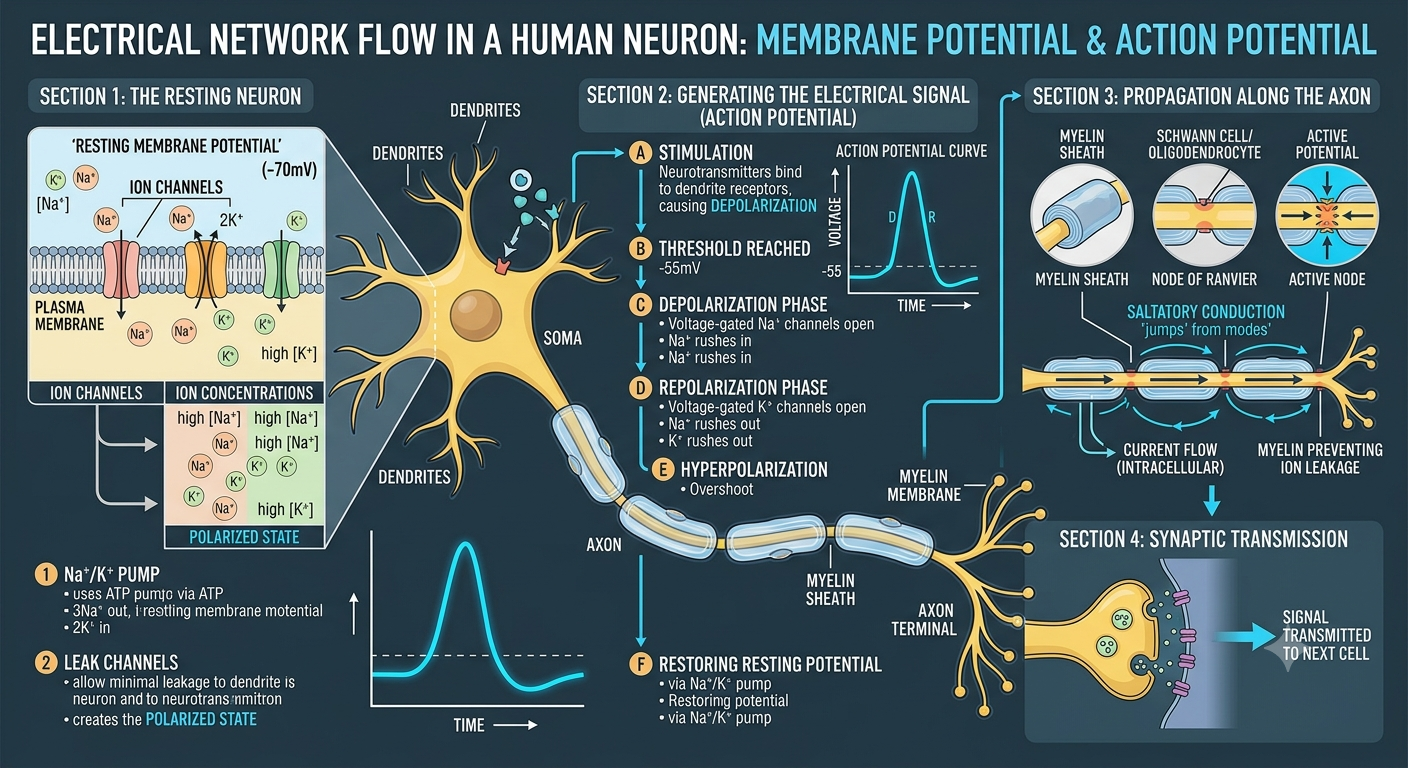
The human body runs on electricity. Not like a wall socket, but as a precise network of charged particles flowing across membranes, cells, and tissues. At the smallest scale, every cell is a battery. At the largest scale, the nervous system is a biological internet where signals travel at up to 120 m/s. Understanding this “electrical network” means understanding how life controls itself.
1. The Basic Unit: The Cell as an Electrical Circuit
Every human cell maintains a voltage difference across its membrane. This is called the membrane potential.
Anatomy of the cellular circuit:
- Battery: Ion gradients. The cell pumps $Na^+$, $K^+$, $Ca^{2+}$, and $Cl^-$ to different concentrations inside vs outside. The sodium-potassium pump $3Na^+$ out, $2K^+$ in uses ATP to keep this battery charged.
- Capacitor: The lipid membrane is an insulator about 5nm thick. It stores charge on each side, just like a capacitor.
- Resistors and Switches: Ion channels are protein pores that open and close. When open, specific ions flow down their concentration and electrical gradient. Each channel acts like a gated resistor.
- Current: The flow of ions. $K^+$ leaking out makes the inside negative. $Na^+$ or $Ca^{2+}$ flowing in makes it more positive.
At rest, most cells sit around -70mV inside relative to outside. This resting potential is the “idle voltage” of the network.
2. Excitable Cells: Neurons and the Action Potential
Nerve cells, or neurons, are specialized for rapid electrical signaling. They don’t just hold a voltage, they send pulses.
The flow of a nerve impulse:
Step 1: Resting State
High $K^+$ inside, high $Na^+$ outside. Membrane potential ~ -70mV. Voltage-gated $Na^+$ and $K^+$ channels are closed.
Step 2: Depolarization
A stimulus opens voltage-gated $Na^+$ channels. $Na^+$ rushes in. Membrane rapidly goes from -70mV to +30mV. This is the rising phase of the action potential.
Step 3: Repolarization
$Na^+$ channels inactivate. Voltage-gated $K^+$ channels open. $K^+$ rushes out, bringing the membrane back down, even a bit below -70mV.
Step 4: Refractory Period
Pumps restore ion gradients. The cell cannot fire again immediately. This ensures signals move in one direction.
This whole event takes about 1-2ms. It is an all-or-nothing event, like a digital 1.
3. The Network: How Signals Travel
A single neuron is not useful alone. The power comes from the network.
A. Within one neuron: Propagation
In unmyelinated axons, the action potential regenerates step by step.
In myelinated axons, Schwann cells wrap the axon in fat, leaving gaps called Nodes of Ranvier. Current “jumps” between nodes. This is saltatory conduction and it’s 50x faster with 100x less energy.
B. Between neurons: Synapses
At the end of an axon, the electrical signal becomes chemical.
- Action potential arrives, opens $Ca^{2+}$ channels.
- $Ca^{2+}$ triggers vesicles to release neurotransmitters like dopamine, glutamate, GABA into the synapse.
- Neurotransmitters bind receptors on the next neuron, opening ion channels.
- If enough channels open, the next neuron reaches threshold and fires its own action potential.
This is where the network computes. Excitatory signals add up. Inhibitory signals subtract. The brain is literally summing currents.
C. The whole nervous system as a network
- Peripheral nerves: Bundles of axons like cables, carrying sensory input in and motor commands out.
- Spinal cord: A high-speed bus connecting body to brain.
- Brain: 86 billion neurons, 100 trillion synapses. A massively parallel network where patterns of electrical firing encode thought, memory, and movement.
4. Other Cells in the Electrical Network
Neurons get the attention, but they are not alone.
- Muscle cells: Action potentials trigger $Ca^{2+}$ release, which triggers contraction. Your heart beats because cardiac cells have automatic action potentials.
- Endocrine cells: Electrical changes trigger hormone release.
- Epithelial cells: Maintain ion gradients to move water and nutrients. This is how kidneys and gut work.
- Glial cells: Astrocytes and oligodendrocytes help maintain ion balance and myelinate axons. They don’t fire, but they regulate the network.
5. Principles of the Biological Electrical Network
The human cell-nerve system follows engineering principles:
A. Graded vs Digital Signals
Dendrites sum small graded potentials. If threshold is reached, an action potential fires. This is analog input, digital output.
B. Directionality
Diodes are built in. Refractory periods and chemical synapses force one-way flow.
C. Amplification
Voltage-gated channels amplify a small input into a large, self-propagating signal.
D. Energy Efficiency
The brain uses ∼20W. It achieves this by only firing when needed, using myelination, and turning channels off quickly.
E. Plasticity
The network rewires. Synapses strengthen or weaken based on use. This is the electrical basis of learning: “neurons that fire together, wire together.”
6. When the Network Fails
Disrupt the electrical flow and disease follows:
- Epilepsy: Too much synchronized firing, network “short circuit.”
- Neuropathy: Damaged myelin slows conduction, like frayed cables.
- Channelopathies: Mutations in ion channels cause heart arrhythmias or muscle disorders.
- Neurodegeneration: Loss of neurons breaks network connections.
Medicine directly targets this network: pacemakers reset heart electricity, deep brain stimulation adds pulses to Parkinson circuits, local anesthetics block $Na^+$ channels.
Conclusion: Life as Current
The human cell is a tiny battery. A nerve is a wire. A brain is a network of 100 trillion switches firing in patterns.
The flow is not electrons in a metal wire. It is ions in water, gated by proteins, powered by ATP. But the principles are the same: potential difference, resistance, capacitance, and information encoded in the timing of pulses.
Modern neuroscience and bioengineering now treat the body as a circuit we can read and write to. From EEGs that read brain waves to cochlear implants that write to auditory nerves, we are learning to interface with this living electrical network.
Understanding cellular and neural electricity is understanding how we sense, think, move, and stay alive. The network never sleeps, because even at rest, the current is flowing.
The electrical network of the human body is one of nature’s most sophisticated communication systems. Every thought, heartbeat, muscle movement, memory, sensation, and reflex depends on tiny electrical signals traveling through billions of interconnected cells. At the center of this network are neurons (nerve cells) and their supporting cells.
1. The Human Electrical Network
Brain
   │
   ▼
Spinal Cord
   │
   ▼
Peripheral Nerves
   │
   ▼
Individual Neurons
   │
   ▼
Synapses
   │
   ▼
Target Cells
(Muscles, Organs, Glands)
The nervous system contains approximately:
- 86 billion neurons
- Hundreds of trillions of synaptic connections
- Nearly 100,000 km of nerve fibers throughout the body.
2. Anatomy of a Nerve Cell (Neuron)
            Dendrites
          /    |    \
         /     |     \
        ▼      ▼      ▼
   -------------------------
   |      Cell Body        |
   |      (Soma)           |
   -------------------------
            │
       Nucleus
            │
            ▼
      Axon Hillock
            │
═══════════════════════════════════
 Myelin Sheath (Electrical Insulation)
═══════════════════════════════════
     ○       ○       ○
   Node    Node    Node
            │
            ▼
      Axon Terminal
            │
      Neurotransmitters
            │
            ▼
      Next Neuron
Each neuron consists of:
- Dendrites – receive incoming signals.
- Cell body (Soma) – processes information.
- Nucleus – controls cellular activities.
- Axon – carries electrical impulses.
- Myelin sheath – acts like insulation around an electrical cable.
- Nodes of Ranvier – gaps where the electrical signal is regenerated.
- Synapse – communication point with the next cell.
3. Where Does the Electricity Come From?
Neurons do not generate electricity like a battery or power station.
Instead, they create electrical voltage by moving charged ions across their cell membrane.
Major ions include:
| Ion | Charge | Main Role |
|---|---|---|
| Sodium (Na⁺) | Positive | Depolarization |
| Potassium (K⁺) | Positive | Repolarization |
| Calcium (Ca²⁺) | Positive | Neurotransmitter release |
| Chloride (Cl⁻) | Negative | Stabilizes electrical activity |
The inside of a resting neuron is about −70 millivolts (mV) relative to the outside.
4. Resting Electrical State
Outside Cell
+++++++++++++++++++++++++

Cell Membrane

-------------------------
Inside Cell (-70 mV)
The sodium-potassium pump continuously maintains this electrical difference by transporting sodium out of the cell and potassium into the cell.
5. How an Electrical Signal Travels
An electrical nerve impulse is called an action potential.
genui{“biology_neuroscience_behavior_senses_learning_block_staging”:{“type_id”:”ACTION_POTENTIAL_NEURON”}}
The process occurs in stages:
- Resting state: membrane is about −70 mV.
- Threshold: a stimulus triggers voltage-gated sodium channels to open.
- Depolarization: sodium ions rush into the neuron, making the inside positive.
- Peak: the voltage reaches approximately +30 mV.
- Repolarization: potassium channels open, allowing potassium to leave the cell.
- Hyperpolarization: the membrane briefly becomes more negative than resting.
- Recovery: ion pumps restore the resting potential.
This sequence typically takes 1–2 milliseconds.
6. Signal Propagation Along the Axon
Neuron

□□□□□□□□□□□□□□□□□□□□□□□□□

Electrical Wave →

□□□□□□□□□□□□□□□□□□□□□□□□□
In myelinated neurons, the impulse “jumps” between nodes of Ranvier, a process known as saltatory conduction, greatly increasing conduction speed.
genui{“biology_neuroscience_behavior_senses_learning_block_staging”:{“type_id”:”ACTION_POTENTIAL_NODES”}}
Typical speeds range from 0.5 m/s in unmyelinated fibers to 120 m/s in heavily myelinated motor neurons.
7. Communication Between Neurons
Electrical signals cannot directly cross the microscopic gap between most neurons. Instead, they are converted into chemical signals at the synapse.
genui{“biology_neuroscience_behavior_senses_learning_block_staging”:{“type_id”:”SYNAPTIC_TRANSMISSION”}}
Key steps include:
- The action potential reaches the axon terminal.
- Calcium channels open.
- Calcium enters the terminal.
- Vesicles release neurotransmitters.
- Neurotransmitters cross the synaptic cleft.
- They bind to receptors on the next neuron.
- Ion channels open in the next neuron.
- A new electrical signal may begin.
Common neurotransmitters include acetylcholine, glutamate, GABA, dopamine, serotonin, and norepinephrine.
8. Electrical Flow Through the Entire Nervous System
Stimulus
   │
   ▼
Skin Receptor
   │
   ▼
Sensory Neuron
   │
   ▼
Spinal Cord
   │
   ▼
Brain
   │
Decision Processing
   │
   ▼
Motor Neuron
   │
   ▼
Muscle
   │
Movement
This coordinated network allows the body to perceive, process, and respond to its environment.
9. Energy Supply for Electrical Activity
Although nerve signals are electrical, neurons rely on chemical energy (ATP) to maintain ion gradients.
The sequence is:
Food
   │
   ▼
Glucose
   │
   ▼
Mitochondria
   │
   ▼
ATP
   │
   ▼
Sodium–Potassium Pumps
   │
   ▼
Electrical Gradient
   │
   ▼
Action Potentials
The brain consumes roughly 20% of the body’s resting energy, despite representing only about 2% of body weight, because maintaining these electrical gradients is energy-intensive.
10. Electrical Activity Throughout the Body
Different organs have characteristic electrical signals:
| Organ | Typical Electrical Activity |
|---|---|
| Brain | Brain waves (EEG) |
| Heart | Electrical conduction (ECG) |
| Skeletal muscles | Muscle activation (EMG) |
| Retina | Electrical responses to light |
| Cochlea | Electrical responses to sound |
11. The Scale of the Human Neural Network
Approximate values:
- Neurons: 86 billion
- Synapses: 100–500 trillion
- Peripheral nerve length: ~100,000 km
- Typical action potential duration: 1–2 ms
- Resting membrane potential: −70 mV
- Peak membrane potential: +30 mV
- Fastest conduction speed: ~120 m/s
- Brain energy use: ~20% of resting metabolic energy
Summary
The human nervous system functions like an ultra-fast biological communication network. Chemical energy from food is converted into ATP, which powers ion pumps that establish electrical gradients across neuronal membranes. When stimulated, neurons generate action potentials by moving sodium and potassium ions across the membrane. These impulses travel rapidly along axons, are transmitted across synapses using neurotransmitters, and activate other neurons, muscles, or glands. This seamless interplay of electrical and chemical signaling enables everything from reflexes and movement to thought, memory, emotion, and consciousness.



Be First to Comment