
Introduction
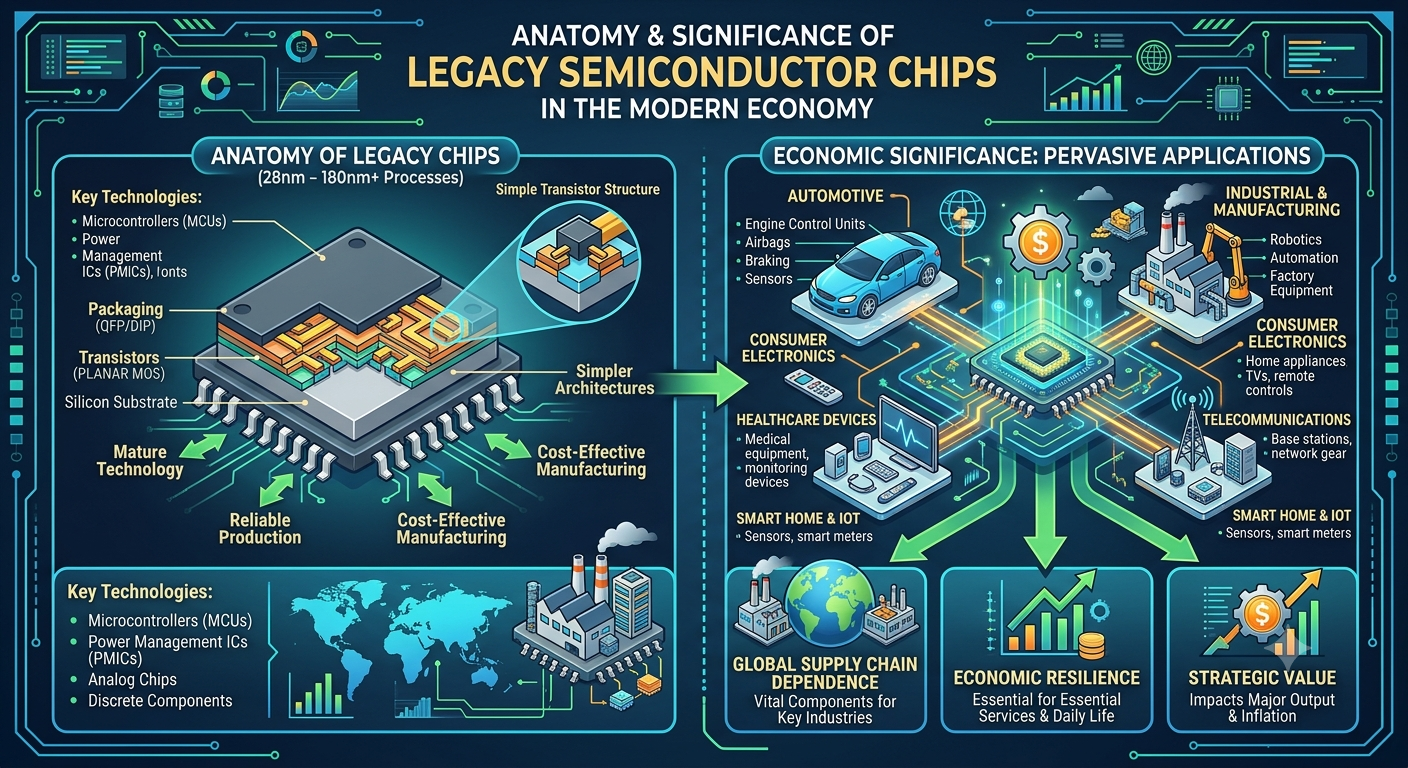
When people discuss semiconductors today, attention often focuses on cutting-edge 2 nm, 3 nm, and 5 nm chips. However, the overwhelming majority of the world’s electronic devices still depend on legacy semiconductor chips, also known as mature-node chips. These chips are the invisible foundation of the global economy.
Legacy chips power automobiles, factories, hospitals, power stations, telecommunications infrastructure, banking systems, defense equipment, household appliances, and industrial machinery. Without them, modern civilization would struggle to function.
Chapter 1: What Are Legacy Semiconductor Chips?
Legacy semiconductor chips are integrated circuits manufactured using older semiconductor fabrication technologies.
Typical process nodes include:
| Generation | Approximate Era |
|---|---|
| 350 nm | 1995–2000 |
| 250 nm | 1997–2002 |
| 180 nm | 1999–2004 |
| 130 nm | 2001–2006 |
| 90 nm | 2003–2008 |
| 65 nm | 2005–2010 |
| 55 nm | 2007–2012 |
| 45 nm | 2008–2013 |
| 40 nm | 2009–2014 |
| 28 nm | 2011–present |
Many organizations define 28 nm and larger as legacy or mature nodes, although definitions vary by industry and application.
Unlike advanced processors used in AI training or flagship smartphones, legacy chips prioritize:
- Reliability
- Long operational life
- Low manufacturing cost
- High production yield
- Stability
- Ease of qualification
- Availability over many years
Chapter 2: Anatomy of a Legacy Semiconductor Ecosystem
The legacy semiconductor industry consists of several interconnected layers.
Layer 1: Raw Materials
Production begins with:
- Silicon
- Quartz sand
- High-purity chemicals
- Industrial gases
- Copper
- Aluminum
- Gold
- Rare earth elements
- Photoresists
- Specialty polymers
Layer 2: Silicon Wafers
Large silicon crystals are grown and sliced into wafers.
Common wafer sizes include:
- 150 mm
- 200 mm
- 300 mm
Many legacy fabs still operate efficiently on 200 mm wafers.
Layer 3: Chip Design
Engineers create:
- Analog ICs
- Mixed-signal ICs
- Microcontrollers (MCUs)
- Power management ICs
- Sensors
- RF chips
- Motor controllers
- Embedded processors
These designs often remain in production for decades.
Layer 4: Fabrication (Wafer Manufacturing)
Hundreds of processing steps include:
- Oxidation
- Photolithography
- Ion implantation
- Chemical vapor deposition
- Plasma etching
- Metal deposition
- Chemical mechanical polishing
- Inspection
- Testing
Layer 5: Packaging
Finished dies are assembled into packages such as:
- DIP
- SOIC
- QFP
- BGA
- QFN
- CSP
Packaging protects the chip and provides electrical connections.
Layer 6: Testing
Manufacturers verify:
- Electrical performance
- Temperature tolerance
- Reliability
- Functional correctness
- Lifetime durability
Automotive chips often undergo particularly rigorous qualification.
Layer 7: Integration
Legacy chips are installed into:
- Vehicles
- Industrial robots
- Medical equipment
- Telecommunications systems
- Consumer electronics
- Military equipment
- Energy infrastructure
Chapter 3: Types of Legacy Chips
1. Microcontrollers (MCUs)
Found in:
- Washing machines
- Air conditioners
- Microwaves
- Cars
- Printers
- Smart meters
They act as the “brains” for dedicated control tasks.
2. Analog Chips
These convert real-world signals into electrical signals and vice versa.
Applications include:
- Audio systems
- Voltage sensing
- Current sensing
- Temperature monitoring
- Industrial instrumentation
3. Power Management ICs
They regulate electrical power by:
- Charging batteries
- Stabilizing voltage
- Protecting circuits
- Managing energy distribution
4. Sensors
Examples include:
- Pressure sensors
- Motion sensors
- Temperature sensors
- Magnetic sensors
- Humidity sensors
- Light sensors
5. Memory Chips
Examples:
- EEPROM
- NOR Flash
- NAND Flash (older generations)
- SRAM
- DRAM (mature-node versions)
6. Connectivity Chips
These support:
- Ethernet
- CAN bus
- LIN bus
- Bluetooth (some implementations)
- Wi-Fi controllers
- USB interfaces
7. Power Semiconductors
Examples include:
- MOSFETs
- IGBTs
- Rectifiers
- Voltage regulators
These are essential in motor drives, renewable energy, and electric power systems.
Chapter 4: Why Legacy Chips Remain Essential
Long Product Lifecycles
Industrial equipment, aircraft, medical devices, and power infrastructure often remain in service for 20–40 years. Redesigning electronics solely to adopt a newer manufacturing node can be costly and may require extensive requalification.
Proven Reliability
Mature manufacturing processes have accumulated years of operational data, making them highly dependable for safety-critical applications.
Lower Cost
Depreciated fabrication equipment and high manufacturing yields help reduce production costs.
Adequate Performance
Many control, sensing, and power-management tasks do not require billions of transistors. Simpler chips are sufficient and often preferable.
Chapter 5: Industries That Depend on Legacy Chips
Nearly every major economic sector uses mature-node semiconductors, including:
- Automotive manufacturing
- Aerospace
- Rail transportation
- Shipping
- Agriculture
- Mining
- Manufacturing
- Telecommunications
- Banking and payment terminals
- Healthcare
- Renewable energy
- Oil and gas
- Smart cities
- Consumer appliances
- Defense and public safety
Chapter 6: The Automotive Industry
A modern vehicle can contain hundreds to thousands of semiconductor devices.
Legacy chips are used for:
- Engine control
- Braking systems
- Steering
- Airbags
- Transmission
- Climate control
- Lighting
- Window controls
- Battery management
- Tire pressure monitoring
- Infotainment support
- Body electronics
During the 2020–2023 semiconductor shortages, shortages of mature-node chips significantly reduced global vehicle production, illustrating how critical these components are to the economy.
Chapter 7: Medical Applications
Legacy chips are found in:
- MRI scanners
- CT scanners
- X-ray systems
- Infusion pumps
- Ventilators
- Patient monitors
- Blood analyzers
- Hearing aids
- Ultrasound equipment
Medical devices prioritize reliability, long-term availability, and regulatory compliance over the latest manufacturing node.
Chapter 8: Industrial Automation
Factories rely on legacy chips in:
- Programmable logic controllers (PLCs)
- Industrial robots
- Variable-speed motor drives
- Conveyor systems
- Sensors
- Barcode scanners
- Industrial networking equipment
These systems often operate continuously for many years with minimal downtime.
Chapter 9: Energy Infrastructure
Power grids and energy facilities use legacy chips in:
- Smart meters
- Grid protection relays
- Solar inverters
- Wind turbine controllers
- Battery energy storage systems
- Power substations
- Industrial generators
- High-voltage protection systems
Chapter 10: Economic Significance
Legacy semiconductors support several pillars of the modern economy:
- Industrial productivity: They enable automation, measurement, and process control.
- Transportation: They underpin vehicle safety and logistics.
- Healthcare: They help power life-saving diagnostic and monitoring equipment.
- Energy security: They assist in generating, transmitting, and managing electricity.
- Communications: They enable networking equipment and telecom infrastructure.
- Consumer affordability: Mature manufacturing keeps many electronic products cost-effective.
- Supply-chain resilience: Continued production at mature nodes reduces dependence on a single generation of technology.
Chapter 11: Challenges Facing Legacy Chips
Despite their importance, mature-node semiconductors face several challenges:
- Aging fabrication equipment
- Dependence on specialized spare parts
- Capacity constraints during periods of high demand
- Geopolitical tensions affecting supply chains
- Long lead times for certain components
- Cybersecurity considerations for connected devices
- Environmental pressures to improve manufacturing efficiency
Chapter 12: The Future of Legacy Semiconductors
Although advanced chips are driving artificial intelligence and high-performance computing, demand for legacy semiconductors is expected to remain strong because:
- Industrial automation continues to expand.
- Electric vehicles require many mature-node analog and power devices.
- Renewable energy systems rely on robust power electronics.
- Smart infrastructure depends on large numbers of sensors and controllers.
- Many long-lived industrial and medical products continue to require compatible replacement components.
Rather than disappearing, legacy chips are likely to coexist with advanced semiconductors, each serving different technical and economic needs.
Conclusion
Legacy semiconductor chips are the quiet workhorses of the digital economy. While advanced processors enable cutting-edge AI and computing, mature-node chips control machines, regulate power, sense the physical world, and keep critical infrastructure operating. Their strengths—reliability, affordability, long product support, and proven manufacturing—make them indispensable across transportation, healthcare, industry, energy, telecommunications, and consumer products.
A resilient modern semiconductor ecosystem depends not only on leading-edge fabrication but also on sustained investment in legacy-chip design, manufacturing, packaging, testing, and supply chains. Together, advanced and legacy semiconductors form complementary pillars that support economic growth, technological innovation, and the functioning of modern society.






Be First to Comment