
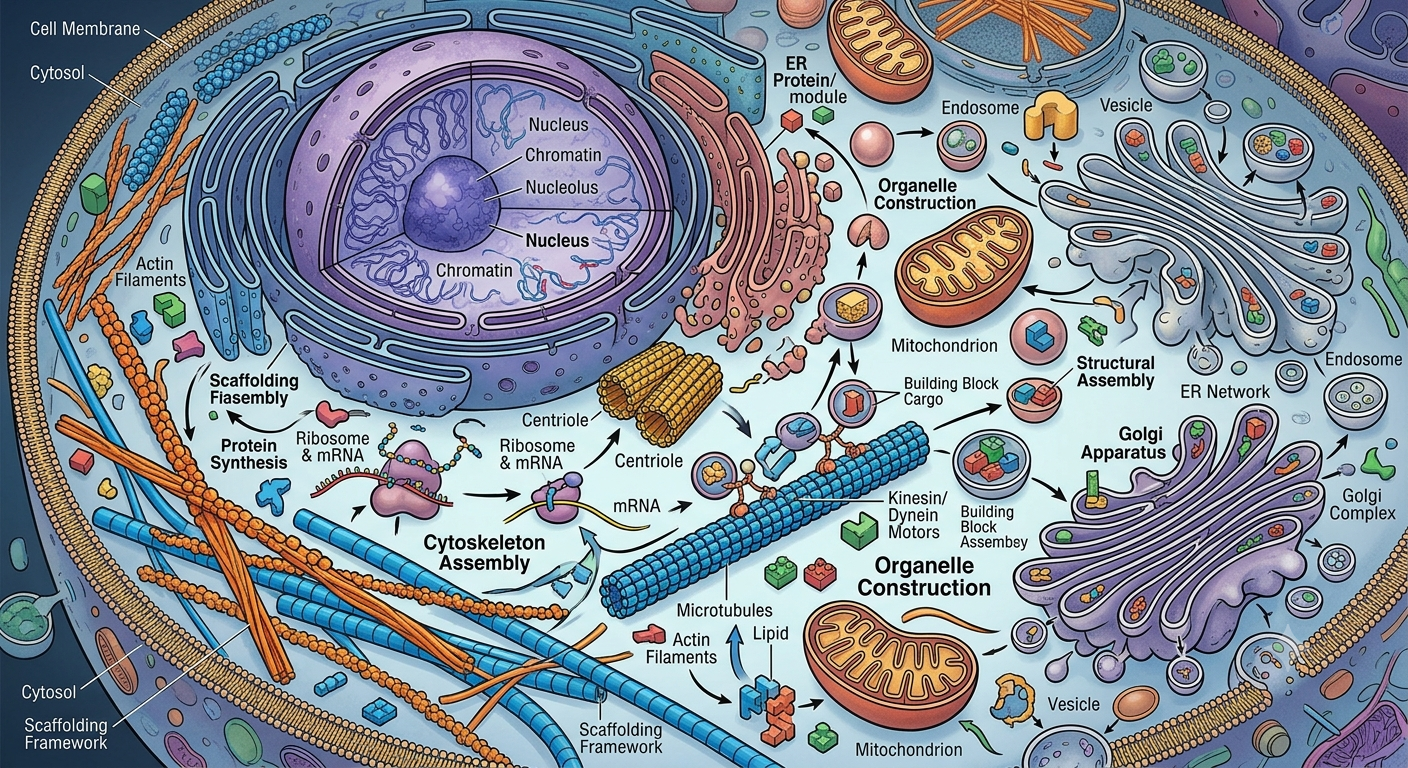
A Comprehensive Article on the Internal Formation, Organization, and Functional Design of the Human Cell
Introduction
The human cell is the smallest living structural and functional unit of the human body. Every organ—including the brain, heart, liver, kidneys, muscles, skin, and blood—is built from cells. The human body contains approximately 30–40 trillion cells, each functioning as an independent microscopic factory while communicating continuously with neighboring cells.
From an engineering perspective, a human cell resembles a self-powered smart city. It has:
- A protective boundary
- Communication networks
- Power stations
- Manufacturing factories
- Waste recycling centers
- Security systems
- Transportation highways
- Information storage
- Quality-control systems
- Self-repair mechanisms
Each cell is only 10–100 micrometers (μm) in diameter, yet contains billions of molecules operating with remarkable precision.
Overall Cell Architecture
A simplified architectural hierarchy is:
Human Cell

│
├── External Environment
│
├── Cell Membrane
│
├── Cytoplasm
│     │
│     ├── Cytosol
│     ├── Organelles
│     ├── Cytoskeleton
│     ├── Transport Vesicles
│     └── Molecular Machinery
│
└── Nucleus
      │
      ├── DNA
      ├── Chromosomes
      ├── Genes
      └── Nucleolus
Major Building Blocks of the Human Cell
1. Cell Membrane
Role: Intelligent security gate
The plasma membrane is about 7–10 nanometers thick.
It consists mainly of:
- Phospholipid bilayer
- Cholesterol
- Membrane proteins
- Glycoproteins
- Glycolipids
- Ion channels
- Receptors
Functions include:
- Protection
- Communication
- Selective transport
- Signal reception
- Electrical potential generation
2. Cytoplasm
The cytoplasm fills almost the entire cell.
It contains:
- Water (70–80%)
- Proteins
- Salts
- Sugars
- RNA
- Organelles
- Cytoskeleton
It acts as the working environment where thousands of biochemical reactions occur every second.
3. Nucleus
The nucleus serves as the control center.
It contains:
- DNA
- Chromosomes
- Genes
- Nuclear envelope
- Nuclear pores
- Nucleoplasm
- Nucleolus
Approximately 2 meters of DNA are compactly packaged within each nucleus.
4. DNA
DNA is the master blueprint.
It stores instructions for:
- Protein production
- Cell growth
- Repair
- Reproduction
- Metabolism
Human DNA contains approximately 3.2 billion base pairs.
5. Chromosomes
Human cells contain:
- 46 chromosomes
- 23 inherited from the mother
- 23 inherited from the father
Each chromosome carries thousands of genes.
6. Nucleolus
The nucleolus manufactures:
- Ribosomal RNA (rRNA)
- Ribosome subunits
It is the cell’s ribosome production center.
Protein Manufacturing System
Ribosomes
These are microscopic protein factories.
Functions:
- Read messenger RNA (mRNA)
- Assemble amino acids
- Produce proteins
A single cell may contain millions of ribosomes.
Rough Endoplasmic Reticulum (RER)
The rough ER is covered with ribosomes.
Functions:
- Protein folding
- Protein modification
- Protein transport
Smooth Endoplasmic Reticulum (SER)
Functions:
- Lipid production
- Hormone synthesis
- Detoxification
- Calcium storage
Golgi Apparatus
The Golgi complex serves as the packaging and distribution center.
Functions:
- Protein modification
- Sorting
- Packaging
- Shipping
It prepares proteins for delivery to their destinations.
Energy System
Mitochondria
Mitochondria are the cell’s power plants.
Each mitochondrion contains:
- Outer membrane
- Inner membrane
- Cristae
- Matrix
- Mitochondrial DNA
- Ribosomes
Functions:
- ATP production
- Cellular respiration
- Heat generation
- Cell signaling
One cell may contain hundreds to thousands of mitochondria depending on its energy needs.
Cellular Skeleton
Cytoskeleton
The cytoskeleton provides shape and internal organization.
It includes:
Microtubules
Functions:
- Transport highways
- Cell division
- Structural support
Intermediate Filaments
Functions:
- Mechanical strength
- Tissue stability
Actin Filaments
Functions:
- Cell movement
- Muscle contraction
- Shape changes
Transportation Network
The cell contains an extensive logistics system.
Components include:
- Vesicles
- Endosomes
- Motor proteins
- Microtubules
Motor proteins such as:
- Kinesin
- Dynein
- Myosin
move cargo throughout the cell.
Waste Recycling System
Lysosomes
Functions:
- Digest bacteria
- Remove damaged proteins
- Recycle worn-out organelles
They contain more than 50 digestive enzymes.
Peroxisomes
Functions:
- Break down fatty acids
- Neutralize toxic compounds
- Decompose hydrogen peroxide
Communication Network
Cells communicate through:
- Hormones
- Neurotransmitters
- Cytokines
- Growth factors
- Receptors
- Ion channels
Communication occurs in milliseconds to seconds.
Electrical Architecture
Human cells maintain electrical charge differences across their membranes.
Typical resting membrane potential:
- Neurons: about −70 mV
- Muscle cells: about −90 mV
This electrical system supports:
- Brain activity
- Muscle contraction
- Heart rhythm
- Cellular communication
Internal Molecular Highways
Inside every cell are dynamic transport systems.
Cargo

↓

Motor Protein

↓

Microtubule Highway

↓

Destination Organelle
This enables efficient movement of:
- Proteins
- Lipids
- RNA
- Organelles
- Signaling molecules
Information Flow
The central flow of genetic information is:
DNA

↓

RNA

↓

Protein

↓

Cell Function
Proteins then perform nearly all structural and functional tasks within the cell.
Human Cell Internal Architecture (Simplified Diagram)
              HUMAN CELL

     ___________________________

    /                           \
   |      Cell Membrane          |
   |                             |
   |   ----------------------    |
   |  |       Nucleus        |   |
   |  | DNA • Genes • RNA    |   |
   |  | Nucleolus            |   |
   |   ----------------------    |
   |                             |
   |   Rough ER                  |
   |   Smooth ER                 |
   |                             |
   |    Golgi Apparatus          |
   |                             |
   |  Mitochondria               |
   |                             |
   |  Ribosomes                  |
   |                             |
   |  Lysosomes                  |
   |                             |
   |  Peroxisomes                |
   |                             |
   |  Cytoskeleton               |
   |                             |
   |  Vesicles                   |
   |                             |
    \___________________________/
Functional Architecture of the Cell
| System | Main Components | Primary Function |
|---|---|---|
| Protection | Cell membrane | Selective barrier and signaling |
| Information | DNA, chromosomes, nucleus | Genetic storage and regulation |
| Manufacturing | Ribosomes, rough ER, Golgi | Protein synthesis and processing |
| Energy | Mitochria | ATP production |
| Transport | Vesicles, microtubules, motor proteins | Intracellular cargo movement |
| Waste Management | Lysosomes, peroxisomes | Recycling and detoxification |
| Structural Support | Cytoskeleton | Shape, stability, and movement |
| Communication | Receptors, ion channels | Signal detection and response |
| Division | Centrosomes, spindle fibers | Cell replication |
| Quality Control | Chaperone proteins, proteasomes | Protein folding and degradation |
Why This Architecture Is Remarkable
The architecture of a human cell is one of nature’s most sophisticated systems. Every second, it coordinates millions of biochemical reactions while maintaining energy production, gene regulation, communication, transport, and repair. Despite its microscopic size, each cell functions as an autonomous yet highly cooperative unit within the body. Understanding these building blocks provides the foundation for modern biology, genetics, medicine, biotechnology, regenerative medicine, and synthetic biology, and continues to inspire advances in computing, robotics, and nanotechnology through its remarkable efficiency and organization.

Be First to Comment