
Introduction
Patents are among the best indicators of a country’s technological capability, research strength, industrial competitiveness, and innovation ecosystem. A patent grants inventors exclusive rights to their inventions for a limited period (typically 20 years), encouraging investment in research and development (R&D).
In the 21st century, patents have become strategic assets. Nations compete not only through natural resources but also through intellectual property (IP), scientific discoveries, advanced manufacturing, and digital technologies.
The countries leading in patents are generally also leaders in:
- Artificial Intelligence (AI)
- Semiconductor manufacturing
- Biotechnology
- Pharmaceuticals
- Telecommunications
- Aerospace
- Robotics
- Renewable energy
- Quantum computing
- Advanced materials
Global Patent Leaders
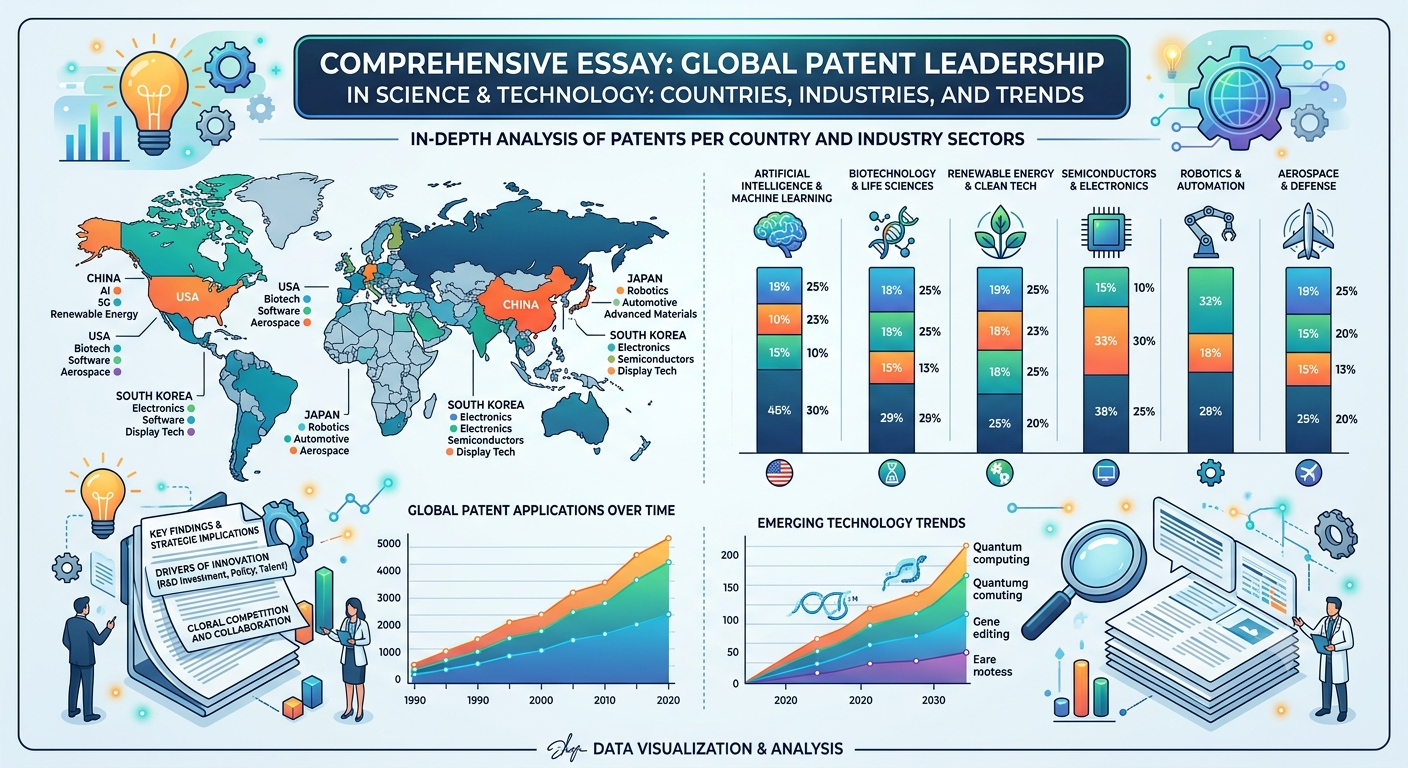
The largest patent-filing countries by annual applications are approximately:
| Rank | China | Approx. Annual Patent Applications | Global Strength |
|---|---|---|---|
| 1 | China | 1.6–1.8 million | Manufacturing, AI, telecommunications, batteries |
| 2 | United States | 550,000–650,000 | Software, biotech, aerospace, semiconductors |
| 3 | Japan | 300,000+ | Robotics, automotive, electronics |
| 4 | South Korea | 250,000+ | Memory chips, displays, consumer electronics |
| 5 | Germany | 180,000+ | Engineering, automotive, industrial machinery |
| 6 | India | Rapidly growing | Digital technology, pharmaceuticals |
| 7 | France | Strong | Aerospace, energy, transportation |
| 8 | United Kingdom | Strong | Life sciences, AI, pharmaceuticals |
| 9 | Switzerland | High quality | Pharmaceuticals, medical technology |
| 10 | Netherlands | High quality | Lithography, electronics, photonics |
Industry Leadership by Country
1. Artificial Intelligence (AI)
Leading countries:
- United States
- China
- United Kingdom
- Canada
- Israel
Key strengths include:
- Large language models
- Computer vision
- Autonomous systems
- Healthcare AI
- AI chips
- Robotics
Major patent holders include companies such as OpenAI’s partners, Google, Microsoft, NVIDIA, IBM, Baidu, Tencent, and Alibaba.
2. Semiconductor Technology
Leading countries:
- United States
- Taiwan
- South Korea
- Japan
- Netherlands
Patent areas include:
- Chip architecture
- Extreme ultraviolet (EUV) lithography
- Memory technology
- Chip packaging
- AI processors
- Electronic design automation (EDA)
3. Telecommunications
Leaders:
- China
- Sweden
- Finland
- South Korea
- United States
These countries dominate patents related to:
- 5G
- Early 6G research
- Satellite communications
- Internet of Things (IoT)
- Mobile network infrastructure
4. Biotechnology
Leading countries:
- United States
- Switzerland
- Germany
- United Kingdom
- France
Patent areas:
- Gene editing
- DNA sequencing
- Personalized medicine
- Cell therapy
- Synthetic biology
5. Pharmaceuticals
Leading countries:
- United States
- Switzerland
- Germany
- United Kingdom
- Japan
Key innovations:
- Cancer drugs
- Vaccines
- Antibiotics
- Precision medicine
- Rare disease treatments
6. Robotics
Leading countries:
- Japan
- South Korea
- China
- Germany
- United States
Applications include:
- Industrial robots
- Surgical robots
- Warehouse automation
- Humanoid robots
- Agricultural robotics
7. Electric Vehicles and Batteries
Leading countries:
- China
- South Korea
- Japan
- Germany
- United States
Key patent areas:
- Lithium-ion batteries
- Solid-state batteries
- Battery management systems
- Electric motors
- Fast charging
8. Aerospace
Leading countries:
- United States
- France
- United Kingdom
- Germany
- China
Patents cover:
- Aircraft engines
- Satellites
- Rockets
- Spacecraft
- Advanced composites
- Navigation systems
9. Renewable Energy
Leading countries:
- China
- Germany
- Denmark
- United States
- Japan
Patent areas:
- Solar cells
- Wind turbines
- Hydrogen
- Grid storage
- Smart grids
10. Quantum Technology
Leading countries:
- United States
- China
- Canada
- Germany
- United Kingdom
Key patent fields:
- Quantum computers
- Quantum communications
- Quantum sensing
- Quantum encryption
Why These Countries Lead
Common characteristics include:
- High investment in R&D (often 2–5% of GDP or more).
- Strong universities and research institutes.
- Government support for innovation.
- Robust intellectual property laws.
- Collaboration between academia and industry.
- Access to venture capital and skilled talent.
- Advanced manufacturing capabilities.
Emerging Patent Powers
Several countries are rapidly increasing their patent activity:
- India – software, pharmaceuticals, space technology.
- Singapore – biotechnology, electronics, fintech.
- Israel – cybersecurity, AI, medical devices.
- United Arab Emirates – AI, clean energy, smart cities.
- Saudi Arabia – energy technologies and industrial innovation.
Africa’s Patent Landscape
Patent activity across Africa is smaller than that of the world’s leading innovation economies, but several countries have active research and innovation ecosystems:
- South Africa – mining technology, medical research, renewable energy, agricultural innovation.
- Egypt – pharmaceuticals, engineering, electronics.
- Morocco – automotive manufacturing, renewable energy.
- Kenya – agricultural technology and digital innovation.
- Nigeria – fintech, software, digital services.
Conclusion
The global patent landscape reflects where countries are investing in the future. China leads in overall patent volume and is particularly strong in telecommunications, batteries, renewable energy, and manufacturing technologies. United States remains a leader in high-impact innovation across AI, biotechnology, pharmaceuticals, aerospace, and advanced semiconductors. Japan, South Korea, and Germany continue to dominate industrial engineering, robotics, electronics, and automotive technologies.
Looking ahead to the 2030s and beyond, competition for leadership in AI, quantum computing, biotechnology, advanced chips, clean energy, and space technologies is expected to define the next era of scientific and technological progress. These fields will likely generate the largest share of valuable patents and shape the global economy for decades to come.

Be First to Comment