
A Comprehensive Tutorial and Scientific Essay
Understanding the Electrical Network That Powers Human Life
- Introduction
- What Is Bioelectricity?
- History of Human Bioelectricity
- The Physics Behind Body Electricity
- Sources of Electrical Energy
- Electrical Properties of Cells
- Sodium-Potassium Pump
- Ion Channels
- Cell Membrane Potential
- Action Potentials
- Electrical Communication Between Neurons
- Brain Electrical System
- Spinal Cord Electrical System
- Peripheral Nervous System
- Electrical Control of Muscles
- Electrical Control of the Heart
- Electrical System of Internal Organs
- Hormones and Electrical Signals
- The Immune System and Bioelectricity
- Electrical Healing and Tissue Repair
- Factors That Damage Electrical Circulation
- Improving Electrical Health
- Future Medical Technologies
- Summary
- Conclusion
Chapter 1
Introduction
The human body is often compared to a biological machine. While muscles, bones, blood vessels, and organs receive much attention, one of the most remarkable systems is largely invisible—the body’s electrical system.
Every heartbeat, every breath, every movement, every thought, every memory, and every sensation depends on electricity.
Unlike electricity in household wiring, the body’s electricity is produced naturally by billions of living cells. Every second, tiny electrical currents travel throughout the body, coordinating communication among approximately 37 trillion cells.
Without this electrical circulation:
- The brain cannot think.
- The heart cannot beat.
- Muscles cannot move.
- Eyes cannot see.
- Ears cannot hear.
- Nerves cannot transmit pain or touch.
- Organs cannot function normally.
Electricity is therefore one of the foundations of life.
Chapter 2
What Is Bioelectricity?
Bioelectricity refers to the electrical phenomena generated by living organisms.
Every cell functions like a miniature battery.
Inside every cell are charged particles called ions.
The most important ions include:
- Sodium (Na⁺)
- Potassium (K⁺)
- Calcium (Ca²⁺)
- Chloride (Cl⁻)
- Magnesium (Mg²⁺)
Because these ions are unevenly distributed inside and outside cells, a voltage difference exists across the cell membrane.
Typical resting membrane voltage:
- approximately –70 millivolts (mV) in neurons
Although tiny, this voltage is essential for life.
Electrical Potential
Electrical potential is stored energy.
Just as water behind a dam stores potential energy, cells store electrical energy across their membranes.
When needed, this stored energy is released rapidly to create electrical impulses.
Human Body as a Giant Electrical Network
The human nervous system contains approximately:
- 86 billion neurons
- Hundreds of trillions of synapses
Each neuron communicates using electrical signals.
Collectively, these signals create one of the most sophisticated electrical communication systems known.
Chapter 3
History of Bioelectricity
Ancient civilizations noticed electrical effects from electric fish, but modern understanding began much later.
Important milestones include:
- Ancient observations of electric rays and electric eels.
- Luigi Galvani (1780s): showed that frog muscles could contract using electrical stimulation, leading to the concept of “animal electricity.”
- Alessandro Volta: challenged Galvani’s interpretation and invented the first electric battery.
- Hermann von Helmholtz: measured the speed of nerve impulses.
- Alan Hodgkin and Andrew Huxley: explained how nerve impulses are generated through ion movements, work that earned the Nobel Prize.
Today, bioelectricity underpins fields such as neuroscience, cardiology, rehabilitation, and bioengineering.
Chapter 4
The Physics Behind Human Electricity
The body’s electrical activity follows the same physical laws that govern electrical circuits.
Key concepts include:
Voltage (V): the electrical pressure that drives current.
Current (I): the flow of charged particles.
Resistance (R): opposition to electrical flow.
Conductivity: how easily electricity moves through tissues.
Different tissues conduct electricity differently:
| Tissue | Conductivity |
|---|---|
| Blood | Very high |
| Muscle | High |
| Brain | High |
| Skin | Moderate (varies with moisture) |
| Fat | Low |
| Bone | Very low |
This is why electrical signals follow preferred pathways through the body.
The Cell Membrane as a Capacitor
Each cell membrane acts like a tiny capacitor, storing electrical charge until it is needed.
With trillions of cells acting together, the body forms a vast network of microscopic electrical storage units that enable rapid communication.
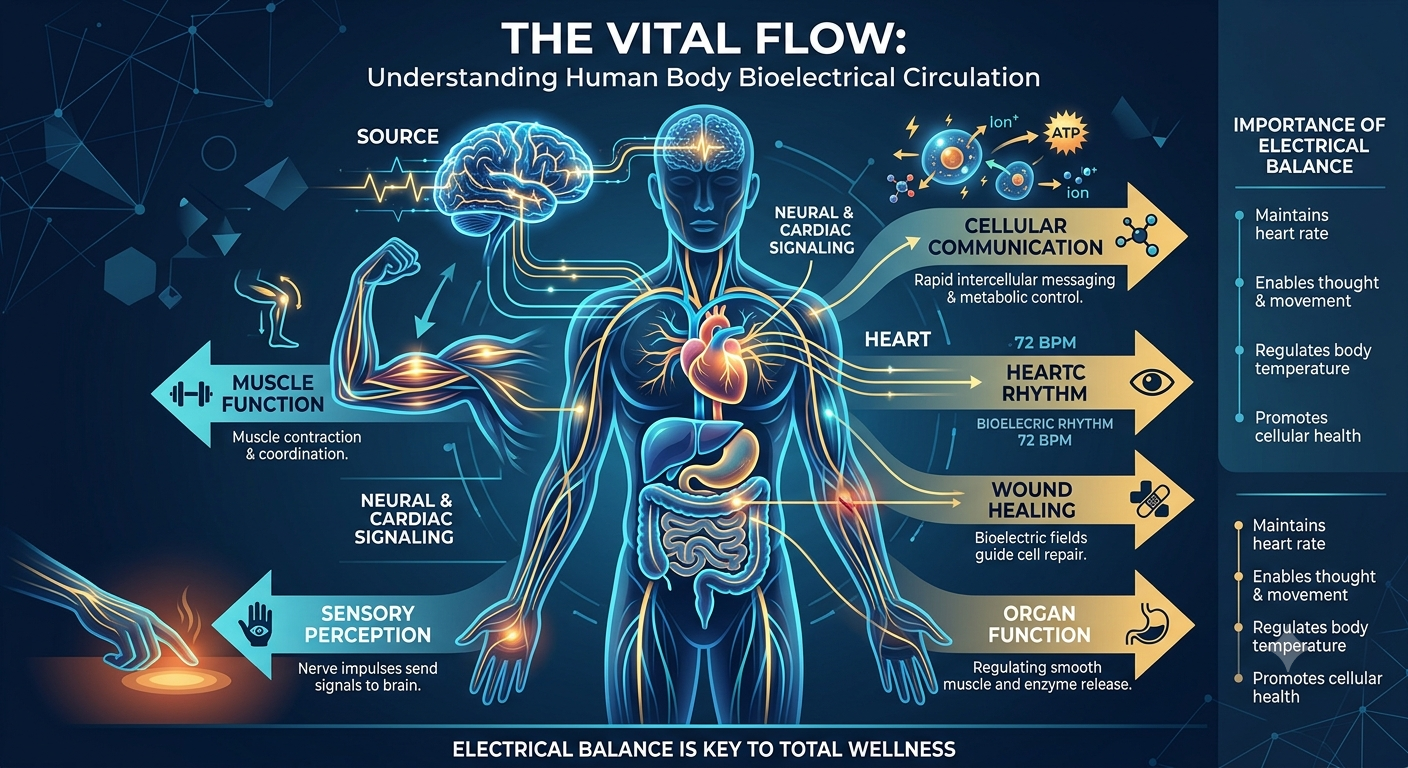
Why Electrical Circulation Matters
Electrical circulation allows the body to:
- Coordinate heartbeat and blood circulation.
- Control breathing rhythms.
- Process sensory information.
- Form thoughts and memories.
- Initiate muscle movement.
- Regulate hormone release.
- Support digestion.
- Aid wound healing and tissue repair.
- Maintain internal balance (homeostasis).
Even brief disruptions in electrical signaling can have serious consequences, such as irregular heart rhythms, seizures, paralysis, or loss of consciousness.
Key Takeaways
The human body is not only a chemical and mechanical system but also an electrical one. Bioelectricity is generated by ion movement across cell membranes and is fundamental to communication between cells, tissues, and organs. From the firing of neurons to the coordinated contraction of the heart, electrical circulation enables virtually every aspect of human life.




Be First to Comment