
Introduction
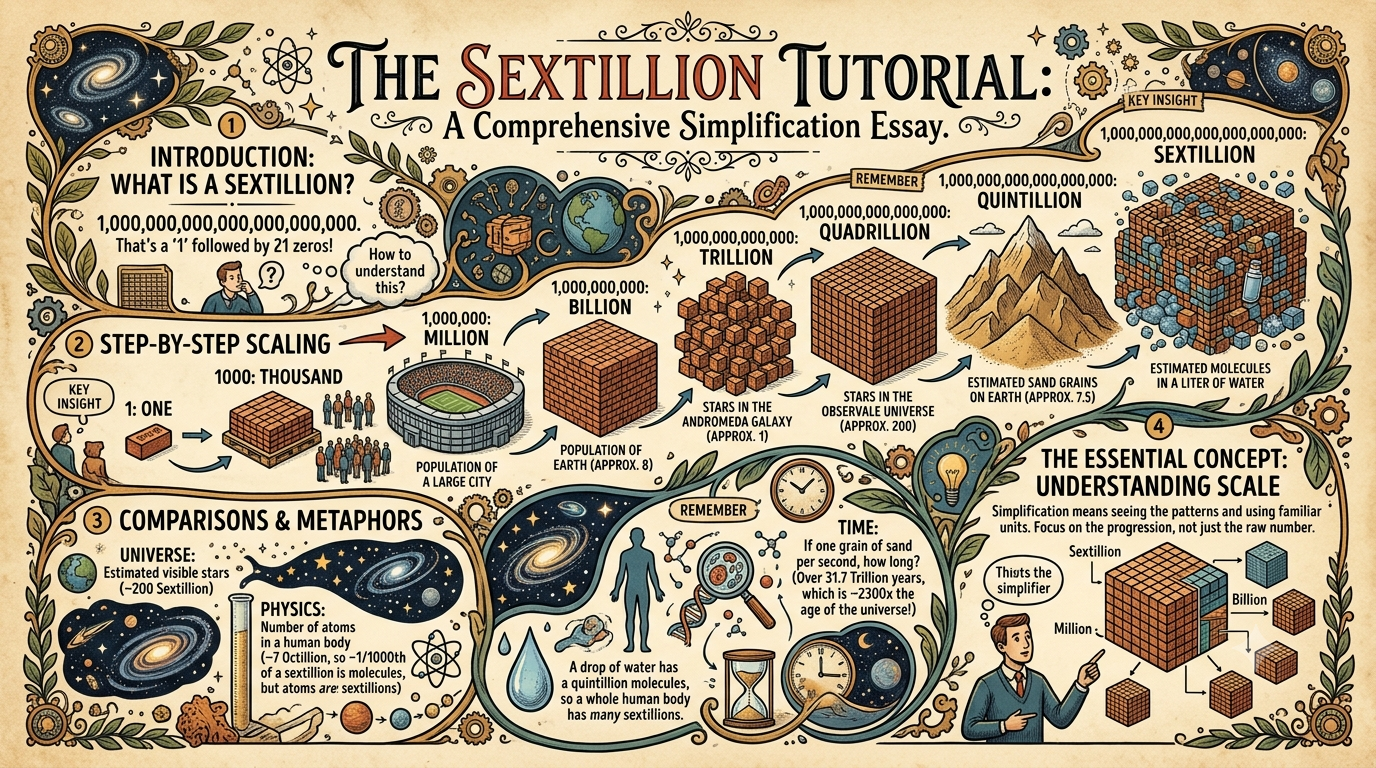
A sextillion is an extremely large number. It belongs to a family of very large numbers that humans created to describe quantities far beyond everyday experience. Scientists, astronomers, economists, engineers, and computer scientists sometimes work with numbers that reach into the sextillions or beyond.
Although a sextillion seems impossible to imagine, it follows a simple mathematical pattern.
Chapter 1: What is a Sextillion?
A sextillion is:
1,000,000,000,000,000,000,000
This is:
1 followed by 21 zeros.
Written with commas:
1,000,000,000,000,000,000,000
Scientific notation:
10²¹
This means
10 × 10 × 10 × … (21 times)
Chapter 2: Counting to a Sextillion
Let’s build up slowly.
| Number | Value | Powers of Ten |
|---|---|---|
| Ten | 10 | 10¹ |
| Hundred | 100 | 10² |
| Thousand | 1,000 | 10³ |
| Million | 1,000,000 | 10⁶ |
| Billion | 1,000,000,000 | 10⁹ |
| Trillion | 10¹² | 1 with 12 zeros |
| Quadrillion | 10¹⁵ | 1 with 15 zeros |
| Quintillion | 10¹⁸ | 1 with 18 zeros |
| Sextillion | 10²¹ | 1 with 21 zeros |
Every new “-illion” adds three more zeros (in the modern short scale used in countries such as South Africa and the United States).
Chapter 3: Understanding the Zeros
A sextillion looks like this:
1
000
000
000
000
000
000
000
There are seven groups of three digits after the leading 1, making 21 zeros.
Grouping digits into threes makes large numbers much easier to read.
Chapter 4: Scientific Notation
Scientists usually avoid writing all the zeros.
Instead they write:
10²¹
Examples:
- 2 sextillion = 2 × 10²¹
- 8 sextillion = 8 × 10²¹
- 450 sextillion = 4.5 × 10²³
Scientific notation saves space and reduces errors.
Chapter 5: The Place Value Ladder
| Name | Power of Ten |
|---|---|
| Ones | 10⁰ |
| Tens | 10¹ |
| Hundreds | 10² |
| Thousands | 10³ |
| Millions | 10⁶ |
| Billions | 10⁹ |
| Trillions | 10¹² |
| Quadrillions | 10¹⁵ |
| Quintillions | 10¹⁸ |
| Sextillions | 10²¹ |
Every step upward represents a thousandfold increase after the million level.
Chapter 6: Comparing Large Numbers
Imagine one grain of rice represents one unit.
- One million grains would fill a small container.
- One billion grains would fill a large warehouse.
- One trillion grains would cover enormous areas.
- One sextillion grains would be unimaginably vast—far beyond what could practically be stored or counted.
These comparisons illustrate why sextillions are difficult to visualize.
Chapter 7: Where Sextillions Appear
Although everyday life rarely involves sextillions, they appear in advanced fields.
Physics
Very large numbers arise when counting tiny particles or describing extremely large systems.
Chemistry
A sample of matter can contain astonishing numbers of atoms or molecules.
Astronomy
Large-scale estimates involving stars, particles, or cosmic processes can approach or exceed sextillion-sized values.
Computer Science
High-performance computing, cryptography, and massive datasets sometimes involve calculations with numbers this large.
Economics
Very long-term economic projections or cumulative financial calculations may occasionally use sextillion-scale figures.
Chapter 8: Everyday Examples
If every person on Earth counted one number every second without stopping, reaching a sextillion would take far longer than the current age of the universe.
This illustrates how enormous a sextillion truly is.
Chapter 9: Relationship to Other Large Numbers
| Name | Zeros |
|---|---|
| Thousand | 3 |
| Million | 6 |
| Billion | 9 |
| Trillion | 12 |
| Quadrillion | 15 |
| Quintillion | 18 |
| Sextillion | 21 |
| Septillion | 24 |
| Octillion | 27 |
| Nonillion | 30 |
| Decillion | 33 |
Each step adds three zeros.
Chapter 10: Memory Trick
Remember this sequence:
- Million = 6 zeros
- Billion = 9 zeros
- Trillion = 12 zeros
- Quadrillion = 15 zeros
- Quintillion = 18 zeros
- Sextillion = 21 zeros
A simple rule:
Every new “-illion” after million adds three more zeros.
Chapter 11: Why We Need Such Large Numbers
Large numbers help us:
- Describe the universe.
- Measure microscopic particles.
- Model scientific phenomena.
- Design advanced technologies.
- Perform large-scale computer simulations.
- Conduct research in mathematics and engineering.
Without names like sextillion, expressing these quantities would be cumbersome.
Chapter 12: Frequently Asked Questions
Is a sextillion real?
Yes. It is a defined numerical value used in mathematics and science.
How many zeros does it have?
21 zeros.
How is it written in scientific notation?
10²¹.
What comes before a sextillion?
Quintillion (10¹⁸).
What comes after a sextillion?
Septillion (10²⁴).
Summary
A sextillion is:
- 1,000,000,000,000,000,000,000
- 10²¹
- 1 followed by 21 zeros
- Larger than a quintillion and smaller than a septillion.
- Used primarily in mathematics, science, astronomy, computing, and engineering to represent extraordinarily large quantities.
Understanding a sextillion is less about memorizing an enormous number and more about recognizing the place-value pattern that governs our number system. Once you understand powers of ten and the way each “-illion” increases by three zeros, even numbers as large as a sextillion become logical and manageable.






Be First to Comment