
Abstract
The Universe is the largest known physical system. Despite centuries of astronomical discoveries, scientists still do not know the full size of the entire Universe. What modern astronomy can measure with confidence is the observable universe—the region whose light has had enough time to reach Earth since the Universe began approximately 13.8 billion years ago. Modern observatories such as the James Webb Space Telescope, Hubble Space Telescope, European Space Agency, and NASA have dramatically improved our understanding of how many galaxies, stars, and planets exist.
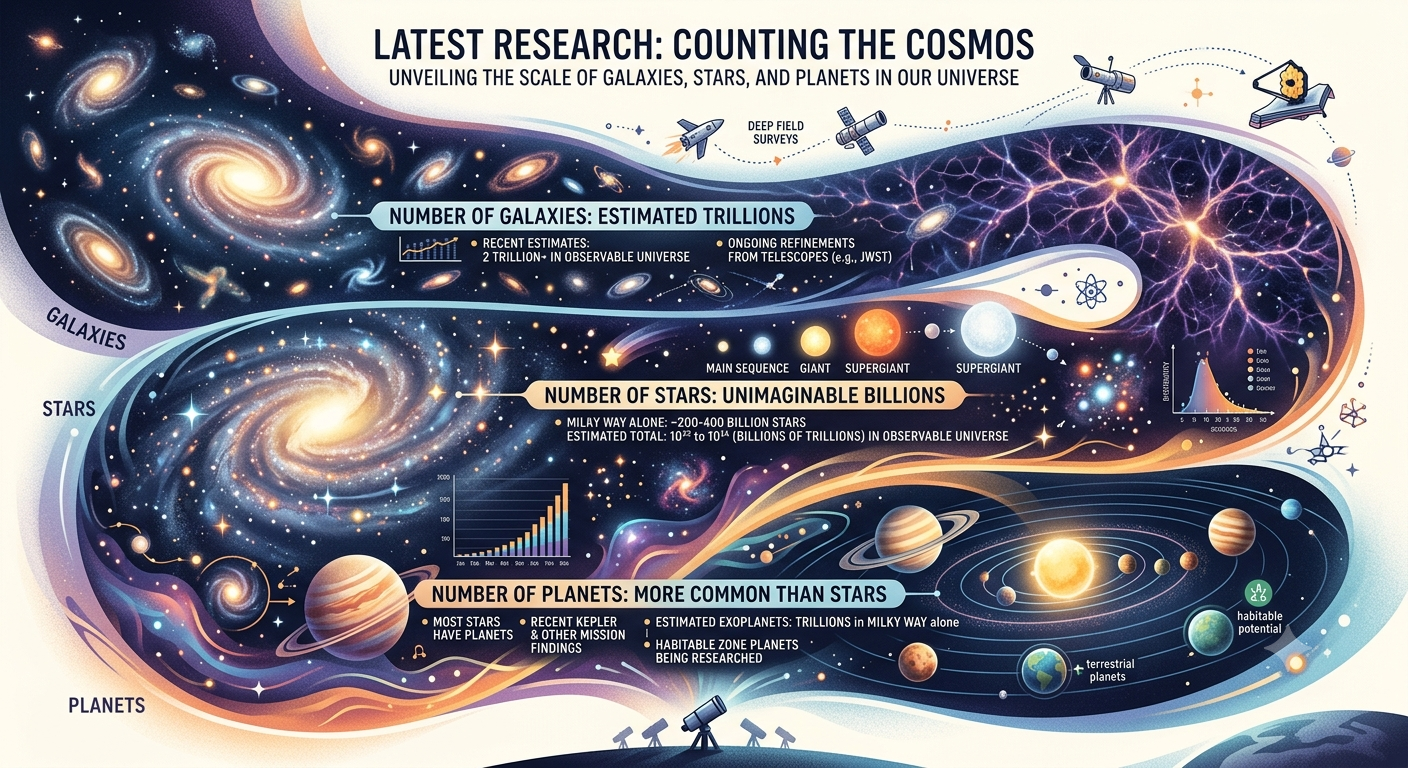
The latest research suggests that the observable universe contains around 1–2 trillion galaxies, about one septillion (10²⁴) stars, and likely even more planets than stars, making planets among the most abundant large objects in the cosmos. (NASA)
1. The Observable Universe
Scientists distinguish between:
- The Observable Universe – everything whose light has reached us.
- The Entire Universe – everything that exists, including regions forever beyond our view.
Current measurements indicate:
- Age: 13.8 billion years
- Diameter of the observable universe: about 93 billion light-years
- Radius: about 46.5 billion light-years
Because space itself expands, the observable universe is much larger than simply 13.8 billion light-years across. (NASA)
2. How Many Galaxies Exist?
Earlier Estimate
During the 1990s, astronomers estimated:
- approximately 100–200 billion galaxies
This estimate came from early deep-field observations.
Modern Estimate
Using improved statistical models and ultra-deep observations, astronomers now estimate:
- 1–2 trillion galaxies in the observable universe.
Many of these are extremely faint dwarf galaxies beyond the reach of current telescopes. (NASA Science)
Why the Number Increased
Modern telescopes revealed that:
- many galaxies are tiny
- many are extremely dim
- many existed only in the early universe
- many have merged into larger galaxies over billions of years
Scientists expect future observatories to detect many of these hidden galaxies.
3. Anatomy of a Galaxy
A typical galaxy contains:
- billions to trillions of stars
- planets
- gas clouds
- dust
- black holes
- nebulae
- dark matter
- star clusters
Examples include:
- Milky Way
- Andromeda Galaxy
- Triangulum Galaxy
4. How Many Stars Exist?
Our own Milky Way contains roughly:
- 100–400 billion stars
Across all galaxies, astronomers estimate approximately:
1 septillion stars
That is:
1,000,000,000,000,000,000,000,000 stars (10²⁴).
To appreciate this scale:
- more stars exist than grains of sand on all Earth’s beaches. (NASA Science)
5. Types of Stars
Major stellar categories include:
- Red dwarfs
- Yellow dwarfs (like the Sun)
- Blue giants
- Red giants
- White dwarfs
- Neutron stars
- Pulsars
- Magnetars
- Brown dwarfs
- Supergiants
Each follows a life cycle from birth in nebulae to eventual stellar remnants.
6. How Many Planets Exist?
Planet numbers are harder to count directly because most are too small and dim to observe.
Current evidence suggests:
- nearly every star hosts at least one planet on average
- many stars host multiple planets
This implies there are at least about 10²⁴ planets in the observable universe, and possibly several times more. (NASA Science)
7. Planetary Diversity
Astronomers have identified many types of planets:
- Rocky planets
- Gas giants
- Ice giants
- Ocean worlds
- Lava worlds
- Desert planets
- Super-Earths
- Mini-Neptunes
- Rogue planets (not orbiting any star)
Only a tiny fraction have been directly studied.
8. Confirmed Exoplanets
Thousands of planets beyond our Solar System have already been confirmed, with many thousands more awaiting confirmation.
Modern space telescopes continue to discover new planetary systems every year. (Reuters)
9. How Scientists Estimate Cosmic Numbers
Astronomers combine:
- deep-field telescope images
- galaxy surveys
- infrared observations
- statistical modeling
- computer simulations
- cosmological theory
Projects such as the COSMOS-Web survey with the James Webb Space Telescope and the DESI project are producing the largest maps of the universe ever assembled. (Phys.org)
10. Major Modern Observatories
Leading observatories include:
- James Webb Space Telescope
- Hubble Space Telescope
- Vera C. Rubin Observatory
- European Southern Observatory
- Square Kilometre Array Observatory
- European Space Agency
- NASA
These facilities are expected to refine galaxy and star counts over the coming decade.
11. Current Best Estimates
| Cosmic Object | Estimated Number |
|---|---|
| Galaxies | 1–2 trillion |
| Stars | ~1 septillion (10²⁴) |
| Planets | At least ~10²⁴, likely several times more |
| Confirmed exoplanets | Thousands, with many more candidates |
12. Remaining Mysteries
Scientists are still investigating:
- the true size of the entire universe
- whether the universe is finite or infinite
- how the earliest galaxies formed
- the nature of dark matter
- the nature of dark energy
- how common life-bearing planets may be
These questions remain among the biggest unsolved problems in modern cosmology. (NASA)
Conclusion
Modern astronomy reveals a universe of astonishing scale. Current evidence indicates that the observable universe contains approximately 1–2 trillion galaxies, around one septillion stars (10²⁴), and at least as many planets, with likely several planets for many stars. These estimates continue to improve as new observatories map ever larger and fainter regions of the cosmos.
The coming years promise even greater discoveries. New surveys from the Vera C. Rubin Observatory, the James Webb Space Telescope, and other next-generation instruments are expected to uncover millions of previously unseen galaxies and deepen our understanding of the origin, evolution, and ultimate fate of the Universe. (rubinobservatory.org)



Be First to Comment