
Introduction
The human circulatory system is one of the most remarkable transportation networks in nature. Every second of every day, blood travels through an intricate network of arteries, veins, and capillaries, delivering oxygen, nutrients, hormones, immune cells, and removing waste products from every organ. If this circulation stopped for only a few minutes, the brain and other vital organs would begin to suffer irreversible damage.
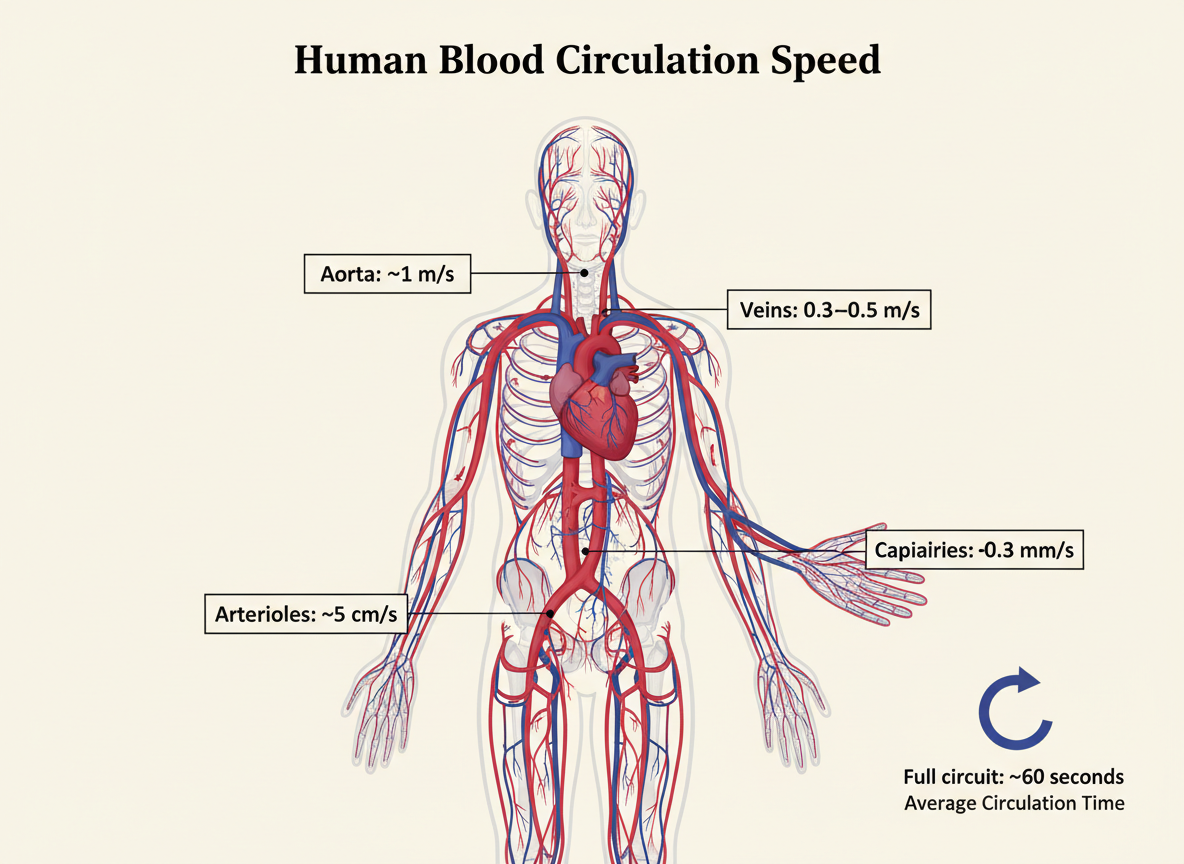
Blood does not travel at one constant speed throughout the body. Instead, its speed changes depending on the type of blood vessel, the size of the vessel, and the body’s activity level.
The Human Circulatory System
An average adult has:
- Heart: 1 muscular pump
- Blood volume: Approximately 5 liters
- Blood vessels: Around 100,000 km long
- Heart rate: 60–100 beats per minute (about 70 bpm at rest)
- Cardiac output: Approximately 5 liters per minute at rest
This means that the heart pumps the body’s entire blood volume approximately once every minute while resting.
Blood Speed Per Second
Blood velocity varies dramatically.
| Blood Vessel | Average Speed |
|---|---|
| Aorta | 30–50 cm/s (0.3–0.5 m/s) |
| Large arteries | 20–40 cm/s |
| Small arteries | 10–20 cm/s |
| Arterioles | 1–5 cm/s |
| Capillaries | 0.03–0.1 cm/s |
| Venules | 0.2–1 cm/s |
| Large veins | 5–20 cm/s |
| Vena cava | 20–30 cm/s |
The fastest blood flow occurs immediately after the heart ejects blood into the aorta.
Understanding Blood Speed
At rest:
- Blood leaves the left ventricle.
- It enters the aorta at nearly 0.5 metres per second.
- It slows considerably as vessels branch into millions of tiny capillaries.
- It speeds up again as veins merge and return blood to the heart.
This changing speed is essential for efficient circulation.
Blood Circulation Time
Average circulation times:
- Heart → Brain → Heart:
- 15–20 seconds
- Heart → Lungs → Heart:
- 6–10 seconds
- Complete body circulation:
- About 45–60 seconds at rest
During exercise:
- 15–30 seconds for a full circulation is possible because of the increased heart rate and cardiac output.
Blood Pumped Every Second
Resting adult:
Cardiac output:
- 5 litres/minute
Therefore:
- ≈83 millilitres every second
During intense exercise:
Elite athletes may reach:
- 30–40 litres/minute
Equivalent to:
- 500–670 millilitres every second
Heart Pumping Speed
Average resting heart:
- 70 beats/minute
Therefore:
- About 1.17 beats every second
During vigorous exercise:
- 180–200 beats/minute
Equivalent to:
- Around 3.3 beats every second
Why Blood Slows in Capillaries
Capillaries are extremely narrow.
Blood slows to approximately:
- 0.03–0.1 cm/s
This slow speed allows:
- Oxygen diffusion
- Nutrient delivery
- Carbon dioxide removal
- Hormone exchange
- Immune surveillance
- Waste removal
If blood moved too quickly through capillaries, tissues would receive insufficient oxygen and nutrients.
Blood Speed in Major Organs
Brain
The brain receives approximately:
- 15–20% of cardiac output
Continuous blood flow is critical because brain cells have minimal energy reserves.
Heart
The heart supplies itself through the coronary arteries, receiving roughly:
- 4–5% of total cardiac output
Coronary blood flow increases substantially during physical activity.
Kidneys
Kidneys receive:
- 20–25% of cardiac output
This high flow supports filtration and regulation of body fluids.
Liver
The liver receives blood from:
- Hepatic artery
- Portal vein
Together they supply roughly:
- 25% of resting cardiac output
Blood Flow During Exercise
Exercise produces several changes:
- Heart beats faster.
- Stroke volume increases.
- Blood pressure rises moderately.
- Blood vessels supplying muscles dilate.
- Blood is redirected away from less active organs.
- Total blood flow increases several-fold.
Elite endurance athletes can pump six to eight times more blood per minute than at rest.
Blood Pressure and Flow
Blood movement depends on pressure generated by the heart.
Typical resting blood pressure:
- Approximately 120/80 mmHg
Pressure decreases progressively from arteries to capillaries and veins.
Oxygen Transport
Each second, blood transports:
- Oxygen to tissues
- Glucose to cells
- Amino acids
- Fatty acids
- Vitamins
- Hormones
- Immune cells
- Heat
It simultaneously removes:
- Carbon dioxide
- Urea
- Metabolic waste
- Excess heat
Red Blood Cell Journey
An individual red blood cell typically completes one full circulation in about one minute at rest.
Over its lifespan of approximately 120 days, a red blood cell may travel hundreds of thousands of kilometres through the body’s vascular network.
Factors Affecting Blood Speed
Blood flow changes according to:
- Age
- Fitness level
- Body temperature
- Hydration
- Emotional stress
- Blood pressure
- Blood vessel diameter
- Blood viscosity
- Disease
- Physical activity
Diseases That Reduce Blood Flow
Reduced circulation may result from:
- Atherosclerosis
- Hypertension
- Heart failure
- Diabetes
- Peripheral artery disease
- Stroke
These conditions impair oxygen delivery and can damage organs if untreated.
Amazing Circulation Facts
- The circulatory system contains about 100,000 km of blood vessels.
- The heart beats approximately 100,000 times each day.
- It pumps roughly 7,000–8,000 litres of blood daily in a resting adult.
- During a lifetime, the heart beats more than 2.5 billion times.
- Blood flow adjusts automatically to meet the needs of different organs.
- Blood spends only fractions of a second in large arteries but much longer in capillaries, where exchange occurs.
Conclusion
The human circulatory system is a highly adaptive transport network. Blood may travel as fast as 0.5 metres per second in the aorta but slow to only 0.03–0.1 centimetres per second in capillaries to allow efficient exchange of oxygen, nutrients, and waste products. At rest, the heart pumps about 83 millilitres of blood every second, circulating the body’s entire blood volume in roughly one minute. During strenuous exercise, this output can increase six- to eight-fold, demonstrating the remarkable capacity of the cardiovascular system to meet changing physiological demands.
The precise regulation of blood speed and circulation is fundamental to sustaining life, supporting every organ, and enabling the human body to adapt continuously to rest, activity, and environmental challenges.



Be First to Comment