
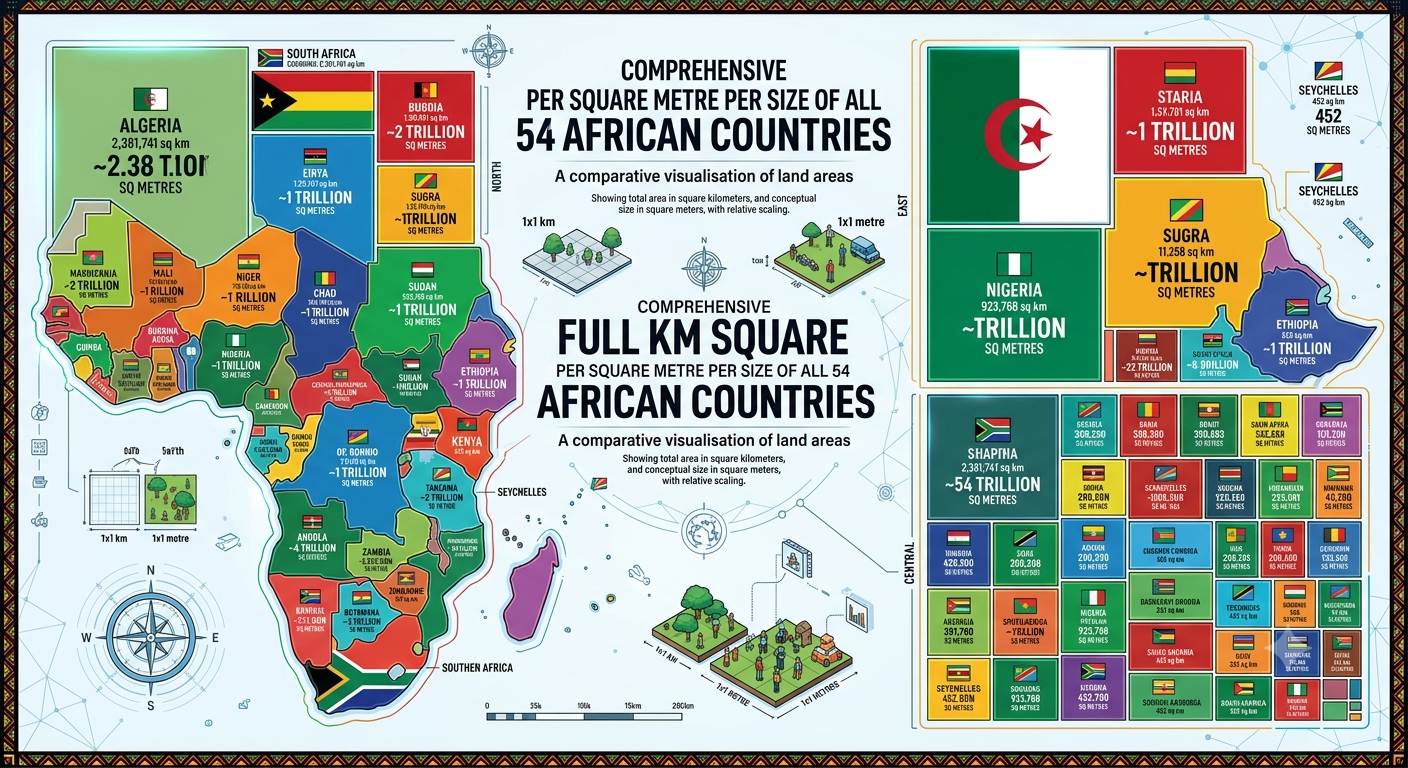
Understanding the Size of Africa
Africa is the world’s second-largest continent, covering approximately 30.37 million square kilometres (30,370,000 km²), or about 30.37 trillion square metres (30,370,000,000,000 m²). It represents around 20% of Earth’s total land area and is home to 54 sovereign countries, each contributing to one of the most geographically diverse continents on Earth.
From the vast Sahara Desert in the north to the lush rainforests of Central Africa and the mountain ranges of East Africa, the continent contains an extraordinary variety of landscapes, climates, ecosystems, and natural resources.
How Land Area Is Measured
Land area is commonly measured using several units:
- 1 square kilometre (km²) = 1,000,000 square metres (m²)
- 1 hectare = 10,000 m²
- 100 hectares = 1 km²
- 1 square mile = 2.58999 km²
Governments, scientists, engineers, urban planners, and environmental researchers rely on these measurements for infrastructure planning, agriculture, conservation, transportation, and economic development.
The Ten Largest Countries in Africa
The largest countries by land area are:
| Rank | Country | Area (km²) |
|---|---|---|
| 1 | Algeria | 2,381,741 |
| 2 | Democratic Republic of the Congo | 2,344,858 |
| 3 | Sudan | 1,861,484 |
| 4 | Libya | 1,759,541 |
| 5 | Chad | 1,284,000 |
| 6 | Niger | 1,267,000 |
| 7 | Angola | 1,246,700 |
| 8 | Mali | 1,240,192 |
| 9 | South Africa | 1,221,037 |
| 10 | Ethiopia | 1,104,300 |
These ten countries account for well over half of Africa’s total land area and contain vast deserts, forests, rivers, mountains, agricultural regions, and mineral resources.
The Smallest Countries in Africa
While some African nations cover millions of square kilometres, others are relatively compact.
The five smallest sovereign countries are:
- Seychelles – 452 km²
- São Tomé and Príncipe – 964 km²
- Mauritius – 2,040 km²
- Comoros – 2,235 km²
- Cabo Verde – 4,033 km²
Despite their small size, these island nations play important roles in tourism, marine conservation, fisheries, finance, and international trade.
Africa’s Five Geographic Regions
North Africa
Dominated by the Sahara Desert, North Africa includes Algeria, Egypt, Libya, Morocco, Tunisia, and neighboring countries. The region is known for its deserts, Mediterranean coastline, ancient civilizations, and abundant solar energy potential.
West Africa
West Africa contains rapidly growing economies, fertile agricultural land, extensive river systems, and a young population driving innovation and entrepreneurship.
Central Africa
Central Africa hosts the Congo Basin, the world’s second-largest tropical rainforest after the Amazon. This region stores enormous amounts of carbon and supports exceptional biodiversity.
East Africa
East Africa is famous for the Great Rift Valley, Mount Kilimanjaro, the Serengeti ecosystem, rich wildlife, and expanding technology sectors.
Southern Africa
Southern Africa combines advanced industrial economies, mineral wealth, modern infrastructure, and internationally recognized conservation areas.
Why Land Area Matters
A country’s land area influences many aspects of national development, including:
- Agriculture and food security
- Water resources
- Urban planning
- Biodiversity conservation
- Transportation infrastructure
- Mining and natural resources
- Renewable energy potential
- Population distribution
- National security
- Climate resilience
Large countries often possess abundant natural resources but face higher infrastructure costs, while smaller countries can sometimes provide services more efficiently due to shorter travel distances.
Interesting Facts About African Geography
- Africa spans all four hemispheres.
- The Equator crosses the continent.
- The Sahara is the largest hot desert on Earth.
- The Congo Basin is one of the world’s most important carbon sinks.
- The Nile is among the longest river systems on the planet.
- Lake Victoria is Africa’s largest lake by surface area.
- Africa contains thousands of protected areas, national parks, and UNESCO World Heritage Sites.
Looking Ahead
Africa’s geography will continue to shape its future. Rapid urbanization, climate adaptation, renewable energy projects, improved transport corridors, and digital connectivity are transforming how land is used across the continent. Investments in sustainable agriculture, smart cities, conservation, and infrastructure will help ensure that Africa’s vast landscapes continue to support economic growth while protecting the environment.
Final Thoughts
Africa’s 54 sovereign nations vary enormously in size—from Algeria’s immense desert landscapes to the island nation of Seychelles. Together, they form a continent of remarkable geographic diversity, rich natural resources, vibrant cultures, and growing economic opportunity.
Understanding the size and distribution of African countries is more than an academic exercise. It provides insight into development, environmental stewardship, infrastructure planning, trade, and the future of one of the world’s most dynamic continents. As Africa’s population and economies continue to grow, its geography will remain one of its greatest strategic assets.
Africa is home to 54 sovereign nations, each with its own geography, climate, natural resources, culture, and economic strengths. This series explores each country individually, highlighting what makes it unique.
1. Algeria
Capital: Algiers
Area: 2,381,741 km²
Algeria is Africa’s largest country by land area. Located in North Africa, nearly 80% of its territory is covered by the Sahara Desert. The country has abundant oil and natural gas reserves, a Mediterranean coastline, and a rich history influenced by Berber, Arab, Roman, and Ottoman civilizations. Algeria is investing in renewable energy, particularly solar power, to complement its energy exports.
2. Angola
Capital: Luanda
Area: 1,246,700 km²
Angola lies on Africa’s southwestern coast. It is rich in petroleum, diamonds, fertile farmland, and freshwater resources. Since the end of its civil war, Angola has expanded its infrastructure, transportation networks, and economic diversification while maintaining one of Africa’s largest oil industries.
3. Benin
Capital: Porto-Novo (official), Cotonou (government seat)
Area: 114,763 km²
Benin is known for its political stability, vibrant cultural traditions, and growing agricultural sector. Cotton remains one of its most important exports, while tourism is increasingly supported by historical sites and national parks.
4. Botswana
Capital: Gaborone
Area: 581,730 km²
Botswana has earned international recognition for responsible governance, wildlife conservation, and sustainable diamond management. The Okavango Delta, one of the world’s largest inland wetlands, supports remarkable biodiversity and eco-tourism.
5. Burkina Faso
Capital: Ouagadougou
Area: 274,200 km²
Burkina Faso is a landlocked nation whose economy relies heavily on agriculture and gold mining. Despite environmental and security challenges, the country continues to invest in education, renewable energy, and rural development.
6. Burundi
Capital: Gitega
Area: 27,834 km²
Burundi is one of Africa’s most densely populated countries. Coffee and tea are key exports, while agriculture supports most households. Its scenic hills have earned it the nickname “The Heart of Africa.”
7. Cabo Verde
Capital: Praia
Area: 4,033 km²
Located in the Atlantic Ocean, Cabo Verde is an island nation with a service-based economy centered on tourism, transportation, fisheries, and renewable energy. Limited natural resources have encouraged strong investment in human capital.
8. Cameroon
Capital: Yaoundé
Area: 475,442 km²
Often described as “Africa in miniature,” Cameroon contains deserts, rainforests, mountains, savannas, and Atlantic coastline. Its diverse geography supports agriculture, forestry, mining, and manufacturing.
9. Central African Republic
Capital: Bangui
Area: 622,984 km²
The Central African Republic possesses extensive forests, diamonds, gold, and other mineral resources. Its long-term development depends on improvements in infrastructure, governance, education, and security.
10. Chad
Capital: N’Djamena
Area: 1,284,000 km²
Stretching from the Sahara Desert in the north to fertile savannas in the south, Chad has significant oil reserves and livestock industries. Climate adaptation and water resource management are major national priorities.
11. Comoros
Capital: Moroni
Area: 2,235 km²
Comoros is an Indian Ocean archipelago renowned for its volcanic landscapes, marine biodiversity, and production of vanilla, cloves, and ylang-ylang essential oil.
12. Democratic Republic of the Congo
Capital: Kinshasa
Area: 2,344,858 km²
The Democratic Republic of the Congo is Africa’s second-largest country and contains the Congo Basin rainforest, one of the world’s most important ecosystems. It possesses globally significant reserves of cobalt, copper, lithium, gold, and other strategic minerals that are essential to modern technologies.
13. Republic of the Congo
Capital: Brazzaville
Area: 342,000 km²
The Republic of the Congo is covered by extensive tropical forests and benefits from petroleum production, timber, agriculture, and growing conservation efforts that protect wildlife and ecosystems.
14. Djibouti
Capital: Djibouti City
Area: 23,200 km²
Located at the entrance to the Red Sea, Djibouti occupies one of the world’s most strategic maritime locations. Its ports serve regional trade, while logistics and international shipping drive much of the economy.
15. Egypt
Capital: Cairo
Area: 1,001,450 km²
Egypt links Africa and Asia through the Sinai Peninsula and the Suez Canal. The Nile River has supported civilization for thousands of years and remains central to agriculture, transportation, and water security. Egypt is also expanding renewable energy and manufacturing.
16. Equatorial Guinea
Capital: Malabo
Area: 28,051 km²
Equatorial Guinea consists of mainland and island territories. Oil production has transformed its economy, while efforts continue to diversify into agriculture, fisheries, tourism, and infrastructure.
17. Eritrea
Capital: Asmara
Area: 117,600 km²
Bordering the Red Sea, Eritrea has a long coastline, mineral resources, and an architectural heritage centered around Asmara, a UNESCO World Heritage city. Fisheries and mining are important sectors.
18. Eswatini
Capital: Mbabane (administrative) and Lobamba (royal and legislative)
Area: 17,364 km²
Eswatini is one of Africa’s smallest countries but has a diverse landscape ranging from mountains to lowveld plains. Agriculture, forestry, sugar production, and manufacturing contribute significantly to its economy.
19. Ethiopia
Capital: Addis Ababa
Area: 1,104,300 km²
Ethiopia is one of Africa’s oldest independent nations and is often regarded as the cradle of humanity due to important archaeological discoveries. Its landscape includes high mountains, fertile plateaus, and the Great Rift Valley. Agriculture remains the backbone of the economy, while manufacturing, renewable energy, and technology sectors continue to expand. Addis Ababa is also home to the headquarters of the African Union.
20. Gabon
Capital: Libreville
Area: 267,668 km²
Gabon possesses one of the highest percentages of forest cover in Africa, with roughly 85% of its land covered by tropical rainforest. Rich in oil, manganese, timber, and biodiversity, Gabon has become a leader in forest conservation and sustainable environmental management.
21. The Gambia
Capital: Banjul
Area: 11,295 km²
The Gambia is mainland Africa’s smallest country by land area. It stretches along both sides of the Gambia River, which supports agriculture, fisheries, transportation, and tourism. Groundnuts remain an important agricultural export.
22. Ghana
Capital: Accra
Area: 238,533 km²
Ghana is recognized for its democratic stability, rich cultural heritage, and diversified economy. Gold, cocoa, oil, and growing digital industries contribute to national development. The country is increasingly becoming a regional hub for finance, innovation, and entrepreneurship.
23. Guinea
Capital: Conakry
Area: 245,857 km²
Guinea possesses some of the world’s largest reserves of bauxite, the primary ore used to produce aluminum. The country also has abundant rivers that provide significant hydroelectric potential and support agriculture.
24. Guinea-Bissau
Capital: Bissau
Area: 36,125 km²
Guinea-Bissau is known for its coastal wetlands, mangrove forests, and the Bijagós Archipelago. Cashew nut production dominates the agricultural sector, while fisheries contribute to food security and exports.
25. Ivory Coast (Côte d’Ivoire)
Capital: Yamoussoukro (official), Abidjan (economic center)
Area: 322,463 km²
Ivory Coast is the world’s largest producer of cocoa beans, making it a vital contributor to the global chocolate industry. Its economy also benefits from coffee, rubber, palm oil, manufacturing, and expanding infrastructure.
26. Kenya
Capital: Nairobi
Area: 580,367 km²
Kenya combines spectacular wildlife, fertile agricultural regions, and a rapidly growing technology sector. Nairobi has earned the nickname “Silicon Savannah” because of its vibrant startup ecosystem. Tourism, agriculture, renewable energy, and financial services remain key economic pillars.
27. Lesotho
Capital: Maseru
Area: 30,355 km²
Completely surrounded by South Africa, Lesotho is the world’s largest country situated entirely above 1,000 metres in elevation. Its mountainous terrain supports water export projects, livestock farming, and eco-tourism.
28. Liberia
Capital: Monrovia
Area: 111,369 km²
Founded in the nineteenth century by formerly enslaved Africans from the United States, Liberia possesses tropical rainforests, mineral resources, and a long Atlantic coastline. Rubber production and maritime shipping have played major roles in its economy.
29. Libya
Capital: Tripoli
Area: 1,759,541 km²
Libya is Africa’s fourth-largest country. Most of its territory lies within the Sahara Desert, while its Mediterranean coastline supports major population centers. The country has significant oil and natural gas reserves that have shaped its economy for decades.
30. Madagascar
Capital: Antananarivo
Area: 587,041 km²
Madagascar is the world’s fourth-largest island and is internationally renowned for its exceptional biodiversity. Approximately 90% of its wildlife species are found nowhere else on Earth, making conservation a global priority.
31. Malawi
Capital: Lilongwe
Area: 118,484 km²
Known as the “Warm Heart of Africa,” Malawi is famous for the beautiful Lake Malawi, one of Africa’s largest freshwater lakes. Agriculture remains central to the economy, while tourism and fisheries continue to grow.
32. Mali
Capital: Bamako
Area: 1,240,192 km²
Mali is home to ancient cities such as Timbuktu, which became renowned as centers of trade and learning during the medieval period. Today, gold mining, agriculture, and livestock remain important sectors of the economy.
33. Mauritania
Capital: Nouakchott
Area: 1,030,700 km²
Mauritania lies between North and West Africa and consists largely of desert landscapes. Iron ore mining, fishing, renewable energy, and livestock contribute significantly to national income.
34. Mauritius
Capital: Port Louis
Area: 2,040 km²
Mauritius has transformed itself into one of Africa’s most diversified economies. Tourism, financial services, information technology, textiles, and education have reduced dependence on sugar production and positioned the country as a regional business hub.
35. Morocco
Capital: Rabat
Area: Approximately 446,550 km²*
Morocco features the Atlas Mountains, Atlantic and Mediterranean coastlines, and portions of the Sahara Desert. The country is a leader in renewable energy, including one of the world’s largest concentrated solar power complexes, alongside strong automotive, aerospace, and agricultural industries.
*The reported area varies depending on whether disputed territories are included.
36. Mozambique
Capital: Maputo
Area: 801,590 km²
Mozambique has one of Africa’s longest Indian Ocean coastlines, providing access to major shipping routes and rich marine resources. Agriculture, fisheries, natural gas, hydropower, and tourism are expected to play increasingly important roles in the country’s long-term economic development.
37. Namibia
Capital: Windhoek
Area: 825,615 km²
Namibia is one of the world’s least densely populated countries. It is famous for the Namib Desert, believed to be one of the oldest deserts on Earth, as well as the dramatic dunes of Sossusvlei and the wildlife of Etosha National Park. Mining, tourism, renewable energy, and fisheries are major contributors to the economy.
38. Niger
Capital: Niamey
Area: 1,267,000 km²
Niger is one of Africa’s largest countries, with much of its territory covered by the Sahara Desert. Uranium mining has long been an important industry, while agriculture and livestock support millions of people. The country is increasingly investing in irrigation, education, and renewable energy.
39. Nigeria
Capital: Abuja
Area: 923,768 km²
Nigeria is Africa’s most populous nation and one of its largest economies. The country is rich in oil and natural gas, while agriculture, manufacturing, financial services, entertainment, and technology continue to expand. Lagos has become one of Africa’s leading centers for business, innovation, and digital entrepreneurship.
40. Rwanda
Capital: Kigali
Area: 26,338 km²
Known as the “Land of a Thousand Hills,” Rwanda has become internationally recognized for its environmental conservation, clean cities, healthcare improvements, and growing technology sector. Tourism, coffee, tea, and services play significant roles in its economy.
41. São Tomé and Príncipe
Capital: São Tomé
Area: 964 km²
Located in the Gulf of Guinea, São Tomé and Príncipe is Africa’s second-smallest sovereign nation. The islands are known for volcanic landscapes, tropical forests, cocoa production, and exceptional marine biodiversity, making eco-tourism an increasingly important sector.
42. Senegal
Capital: Dakar
Area: 196,722 km²
Senegal is one of West Africa’s most stable democracies. Its Atlantic coastline supports fisheries, trade, and tourism, while agriculture, phosphates, and emerging energy projects contribute to economic growth. Dakar serves as a major cultural and commercial hub.
43. Seychelles
Capital: Victoria
Area: 452 km²
Seychelles is Africa’s smallest sovereign country by land area. Comprising 115 islands in the Indian Ocean, it is renowned for pristine beaches, coral reefs, marine conservation, and a tourism-driven economy. The nation is also recognized for its leadership in protecting ocean ecosystems.
44. Sierra Leone
Capital: Freetown
Area: 71,740 km²
Sierra Leone has abundant deposits of diamonds, rutile, bauxite, and iron ore. Fertile agricultural land and beautiful Atlantic beaches offer significant opportunities for agriculture and tourism. Continued investment in education and infrastructure is helping to strengthen long-term development.
45. Somalia
Capital: Mogadishu
Area: 637,657 km²
Somalia possesses Africa’s longest mainland coastline, stretching along the Indian Ocean and the Gulf of Aden. Livestock, fisheries, trade, telecommunications, and entrepreneurship remain important sectors, while ongoing reconstruction aims to improve infrastructure and economic opportunities.
46. South Africa
Capital: Pretoria (administrative), Cape Town (legislative), Bloemfontein (judicial)
Area: 1,221,037 km²
South Africa is one of Africa’s most industrialized economies. The country is rich in minerals including gold, platinum, manganese, and chromium. It also has advanced financial institutions, world-class universities, extensive transportation networks, and internationally recognized national parks such as Kruger National Park.
47. South Sudan
Capital: Juba
Area: 619,745 km²
South Sudan became Africa’s newest sovereign state in 2011. The country possesses extensive wetlands, fertile agricultural land, significant oil reserves, and rich biodiversity. Investment in infrastructure, education, healthcare, and peacebuilding remains central to its long-term development.
48. Sudan
Capital: Khartoum*
Area: 1,861,484 km²
Sudan is Africa’s third-largest country by land area. It occupies a strategic position between North and Sub-Saharan Africa and includes deserts, fertile river valleys, and savannas. Agriculture, livestock, and mineral resources remain important economic sectors.
*The country’s administrative arrangements have been affected by the ongoing conflict.
49. Tanzania
Capital: Dodoma
Area: 947,303 km²
Tanzania is home to Mount Kilimanjaro, Africa’s highest mountain, and Serengeti National Park, one of the world’s most famous wildlife ecosystems. Tourism, agriculture, mining, natural gas, and manufacturing all contribute to its growing economy.
50. Togo
Capital: Lomé
Area: 56,785 km²
Togo is a narrow West African country with fertile agricultural regions and an important Atlantic port. Phosphate mining, agriculture, logistics, and regional trade support the national economy.
51. Tunisia
Capital: Tunis
Area: 163,610 km²
Tunisia lies on the Mediterranean coast and has a diverse economy that includes manufacturing, tourism, agriculture, renewable energy, and information technology. The country’s rich archaeological heritage attracts visitors from around the world.
52. Uganda
Capital: Kampala
Area: 241,550 km²
Uganda is often called the “Pearl of Africa” because of its fertile landscapes, lakes, and biodiversity. Agriculture remains the backbone of the economy, while tourism, oil development, manufacturing, and digital innovation are expanding rapidly.
53. Zambia
Capital: Lusaka
Area: 752,618 km²
Zambia is one of Africa’s leading copper producers and is also rich in cobalt and other minerals. The country is home to Victoria Falls, one of the world’s largest waterfalls, and has considerable potential in hydropower, agriculture, and tourism.
54. Zimbabwe
Capital: Harare
Area: 390,757 km²
Zimbabwe is known for its dramatic landscapes, including Victoria Falls and the balancing rock formations near Harare. Agriculture, mining, tourism, and manufacturing remain important sectors, while the country also possesses significant deposits of gold, platinum, lithium, and chromium.


Be First to Comment