
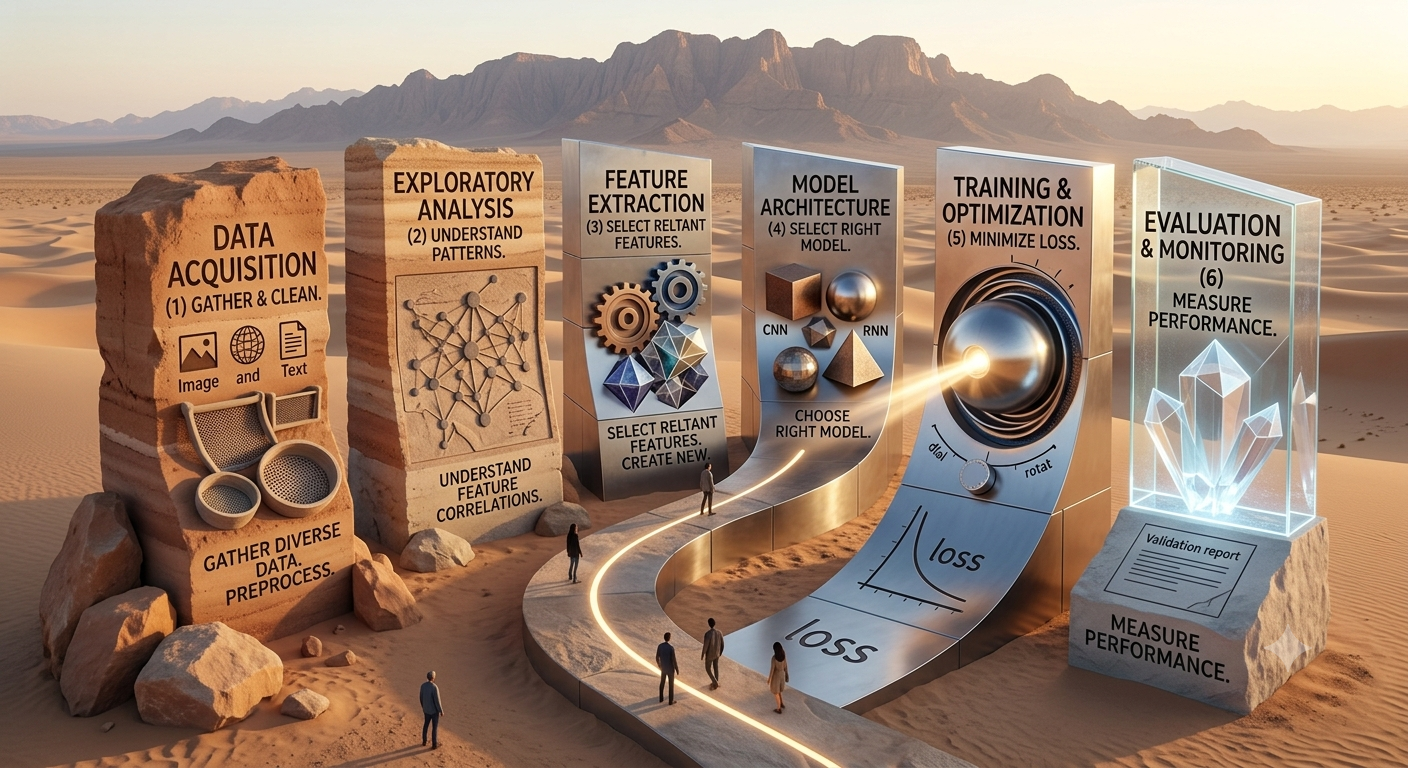
Artificial Intelligence (AI) models are computer systems that learn patterns from data and use those patterns to make predictions, generate content, recognize images, understand language, and solve problems. Training an AI model is a systematic process that combines data, computing power, algorithms, evaluation, and continuous improvement.
1. Understanding the AI Training Ecosystem
Before training an AI model, it is important to understand the major components:
| Component | Purpose |
|---|---|
| Data | The knowledge source for the AI |
| Algorithms | Learning methods |
| Compute | CPUs, GPUs, TPUs |
| Storage | Datasets and model files |
| Frameworks | PyTorch, TensorFlow, JAX |
| Evaluation | Measuring performance |
| Deployment | Making AI available to users |
2. Step 1: Define the Problem
Every AI project begins with a clear objective.
Examples:
- Image Recognition
- Speech Recognition
- Language Translation
- Chatbots
- Medical Diagnosis
- Fraud Detection
- Autonomous Vehicles
Questions to answer:
- What problem are we solving?
- Who will use the model?
- What data is available?
- What level of accuracy is required?
3. Step 2: Collect Data
Data is the fuel of AI.
Types of data:
Structured Data
- Databases
- Spreadsheets
- Financial records
Unstructured Data
- Images
- Videos
- Audio
- Text
Semi-Structured Data
- JSON
- XML
- Logs
Examples:
| AI Type | Data Needed |
|---|---|
| ChatGPT | Books, websites, articles |
| Medical AI | Medical records |
| Vision AI | Millions of images |
| Voice AI | Audio recordings |
4. Step 3: Data Cleaning
Raw data is often messy.
Tasks include:
- Removing duplicates
- Fixing errors
- Removing irrelevant information
- Standardizing formats
- Handling missing values
Example:
Before:
Johannesburg
johannesburg
JHB
After:
Johannesburg
5. Step 4: Data Labeling
Supervised learning requires labels.
Examples:
Image AI
Image → Cat
Image → Dog
Language AI
Sentence → Positive
Sentence → Negative
Medical AI
X-ray → Healthy
X-ray → Disease
Label quality directly impacts model quality.
6. Step 5: Split the Dataset
Typical division:
- Training Data: 70%
- Validation Data: 15%
- Testing Data: 15%
Purpose:
Training Set
Teaches the model.
Validation Set
Tunes parameters.
Test Set
Measures final performance.
7. Step 6: Select an AI Architecture
Different problems require different models.
Traditional Machine Learning
- Decision Trees
- Random Forests
- Support Vector Machines
Deep Learning
- CNNs (Images)
- RNNs (Sequences)
- Transformers (Language)
Popular transformer models include:
- OpenAI GPT series
- Google DeepMind Gemini series
- Meta Llama series
8. Step 7: Feature Engineering
Features are useful information extracted from data.
Examples:
House Prices
Features:
- Size
- Bedrooms
- Location
- Age
Agriculture
Features:
- Rainfall
- Soil Quality
- Temperature
Good features improve performance.
9. Step 8: Choose a Framework
Popular AI frameworks:
These frameworks handle:
- Matrix calculations
- GPU acceleration
- Automatic differentiation
- Distributed training
10. Step 9: Build the Neural Network
Example architecture:
Input Layer
↓
Hidden Layer 1
↓
Hidden Layer 2
↓
Output Layer
Modern AI models can have:
- Millions of parameters
- Billions of parameters
- Trillions of parameters
11. Step 10: Initialize Parameters
The model begins with random weights.
Example:
Weight A = 0.23
Weight B = -0.91
Weight C = 0.12
Training gradually adjusts these values.
12. Step 11: Forward Pass
Data enters the model.
Example:
Input:
Image of a Cat
Prediction:
Dog = 30%
Cat = 70%
This is the model’s first guess.
13. Step 12: Calculate Loss
Loss measures prediction error.
Example:
Actual:
Cat
Prediction:
70% Cat
Loss tells us how wrong the model is.
Common loss functions:
- Cross Entropy
- Mean Squared Error
- Hinge Loss
14. Step 13: Backpropagation
The model learns from mistakes.
Process:
- Calculate error
- Send error backward
- Update weights
This is the heart of deep learning.
15. Step 14: Optimization
Optimization improves the model.
Popular optimizers:
- SGD
- Adam
- AdamW
- RMSProp
Goal:
Reduce loss continuously.
16. Step 15: Repeat Training
One complete cycle is called an Epoch.
Example:
Dataset:
100,000 samples
Epochs:
- 10
- 50
- 100
- 1,000+
Large models may train for weeks or months.
17. Step 16: Validation
The validation set checks whether the model generalizes.
Common metrics:
- Accuracy
- Precision
- Recall
- F1 Score
For language models:
- Perplexity
- BLEU
- ROUGE
18. Step 17: Hyperparameter Tuning
Hyperparameters are settings chosen before training.
Examples:
- Learning Rate
- Batch Size
- Number of Layers
- Dropout Rate
Optimization methods:
- Grid Search
- Random Search
- Bayesian Optimization
19. Step 18: Prevent Overfitting
Overfitting occurs when the model memorizes training data.
Solutions:
- More data
- Data augmentation
- Dropout
- Regularization
- Early stopping
20. Step 19: Testing
The final model is tested using unseen data.
Questions:
- Is accuracy acceptable?
- Are errors reasonable?
- Does the model generalize?
21. Step 20: Fine-Tuning
Instead of training from scratch, organizations often fine-tune existing models.
Benefits:
- Lower cost
- Faster training
- Better performance
Examples:
- Fine-tuning GPT models
- Fine-tuning Llama models
- Fine-tuning image models
22. Step 21: Safety and Alignment
Modern AI requires safety measures.
Areas include:
- Bias reduction
- Fairness
- Privacy protection
- Security testing
- Hallucination reduction
23. Step 22: Model Compression
Large models are expensive.
Techniques:
- Quantization
- Pruning
- Distillation
Benefits:
- Faster inference
- Lower costs
- Mobile deployment
24. Step 23: Deployment
The model is released to users.
Deployment options:
- Cloud
- Mobile
- Edge Devices
- Enterprise Servers
25. Step 24: Monitoring
After deployment:
- Monitor accuracy
- Detect failures
- Measure latency
- Track user feedback
AI systems require continuous maintenance.
26. Step 25: Continuous Learning
Modern AI systems improve over time.
Cycle:
Data Collection
↓
Training
↓
Evaluation
↓
Deployment
↓
Monitoring
↓
Retraining
↓
Improvement
AI Training Pipeline Summary (30 Major Steps)
- Define problem
- Define objectives
- Gather requirements
- Collect data
- Store data
- Clean data
- Normalize data
- Label data
- Analyze data
- Split datasets
- Select architecture
- Engineer features
- Select framework
- Build model
- Initialize parameters
- Forward pass
- Calculate loss
- Backpropagation
- Optimization
- Epoch training
- Validation
- Hyperparameter tuning
- Regularization
- Overfitting prevention
- Testing
- Fine-tuning
- Safety alignment
- Compression
- Deployment
- Monitoring and retraining
Conclusion
Training an AI model is a complete lifecycle rather than a single task. The world’s leading AI systems—from language models to medical and scientific AI—follow the same fundamental journey: data → learning → evaluation → deployment → improvement. The difference between small AI projects and frontier AI systems lies mainly in the scale of data, computing resources, model size, and engineering sophistication. Mastering these 30 steps provides a strong foundation for understanding how modern AI systems are created and improved.





Be First to Comment