
1. Introduction
The human body is home to trillions of microorganisms—bacteria, fungi, archaea, and viruses—collectively known as the human microbiota. Among these, bacteria are the most abundant and influential. They inhabit nearly every surface and cavity of the body, from the skin to the gut, from the mouth to the reproductive tract. Far from being mere passengers, bacteria play essential roles in digestion, immunity, metabolism, and even mental health.
Understanding the anatomy of bacteria—their structure, physiology, and interactions with the human body—is crucial for appreciating how these microscopic organisms shape human health. This essay provides a comprehensive, tutorial‑style exploration of bacterial anatomy, their distribution in the body, their beneficial and harmful roles, and the biological patterns that govern their behavior.
2. What Are Bacteria?
Bacteria are unicellular, prokaryotic organisms. Unlike human cells, they lack a nucleus and membrane‑bound organelles. Their simplicity allows them to reproduce rapidly, adapt quickly, and survive in extreme environments.
Key Characteristics
- Microscopic size: typically 0.5–5 micrometers
- Prokaryotic cell structure
- Asexual reproduction through binary fission
- Metabolic diversity (aerobic, anaerobic, photosynthetic, fermentative)
- Ability to form communities such as biofilms
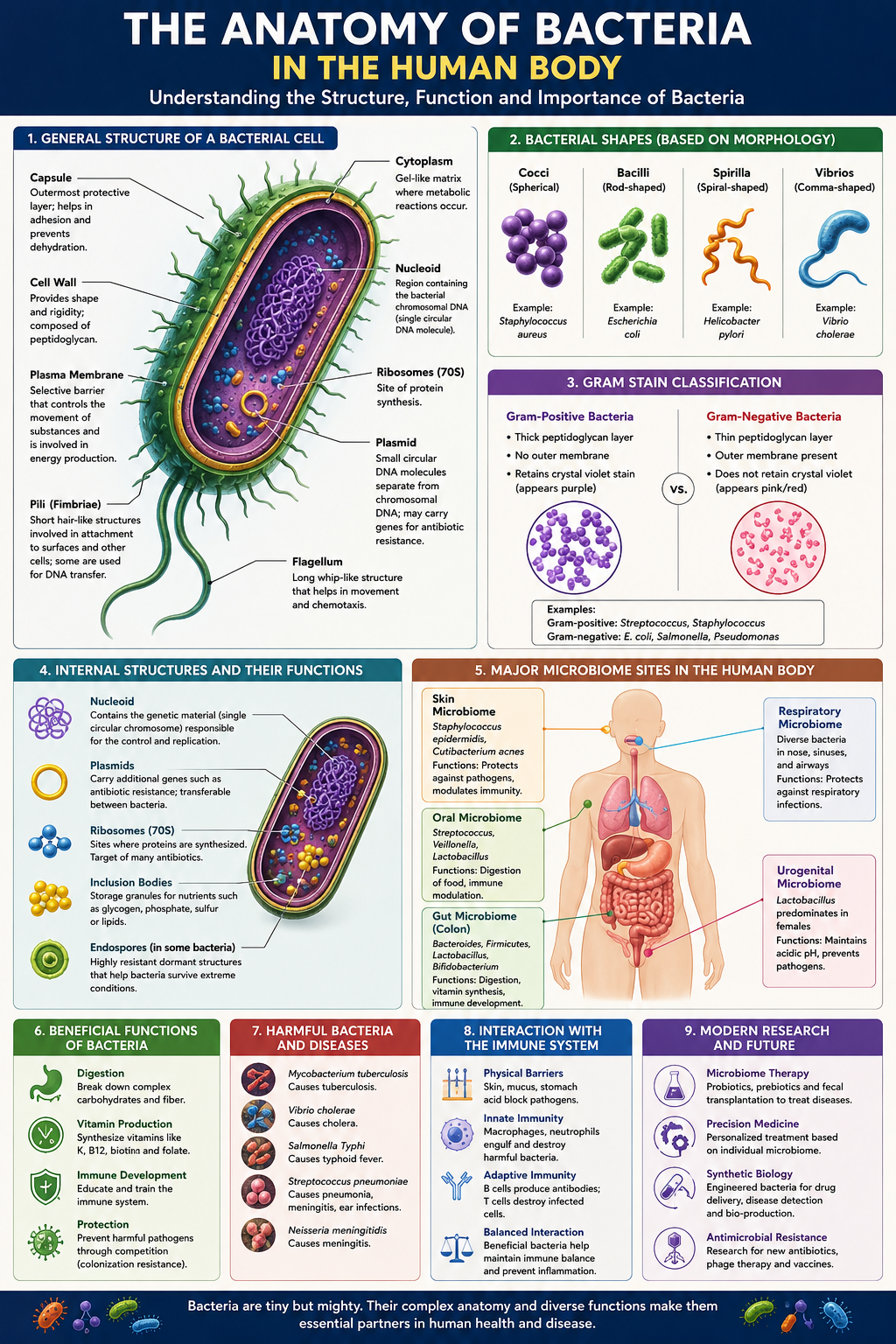
3. The Anatomy of a Bacterial Cell
Although bacteria vary in shape and complexity, most share a common structural blueprint.
3.1 Cell Envelope
The cell envelope protects the bacterium and determines how it interacts with the environment.
a. Cell Wall
- Made of peptidoglycan, a mesh-like polymer.
- Determines bacterial shape.
- Two major types:
- Gram-positive: thick peptidoglycan layer
- Gram-negative: thin peptidoglycan + outer membrane
b. Plasma Membrane
- Phospholipid bilayer controlling nutrient and waste transport.
- Site of energy production (bacteria lack mitochondria).
c. Capsule (optional)
- Sticky polysaccharide layer.
- Protects against immune attack.
- Helps bacteria adhere to surfaces.
3.2 Cytoplasm
The internal fluid containing:
- Ribosomes (70S type)
- Nucleoid (DNA region)
- Plasmids (extra DNA circles)
- Enzymes for metabolism
3.3 Genetic Material
Bacteria have:
- One circular chromosome
- Plasmids carrying antibiotic resistance or virulence genes
They can exchange genes through:
- Conjugation (bacterial mating)
- Transformation (absorbing DNA)
- Transduction (virus-mediated transfer)
3.4 Appendages
a. Flagella
- Tail-like structures for movement.
b. Pili and Fimbriae
- Hair-like structures for attachment.
- Pili also transfer DNA.
4. Bacterial Shapes and Their Significance
Bacteria come in several shapes, each adapted to specific environments.
| Shape | Description | Examples |
|---|---|---|
| Cocci | Spherical | Staphylococcus, Streptococcus |
| Bacilli | Rod-shaped | E. coli, Lactobacillus |
| Spirilla/Spirochetes | Spiral | Helicobacter pylori, Treponema |
| Vibrios | Comma-shaped | Vibrio cholerae |
Shape influences:
- Movement
- Nutrient absorption
- Ability to colonize surfaces
5. Where Bacteria Live in the Human Body
The human body contains over 100 trillion bacterial cells, outnumbering human cells.
5.1 Gut Microbiota
The largest bacterial community.
Functions:
- Digesting fiber
- Producing vitamins (B12, K)
- Training the immune system
- Regulating metabolism
- Influencing mood via the gut–brain axis
Dominant groups:
- Firmicutes
- Bacteroidetes
- Actinobacteria
- Proteobacteria
5.2 Skin Microbiota
Skin bacteria protect against pathogens.
Common species:
- Staphylococcus epidermidis
- Cutibacterium acnes
5.3 Oral Microbiota
The mouth hosts over 700 species.
Roles:
- Breaking down food
- Maintaining oral pH
- Preventing harmful colonization
5.4 Respiratory Tract
Bacteria here help regulate immune responses.
5.5 Urogenital Tract
Especially in women, Lactobacillus species maintain acidic pH and prevent infections.
6. Beneficial vs Harmful Bacteria
6.1 Beneficial (Commensal & Mutualistic) Bacteria
They help with:
- Digestion
- Vitamin production
- Immune regulation
- Pathogen defense
6.2 Harmful (Pathogenic) Bacteria
Examples:
- Staphylococcus aureus
- Mycobacterium tuberculosis
- Salmonella
- Clostridium difficile
Pathogens cause disease by:
- Producing toxins
- Invading tissues
- Evading immune defenses
7. How Bacteria Communicate: Quorum Sensing
Bacteria use chemical signals to coordinate behavior.
They can:
- Form biofilms
- Regulate virulence
- Share nutrients
- Resist antibiotics
This communication mirrors patterns seen in insect colonies, fungal networks, and ecosystems.
8. Patterns of Bacterial Behavior in Nature
Bacteria follow universal biological patterns:
8.1 Symbiosis
Mutual benefit between bacteria and host.
8.2 Competition
Bacteria compete for space and nutrients.
8.3 Cooperation
Biofilms and quorum sensing show collective behavior.
8.4 Evolutionary Adaptation
Rapid mutation allows bacteria to survive antibiotics.
8.5 Ecological Balance
Bacterial communities behave like ecosystems, maintaining equilibrium.
9. The Human Microbiome as an Ecosystem
The microbiome mirrors natural ecosystems:
- Diversity ensures stability
- Keystone species (e.g., Bacteroides) maintain balance
- Disturbances (antibiotics, diet changes) cause dysbiosis
- Recovery follows ecological succession patterns
10. Bacteria and the Immune System
Bacteria shape immunity by:
- Training immune cells
- Regulating inflammation
- Preventing autoimmune disorders
The immune system, in turn, shapes bacterial populations.
11. Modern Research and Applications
11.1 Probiotics
Live bacteria that improve gut health.
11.2 Fecal Microbiota Transplantation (FMT)
Used to treat severe infections like C. difficile.
11.3 Synthetic Biology
Engineered bacteria can:
- Detect cancer
- Deliver drugs
- Clean toxins
12. Conclusion
Bacteria are not merely microscopic organisms living within us—they are integral partners in human biology. Their anatomy, behavior, and ecological patterns reveal a complex, dynamic relationship with the human body. Understanding this relationship is essential for advancing medicine, nutrition, mental health, and biotechnology.
The human–bacteria partnership is one of the most profound examples of biological interdependence in nature. As research continues, our appreciation for these tiny organisms grows, revealing that human health is inseparable from the microbial world within.





Be First to Comment