
PAGE 1 — INTRODUCTION TO THE HUMAN NERVOUS SYSTEM
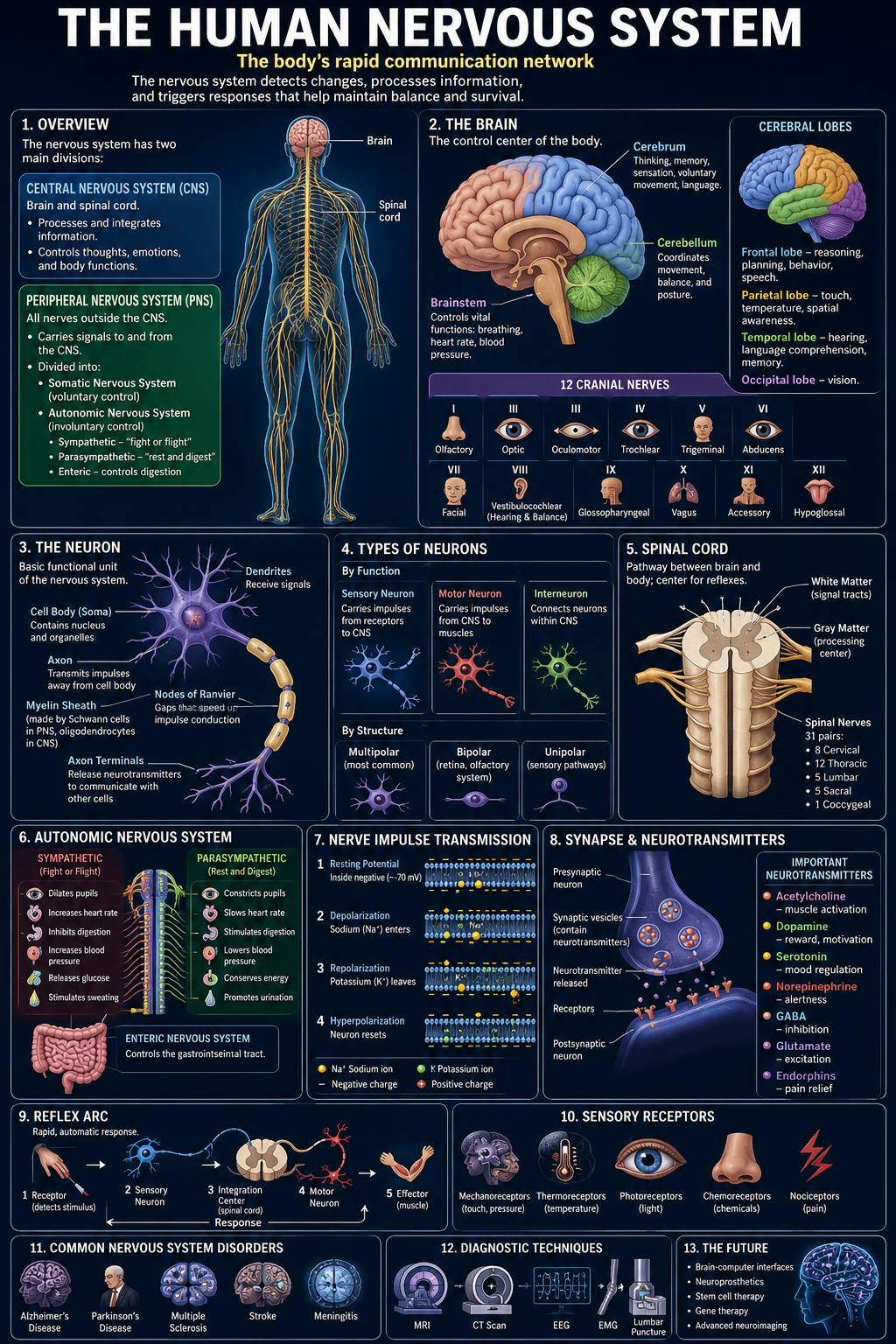
The human nervous system is the body’s master communication, coordination, and control network. It regulates every thought, movement, sensation, memory, and emotion. It interprets internal and external stimuli, integrates information, and generates appropriate responses. It is composed of billions of neurons and trillions of synapses, forming the most complex biological system known.
Core functions:
- Sensory input — detecting stimuli
- Integration — processing information
- Motor output — generating responses
The nervous system operates at lightning speed using electrochemical signals, enabling rapid communication unmatched by any other body system.
PAGE 2 — MAJOR DIVISIONS OF THE NERVOUS SYSTEM
The nervous system is divided into:
1. Central Nervous System (CNS)
- Brain
- Spinal cord
Responsible for integration, decision‑making, and higher cognition.
2. Peripheral Nervous System (PNS)
- Cranial nerves
- Spinal nerves
- Peripheral ganglia
Connects the CNS to limbs, organs, and tissues.
Functional Divisions
- Somatic Nervous System — voluntary control
- Autonomic Nervous System — involuntary control
- Enteric Nervous System — gastrointestinal regulation
PAGE 3 — THE CENTRAL NERVOUS SYSTEM (CNS)
The CNS is the command center.
The Brain
Protected by the skull and meninges, it contains:
- Cerebrum — thought, memory, voluntary movement
- Cerebellum — balance, coordination
- Brainstem — vital functions (breathing, heart rate)
The Spinal Cord
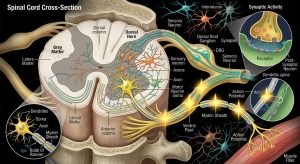
A long, cylindrical structure transmitting signals between brain and body. It also mediates reflexes, which bypass the brain for rapid responses.
PAGE 4 — THE PERIPHERAL NERVOUS SYSTEM (PNS)
The PNS links the CNS to the rest of the body.
Cranial Nerves (12 pairs)
Control facial movement, vision, smell, taste, hearing, and autonomic functions.
Spinal Nerves (31 pairs)
Emerge from the spinal cord and branch into:
- Dorsal roots — sensory
- Ventral roots — motor
The PNS enables sensation, movement, and organ regulation.
PAGE 5 — NEURONS: THE BASIC FUNCTIONAL UNIT
Neurons are specialized cells that transmit electrical impulses.
Neuron Structure
- Dendrites — receive signals
- Cell body (soma) — integrates signals
- Axon — transmits impulses
- Myelin sheath — increases speed
- Axon terminals — release neurotransmitters
Types of Neurons
- Sensory neurons — detect stimuli
- Motor neurons — activate muscles/glands
- Interneurons — connect neurons within CNS
PAGE 6 — GLIAL CELLS: SUPPORTING THE NERVOUS SYSTEM
Glial cells outnumber neurons and provide structural and metabolic support.
CNS Glial Cells
- Astrocytes — maintain blood‑brain barrier
- Oligodendrocytes — form myelin
- Microglia — immune defense
- Ependymal cells — produce cerebrospinal fluid
PNS Glial Cells
- Schwann cells — myelination
- Satellite cells — support ganglia
PAGE 7 — ELECTRICAL SIGNALING: ACTION POTENTIALS
Neurons communicate using action potentials, rapid changes in membrane voltage.
Key Steps
- Resting potential
- Depolarization (Na⁺ influx)
- Repolarization (K⁺ efflux)
- Hyperpolarization
- Return to resting state
Saltatory Conduction
In myelinated axons, impulses “jump” between nodes of Ranvier, increasing speed dramatically.
PAGE 8 — CHEMICAL SIGNALING: SYNAPSES & NEUROTRANSMITTERS
At synapses, electrical signals convert to chemical signals.
Process
- Action potential reaches terminal
- Calcium channels open
- Neurotransmitters released
- Bind to receptors on next neuron
- Signal continues
Major Neurotransmitters
- Dopamine
- Serotonin
- Acetylcholine
- GABA
- Glutamate
PAGE 9 — THE SOMATIC NERVOUS SYSTEM
Controls voluntary movement and conscious sensation.
Functions
- Skeletal muscle activation
- Reflex arcs
- Proprioception (body position awareness)
Reflex Arc Components
- Receptor
- Sensory neuron
- Integration center
- Motor neuron
- Effector
PAGE 10 — THE AUTONOMIC NERVOUS SYSTEM (ANS)
Regulates involuntary functions.
Sympathetic Division
“Fight or flight”
- Increased heart rate
- Dilated pupils
- Reduced digestion
Parasympathetic Division
“Rest and digest”
- Slows heart rate
- Stimulates digestion
- Promotes relaxation
PAGE 11 — THE ENTERIC NERVOUS SYSTEM
Sometimes called the “second brain.”
Functions
- Controls gastrointestinal motility
- Regulates enzyme secretion
- Coordinates peristalsis
It operates independently but communicates with the CNS via the vagus nerve.
PAGE 12 — BRAIN ANATOMY IN DETAIL
Cerebrum
- Frontal lobe — reasoning, planning, movement
- Parietal lobe — sensory integration
- Temporal lobe — hearing, memory
- Occipital lobe — vision
Diencephalon
- Thalamus — sensory relay
- Hypothalamus — homeostasis, hormones
Cerebellum
- Coordination
- Balance
- Motor learning
Brainstem
- Midbrain
- Pons
- Medulla oblongata
PAGE 13 — SPINAL CORD ANATOMY
Regions
- Cervical
- Thoracic
- Lumbar
- Sacral
Internal Structure
- Gray matter — neuron cell bodies
- White matter — myelinated axons
Functions
- Conducts signals
- Mediates reflexes
- Coordinates limb movement
PAGE 14 — NERVE PATHWAYS & TRACTS
Ascending (Sensory) Tracts
Carry information to the brain:
- Spinothalamic tract
- Dorsal column pathway
Descending (Motor) Tracts
Carry commands from the brain:
- Corticospinal tract
- Vestibulospinal tract
These pathways ensure coordinated movement and perception.
PAGE 15 — INTEGRATION, PLASTICITY & CONCLUSION
Neuroplasticity
The nervous system can reorganize itself by forming new neural connections. This underlies:
- Learning
- Memory
- Recovery from injury
Integration
The nervous system integrates sensory, emotional, cognitive, and motor information to maintain homeostasis and enable complex behavior.
Conclusion
The human nervous system is a masterpiece of biological engineering. Its complexity allows humans to think, feel, move, adapt, and survive. Understanding its structure and function is essential for medicine, psychology, biology, and human development.


Be First to Comment