
Abstract
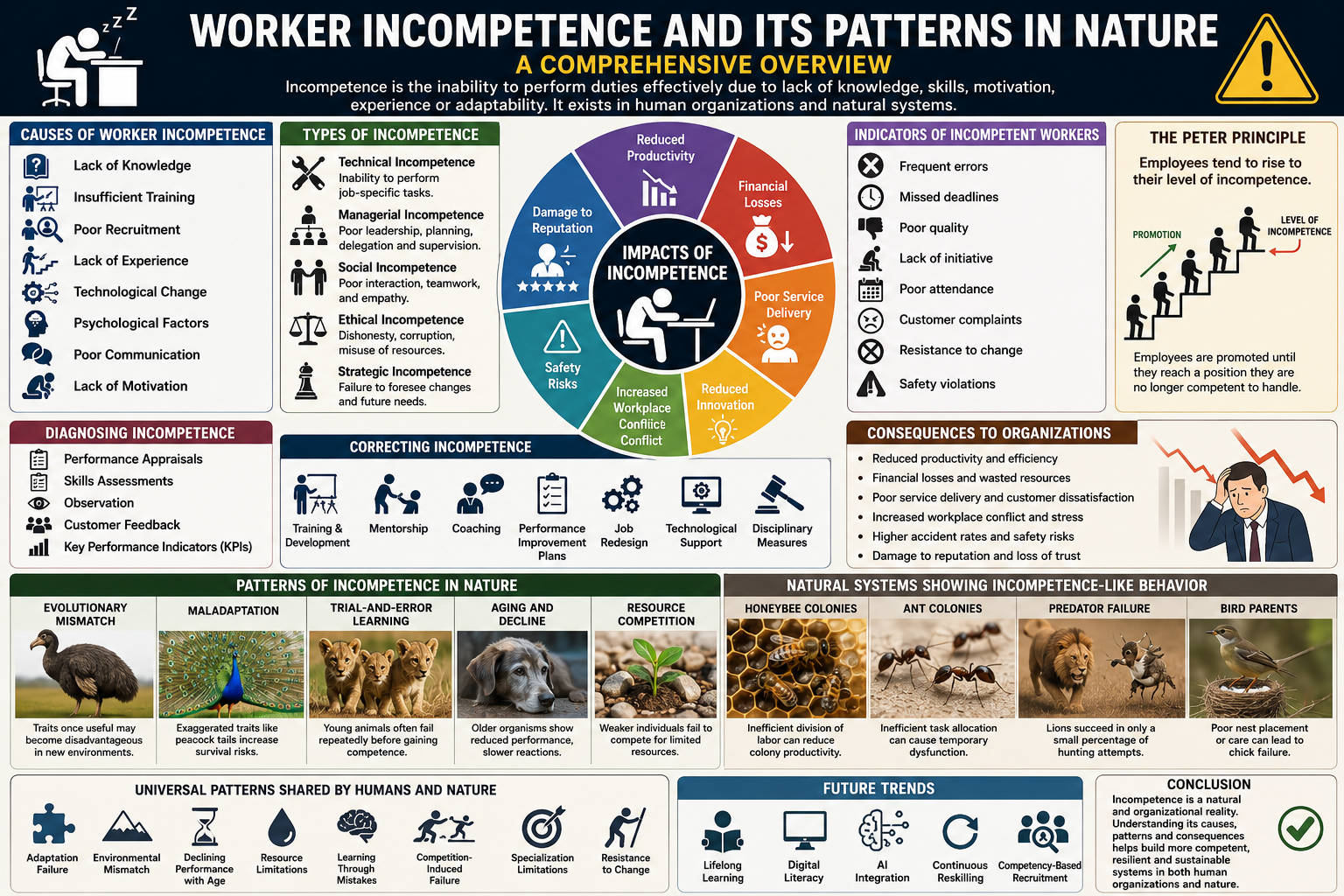
Worker incompetence is a universal phenomenon that manifests across industries, cultures, and organizational structures. Although often treated as a purely human or managerial problem, incompetence follows patterns that mirror natural systems—biological, ecological, and evolutionary. This essay explores incompetence as a structural, behavioral, and systemic issue, examining its psychological roots, organizational triggers, and parallels in nature. By understanding incompetence as a patterned phenomenon rather than a random failure, leaders can better predict, mitigate, and transform it.
1. Introduction
Incompetence is typically defined as the inability to perform tasks to expected standards. However, this definition oversimplifies a complex phenomenon. Incompetence is not merely a lack of skill; it is a predictable outcome of cognitive limitations, environmental pressures, flawed systems, and evolutionary patterns.
This essay argues that incompetence:
- Emerges from identifiable psychological and structural factors
- Follows patterns similar to those found in natural ecosystems
- Can be analyzed, predicted, and mitigated using principles from biology, ecology, and complexity science
2. Defining Incompetence: Beyond Skill Deficiency
2.1 Cognitive Incompetence
This includes:
- Poor decision-making
- Limited problem-solving ability
- Inability to adapt to new information
- Cognitive overload
2.2 Behavioral Incompetence
Manifested through:
- Procrastination
- Poor communication
- Lack of initiative
- Emotional instability
2.3 Structural Incompetence
Occurs when:
- Systems are poorly designed
- Roles are unclear
- Workflows are inefficient
- Leadership is inconsistent
2.4 Situational Incompetence
Even competent workers become incompetent under:
- Stress
- Ambiguous instructions
- Toxic environments
- Unrealistic deadlines
3. The Peter Principle: A Natural Law of Organizational Incompetence
The Peter Principle states that employees rise to their level of incompetence. This happens because promotions are based on performance in a current role, not suitability for the next one.
Why it happens:
- Skills do not transfer linearly
- Higher roles require different cognitive abilities
- Organizations reward past performance, not future potential
Natural parallel:
In evolution, species thrive in one environment but fail when conditions change. Adaptation is not guaranteed.
4. Psychological Roots of Incompetence
4.1 The Dunning–Kruger Effect
People with low ability often:
- Overestimate their competence
- Underestimate complexity
- Resist feedback
This creates a self-reinforcing loop of incompetence.
4.2 Learned Helplessness
Workers exposed to repeated failure or micromanagement may:
- Stop trying
- Avoid responsibility
- Lose confidence
4.3 Cognitive Biases
Biases such as confirmation bias, optimism bias, and anchoring distort judgment and lead to poor decisions.
5. Organizational Drivers of Incompetence
5.1 Poor Leadership
Leaders who lack clarity, consistency, or emotional intelligence create environments where incompetence thrives.
5.2 Toxic Culture
Cultures that reward compliance over creativity suppress competence.
5.3 Lack of Training
Skills decay without reinforcement. Workers stagnate when organizations fail to invest in development.
5.4 Misaligned Incentives
When incentives reward speed over quality or appearance over substance, incompetence becomes rational behavior.
6. Patterns of Incompetence in Nature
Incompetence is not unique to humans. Nature is full of systems that fail, adapt poorly, or behave inefficiently.
6.1 Biological Parallels
6.1.1 Genetic Mutations
Not all mutations are beneficial. Many reduce fitness—nature’s version of incompetence.
6.1.2 Maladaptive Behaviors
Animals sometimes:
- Choose poor mates
- Fail to recognize predators
- Waste energy on ineffective strategies
These behaviors mirror human workplace errors.
6.2 Ecological Parallels
6.2.1 Resource Misallocation
Ecosystems collapse when species overconsume resources—similar to organizations that mismanage budgets or talent.
6.2.2 Invasive Species
Incompetence emerges when ecosystems fail to regulate harmful elements, just as companies fail to manage toxic employees.
6.3 Evolutionary Parallels
Evolution is not efficient; it is iterative. Many species survive despite suboptimal traits.
Examples:
- The human spine is poorly designed for upright walking
- The panda’s thumb is an inefficient adaptation
- Birds sometimes build nests in unsafe locations
These inefficiencies mirror organizational incompetence: systems evolve through patchwork solutions rather than optimal design.
7. Patterns of Incompetence as Complex Systems
Incompetence behaves like a complex adaptive system:
- Small errors compound into large failures
- Feedback loops reinforce bad habits
- Systems drift toward disorder without intervention
7.1 Entropy in Organizations
Just as physical systems move toward disorder, organizations naturally drift toward inefficiency unless energy (training, leadership, structure) is applied.
7.2 Emergent Behavior
Incompetence spreads through:
- Social modeling
- Group norms
- Informal networks
8. Case Studies of Incompetence
8.1 The Domino Effect
One incompetent worker can:
- Slow down workflows
- Increase errors
- Create bottlenecks
- Lower team morale
8.2 The Overconfident Manager
A manager who overestimates their ability can:
- Misallocate resources
- Make poor strategic decisions
- Undermine competent staff
8.3 The Undertrained Employee
Without proper onboarding:
- Mistakes multiply
- Productivity drops
- Customer satisfaction declines
9. The Cost of Incompetence
9.1 Economic Costs
- Rework
- Delays
- Lost clients
- Reduced productivity
9.2 Psychological Costs
- Burnout
- Frustration
- Low morale
9.3 Strategic Costs
- Loss of competitive advantage
- Poor innovation
- Reputational damage
10. Detecting Patterns of Incompetence
10.1 Behavioral Indicators
- Repeated mistakes
- Avoidance of responsibility
- Poor communication
10.2 Structural Indicators
- High turnover
- Frequent crises
- Conflicting instructions
10.3 Cultural Indicators
- Blame culture
- Fear of feedback
- Lack of accountability
11. Mitigating Incompetence
11.1 Training and Development
Continuous learning reduces skill decay.
11.2 Clear Role Definition
Ambiguity breeds incompetence.
11.3 Feedback Systems
Constructive feedback prevents small errors from becoming systemic.
11.4 Psychological Safety
Workers perform better when they feel safe to ask questions and admit mistakes.
11.5 Leadership Reform
Competent leadership is the strongest antidote to incompetence.
12. Competence as a Natural Counterforce
Just as ecosystems self-correct, organizations can evolve toward competence through:
- Adaptation
- Selection
- Reinforcement of effective behaviors
Competence emerges when systems reward learning, collaboration, and accountability.
13. Conclusion
Incompetence is not random. It is patterned, predictable, and deeply rooted in both human psychology and natural systems. By understanding incompetence through the lens of biology, ecology, and complexity science, organizations can better anticipate failures and design environments where competence thrives.
The key insight is this: incompetence is a natural phenomenon, but so is improvement. With the right structures, incentives, and leadership, incompetence can be transformed into growth, resilience, and innovation.



Be First to Comment