
1. Introduction
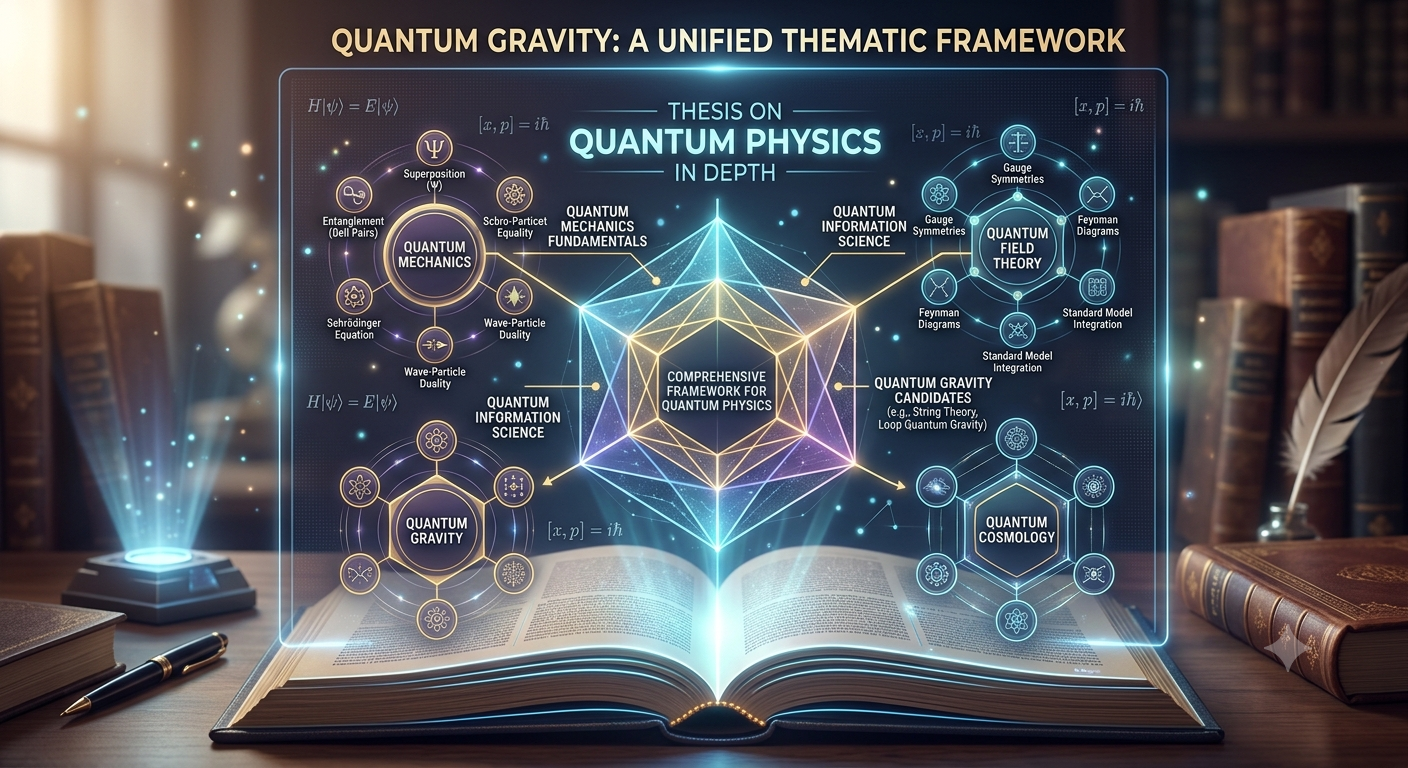
Quantum Physics, also known as Quantum Mechanics, is the branch of physics that studies matter and energy at the smallest scales of nature—atoms, electrons, photons, quarks, and other subatomic particles.
Classical physics, developed by Isaac Newton, explains the motion of planets, falling objects, and everyday phenomena. However, at microscopic scales, classical laws fail. Quantum Physics emerged in the early 20th century to explain these phenomena.
Today, quantum physics is the foundation of:
- Modern electronics
- Computers
- Lasers
- Nuclear energy
- Medical imaging
- Telecommunications
- Quantum computing
- Artificial Intelligence hardware
Without quantum physics, modern civilization would not exist in its current form.
2. Historical Development of Quantum Physics
First Quantum Revolution (1900–1930)
Max Planck (1900)
Max Planck proposed that energy is emitted in discrete packets called quanta.
He introduced:
E = hf
Where:
- E = Energy
- h = Planck’s Constant
- f = Frequency
This became the birth of quantum theory.
Albert Einstein (1905)
Albert Einstein explained the photoelectric effect.
He showed that light behaves as particles called photons.
This discovery later earned him the Nobel Prize.
Niels Bohr (1913)
Niels Bohr developed the atomic model.
Electrons occupy fixed energy levels around the nucleus and can jump between levels by absorbing or emitting photons.
Louis de Broglie (1924)
Louis de Broglie proposed:
Matter behaves like waves.
This idea introduced wave-particle duality.
Werner Heisenberg (1927)
Werner Heisenberg developed the:
Uncertainty Principle
It states that it is impossible to know exactly both:
- Position
- Momentum
of a particle simultaneously.
Erwin Schrödinger (1926)
Erwin Schrödinger developed the Schrödinger Equation.
This equation describes how quantum systems evolve over time.
3. Core Principles of Quantum Physics
A. Quantization
Many physical properties exist only in discrete amounts.
Examples:
- Atomic energy levels
- Electron charge
- Photon energy
Nature is not always continuous.
B. Wave-Particle Duality
Every particle possesses both:
- Particle properties
- Wave properties
Examples:
| Object | Particle Nature | Wave Nature |
|---|---|---|
| Electron | Yes | Yes |
| Photon | Yes | Yes |
| Proton | Yes | Yes |
C. Superposition
A quantum particle can exist in multiple states simultaneously.
Example:
A quantum bit (qubit) can be:
- 0
- 1
- Both 0 and 1 simultaneously
until measured.
D. Quantum Entanglement
Two particles become linked.
When one particle changes state, the other instantly reflects a correlated state regardless of distance.
Einstein famously called this:
“Spooky action at a distance.”
Entanglement is the basis for:
- Quantum communication
- Quantum cryptography
- Quantum internet
E. Quantum Tunneling
Particles can pass through barriers they should not cross according to classical physics.
Applications:
- Semiconductor chips
- Nuclear fusion in stars
- Tunnel microscopes
F. Probability
Classical physics predicts exact outcomes.
Quantum physics predicts probabilities.
Instead of certainty:
- 100% position
Quantum physics gives:
- Probability distribution
4. Structure of Matter
Fundamental Particles
The current framework is called the:
Standard Model
It contains:
Quarks
Six types:
- Up
- Down
- Charm
- Strange
- Top
- Bottom
Quarks form:
- Protons
- Neutrons
Leptons
Examples:
- Electron
- Muon
- Tau
- Neutrinos
Force Carriers
| Force | Particle |
|---|---|
| Electromagnetic | Photon |
| Strong Nuclear | Gluon |
| Weak Nuclear | W and Z Bosons |
| Gravity | Graviton (hypothetical) |
5. The Four Fundamental Forces
Gravity
Weakest force but dominates cosmic scales.
Responsible for:
- Planets
- Stars
- Galaxies
Electromagnetic Force
Controls:
- Electricity
- Magnetism
- Chemistry
- Light
Strong Nuclear Force
Holds quarks together.
Without it:
- Atoms could not exist.
Weak Nuclear Force
Responsible for:
- Radioactive decay
- Nuclear reactions
6. Quantum Field Theory
Modern quantum physics describes reality using fields.
Particles are excitations of fields.
Examples:
- Electron Field
- Photon Field
- Quark Field
Think of particles as ripples on invisible cosmic oceans.
7. Quantum Physics and the Universe
The Big Bang
Quantum fluctuations may have helped create:
- Matter
- Galaxies
- Cosmic structures
Shortly after the universe began.
Black Holes
Quantum theory predicts:
Hawking Radiation
Proposed by Stephen Hawking.
Black holes slowly lose energy and may eventually evaporate.
Dark Matter
Approximately 27% of the universe appears to consist of invisible matter.
Its quantum nature remains unknown.
Dark Energy
Approximately 68% of the universe consists of mysterious energy driving expansion.
One possibility involves quantum vacuum energy.
8. Quantum Computing
Traditional computers use:
- Bits (0 or 1)
Quantum computers use:
- Qubits
Advantages:
- Massive parallelism
- Optimization
- Drug discovery
- Cryptography
- AI acceleration
Leading organizations include:
9. Quantum Physics in Daily Life
Quantum physics powers:
Electronics
- Smartphones
- Computers
- TVs
Medicine
- MRI scanners
- PET scans
- Radiation therapy
Communications
- Fiber optics
- Satellites
- Internet infrastructure
Energy
- Solar panels
- Nuclear power plants
10. Major Unsolved Problems
Quantum Gravity
Scientists seek to unite:
- Quantum Mechanics
- General Relativity
into one theory.
Theory of Everything
A framework explaining:
- All particles
- All forces
- Space
- Time
under one mathematical structure.
Candidates include:
- String Theory
- Loop Quantum Gravity
Dark Matter Identity
No particle has yet been definitively identified.
Measurement Problem
Why does a quantum system appear to choose one outcome when measured?
This remains one of science’s deepest mysteries.
11. Quantum Physics and Artificial Intelligence
The next technological revolution may combine:
- Quantum Computing
- Artificial Intelligence
- Robotics
- Advanced Materials
- Biotechnology
Potential outcomes:
- Faster AI training
- Drug discovery
- Climate modeling
- Financial optimization
- Smart infrastructure
12. Future Outlook (2026–2100)
Experts anticipate progress in:
- Quantum internet
- Quantum sensors
- Quantum encryption
- Quantum medicine
- Quantum materials
- Fault-tolerant quantum computers
Future industries may rely on quantum technologies as heavily as modern society relies on electricity today.
Conclusion
Quantum Physics is humanity’s most successful theory for describing the microscopic world. It explains the behavior of atoms, molecules, light, and subatomic particles while underpinning nearly every modern technology. Despite its extraordinary success, major mysteries remain, including quantum gravity, dark matter, dark energy, and the nature of reality itself. The continued study of quantum physics is expected to shape the scientific, technological, and economic development of the 21st century and beyond.




Be First to Comment