
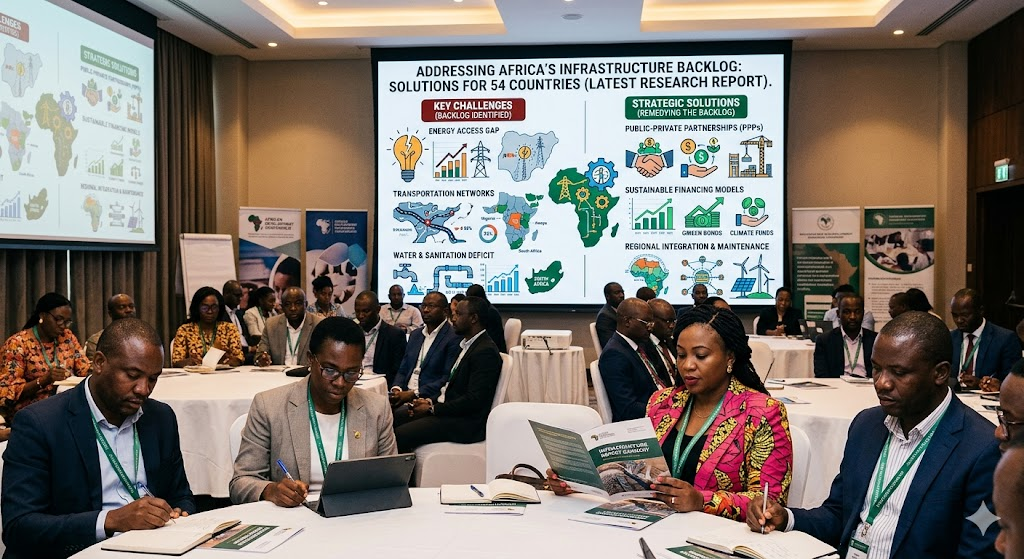
Here is the Global Infrastructure Backlog: A Comprehensive Analysis of 54 Nations, Latest Research, and the Road to Remediation
Introduction: The Weight of Unbuilt Things
Few crises in contemporary global development are simultaneously so visible and so under-discussed as the infrastructure backlog. Every potholed road, every power outage, every rural community without clean water, and every city choking on congestion is a symptom of a structural deficit decades in the making. The term “backlog” is almost clinical in its understatement—what it represents is the compounding cost of delayed, deferred, and abandoned investment across roads, electricity grids, water systems, ports, railways, hospitals, schools, and digital networks.
The World Bank estimates that there is a US$1 trillion per year gap—equivalent to 1.4% of global GDP—between what infrastructure requires and what is currently being spent. The imperative to develop environmentally clean infrastructure would raise this estimate by an additional $200–300 billion annually. These are not abstract numbers: they translate into child deaths from contaminated water, crops rotting at ports, factories unable to power their machines, and students studying by kerosene light.
This essay examines the infrastructure backlog across 54 of the world’s most severely affected nations — concentrated in Africa but extending into Asia, Latin America, and even pockets of the developed world — drawing on the most current research reports of 2025–2026. It interrogates the causes, measures the scale, traces the sectoral dimensions, and charts a detailed remediation agenda.
The Scale of the Crisis:
The PwC Global Infrastructure Outlook
PwC’s landmark Global Infrastructure Outlook 2025–50, commissioned with Oxford Economics, represents perhaps the most comprehensive market-ready global infrastructure forecast available. The report covers nine sectors and 20 subsectors across 45 countries and territories and is designed to help investors, policymakers, and industry leaders identify opportunities with far greater precision than prior analyses.
The report finds that chronic underinvestment has created large backlogs—both in upgrading existing facilities in developed markets and in building new ones to meet unmet demand in emerging economies. Annual spending on health and aged-care facilities alone is projected to grow by 73% between 2024 and 2050, while spending on educational facilities is set to grow by 30% over the same period.
The Global Construction
The Global Infrastructure Construction Report 2025 projects that global infrastructure output will grow by 4.7% in 2025 in real terms — solid growth, but a notable moderation from the 7.0% expansion recorded in 2024. This deceleration is concerning, since demand is accelerating far faster than supply in most regions.
McKinsey’s Global Institute remains the most cited source on the investment shortfall. The researchers found a $5.5 trillion global spending gap between current trajectories and the investment needed through to 2035, with $3.7 trillion in annual economic infrastructure investment required every year just to support expected growth rates.
Emerging economies account for approximately 60% of global infrastructure needs. Despite this, if current underinvestment trajectories persist, the world will fall short by roughly 11%—or $350 billion per year.
The Energy Dimension: A Binding Physical Constraint
A particularly alarming finding from the 2026 Global Forecast concerns the time-to-build problem. Transmission project backlogs already exceed five years in many markets, natural gas turbines require three to four years for delivery, and nuclear plants take over a decade to construct. Data center vacancy rates have fallen to just 1–2%, with new capacity 75–100% pre-leased years before coming online. The timeline mismatch between surging demand and slow-moving supply creates a binding constraint that no amount of capital alone can solve.
The 54-Country Focus: Africa at the Epicenter
While the infrastructure backlog is a global phenomenon, the African continent—with its 54 sovereign nations—represents both the most acute concentration of deficit and the greatest opportunity for transformational change. The African Development Bank, OECD, World Bank, and PwC have all flagged the continent as the primary zone of infrastructure crisis.
The Annual Financing Gap
As of the 2024–2025 fiscal period, Africa’s infrastructure financing gap—the difference between required capital investment and actual expenditure—is estimated to range between $68 billion and $108 billion annually, within a broader total investment requirement of $130 billion to $170 billion per year. A critical observation from 2025 data is that the gap is widening not because investment is falling, but because the target—driven by population growth and climate resilience needs—is moving away faster than spending can catch up.
The Economic Cost of Infrastructure Deficiency
Poor infrastructure has resulted in a 40% loss in productivity across African countries and up to a 2-percentage-point reduction in annual national economic growth. Energy costs for manufacturing enterprises are up to four times higher than in comparable markets, road freight tariffs are two times higher than in the United States, and travel times along critical export corridors are up to three times longer than in Asia. Telecommunications costs—including mobile and internet services—cost approximately four times as much as in South Asia.
What Is Driving the Deficit: Sectors Under Strain
The infrastructure gap across Africa is driven primarily by a backlog in water and sanitation infrastructure, which accounts for approximately 41% of the total deficit, followed by electricity supply and transport access, each contributing about 28%, with ICT infrastructure making up the remainder.
Energy
In 2024, Africa added over 6.5 gigawatts of utility-scale energy capacity to its grid. By comparison, India added 18 GW in renewables alone, and the United States added 48.6 GW. To meet its development goals, Africa must double or triple its annual energy buildout. This is not merely an infrastructure challenge—it is a strategic economic imperative. For individual countries, the consequences of the electricity deficit are severe: rolling blackouts suppress manufacturing, spoil food, disable medical equipment, and make digital commerce impossible.
Digital Connectivity
Narrowing the rural-urban digital divide is identified as the single biggest lever to reduce Africa’s internet access deficit, particularly in countries where rural populations exceed 60–70% of the total. A phased liberalisation of digital markets—such as Ethiopia’s post-monopoly surge—can rapidly accelerate network coverage when well-calibrated.
Transport
Road connectivity remains critically inadequate across low-income African nations. The majority of Africa’s road networks are unpaved, and in land-locked countries, the cost of freight over poor roads adds dramatically to the price of exports, making participation in global value chains structurally uncompetitive.
Water and Sanitation
Access to electricity, improved sanitation, and clean water in Africa are among the lowest in the world. Hundreds of millions across Sub-Saharan Africa lack access to safely managed drinking water—a deficit with catastrophic implications for health, gender equality, and economic productivity.
The Fiscal Constraint: Debt, Taxes, and Tightening Budgets
The scale of the required investment is compounded by the fiscal reality facing most African governments. African countries face high debt burdens and severe fiscal tightness. In 2024, public debt reached 67% of Africa’s GDP—surpassing the 62% level of 2000. Eight African countries are currently in outright debt distress and 15 others face a high risk of debt distress. Between 2009–13 and 2019–23, fiscal tightness on the continent increased by 2.1 years—faster than in developing Asia (+1.3 years) and Latin America and the Caribbean
In 2021, the average tax-to-GDP ratio for 33 African countries stood at 15.6%—low compared to the averages for Asia-Pacific and Latin America and the Caribbean Without stronger domestic revenue mobilization, African governments simply cannot self-finance the infrastructure they need.
The Paradox of Projects
A recurring theme in the analysis is what researchers have dubbed the “Paradox of Projects.” Global capital markets are awash with liquidity seeking yield; at the same time, Africa has a desperate need for investment. Yet the two fail to meet. It is estimated that 80% of infrastructure projects in Africa fail to reach financial close—not for lack of interest on the part of investors, but due to structural preparation and regulatory and political risk barriers.
The Investment Requirement in Comparative Perspective
Filling Africa’s investment needs would require infrastructure spending on par with China or Vietnam. The requirement of USD 155 billion in annual investment by 2040 is equivalent to 5.6% of Africa’s GDP—nearly double the total annual spending of USD 83 billion recorded on average from 2016 to 2020. As a share of GDP, Africa’s investment need is three times larger than that of Latin America and the Caribbean and five times larger than that of developing Asia.
—other
Beyond Africa: The Wider Backlog Across Emerging and Developed Economies
Asia
Asia presents a more differentiated picture. While China has made extraordinary strides—adding 18 GW of renewable energy in a single year, building the world’s most expansive high-speed rail network, and constructing over 80% of the world’s largest infrastructure projects—other nations in the region face severe backlogs. South and Southeast Asia alone track tens of thousands of infrastructure projects in their pipelines. With a total of 3,252 projects valued at US$3.2 trillion, South and South East Asia has the highest number of infrastructure projects globally at any one time. Bangladesh, the Philippines, Myanmar, Cambodia, and Vietnam all face significant transport, water, and energy deficits relative to their growth trajectories.
Latin America
Latin American infrastructure deficits reflect decades of fiscal volatility, political instability, and inadequate planning. Brazil’s rural road network, Colombia’s inter-regional connectivity, and the electricity sectors of several Central American nations all face structural backlogs. The continent’s private investment in infrastructure has consistently undershot need.
The Developed World: Hidden Backlogs
Even wealthy nations face significant infrastructure backlogs, though of a different character. Infrastructure investment has actually declined as a share of GDP in 11 of the G20 economies since the global financial crisis. Cutbacks have occurred in the European Union, the United States, Russia, and Mexico. In the United States, the American Society of Civil Engineers has repeatedly given the nation’s infrastructure a near-failing grade. Bridges are aging, water mains date back to the 19th century, and the electrical grid requires fundamental modernization to accommodate the transition to renewables and the surging electricity demand of AI data centers.
The Sectoral Anatomy of the Global Backlog
Roads and Transport
Road infrastructure forms the backbone of economic activity — yet global road investment has lagged demand for decades. In Africa, fewer than 40% of rural communities have access to an all-season road. In South Asia, rapid urbanisation has outpaced road construction. Even in the European Union, the eastern member states face significant road quality deficits compared to the west.
Electricity and Renewables
The energy transition is simultaneously the most urgent and most complex dimension of the infrastructure backlog. Electricity, power, and renewables are among the fastest-growing sectors globally, but the pace of construction cannot match the pace of demand—driven by electrification of transport, heating, industry, and the exponential expansion of digital infrastructure.
Water and Sanitation
The World Bank estimates that developing countries need to invest around 4.5% of GDP to achieve infrastructure-related Sustainable Development Goals and to stay on track to limit climate change to no more than 2 degrees Celsius. Water infrastructure is central to this—and among the most underfunded.
Digital Infrastructure
New sectors such as power storage and data centers have risen to prominence as infrastructure priorities, alongside the transmission and distribution infrastructure needed to support the AI revolution. In developing countries, last-mile digital connectivity remains elusive—rural broadband, mobile data coverage, and affordable data plans are the frontiers where the backlog is most pronounced.
Healthcare and Education Facilities
Chronic underinvestment has created large backlogs in upgrading existing healthcare facilities in developed markets and in building new ones in emerging economies. Annual spending on health and aged-care facilities is projected to grow by 73% between 2024 and 2050, while educational facility spending is set to grow by 30% over the same period.
Root Causes of the Backlog
Understanding what has produced the backlog is essential for designing remedies. The causes are multiple and interlocking.
Fiscal constraints and competing priorities. Governments facing health crises, pension obligations, education costs, and debt service simply cannot allocate sufficient revenue to infrastructure. In low-income countries, the fiscal space is negligible.
Corruption and weak institutions. Infrastructure spending is notoriously susceptible to graft. In many countries, a significant share of project costs is absorbed by bribes, kickbacks, and inflated contracts — meaning the real value delivered to citizens is a fraction of the nominal investment.
Project preparation failures. Private investors are often unable to commit the capital required because governments have been unable to create investment-ready project pipelines—leaving investors unsure of how, where, and when to commit capital. Without bankable projects, private capital sits on the sideline.
Low construction productivity. Improving productivity in the construction sector alone could unleash an additional $1.6 trillion in value globally. Construction is one of the least digitized and least productive industries in the world, plagued by fragmentation, poor data management, and resistance to innovation.
Political short-termism. Infrastructure investments take years or decades to deliver returns — longer than most political cycles. Politicians facing elections have incentives to favour visible short-term spending over long-horizon infrastructure projects.
Climate change-related disruption. Extreme weather events destroy existing infrastructure faster than it can be replaced. Flooding, drought, wildfires, and cyclones impose enormous costs on already-strained infrastructure budgets, compounding the backlog.
Remediation: A Detailed Agenda for Closing the Gap
Addressing the global infrastructure backlog requires action on financing, governance, technology, institutional capacity, and international cooperation simultaneously. No single lever is sufficient.
Scaling Public-Private Partnerships
Public-private partnerships are collaborative arrangements between a government agency and a private partner to fund, build, and manage infrastructure projects. By leveraging private capital, expertise, and innovation, PPPs can enable governments to build the resilient, sustainable infrastructure needed to support growing populations and meet global climate goals.
Private enterprises involved in PPPs are incentivized to deliver projects on time and within budget—contrasting with traditional public works, which are often bogged down by inefficiencies, delays, and cost overruns. However, PPP success depends critically on a stable regulatory environment, transparent procurement, and effective risk allocation.
Public-private partnerships are increasingly viewed as a primary solution, with technology-driven asset management playing a pivotal role in ensuring transparency and accountability in infrastructure spending.
Building Investment-Ready Project Pipelines
Perhaps the single most impactful near-term intervention is the professionalisation of project preparation. Governments — particularly in Africa and South Asia — need dedicated project preparation facilities that can develop a pipeline of bankable projects, complete with feasibility studies, environmental assessments, financial models, and regulatory approvals. Without this, private capital cannot deploy.
Creating enabling environments through transparent project pipelines, streamlined regulatory frameworks, and innovative financing models is essential to attracting private capital and accelerating delivery
Mobilising Domestic Capital
The World Bank has advocated for simple, scalable mechanisms to close the multi-trillion-dollar infrastructure financing gap through domestic capital mobilization. Africa’s pension funds, insurance industries, and sovereign wealth funds hold substantial assets—but their capital is rarely directed toward infrastructure. Regulatory reforms enabling long-term institutional investors to participate in infrastructure financing could unlock hundreds of billions in domestic capital.
Blended Finance Mechanisms
Blended finance — the strategic use of development finance (from multilateral development banks and bilateral donors) to catalyse private investment — is increasingly recognised as a critical tool. By absorbing first-loss tranches or providing guarantees, development finance institutions can de-risk projects sufficiently for commercial investors to enter.
Public-private partnerships have been proposed as a way to mobilize long-term private investment and expertise in countries with fiscal constraints and limited borrowing capacity. However, recent research shows that FDI through PPPs is not increasing quickly enough to meet sustainable development goals, particularly in vulnerable economies. New financing architectures—including the “Compromiso de Sevilla” framework adopted at the 4th International Conference on Financing for Development—are attempting to fundamentally rethink these investment models.
Raising Construction Productivity Through Technology
Improving productivity in the construction sector could unlock $1.6 trillion in additional global value. The levers here are well-understood: Building Information Modelling, drone-based site monitoring, modular and prefabricated construction, AI-driven project management, and advanced procurement systems. The challenge is adoption—particularly in developing-country contexts where the construction workforce is informal and training infrastructure is weak.
Smart cities employ ICT infrastructure — including high-speed wireless networks and IoT and AI solutions — to manage water and waste management, electricity generation, and street lighting more efficiently. PPP Legal technologies can dramatically reduce the cost of operating existing infrastructure while extending its useful life.
Regional Integration and Cross-Border Projects
One of Africa’s most underutilised assets is its potential for regional infrastructure integration. Building integrated African grids is no longer aspirational — it is essential. Cross-border interconnectors and regional power markets are key to unlocking scale, attracting investment, and stabilising supply. The priority is to mobilise finance for intra-pool transmission links and inter-pool interconnections that can lay the foundation for a truly continental power system.
Similar logic applies to transport corridors, port systems, and data infrastructure. Cross-border infrastructure can share costs among multiple nations, make projects viable at scales that individual countries cannot sustain, and deepen the regional economic integration that drives growth.
Climate-Resilient Design
Every dollar spent on infrastructure must now account for climate risk. Infrastructure built to 20th-century climate assumptions will fail prematurely in a world of intensifying storms, floods, and heat waves. Governments and financiers must mainstream climate resilience into project design — elevating roads above flood plains, hardening coastal ports against storm surge, and designing power grids for extreme temperature variability.
Anti-Corruption and Institutional Reform
Infrastructure investment yields its full returns only when the full value of the investment actually reaches the ground. Strengthening procurement transparency, independent project monitoring, judicial enforcement of contracts, and anti-corruption institutions is not optional — it is foundational. Countries with stronger governance consistently attract more infrastructure investment and get more value from it.
Increasing Tax Revenue to Fund Public Investment
The average tax-to-GDP ratio for African countries stands at just 15.6%, compared to 19.8% in Asia-Pacific and 21.7% in Latin America. Expanding the tax base—through formalization of the economy, digital tax administration, property taxes, and resource revenue management—can increase the fiscal space available for infrastructure without increasing debt burdens.
Targeted Debt Relief and Concessional Financing
For the most heavily indebted low-income countries, debt relief may be a prerequisite for infrastructure investment. Countries in debt distress cannot run the primary surpluses needed to invest in public goods. Multilateral creditor coordination — under frameworks like the G20 Common Framework — needs to be faster, more comprehensive, and more debt-inclusive.
Studies from the G20’s Global Infrastructure Hub, the United Nations, and McKinsey confirm that the infrastructure financing gap is huge, standing in multiples of trillions per year. Unfortunately, the spectre of trillion-dollar gaps is intimidating—even overwhelming—and the more these unimaginable numbers are tossed around, the easier it becomes to dismiss them as unachievable. The answer is to decompose the problem: identify the specific projects in each country, build the institutional frameworks to prepare and execute them, and deploy capital systematically.
Conclusion: The Cost of Inaction
The infrastructure backlog is not a passive condition. It actively compounds. Deferred maintenance accelerates deterioration. Delayed connections prevent economic activity that could generate the revenue to fund further investment. Populations living without reliable electricity, clean water, or transport connectivity are trapped in cycles of poverty that infrastructure investment could break.
According to the McKinsey Global Institute, the world needs to increase its investment in infrastructure by 60% through to 2030 just to maintain current levels of infrastructure capacity and service relative to GDP. That is not a transformational agenda — it is merely the baseline for standing still. Closing the actual backlog requires something far more ambitious.
For the 54 countries of Africa and the dozens of emerging economies beyond it, the infrastructure deficit is not destiny. It is a policy choice, and it can be reversed through the sustained application of financing innovation, institutional reform, technological adoption, and political will. The research is clear, the tools exist, and the capital is available. What has been missing — and what must be found — is the coordination and commitment to deploy them at the necessary scale.
The stakes are as high as they come: half a billion people without electricity, a billion without reliable clean water, and billions more without the connectivity, mobility, and opportunity that infrastructure makes possible. The backlog is not an accounting entry. It is a measure of unlived human potential — and closing it is among the most consequential tasks of our generation.






Be First to Comment