
Executive Summary
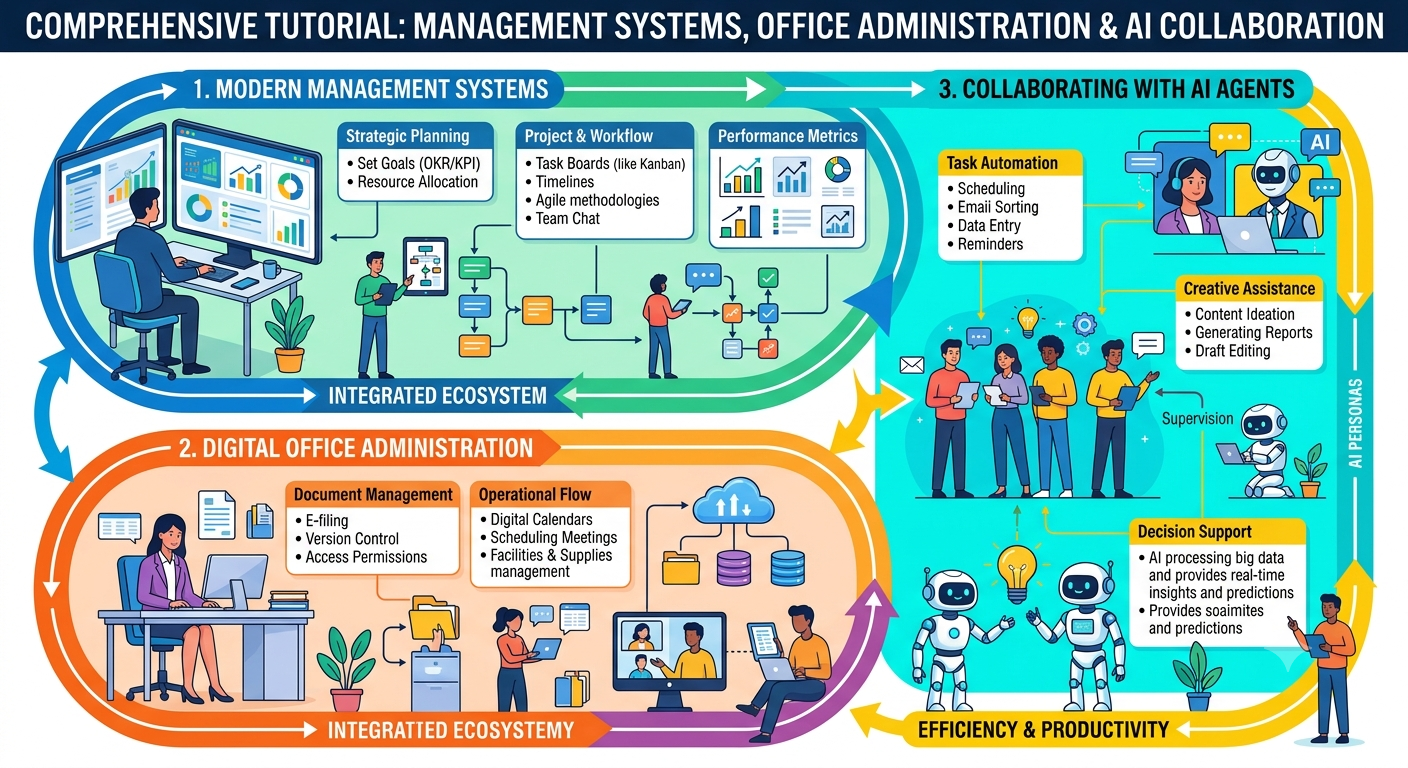
The future workplace combines human intelligence, digital management systems, and AI agents working together. Organizations that successfully integrate these three elements can improve productivity, decision-making, customer service, innovation, and long-term competitiveness.
Think of a modern organization as a living body:
- Management systems are the brain that plans and coordinates.
- Office administration is the nervous system that keeps information flowing.
- AI agents are intelligent assistants that automate routine work, analyze information, and support decisions.
- Employees provide creativity, ethics, leadership, judgment, and relationships.
The future belongs to organizations where humans and AI collaborate rather than compete.
Part I: Understanding Management Systems
What is a Management System?
A management system is an organized framework that helps an organization achieve its goals through planning, organizing, directing, coordinating, and controlling resources.
Resources include:
- People
- Money
- Time
- Equipment
- Buildings
- Information
- Technology
- AI systems
- Knowledge
A management system answers five questions:
- Where are we?
- Where do we want to go?
- How will we get there?
- Who is responsible?
- How do we measure success?
The Five Classical Functions of Management
1. Planning
Planning determines future actions.
Activities include:
- Setting objectives
- Budgeting
- Forecasting
- Risk assessment
- Strategic planning
- Scheduling
Example:
A manufacturing company plans to produce one million products next year.
2. Organizing
Organizing arranges resources efficiently.
Includes:
- Organizational structure
- Departments
- Job descriptions
- Resource allocation
- Reporting lines
3. Leading
Leadership motivates employees.
Leadership involves:
- Communication
- Motivation
- Coaching
- Decision-making
- Conflict resolution
- Team development
4. Controlling
Managers compare actual performance against targets.
Examples:
- Financial reports
- Production targets
- Sales performance
- Customer satisfaction
- Employee productivity
5. Continuous Improvement
Organizations constantly improve processes through:
- Innovation
- Employee suggestions
- Customer feedback
- AI recommendations
- Data analytics
Levels of Management
Executive Management
Examples:
- CEO
- President
- Managing Director
Responsibilities:
- Vision
- Corporate strategy
- Investment decisions
- Partnerships
Middle Management
Examples:
- Operations Manager
- HR Manager
- Finance Manager
Responsibilities:
- Department management
- Policy implementation
- Performance monitoring
Operational Management
Examples:
- Supervisors
- Team Leaders
Responsibilities:
- Daily operations
- Staff supervision
- Workflow coordination
Types of Management Systems
Modern organizations often use specialized management systems, including:
| System | Purpose |
|---|---|
| Financial Management | Manage budgets, accounting, and investments |
| Human Resource Management | Recruit, develop, and support employees |
| Customer Relationship Management (CRM) | Manage customer interactions and sales |
| Enterprise Resource Planning (ERP) | Integrate finance, inventory, purchasing, manufacturing, and HR |
| Project Management | Plan, execute, and monitor projects |
| Supply Chain Management | Coordinate suppliers, logistics, and inventory |
| Knowledge Management | Capture and share organizational knowledge |
| Quality Management | Improve products and services |
| Risk Management | Identify and mitigate risks |
| Information Security Management | Protect digital assets and information |
Part II: Office Administration
Definition
Office administration coordinates the daily operations of an organization to ensure information, people, resources, and processes work efficiently.
Without effective administration, even a strong strategy can fail.
Core Administrative Responsibilities
Administrative professionals typically handle:
- Correspondence
- Filing
- Scheduling
- Procurement
- Meeting coordination
- Travel arrangements
- Document management
- Reception
- Customer support
- Office supplies
- Compliance
- Record keeping
Office Workflow
A typical administrative workflow includes:
Customer Inquiry

↓

Reception

↓

Registration

↓

Department Assignment

↓

Processing

↓

Approval

↓

Communication

↓

Archive

↓

Performance Report
Document Management
Common documents include:
- Contracts
- Invoices
- Purchase orders
- Reports
- Policies
- Employee records
- Meeting minutes
- Standard operating procedures (SOPs)
Modern document management emphasizes:
- Version control
- Secure storage
- Access permissions
- Audit trails
- Digital signatures
- Searchable archives
Office Communication
Communication channels include:
Internal:
- Meetings
- Chat platforms
- Project boards
- Intranets
External:
- Customers
- Suppliers
- Government agencies
- Investors
- Partners
Effective communication should be:
- Clear
- Timely
- Accurate
- Professional
- Action-oriented
Time Management
High-performing offices prioritize work using methods such as:
- Urgent vs. important matrices
- Daily planning
- Weekly reviews
- Calendar management
- Task batching
- Delegation
Office Technology
Modern offices rely on:
- Cloud storage
- Digital calendars
- Video conferencing
- Workflow automation
- Electronic signatures
- Business intelligence dashboards
- Enterprise databases
- Cybersecurity tools
Part III: Collaborating with AI Agents
What is an AI Agent?
An AI agent is software that can perceive information, reason about it, decide on actions, and complete tasks with varying levels of autonomy.
Unlike a simple chatbot, an AI agent can often:
- Analyze data
- Plan tasks
- Use software tools
- Generate documents
- Monitor processes
- Trigger workflows
- Learn from feedback
Levels of AI Assistance
- Assistant – answers questions and drafts content.
- Workflow agent – follows predefined business processes.
- Decision-support agent – analyzes data and recommends actions.
- Autonomous agent – completes approved tasks with limited human oversight.
- Multi-agent system – specialized AI agents collaborate on complex work.
AI Agents Across Business Functions
| Department | Example AI Tasks |
|---|---|
| Executive | Strategic summaries and KPI monitoring |
| Finance | Invoice processing and forecasting |
| HR | Resume screening and onboarding support |
| Sales | Lead qualification and proposal drafting |
| Marketing | Campaign planning and content generation |
| Procurement | Supplier comparisons and purchase recommendations |
| Customer Service | Answering common inquiries and routing cases |
| IT | Monitoring systems and assisting with troubleshooting |
| Legal | Document review and clause identification (with human review) |
| Operations | Scheduling, reporting, and process optimization |
Human–AI Collaboration Model
A practical workflow is:
Human sets objective

↓

AI gathers information

↓

AI analyzes data

↓

AI drafts recommendations

↓

Human reviews

↓

Human approves or revises

↓

AI executes approved routine tasks

↓

Human monitors outcomes
Humans remain responsible for accountability, ethics, and major decisions.
Skills for Working with AI
Professionals increasingly benefit from developing:
- Critical thinking
- Prompt writing
- Data literacy
- Digital communication
- Process mapping
- Ethical judgment
- Cybersecurity awareness
- Change management
- Continuous learning
Designing AI-Ready Office Processes
An effective process often includes:
- Define the business objective.
- Map the current workflow.
- Identify repetitive tasks suitable for automation.
- Assign AI responsibilities.
- Define human approval points.
- Measure performance.
- Refine the workflow based on results.
Governance and Risk Management
Organizations should establish policies covering:
- Data privacy
- Confidentiality
- Access controls
- Human oversight
- Accuracy checks
- Bias monitoring
- Regulatory compliance
- Incident response
- Audit logging
- Responsible AI use
Key Performance Indicators (KPIs)
Useful metrics include:
| Area | Example KPIs |
|---|---|
| Productivity | Tasks completed, turnaround time |
| Finance | Cost savings, budget variance |
| Customer Service | Response time, satisfaction score |
| HR | Employee engagement, retention |
| Projects | Schedule adherence, milestone completion |
| AI | Automation rate, accuracy, human review rate |
Example: AI-Enabled Office Administration
Imagine a purchase request:
- An employee submits a request through an online form.
- An AI agent checks whether the request is complete.
- The AI verifies available budget and compares approved suppliers.
- The AI prepares a recommendation.
- A manager reviews and approves it.
- The system generates the purchase order.
- Delivery is tracked automatically.
- The invoice is matched with the purchase order and goods received.
- Financial records are updated.
- A dashboard reports cycle time and spending trends.
This reduces manual work while keeping human oversight where it matters.
Emerging Trends (2026 and Beyond)
Many organizations are moving toward:
- AI-assisted knowledge management
- Natural-language interfaces for business software
- Predictive analytics for planning
- Digital twins of business processes
- Multi-agent collaboration
- Intelligent document processing
- Personalized employee assistants
- Continuous compliance monitoring
- Hybrid human–AI teams
Building a Future-Ready Organization
A resilient organization combines:
- Clear strategic goals
- Well-documented business processes
- Skilled and adaptable employees
- Reliable management information systems
- Secure digital infrastructure
- Responsible AI governance
- Continuous performance measurement
- A culture of learning and innovation
When management systems, office administration, and AI agents work together, organizations can make better decisions, reduce repetitive work, improve service quality, and respond more effectively to changing business conditions. The most successful organizations will treat AI as a collaborative tool that augments human expertise rather than replacing the judgment, creativity, and ethical responsibility that people bring to the workplace.




Be First to Comment