
Introduction
Writing is one of humanity’s greatest inventions. Before writing existed, people relied entirely on memory and spoken language to preserve knowledge. As civilizations grew, writing became the foundation for recording history, laws, science, mathematics, philosophy, business, and culture.
Today, two of the world’s most influential writing systems are:
- Chinese characters (Hanzi) – one of the world’s oldest continuously used writing systems.
- The English alphabet – a modern alphabetic writing system that has become the dominant international language for science, technology, and global communication.
Although they look very different, both systems were developed to solve the same challenge: helping humans store, communicate, and expand knowledge across generations.
The Human Brain: Nature’s Living Computer
Before comparing the two writing systems, it helps to understand how the brain works.
The human brain contains approximately 86 billion neurons, connected by trillions of synapses. Every time you learn a new word, recognize a character, or read a sentence, billions of neurons communicate using tiny electrical and chemical signals.
Your brain processes language through several forms of memory:
- Visual memory
- Auditory memory
- Semantic (meaning) memory
- Working memory
- Long-term memory
- Pattern recognition
- Motor memory (writing)
Writing systems activate these memory systems in different ways.
The Chinese Writing System
What is Chinese Writing?
Chinese writing uses characters, called Hanzi (汉字).
Unlike English, each character generally represents a meaningful unit (a word or part of a word), not an individual sound.
For example:
| Character | Meaning |
|---|---|
| 山 | Mountain |
| 木 | Tree |
| 水 | Water |
| 火 | Fire |
| 日 | Sun |
| 月 | Moon |
| 人 | Person |
| 心 | Heart |
Many of the earliest characters were inspired by pictures of real-world objects, although modern characters have evolved over thousands of years.
Evolution of Chinese Writing
The Chinese writing system has developed over more than 3,000 years.
Stages include:
- Oracle Bone Script
- Bronze Script
- Seal Script
- Clerical Script
- Regular Script
- Simplified Chinese
Despite these changes, modern readers can still trace many characters back to their ancient origins.
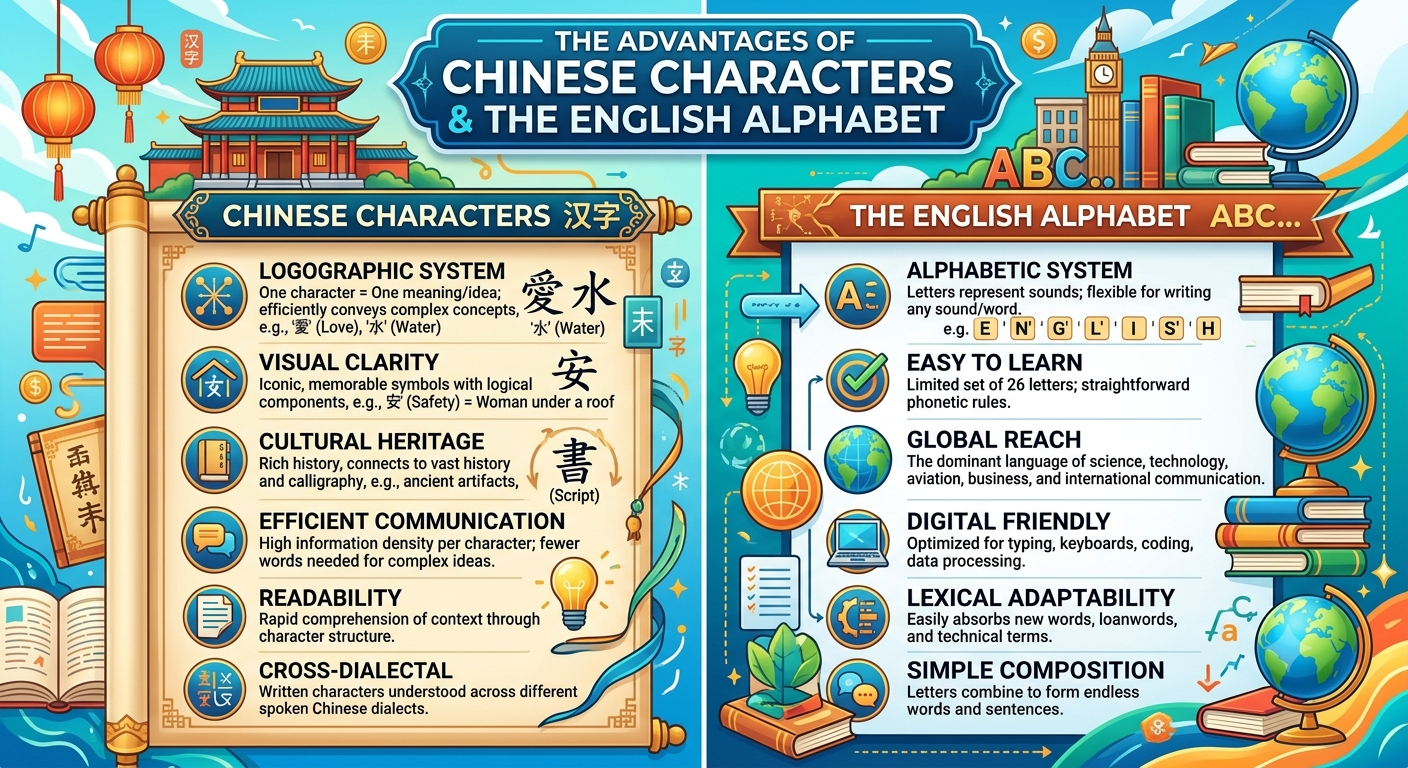
Advantages of Chinese Characters
1. Strong Visual Memory
Chinese characters train the brain to remember detailed visual patterns.
When a student learns a character, they memorize:
- Shape
- Stroke order
- Balance
- Meaning
- Pronunciation
This engages multiple brain systems at the same time.
2. Concept-Based Learning
Each character often represents an entire idea.
For example:
- 木 = Tree
- 林 = Woods (two trees together)
- 森 = Forest (three trees together)
This illustrates how meaning can be built visually.
3. Excellent Pattern Recognition
Reading Chinese encourages recognition of complex visual structures.
Over time, readers become highly skilled at identifying subtle differences among characters.
4. Historical Continuity
Chinese literature spans thousands of years. A stable writing tradition allows access to ancient philosophy, poetry, and historical records.
5. Efficient Communication
Many Chinese words are concise. A small number of characters can express ideas that require more letters in alphabetic languages.
Memory Development Through Chinese
Learning Chinese strengthens:
- Visual memory
- Long-term memory
- Pattern recognition
- Attention to detail
- Symbol recognition
- Spatial awareness
- Fine motor control through handwriting
Because thousands of characters must be distinguished, learners spend considerable time practicing recognition and recall.
The English Alphabet
What is the English Alphabet?
English uses 26 letters.
Each letter represents one or more speech sounds, and letters combine to form words.
Examples:
C + A + T = Cat
B + O + O + K = Book
The alphabetic principle allows a relatively small set of symbols to produce an enormous vocabulary.
History of the English Alphabet
The English alphabet developed through several stages:
- Ancient Egyptian symbols influenced early writing.
- Phoenician alphabet.
- Greek alphabet.
- Latin alphabet.
- Modern English alphabet.
This evolution produced one of the most widely used writing systems in the world.
Advantages of the English Alphabet
1. Easy to Learn
Children can learn the 26 letters relatively quickly.
Once the alphabet is understood, learners can decode many new words.
2. Flexible Word Creation
English continuously creates new words, especially in science and technology.
Examples include:
- Smartphone
- Blockchain
- Cryptocurrency
- Biotechnology
- Nanotechnology
- Artificial Intelligence
The alphabet easily adapts to innovation.
3. Global Communication
English is widely used in:
- International trade
- Aviation
- Medicine
- Engineering
- Scientific research
- Software development
- Artificial Intelligence
- Higher education
This makes English a practical tool for global collaboration.
4. Efficient Typing and Digital Use
Alphabetic keyboards are straightforward, enabling rapid typing on computers and mobile devices.
Memory Development Through English
Learning English strengthens:
- Auditory memory
- Phonetic awareness
- Sequential memory
- Vocabulary growth
- Reading fluency
- Grammar understanding
- Rapid word recognition
Readers learn to connect letter patterns with pronunciation and meaning.
Comparing the Two Systems
| Area | Chinese Characters | English Alphabet |
|---|---|---|
| Number of symbols | Thousands | 26 letters |
| Learning curve | Longer | Shorter |
| Writing principle | Meaning-based units | Sound-based letters |
| Memory emphasis | Visual and symbolic | Auditory and phonetic |
| Pattern recognition | Very strong | Strong for spelling patterns |
| New word creation | Compound characters and words | Flexible letter combinations |
| Typing | Character input methods | Direct keyboard entry |
| Global reach | Widely used in Chinese-speaking regions | International lingua franca |
Brain Functions Activated
Chinese
The brain emphasizes:
- Visual cortex
- Spatial processing
- Symbol recognition
- Long-term visual memory
- Motor memory for stroke order
English
The brain emphasizes:
- Auditory processing
- Phonological decoding
- Sequential processing
- Vocabulary networks
- Reading fluency
Both systems engage overlapping language areas in the brain, but they place different demands on visual and sound processing.
Memory in Daily Life
A person reading Chinese often recognizes entire characters and words as visual units.
A person reading English usually processes sequences of letters and their sounds before identifying the word.
Both approaches become highly automatic with practice.
Role in Artificial Intelligence
Modern AI systems can:
- Translate between Chinese and English.
- Recognize handwritten characters.
- Convert speech to text.
- Generate written content.
- Assist language learning.
- Search information across multiple languages.
Multilingual AI helps connect people and knowledge regardless of writing system.
The Future of Writing
Future technologies may include:
- Real-time speech translation.
- AI-assisted writing.
- Augmented reality language overlays.
- Brain-computer interfaces for communication.
- Personalized language tutoring powered by AI.
Rather than replacing traditional writing, these tools are likely to make multilingual communication more accessible.
Lessons for Modern Society
Both Chinese characters and the English alphabet demonstrate that there is more than one effective way to organize human knowledge.
Chinese writing highlights the power of visual symbolism and historical continuity. The English alphabet highlights efficiency, flexibility, and global accessibility.
In today’s interconnected world, proficiency in either system—and especially in both—can enhance opportunities in education, science, business, diplomacy, and technology.
Writing systems are not merely collections of symbols; they are powerful technologies for storing human knowledge.
- Chinese characters excel at representing meaning through rich visual symbols, strengthening visual memory and pattern recognition.
- The English alphabet excels at representing speech through a compact set of letters, supporting efficient learning, rapid communication, and global collaboration.
- Both systems contribute uniquely to cognitive development and human civilization.
- In the age of artificial intelligence, understanding multiple writing systems provides an advantage for participating in an increasingly connected and knowledge-driven world.
The greatest advantage in the 21st century is not choosing one writing system over another, but appreciating how different systems complement each other and enrich the ways humans learn, remember, and communicate.





Be First to Comment