
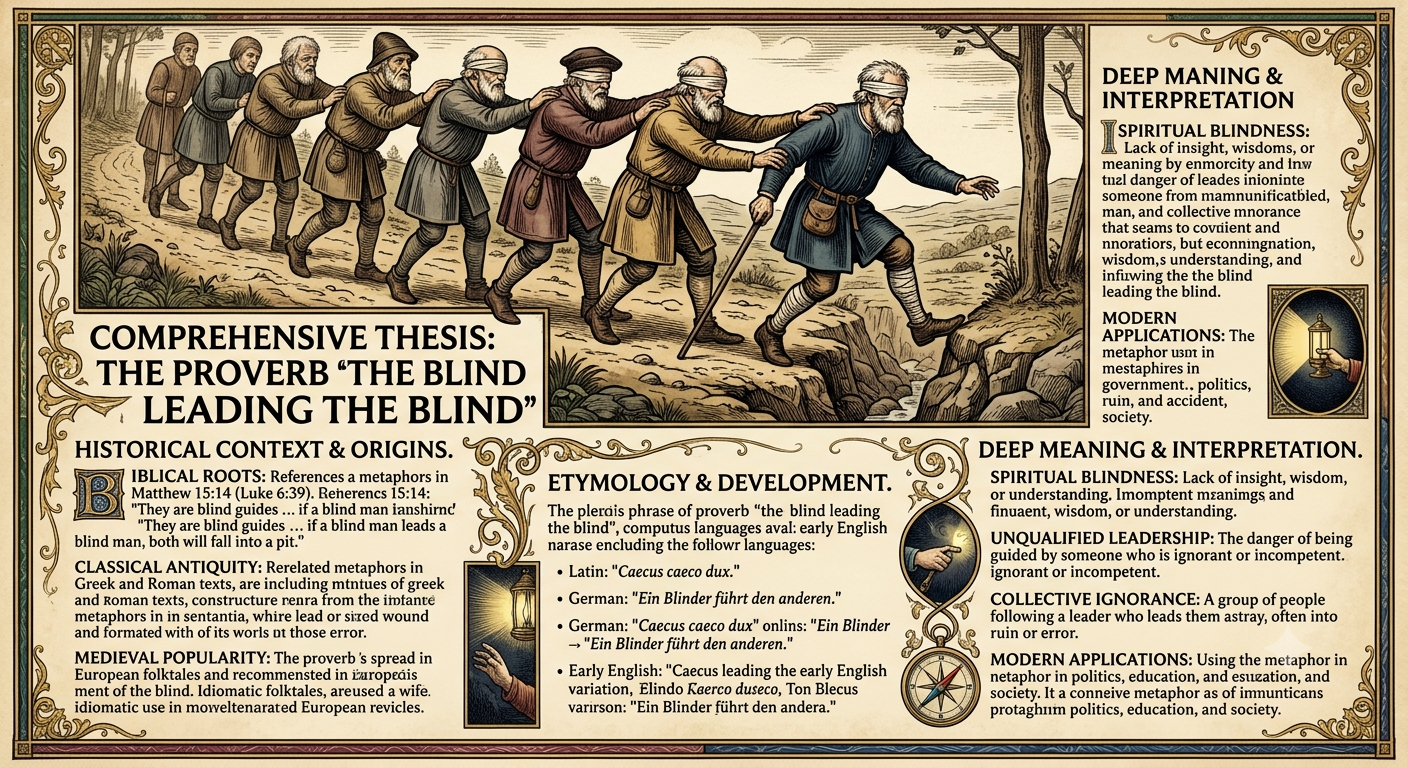
The Blind Leading the Blind
Abstract
The proverb “the blind leading the blind” is one of the world’s oldest and most enduring metaphors. It describes a situation in which a person who lacks knowledge, wisdom, competence, or insight attempts to guide another person who is equally uninformed. The result is usually confusion, failure, or mutual disaster.
Although the proverb refers literally to blindness, it has been understood for centuries as a metaphor for intellectual, moral, spiritual, educational, political, or organizational ignorance rather than a statement about people with visual impairments.
Today, the proverb applies to leadership, education, politics, business, social media, finance, technology, and artificial intelligence.
Chapter 1: Definition
The proverb means:
When someone who does not know the correct way tries to guide others, both leader and follower are likely to fail.
It teaches that:
- Knowledge matters.
- Competence matters.
- Wisdom matters.
- Experience matters.
- Humility matters.
Without these qualities, leadership becomes dangerous.
Chapter 2: Literal Meaning
Imagine two people who are completely blind walking through a forest.
One decides to become the guide.
Since neither knows the path:
- both may fall,
- both may become lost,
- both may walk into danger.
This simple picture became one of history’s greatest metaphors.
Chapter 3: Historical Origins
Ancient India
One of the earliest known versions appears in the Upanishads (around 800–500 BCE).
A famous passage describes ignorant people believing themselves to be wise:
“Living in ignorance, yet thinking themselves wise, they wander about like blind men led by the blind.”
This teaching warned against false teachers and superficial knowledge.
Ancient Greece
Greek philosophers expressed similar ideas.
Thinkers such as:
- Socrates
- Plato
- Aristotle
repeatedly warned that ignorance combined with overconfidence is more dangerous than ignorance alone.
Socrates famously emphasized recognizing one’s own ignorance as the beginning of wisdom.
The Bible
The proverb became especially famous through the teachings of Jesus.
In the Gospel of Matthew (15:14):
“If the blind lead the blind, both shall fall into the ditch.”
A similar statement appears in Luke 6:39:
“Can the blind lead the blind? Shall they not both fall into the ditch?”
Here, blindness symbolizes spiritual ignorance and misguided leadership.
Chapter 4: Medieval Development
During the Middle Ages, the proverb became common across Europe.
Religious scholars used it to criticize:
- false prophets,
- corrupt clergy,
- uneducated leaders,
- pride.
Artists also illustrated the proverb.
One of the most famous examples is:
Pieter Bruegel the Elder
His 1568 painting “The Blind Leading the Blind” depicts six blind men walking together, with each successive person falling after the one in front. It vividly represents the consequences of misguided leadership.
Chapter 5: Symbolism
The proverb uses blindness symbolically.
Blindness may represent:
- ignorance,
- arrogance,
- misinformation,
- lack of education,
- poor judgment,
- absence of critical thinking,
- moral confusion.
The ditch represents:
- failure,
- disaster,
- loss,
- collapse,
- regret,
- wasted effort.
Chapter 6: Psychological Meaning
Modern psychology explains why the proverb remains relevant.
Sometimes people:
- greatly overestimate their knowledge,
- refuse expert advice,
- mistake confidence for competence,
- copy uninformed individuals.
This is related to the well-known cognitive bias called the Dunning–Kruger effect, in which people with limited knowledge may overestimate their abilities.
Chapter 7: Educational Meaning
Education seeks to prevent “the blind leading the blind.”
A qualified teacher should possess:
- knowledge,
- preparation,
- experience,
- critical thinking,
- ethical responsibility.
If teachers misunderstand a subject, students may inherit those errors.
Chapter 8: Business Meaning
A company can suffer if:
- managers lack competence,
- executives make uninformed decisions,
- employees receive poor training.
Examples include:
- failed projects,
- financial losses,
- low morale,
- declining innovation,
- customer dissatisfaction.
Strong organizations invest in learning, mentoring, and evidence-based decision-making.
Chapter 9: Political Meaning
History contains many examples where poorly informed or ineffective leadership contributed to:
- economic crises,
- corruption,
- wars,
- institutional decline,
- social unrest.
The proverb reminds citizens to evaluate leaders based on integrity, competence, and informed judgment rather than rhetoric alone.
Chapter 10: Scientific Meaning
Science advances by questioning assumptions and testing ideas.
When unsupported claims are accepted without evidence:
- research quality declines,
- misinformation spreads,
- progress slows.
Peer review, replication, and open criticism help reduce the risk of “the blind leading the blind.”
Chapter 11: Artificial Intelligence
The proverb has new relevance in the AI era.
AI systems can spread errors if they are trained on inaccurate information or used without human oversight. Likewise, people who rely uncritically on AI outputs may repeat mistakes.
Responsible AI use combines:
- human expertise,
- verification,
- critical thinking,
- reliable data.
Chapter 12: Social Media
Online platforms can amplify misinformation when users share content without verifying it.
Examples include:
- false medical advice,
- fabricated news,
- investment scams,
- manipulated images,
- conspiracy theories.
Digital literacy helps people distinguish reliable information from misleading content.
Chapter 13: Leadership Lessons
Effective leaders:
- continue learning,
- seek expert advice,
- admit uncertainty,
- make evidence-based decisions,
- encourage constructive criticism,
- mentor others responsibly.
Poor leaders often:
- reject feedback,
- act on assumptions,
- confuse confidence with competence,
- discourage questions.
Chapter 14: Natural Analogies
Many social animals demonstrate the value of informed leadership.
Examples include:
- Elephant herds often benefit from the experience of older matriarchs who remember migration routes and water sources.
- Honeybee swarms collectively evaluate potential nest sites before choosing one.
- Migratory birds rely on coordinated group behavior and learned routes.
These examples illustrate that successful guidance often depends on experience, communication, and collective learning.
Chapter 15: Modern Examples
The proverb can apply when:
- an unqualified financial adviser gives investment advice,
- an inexperienced manager directs a complex engineering project,
- unverified online influencers spread health misinformation,
- someone copies incorrect AI-generated information without checking it,
- a student learns from inaccurate educational materials.
Chapter 16: Opposite Wisdom
The opposite of “the blind leading the blind” is competent, informed guidance.
Healthy leadership emphasizes:
- lifelong learning,
- expertise,
- humility,
- accountability,
- evidence,
- continuous improvement.
Chapter 17: Universal Message
Across cultures and centuries, this proverb teaches that leadership carries responsibility. Guiding others requires more than confidence—it requires knowledge, judgment, and a willingness to learn.
The lesson is not that leaders must know everything. Rather, effective leaders recognize the limits of their knowledge, seek reliable information, and remain open to correction.
Key Takeaways
- The proverb is over 2,000 years old, with roots in ancient Indian philosophy and later prominence in the New Testament.
- “Blindness” symbolizes ignorance or lack of insight, not physical blindness.
- It warns against uninformed leadership in every field of life.
- The consequences can include confusion, poor decisions, and shared failure.
- The enduring solution is education, humility, critical thinking, and responsible leadership.
Conclusion
“The blind leading the blind” remains one of humanity’s most enduring lessons because every generation faces the same challenge: choosing who to trust for guidance. Whether in education, business, science, politics, or technology, lasting progress depends on leaders who combine knowledge with humility and followers who think critically rather than accepting guidance unexamined. The proverb therefore serves as both a warning and an invitation—to become capable enough to lead wisely and discerning enough to choose trustworthy guides.





Be First to Comment