
Abstract
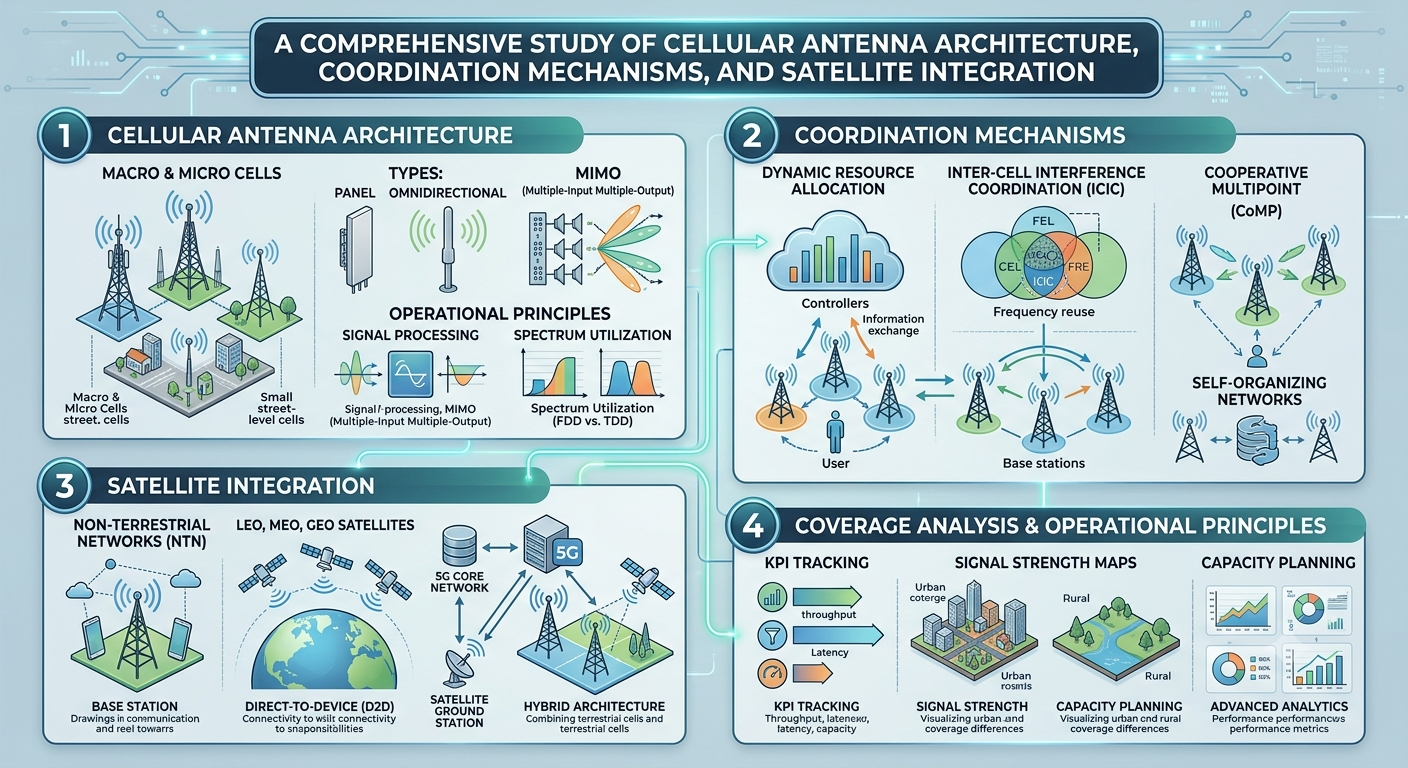
Cellular communication is one of humanity’s most transformative engineering achievements. Modern cellular networks connect billions of people through an intelligent ecosystem of antennas, radio towers, fiber-optic networks, satellites, data centers, and cloud-based control systems. Every phone call, text message, video conference, online payment, and IoT sensor relies on coordinated communication between terrestrial cellular antennas and, increasingly, satellites orbiting Earth.
This study explores the architecture, engineering principles, coordination mechanisms, antenna types, satellite integration, and coverage optimization of modern cellular communication systems.
Chapter 1: Introduction to Cellular Networks
A cellular network divides a geographical area into many smaller regions called cells.
Each cell is served by one or more antennas connected to a Base Station (BS).
Instead of one enormous antenna covering an entire country, engineers deploy thousands of smaller antennas.
Advantages include:
- Higher capacity
- Better signal quality
- Lower transmission power
- Reduced interference
- Efficient frequency reuse
- Easier maintenance
- Scalability
The “cell” concept allows millions of users to share limited radio frequencies efficiently.
Chapter 2: Evolution of Cellular Technology
| Generation | Years | Main Innovation |
|---|---|---|
| 1G | 1980s | Analog voice |
| 2G | 1990s | Digital voice, SMS |
| 3G | 2000s | Mobile Internet |
| 4G LTE | 2010s | Broadband data |
| 5G | 2020s | Massive IoT, AI, ultra-low latency |
| 6G (Research) | 2030+ | AI-native networking, integrated satellite communications |
Chapter 3: Anatomy of a Cellular Network
Internet
      │
Cloud Services
      │
Core Network
      │
Fiber Backbone
      │
Regional Data Centers
      │
Base Station Controller
      │
Radio Base Station
      │
Cellular Antenna
      │
Wireless Signal
      │
Mobile Phone
Every layer performs a specific function.
Chapter 4: Cellular Antenna Architecture
A cellular antenna consists of several major components:
1. Antenna Elements
Radiate electromagnetic waves.
Functions:
- Transmit
- Receive
- Shape radio beams
2. Reflector
Located behind antenna elements.
Purpose:
- Focus energy
- Increase gain
- Reduce unwanted radiation
3. Radome
Protective outer shell.
Protects against:
- Rain
- Wind
- UV radiation
- Dust
- Snow
4. Feed Network
Distributes RF energy to antenna elements.
5. Remote Radio Unit (RRU)
Converts digital signals into radio waves.
Contains:
- Power amplifier
- Filters
- Digital processors
6. Tower Structure
Supports:
- Antennas
- Microwave dishes
- GPS receivers
- Cameras
- Warning lights
Chapter 5: Types of Cellular Antennas
1. Omnidirectional Antenna
Coverage:
360°
Used in:
- Rural areas
- Temporary sites
- Small networks
Advantages:
- Wide coverage
- Simple deployment
2. Sector Antenna
Most common cellular antenna.
Coverage:
60°
90°
120°
Normally three sector antennas provide complete 360° coverage around a tower.
3. Panel Antenna
Flat rectangular antenna.
Used in:
- 4G
- 5G
Provides:
- High gain
- Beam shaping
- Directional coverage
4. Massive MIMO Antenna
Hundreds of antenna elements operate simultaneously.
Capabilities:
- Beamforming
- Spatial multiplexing
- User tracking
Typical 5G antennas contain:
64
128
256
or more transmitting elements.
5. Small Cell Antenna
Installed on:
- Streetlights
- Utility poles
- Buildings
Ideal for:
- Dense cities
- Stadiums
- Shopping malls
6. Distributed Antenna System (DAS)
Used inside:
- Airports
- Hospitals
- Tunnels
- Office buildings
Improves indoor cellular coverage.
Chapter 6: Cellular Tower Types
Major tower designs include:
- Monopole towers
- Lattice towers
- Guyed towers
- Rooftop towers
- Camouflaged towers (trees, flagpoles, church steeples)
- Utility-pole-mounted systems
Tower selection depends on terrain, zoning, wind loading, and required coverage.
Chapter 7: Frequency Bands
Different frequencies serve different purposes.
| Frequency | Characteristics |
|---|---|
| 600–900 MHz | Long range, excellent building penetration |
| 1.8–2.6 GHz | Balanced coverage and capacity |
| 3.5 GHz | High-capacity 5G |
| 26–39 GHz (mmWave) | Very high speeds over short distances |
Lower frequencies cover larger areas, while higher frequencies deliver more bandwidth but require denser antenna deployment.
Chapter 8: Coordination Between Cellular Antennas
Thousands of antennas coordinate continuously.
They exchange information about:
- User movement
- Traffic load
- Radio interference
- Available channels
- Neighboring cells
- Synchronization timing
When a person moves, the network performs a handover, transferring the connection to a neighboring cell without interrupting the call or data session.
Chapter 9: Coverage Optimization
Engineers optimize networks by balancing:
- Signal strength
- User density
- Terrain
- Buildings
- Vegetation
- Weather
- Traffic demand
- Interference
Advanced techniques include:
- Beamforming
- Carrier aggregation
- Dynamic spectrum sharing
- AI-assisted radio optimization
- Self-organizing networks (SON)
Chapter 10: Fiber and Backhaul
The antenna is only one part of the system.
Traffic travels from the antenna to the core network through:
- Fiber-optic cables
- Microwave radio links
- Millimeter-wave backhaul
- Satellite backhaul (for remote locations)
Fiber provides the highest capacity and lowest latency, while microwave and satellite links extend service where fiber is unavailable.
Chapter 11: Satellite Integration with Cellular Networks
Modern cellular systems increasingly integrate satellites with terrestrial networks.
Satellite layers include:
Low Earth Orbit (LEO)
Altitude:
Approximately 300–2,000 km
Advantages:
- Low latency
- Fast Internet
- Direct-to-phone capabilities
Medium Earth Orbit (MEO)
Altitude:
Approximately 2,000–35,786 km
Applications:
- Navigation
- Communications
- Specialized connectivity
Geostationary Orbit (GEO)
Altitude:
35,786 km
Advantages:
- Very wide coverage
- Broadcast services
- Stable position relative to Earth
Trade-off:
Higher latency than LEO systems.
Chapter 12: How Cellular and Satellites Work Together
Hybrid operation allows:
- The phone connects directly to a terrestrial tower when available.
- If no tower is reachable, compatible devices and networks may connect through satellites for supported services.
- The network automatically selects the most suitable communication path based on signal quality and service availability.
This approach improves resilience during disasters and extends connectivity to remote regions, oceans, and sparsely populated areas.
Chapter 13: Coverage Analysis
Coverage depends on several engineering factors:
- Antenna height
- Transmit power
- Frequency band
- Terrain
- Building density
- Antenna tilt
- Weather
- User density
Approximate terrestrial coverage (highly variable):
| Environment | Typical Cell Radius |
|---|---|
| Dense urban | 0.2–2 km |
| Suburban | 2–10 km |
| Rural | 10–35 km or more |
Actual values vary with spectrum, regulations, topography, and network design.
Chapter 14: Artificial Intelligence in Cellular Networks
Modern AI systems help operators:
- Predict network congestion
- Detect equipment faults
- Optimize antenna tilt
- Reduce interference
- Improve energy efficiency
- Support predictive maintenance
- Enhance cybersecurity
- Allocate radio resources dynamically
These capabilities are central to today’s 5G deployments and are expected to become even more important in 6G.
Chapter 15: Future Trends (2026–2035)
The next decade is expected to feature:
- AI-native radio access networks
- Wider use of Open RAN architectures
- Integrated terrestrial and non-terrestrial networks (NTN)
- Expansion of direct-to-device satellite connectivity
- Advanced Massive MIMO and intelligent beamforming
- Energy-efficient “green” base stations
- Edge computing integrated with radio networks
- Research toward 6G with sensing, communications, and AI working together
Conclusion
Cellular communication is a highly coordinated engineering ecosystem rather than simply a collection of towers. Each antenna functions as part of an intelligent network that continuously manages radio resources, user mobility, interference, and traffic. Terrestrial antennas, fiber-optic backhaul, cloud-based core networks, and satellite systems increasingly operate together to provide reliable connectivity across cities, rural regions, and remote environments.
As 5G matures and 6G research advances, the integration of artificial intelligence, beamforming, edge computing, and satellite communications will make future cellular networks more adaptive, resilient, and capable of supporting billions of people and connected devices worldwide.


Be First to Comment