
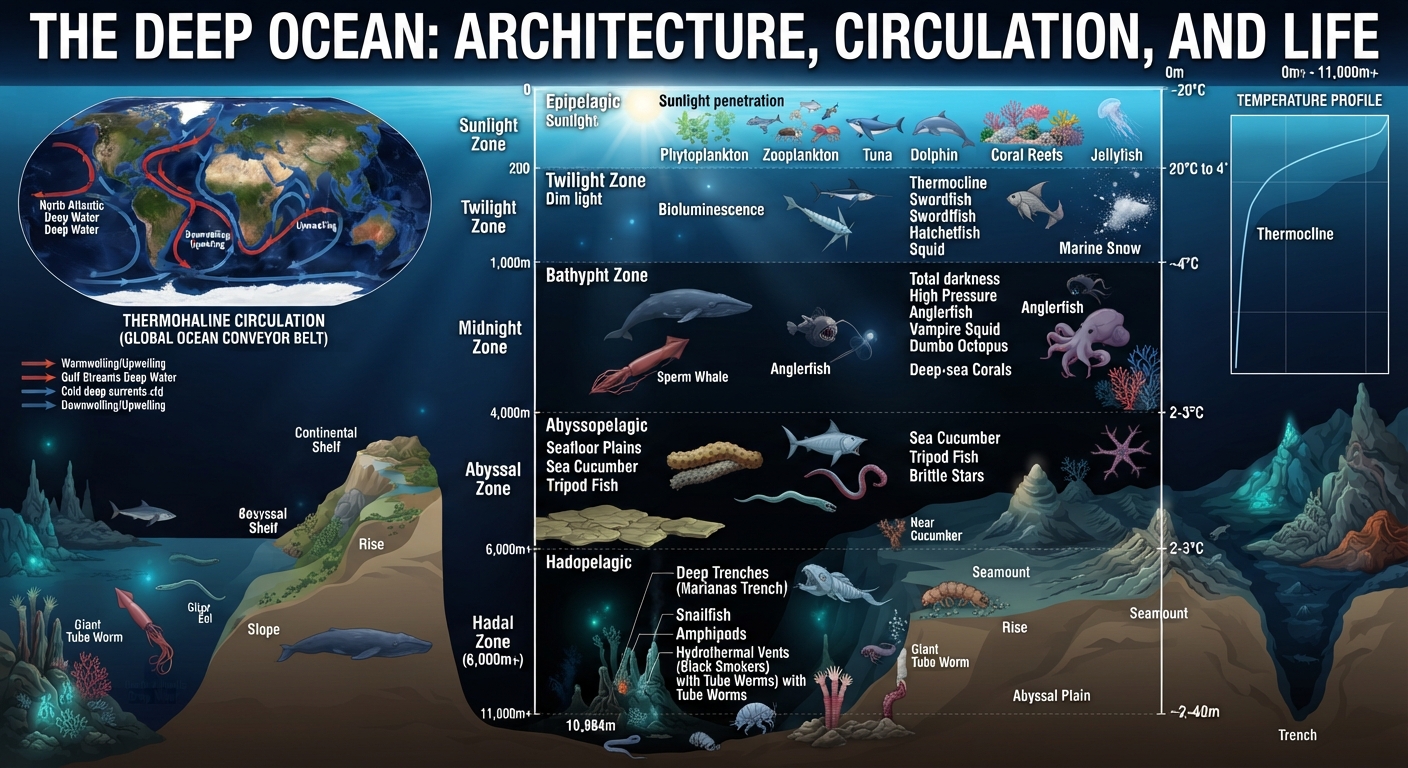
Depth, Temperature, Circulation, Marine Life, Ecosystems, and the Total Ocean System
Comprehensive Thesis
A sprinkling of cosmic dust may have helped kick-start life on Earth | Space
Ocean Zones – Woods Hole Oceanographic Institution
7
The Earth’s ocean is one of the largest, most complex, and least explored physical and biological systems on our planet. It is not simply a massive body of water. It is a dynamic planetary system that regulates climate, stores heat, transports energy, circulates nutrients, supports biological ecosystems, influences atmospheric conditions, and helps maintain the conditions necessary for life.
To understand the ocean deeply, we must examine it as an interconnected architecture of geology, water, pressure, temperature, chemistry, currents, microorganisms, animals, ecosystems, and planetary energy transfer.
Chapter 1 — The total architecture of Earth’s ocean
File:World map of bathymetric data – GEBCO 2014.jpg – Wikimedia Commons
File:Oceanic basin.svg – Wikimedia Commons
marine ocean biome at emaze Presentation
4
Earth’s ocean covers approximately 71% of the planet’s surface.
Although we commonly divide it into five oceans, they are connected and form one continuous global ocean.
| Ocean | Major characteristics |
|---|---|
| Pacific Ocean | Largest and generally deepest ocean basin |
| Atlantic Ocean | Major north-south transport and exchange basin |
| Indian Ocean | Strongly influenced by monsoon circulation |
| Southern Ocean | Surrounds Antarctica; major global circulation connection |
| Arctic Ocean | Smallest and shallowest ocean; polar ice and freshwater influence |
Approximate global ocean statistics
| Property | Approximate value |
|---|---|
| Ocean-covered surface | 361 million km² |
| Average depth | 3.7 km |
| Total water volume | 1.33 billion km³ |
| Deepest known point | About 10.9 km |
| Percentage of Earth’s surface covered | 71% |
| Percentage of Earth’s water found in ocean | About 97% |
The ocean has enormous three-dimensional volume. Its depth means that the planetary ocean is not just a surface environment—it is a vertical world extending from sunlit water to darkness, immense pressure, and geological environments below the deepest mountains on land.
Chapter 2 — How deep is the ocean?
2.1 The ocean floor is a geological landscape
The ocean floor is not flat. It contains mountains, valleys, plains, volcanoes, ridges, trenches, plateaus, and enormous geological structures.
What is the seabed like – iNEWS
10
Major ocean-floor structures
1. Continental shelf
A relatively shallow submerged extension of continental land.
It often supports highly productive fisheries because sunlight, nutrients, and mixing can support abundant marine life.
2. Continental slope
The steeper region connecting the continental shelf to the deeper ocean basin.
3. Continental rise
An accumulation of sediments near the base of continental slopes in many locations.
4. Abyssal plains
Vast, relatively flat areas of the deep ocean floor, often covered with fine sediments.
5. Mid-ocean ridges
Massive underwater mountain systems where tectonic plates separate and new oceanic crust forms.
6. Seamounts
Underwater volcanic mountains that may rise thousands of metres above the surrounding seabed.
7. Ocean trenches
Extremely deep, narrow depressions associated with tectonic plate boundaries, particularly subduction zones.
2.2 The deepest ocean
How Deep is the Mariana Trench? | Ultimate Kilimanjaro
Deepest Trench Now With More Deep | Deep Sea News
Unlocking the Mysteries of Earthquakes and Deep Ocean | Sustainable Campus
7
The deepest known part of the ocean is the Challenger Deep, located within the Mariana Trench in the western Pacific.
Its depth is approximately 10.9 kilometres, although exact measurements vary slightly with survey methods.
To understand the scale:
- Mount Everest is approximately 8.85 km above sea level.
- Challenger Deep is nearly 11 km below the ocean surface.
- The deepest ocean is deeper than Everest is tall.
The ocean’s deepest areas are called the hadal zone, named after Hades in ancient Greek mythology.
These environments are characterized by extreme pressure, complete darkness, low temperatures, and specialized organisms.
Chapter 3 — The vertical architecture of the ocean
Oceanographers divide the ocean into layers according to sunlight penetration, depth, temperature, and biological conditions.
9
Ocean depth zones
| Zone | Approximate depth | Main characteristics |
|---|---|---|
| Epipelagic | 0–200 m | Sunlight; photosynthesis; most familiar marine productivity |
| Mesopelagic | 200–1,000 m | Dim light; no significant photosynthesis |
| Bathypelagic | 1,000–4,000 m | Permanent darkness; cold water |
| Abyssopelagic | 4,000–6,000 m | Very cold; high pressure; extensive deep-sea habitat |
| Hadal | 6,000 m to deepest trenches | Extreme pressure; specialized trench ecosystems |
These are broad biological and oceanographic boundaries. Actual conditions vary with latitude, season, water clarity, and ocean location.
3.1 Epipelagic: the sunlit ocean
Reef Recon – Blue Planet Diving
Phytoplankton: The Ocean’s Largest Oxygen Factory
Underwater Cathedrals: Shooting Magnificent Kelp Forests
This layer receives sufficient sunlight for photosynthesis.
Its major biological components include:
- Phytoplankton
- Cyanobacteria
- Seaweed
- Seagrasses
- Zooplankton
- Fish
- Marine mammals
- Coral ecosystems
Photosynthesis is one of the most important processes in the ocean.
Phytoplankton convert solar energy, carbon dioxide, and nutrients into organic matter.
This creates the foundation of many ocean food webs.
3.2 Mesopelagic: the twilight zone
Fotografie: Diese Tiefsee-Bewohner scheinen nicht von dieser Welt | STERN.de
From dumbo octopus to goblin shark: 6 deep-sea animals that look truly unreal | – The Times of India
Photos: New Species, “Living Fossils” Found in Atlantic | National Geographic
9
Between approximately 200 and 1,000 metres, sunlight becomes increasingly weak.
Many animals have adapted to this environment using:
- Bioluminescence
- Large sensitive eyes
- Camouflage
- Vertical migration
- Specialized sensory systems
One of the largest biological movements on Earth occurs here.
Every night, enormous numbers of organisms move upward toward shallower waters to feed. During daylight, many descend again.
This process is known as diel vertical migration.
It transfers carbon, nutrients, and biological energy between ocean layers.
3.3 Bathypelagic: the midnight ocean
Into the Midnight Zone | God’s World News
What Is the Pelagic Zone in the Ocean? – Pelagic Layers
10
At approximately 1,000–4,000 metres, sunlight is absent.
The environment is characterized by:
- Darkness
- Low temperatures
- High pressure
- Limited food availability
- Slow biological processes in many organisms
Animals here rely on food arriving from upper ocean layers, including:
- Marine snow
- Dead organisms
- Organic particles
- Migrating animals
- Predation
The deep ocean is not empty. It is a vast habitat populated by organisms adapted to its unique environmental conditions.
3.4 Abyssopelagic: the abyss
The abyss extends across much of the deep ocean, generally from around 4,000 to 6,000 metres.
Life in the deep – microbes of the abyss|ERC
10
The abyss is an enormous environment of:
- Fine sediment
- Extremely cold water
- High pressure
- Low food availability
- Slow-growing ecosystems
Organisms may include sea cucumbers, amphipods, worms, sponges, microorganisms, and other specialized life.
Much of the abyssal ecosystem depends on organic material originating from the surface.
3.5 Hadal: the trench environment
Zonation in the ocean powerpoint | PPT
Extreme Evolution – Schmidt Ocean Institute
6
The hadal zone consists primarily of deep ocean trenches.
Life here must withstand pressures far greater than those experienced at the ocean surface.
Specialized adaptations include:
- Pressure-tolerant proteins
- Flexible cellular structures
- Membrane modifications
- Specialized metabolism
- Adaptations to low food availability
Even in these extreme environments, life exists.
Chapter 4 — Ocean temperature architecture
Temperature is one of the most important physical properties controlling the ocean.
It influences:
- Water density
- Circulation
- Oxygen availability
- Metabolism
- Marine species distribution
- Climate
- Nutrient movement
Ocean Acoustics – underwater-systems
PPT – “The open ocean is a biological desert.” PowerPoint Presentation – ID:6787775
Marine Science Basics – Marine Science Australia
7
4.1 Three major temperature structures
A. Surface mixed layer
The upper ocean is influenced by:
- Solar radiation
- Wind
- Waves
- Evaporation
- Atmospheric temperature
Wind mixes surface water, producing a relatively uniform temperature layer.
B. Thermocline
The thermocline is a region where temperature decreases rapidly with increasing depth.
In tropical and subtropical oceans, it may be especially pronounced.
It acts as a transition between warm surface water and colder deep water.
C. Deep ocean
Deep water is generally cold, often around 0–4°C across large regions.
The temperature is relatively stable compared with surface water.
4.2 Why the ocean becomes colder with depth
Sunlight primarily heats the upper ocean.
Water absorbs and scatters solar energy, and only a small fraction of sunlight penetrates deeply enough to influence the lower ocean.
The deep ocean is also influenced by cold water formed at high latitudes that sinks and spreads through the global circulation system.
The ocean therefore contains a huge temperature gradient:
Warm surface → transition layer → cold deep water
Chapter 5 — Ocean pressure architecture
Pressure increases with depth because the weight of water above increases.
A useful approximation is:
\[ P \approx P_0 + \rho gh \]
Where:
- \(P\) = pressure
- \(P_0\) = atmospheric pressure at the surface
- \(\rho\) = seawater density
- \(g\) = gravitational acceleration
- \(h\) = depth
Pressure increases approximately by one atmosphere for every 10 metres of seawater.
| Depth | Approximate total pressure |
|---|---|
| Surface | 1 atmosphere |
| 100 m | 11 atmospheres |
| 1,000 m | 101 atmospheres |
| 4,000 m | 401 atmospheres |
| 6,000 m | 601 atmospheres |
| 10,000 m | About 1,001 atmospheres |
The deep ocean is therefore an environment where biological chemistry and structural adaptations must function under enormous pressure.
Chapter 6 — The architecture of ocean circulation
The ocean is continuously moving. It behaves somewhat like a planetary circulatory system, transporting heat, oxygen, nutrients, carbon, and organisms across enormous distances.
PPT – Virginia Earth Science Interactive SOL Review PowerPoint Presentation – ID:5809003
Geoengineering to Stabilise AMOC Explained
6.2.3 What is the general pattern of ocean currents? – Earth & Space Science
4
Ocean circulation consists of several interacting mechanisms.
6.1 Wind-driven currents
Solar energy heats Earth’s atmosphere unevenly.
This creates atmospheric pressure differences and winds. Winds transfer momentum to the ocean surface, generating currents.
Major surface currents include:
- Gulf Stream
- Kuroshio Current
- Brazil Current
- Agulhas Current
- California Current
- Canary Current
- Antarctic Circumpolar Current
Earth’s rotation also influences current direction through the Coriolis effect.
6.2 Ocean gyres
Large circular systems of currents develop in major ocean basins.
There are five major subtropical gyres:
- North Atlantic
- South Atlantic
- North Pacific
- South Pacific
- Indian Ocean
These circulation systems help distribute heat and influence the movement of floating materials, marine organisms, and nutrients.
6.3 Thermohaline circulation
PPT – The Dynamic Ocean PowerPoint Presentation, free download – ID:4805512
Frontiers | Observing Antarctic Bottom Water in the Southern Ocean
9
Thermohaline circulation is driven by differences in water density associated with temperature and salinity.
The basic process:
- Warm surface water travels toward colder regions.
- Water loses heat to the atmosphere.
- In some polar regions, salinity increases when sea ice forms and salt is excluded from the ice.
- The colder, saltier water becomes denser.
- Dense water sinks and spreads through deep ocean basins.
- Deep water slowly circulates.
- Water returns toward the surface through mixing and upwelling.
This circulation is part of the ocean’s global overturning system. It helps distribute heat and influences the climate system.
NOAA describes this system as a combination of wind-driven surface circulation and density-driven deep circulation. National Ocean Service+2
Chapter 7 — Upwelling and downwelling: the ocean’s vertical transport system
Why Are the Eastern Margins of Ocean Basins Full of Fish? · Frontiers for Young Minds
PPT – Ocean Circulation PowerPoint Presentation, free download – ID:4478135
8
Upwelling
Upwelling is the movement of deeper water toward the ocean surface.
Deep water often contains nutrients accumulated from the decomposition of organic matter.
When this water reaches the sunlit zone, it can stimulate phytoplankton growth.
This creates productive marine ecosystems.
Important upwelling regions include areas near:
- Namibia
- Peru
- California
- Northwest Africa
- Southern Africa’s west coast
The Benguela Current system off southwestern Africa is particularly important for marine productivity and fisheries.
Downwelling
Downwelling is the movement of surface water downward.
It can transport:
- Oxygen
- Heat
- Dissolved carbon
- Organic material
into deeper ocean layers.
Upwelling and downwelling create a vertical circulation system that connects surface ecosystems with the deep ocean.
Chapter 8 — Ocean chemistry architecture
Seawater is a complex chemical solution.
It contains water molecules, dissolved salts, gases, minerals, nutrients, organic compounds, and microscopic particles.
The oceans’ climate challenge | Feature | Chemistry World
Ocean Acidification Illustrations
7
8.1 Salinity
Typical ocean salinity averages approximately 35 grams of dissolved salts per kilogram of seawater.
Major dissolved ions include:
| Ion | Importance |
|---|---|
| Chloride | Major component of seawater salts |
| Sodium | Major dissolved cation |
| Magnesium | Important in biological and chemical systems |
| Sulfate | Important in ocean chemistry and microbial processes |
| Calcium | Shells, skeletons, and mineral formation |
| Potassium | Biological chemistry |
| Bicarbonate | Carbon storage and acid-base chemistry |
Salinity varies because of evaporation, precipitation, river input, ice formation, ice melting, and ocean circulation.
8.2 Dissolved oxygen
Oxygen enters the ocean through:
- Atmospheric exchange
- Photosynthesis
Oxygen is consumed through respiration and decomposition.
Deep water oxygen levels depend on the balance between oxygen entering through circulation and oxygen consumed by biological processes.
Some ocean regions contain oxygen-minimum zones, where oxygen concentrations are especially low.
8.3 Carbon dioxide and ocean acidification
The ocean absorbs carbon dioxide from the atmosphere.
When carbon dioxide dissolves in seawater, chemical reactions produce carbonic acid and alter the carbonate system.
This changes seawater acidity and reduces the availability of carbonate ions in some conditions.
These changes can affect organisms that build calcium-carbonate structures, including some corals, shellfish, and plankton.
Chapter 9 — Ocean biological architecture: the living ocean
The ocean contains life ranging from microscopic bacteria to the largest animals known to have existed.
Планктон – это что? Понятие планктона, виды и описание – Gkd.ru
Your Guide to the Kona Black Water Dive Adventure
10
Marine organisms can be organized according to their ecological roles.
9.1 Primary producers
Primary producers create organic matter from inorganic materials using energy.
The principal oceanic producers include:
- Phytoplankton
- Cyanobacteria
- Seaweeds
- Seagrasses
Phytoplankton are especially important because they support much of the ocean’s food-web energy.
9.2 Primary consumers
These organisms feed on primary producers.
Examples include:
- Zooplankton
- Krill
- Some small fish
- Grazing organisms
9.3 Secondary consumers
These feed on primary consumers.
Examples include:
- Small predatory fish
- Jellyfish
- Squid
- Some larger crustaceans
9.4 Higher-level predators
Examples include:
- Tuna
- Sharks
- Seals
- Dolphins
- Large predatory fish
- Some seabirds
Food webs are complex networks rather than simple straight lines.
One organism may eat multiple species and may itself be prey for several different predators.
Chapter 10 — Marine creatures and their adaptations
A. Microscopic life
Phenomenal Phytoplankton: Scientists Uncover Cellular Process Behind Oxygen Production
Marine Microbes | Smithsonian Ocean
7
Microscopic organisms are foundational to ocean ecology.
They:
- Produce organic matter
- Participate in nutrient cycles
- Influence carbon movement
- Support larger organisms
- Help regulate chemical processes
A tiny organism may have a planetary-scale influence through its collective activity.
B. Fish
inside a giant sardines school of fish bait ball
En lysande lösning | Forskning & Framsteg
8
Fish exhibit enormous diversity.
Their adaptations include:
- Gills for extracting oxygen from water
- Fins for movement and stability
- Sensory systems for detecting vibrations and chemical signals
- Buoyancy control
- Camouflage
- Specialized feeding structures
C. Marine mammals
Whales eat three times more than previously thought | National Geographic
As 10 melhores praias da Maurícia: paraísos de areia branca e água azul-turquesa
¿Las focas tienen patas o aletas? – ¡Aletas!
Marine mammals include whales, dolphins, seals, sea lions, and other groups.
They are mammals rather than fish.
Their adaptations include:
- Lungs
- Warm-blooded physiology
- Specialized diving abilities
- Insulation
- Efficient swimming structures
D. Cephalopods
Unprecedented, massive octopus nursery found in deep sea | National Geographic
Windows to the Deep 2021: A Firsthand Account | NOAA Fisheries
7
Octopuses, squid, and cuttlefish are highly specialized molluscs.
Their adaptations include:
- Flexible bodies
- Complex sensory systems
- Color and pattern changes
- Camouflage
- Jet propulsion in many species
E. Deep-sea organisms
Extreme Evolution – Schmidt Ocean Institute
Daily briefing: 14 things PhD students liked hearing from their supervisors | Nature
9
Deep-sea organisms often exhibit:
- Slow metabolism
- Energy-efficient behavior
- Specialized sensory adaptations
- Pressure tolerance
- Feeding adaptations for scarce food
The deep ocean’s ecological architecture differs greatly from surface ecosystems.
Chapter 11 — Ecosystems throughout the ocean
The ocean is not one uniform habitat. It contains many distinct ecosystems with different temperatures, depths, chemistry, energy sources, and biological communities.
World Reef Awareness Day 2025: Bringing corals back to life – Earth.com
What Are Blue Foods? Why They’re Vital for People and the Planet — Fed by Blue
7
11.1 Coral reefs
Coral reefs are complex ecosystems built primarily by coral animals that produce calcium-carbonate skeletons.
They support:
- Fish
- Crustaceans
- Molluscs
- Sponges
- Algae
- Microorganisms
Reefs depend heavily on light, suitable temperatures, water chemistry, and ecological relationships.
11.2 Kelp forests
Kelp forests are underwater ecosystems formed by large marine algae.
They provide:
- Habitat
- Food
- Shelter
- Nursery environments
- Carbon storage
They are especially important in cool, nutrient-rich coastal waters.
11.3 Seagrass meadows
Seagrasses are flowering plants that grow underwater.
Their ecological functions include:
- Stabilizing sediments
- Providing habitat
- Supporting juvenile marine animals
- Capturing carbon
- Improving water clarity
11.4 Polar ecosystems
Polar oceans are influenced by:
- Sea ice
- Seasonal sunlight
- Cold water
- Nutrient circulation
- Specialized organisms
The seasonal cycle of sunlight creates large changes in productivity.
Chapter 12 — Life without sunlight: chemosynthetic ecosystems
The Salty Sea | manoa.hawaii.edu/ExploringOurFluidEarth
Chemosynthesis Fact Sheet – Deep Ocean Education Project
Dive 14: Bodie Seep and Midwater Transects – NOAA Ocean Exploration
9
One of the greatest scientific discoveries in oceanography was the discovery of hydrothermal vent ecosystems.
These communities can exist without sunlight being their primary energy source.
Hydrothermal vents
Hydrothermal vents occur where seawater circulates through cracks in the oceanic crust, becomes heated by geological processes, and emerges carrying dissolved chemicals.
Some microorganisms use chemical energy to manufacture organic matter.
This process is called chemosynthesis.
The basic ecological chain can be:
Chemosynthetic food-web architecture
Geological energy and chemical compounds
↓
Chemosynthetic microorganisms
↓
Specialized animals and symbiotic organisms
↓
Predators and associated ecosystem
This discovery demonstrated that ecosystems can obtain their foundational energy from chemical processes rather than directly from sunlight.
Hydrothermal vent communities can include microbes, tube worms, clams, mussels, crustaceans, and other organisms. National Ocean Service+2
Chapter 13 — Marine snow: the ocean’s food delivery system
Phänomen unter Wasser: Was ist Meeresschnee? | Weather.com
Des scientifiques ont découvert 476 carcasses de baleines dans une même fosse océanique – Lanature
The snow that falls to the bottom of the sea – Marine Madness
8
Marine snow consists of organic particles that sink from upper ocean layers toward deeper waters.
It includes:
- Dead phytoplankton
- Animal waste
- Small organisms
- Organic fragments
- Aggregated particles
The process is extremely important because sunlight-driven biological production occurs primarily near the surface, while much of the deep ocean is dark.
Marine snow transfers energy downward.
Some material is consumed while sinking. Some reaches the seafloor and supports benthic organisms.
This is one of the ocean’s principal biological connections between the surface and deep ocean.
Chapter 14 — The ocean’s carbon architecture
The ocean is one of Earth’s major carbon reservoirs.
Carbon enters and leaves the ocean through multiple interconnected mechanisms.
Microbial Carbon Pump: How Ocean Microbes Capture Carbon and Regulate Earth’s Cl
Our Evolving Understanding of Biological Carbon Export – Eos
The Carbon Cycle – Integrated Science
6
Major carbon pathways
1. Atmospheric exchange
Carbon dioxide exchanges between the atmosphere and the ocean surface.
2. Photosynthesis
Phytoplankton absorb carbon dioxide and convert it into organic matter.
3. Food-web transfer
Organic carbon moves between organisms as they consume one another.
4. Biological pump
Organic particles sink into deeper water.
5. Dissolution
Some carbon-containing material dissolves in seawater.
6. Sediment burial
Some organic matter and mineral carbon are buried in ocean sediments.
7. Deep circulation
Ocean currents transport dissolved carbon over large distances.
The ocean is therefore both a biological carbon-processing system and a physical carbon-transport system.
Chapter 15 — The ocean’s oxygen architecture
Oxygen is essential for many marine organisms.
The Mystery of Respiration in the Dark Ocean · Frontiers for Young Minds
Tiny Marine “Snowflakes” Play a Big Role in the Sea
Vitamin Sea – Blog de l’ISIGE – MINES Paris
7
Oxygen enters through two principal processes:
- Exchange with the atmosphere.
- Photosynthesis by marine organisms.
Oxygen is removed through:
- Respiration
- Organic matter decomposition
- Chemical oxidation
The balance between oxygen supply and oxygen consumption determines the oxygen conditions of marine habitats.
Some regions contain oxygen-minimum zones. Organisms living in such areas may have special physiological adaptations.
Oxygen levels also influence the distribution of marine species and the structure of ecosystems.
Chapter 16 — The ocean as Earth’s climate-regulation engine
The ocean is one of the largest regulators of Earth’s climate because water has a very high capacity to store heat.
Geoengineering to Stabilise AMOC Explained
Modeling of Hydrological Systems in Semi-Arid Central Asia – 7 Climate Data
Earth Observatory – NASA Science
5
16.1 Heat storage
The ocean absorbs substantial energy from the Sun.
Because water can store large quantities of heat, the ocean warms and cools more slowly than land.
This helps reduce extreme temperature fluctuations in coastal areas.
16.2 Heat transportation
Ocean currents transport heat from warmer regions toward cooler regions.
This influences:
- Regional temperatures
- Rainfall
- Storm development
- Atmospheric circulation
- Seasonal climate
16.3 Interaction with the atmosphere
The ocean exchanges:
- Heat
- Water vapour
- Carbon dioxide
- Momentum
Wind creates waves and currents. Ocean evaporation contributes moisture to the atmosphere. Atmospheric conditions also influence ocean temperature and circulation.
The ocean and atmosphere therefore form a coupled system rather than two independent systems.
Chapter 17 — Waves, tides, and ocean movement
How Ocean Waves Form Infographic | LivePhysics™
Text Structure: Waves and Tides | Review It
The Role of Internal Waves in Climate Change | Geography Realm
9
Waves
Most surface waves are generated by wind transferring energy into the water.
Wave properties include:
- Height
- Wavelength
- Period
- Frequency
- Direction
- Energy
Waves transport energy, while the movement of individual water particles is generally much smaller than the apparent movement of the wave itself.
Tides
Tides are primarily generated by the gravitational interactions of Earth, Moon, and Sun.
They create periodic rises and falls in sea level.
Tidal movements are especially important in:
- Coastal ecosystems
- Estuaries
- Tidal flats
- Coastal navigation
- Energy systems
Internal waves
The ocean also contains waves that occur beneath the surface, often along boundaries between water layers of different densities.
These waves can transport energy and influence mixing.
Chapter 18 — The ocean floor and geological architecture
How an unprecedented magma river surged beneath an Iceland town
PPT – Continental Margins & Ocean Basins PowerPoint Presentation, free download – ID:80062
7
The ocean floor is part of Earth’s active geological system.
Its architecture is continuously influenced by:
- Plate tectonics
- Volcanism
- Sediment deposition
- Erosion
- Landslides
- Chemical processes
Mid-ocean ridge systems
At divergent plate boundaries, tectonic plates separate.
Magma rises, cools, and creates new oceanic crust.
This process is called seafloor spreading.
Subduction zones
At convergent plate boundaries, one tectonic plate may move beneath another.
These processes help create deep ocean trenches and are associated with earthquakes and volcanic activity.
Sediments
Ocean sediments contain materials from:
- Rivers
- Wind
- Marine organisms
- Volcanic activity
- Chemical precipitation
- Erosion
Sediments preserve records of Earth’s climate, geological history, and biological evolution.
Chapter 19 — The ocean’s complete interconnected architecture
The ocean can be understood as an interconnected system of layers and processes.
Earth’s Ocean System
ATMOSPHERE
Wind • Rain • Heat • Carbon dioxide • Evaporation
↕ Heat, gas, moisture, energy exchange
SURFACE OCEAN
Sunlight • Waves • Wind-driven currents • Phytoplankton • Coral ecosystems
↕ Mixing • Migration • Carbon • Nutrients
MID-OCEAN
Twilight zone • Vertical migration • Predators • Oxygen gradients
↕ Deep circulation • Marine snow • Sinking water
DEEP OCEAN
Cold water • High pressure • Abyssal ecosystems • Deep currents
↕ Sediment exchange • Geological heat • Chemical reactions
OCEAN FLOOR & SUBSURFACE GEOLOGY
Sediments • Crust • Plate tectonics • Volcanoes • Vents • Microbial life
This is not a static arrangement. Every layer interacts with the others.
For example:
- Sunlight heats surface water.
- Phytoplankton convert sunlight into biological energy.
- Organisms consume phytoplankton.
- Organic matter sinks.
- Deep organisms consume this material.
- Currents redistribute nutrients and carbon.
- Upwelling brings some nutrients back toward the surface.
- Geological activity changes the ocean floor and its chemical environment.
- Ocean circulation transfers heat around the planet.
- The atmosphere influences winds, evaporation, rainfall, and ocean temperature.
The ocean’s physical, chemical, geological, and biological systems are interconnected. Woods Hole Oceanographic Institution+2
Chapter 20 — How humans explore the ocean
Geologist Describes “Frightening, Exhilarating” Dive 8,500 Feet Underwater
Exploration sector | Earth Sciences New Zealand | NIWA
9
The ocean is difficult to explore because it combines enormous scale with darkness, pressure, remoteness, and constantly changing conditions.
Modern oceanography uses several technologies.
| Technology | Scientific purpose |
|---|---|
| Sonar | Mapping seafloor and detecting objects |
| Multibeam sonar | Measuring bathymetry across broad areas |
| Autonomous underwater vehicles | Collecting data without continuous human control |
| Remotely operated vehicles | Investigating deep environments |
| Research submarines | Human scientific observation |
| Satellites | Observing sea-surface temperature, height, colour, ice, and other properties |
| CTD instruments | Measuring conductivity, temperature, and depth |
| Ocean buoys | Monitoring conditions continuously |
| Sediment cores | Studying geological and climate history |
| DNA sequencing | Identifying organisms and microbial communities |
The CTD instrument
One of the most important oceanographic instruments is the CTD.
CTD stands for:
- Conductivity
- Temperature
- Depth
Conductivity helps determine salinity.
Temperature and pressure measurements reveal how ocean water is structured vertically.
Scientists can use CTD measurements to identify water masses, temperature layers, density changes, and ocean circulation patterns.
Chapter 21 — Major challenges facing the ocean
A rischio estinzione il 44% dei coralli di tutto il mondo
Qué es la moda sostenible y cómo identificar prendas responsables | ECOALF
Images and Media: Fig4_ENSO-June-SST-trend_1900-2017_Lg.png | NOAA Climate.gov
7
The ocean is changing because of human activity and natural processes.
Major environmental challenges include:
1. Ocean warming
Increasing heat in the climate system changes ocean temperatures, affecting ecosystems, circulation, and marine species.
2. Ocean acidification
Increasing dissolved carbon dioxide alters seawater chemistry.
3. Oxygen loss
In some regions, ocean oxygen concentrations are declining, creating stress for marine organisms.
4. Marine pollution
Pollution includes plastic, chemical contaminants, nutrients, oil, and other materials entering marine ecosystems.
5. Habitat degradation
Coral reefs, mangroves, seagrasses, coastal wetlands, and other habitats can be damaged by environmental pressures.
6. Overfishing
Excessive fishing can reduce populations, change food webs, and disrupt ecosystem balance.
7. Climate-related changes
Changes in ice, rainfall, temperature, sea level, and ocean circulation affect the ocean’s ecological and physical systems.
Understanding these challenges requires long-term observations, scientific research, conservation, and responsible management.
Chapter 22 — The scientific significance of the ocean to civilization
The ocean is fundamental to the development and survival of civilization.
It influences:
- Global climate
- Food systems
- Transportation
- International trade
- Biological resources
- Scientific discoveries
- Renewable energy
- Coastal economies
- Weather forecasting
- Environmental stability
Ocean science is an interdisciplinary field connecting physics, chemistry, biology, mathematics, geology, engineering, computer science, and economics.
The future of ocean research increasingly depends on data infrastructure, artificial intelligence, autonomous robotics, advanced sensors, satellite systems, and computational models.
Chapter 23 — The ocean as a planetary machine
The ocean can be understood through five major systems.
The five fundamental ocean systems
1. Physical system
Water movement, waves, tides, pressure, temperature, density, and circulation.
Hvorfor er havet salt, og betyder det noget?
2. Chemical system
Salinity, oxygen, carbon, nutrients, minerals, acidity, and dissolved gases.
3. Geological system
Ocean basins, crust, ridges, trenches, sediments, volcanoes, and tectonic processes.
Phycokey – Oceanic Phytoplankton Mix Images
4. Biological system
Microorganisms, plants, animals, food webs, habitats, reproduction, and ecosystems.
An extraterrestrial’s view of the Earth | Instituto de Astrofísica de Canarias • IAC
5. Planetary climate system
Heat regulation, carbon storage, atmosphere interaction, rainfall, climate, and global energy transfer.
These five systems operate simultaneously.
A change in one system may influence the others. For example, ocean warming can change water density and circulation, influence oxygen levels, alter habitats, affect species distribution, and change the rate of certain biological and chemical processes.
Final conclusion
The ocean is Earth’s largest interconnected water environment and one of the planet’s most powerful regulators of climate and life.
Its architecture extends from the sunlit surface, where solar energy drives photosynthesis, through twilight and midnight waters, into cold abyssal plains and the extreme depths of ocean trenches.
Within this enormous three-dimensional environment, water circulates, heat moves, nutrients cycle, carbon is stored, geological processes reshape the seabed, and living organisms form complex ecosystems.
The deepest ocean is not simply a place of darkness. It is a world of specialized biological systems, geological activity, chemical energy, and extraordinary adaptations.
The ocean is simultaneously a planetary heat engine, a global circulatory system, a chemical reservoir, a geological landscape, a living ecosystem, and a critical foundation of Earth’s climate stability.
Its complete understanding is one of humanity’s great scientific challenges.
Recommended scientific reference sources
- NOAA National Ocean Service — ocean circulation, ocean chemistry, marine science and ocean systems.
- NOAA Ocean Exploration — deep-sea environments, exploration technology, marine habitats.
- Woods Hole Oceanographic Institution — ocean physics, biology, chemistry and engineering.
- Smithsonian Ocean — marine life, ocean ecology, geological and physical systems.
- NASA — satellite observations of ocean temperature, circulation, sea level, and Earth climate.





Be First to Comment