
Comprehensive Thesis
1. Introduction
Modern digital infrastructure is built upon four interconnected technological pillars:
- Data architecture — the collection, organization, storage, processing, and movement of information.
- Core architecture — the foundational computing infrastructure, hardware, operating systems, networks, databases, and enterprise systems.
- Cloud architecture — the delivery of computing resources, software, storage, and digital services through networked infrastructure.
- Cybersecurity architecture — the coordinated protection of digital information, systems, infrastructure, identities, and services.
Together, these four pillars form the backbone of the modern digital economy.
They support banking, hospitals, telecommunications, artificial intelligence, government services, manufacturing, transportation, agriculture, education, scientific research, and international commerce.
Beetoric | Presentación institucional
9
The relationship can be understood as:
\[ \boxed{\text{DATA}+\text{CORE}+\text{CLOUD}+\text{SECURITY}} \]
These components are not separate islands. They operate as a unified technological ecosystem.
PART I — DATA ARCHITECTURE
2. What is data architecture?
Data architecture is the systematic design of how information is collected, organized, stored, transformed, accessed, maintained, and used throughout an organization.
Data represents observations, transactions, measurements, records, events, and facts.
Examples include:
- Customer records
- Bank transactions
- Medical laboratory results
- Agricultural soil measurements
- Satellite imagery
- Manufacturing sensor readings
- Government population statistics
- Artificial intelligence training information
- Inventory and logistics information
The data architecture determines how these information assets move through an organization.
3. The data lifecycle
1. Data generation & collectionDevices, transactions, forms, applications, sensors
2. Data ingestionReceiving and transferring information
3. Processing & validationCleaning, checking, transforming, classifying
4. StorageDatabases, warehouses, object storage, archives
5. Analysis & intelligenceAnalytics, mathematical models, AI, reporting
6. Decision & actionBusiness decisions, automation, services, innovation
Stage 1: Data generation
Information is generated through human activity and technological systems.
Examples:
- A customer makes a payment.
- A farmer records rainfall.
- A satellite captures an image.
- A factory machine measures temperature.
- A student submits an examination.
- A vehicle records movement information.
Stage 2: Data ingestion
Data ingestion is the process of bringing information into a computing environment.
It can happen through:
- Application programming interfaces (APIs)
- Electronic forms
- File transfers
- Sensors
- Streaming events
- Database connections
- Mobile applications
Stage 3: Processing
Information may require:
- Validation
- Classification
- Standardization
- Removing duplicate records
- Correcting inconsistent formats
- Converting units
- Linking related datasets
Poor-quality information creates poor-quality decisions.
Stage 4: Storage
Different forms of information require different storage technologies.
| Storage technology | Main function |
|---|---|
| Relational database | Structured transactional records |
| Object storage | Documents, images, video, large files |
| Data warehouse | Organized analytical information |
| Data lake | Large collections of varied raw and processed data |
| Cache | Frequently accessed information |
| Archive | Long-term retention |
Stage 5: Analysis
Data becomes more economically valuable when transformed into knowledge.
Mathematical methods include:
- Statistics
- Probability
- Linear algebra
- Optimization
- Forecasting
- Machine learning
- Simulation
- Econometrics
Stage 6: Decision-making
Information can support decisions such as:
- How much inventory to purchase
- How to allocate resources
- How to identify infrastructure problems
- How to improve customer service
- How to forecast demand
- How to plan production
- How to improve public services
PART II — CORE COMPUTING ARCHITECTURE
4. What is core architecture?
Core architecture refers to the foundational systems upon which digital services operate.
It is the underlying technological machinery that allows applications to function.
The core includes physical computing, software, networking, storage, databases, system management, and business applications.
冯诺依曼体系结构及操作系统(OS)的简单认识_冯诺依曼架构-CSDN博客
Dell Technologies – Overview – WWT
Notes for A1.3.2 Functions of an Operating System – IB | RevisionDojo
8
5. The fundamental computing stack
Application LayerBanking, websites, AI, business applications
Platform LayerRuntime environments, middleware, APIs
Operating SystemLinux, Windows Server, other operating systems
Computing HardwareCPU, GPU, RAM, SSD, network interfaces
Physical InfrastructurePower, cooling, buildings, cabling, physical environment
6. Hardware foundation
Central Processing Unit — CPU
The CPU executes instructions and coordinates computational tasks.
Its architecture contains:
- Arithmetic logic units
- Control units
- Registers
- Cache memory
- Instruction-processing pipelines
- Multiple cores
Graphics Processing Unit — GPU
GPUs are designed to perform many computational operations in parallel.
They are particularly important in:
- Artificial intelligence
- Scientific computing
- Image processing
- Simulation
- Large-scale mathematical computation
Random Access Memory — RAM
RAM provides fast temporary working space for active programs and information.
When a program runs, relevant data and instructions are often loaded into memory.
Storage
Storage retains information beyond the immediate execution of programs.
Examples:
- Solid-state drives
- Hard disk drives
- Network storage
- Distributed storage systems
Network interfaces
Network hardware enables computers to exchange information with other systems.
This includes:
- Ethernet
- Fiber-optic interfaces
- Wireless networking
- High-performance data-center networking
PART III — CLOUD ARCHITECTURE
7. What is cloud computing?
Cloud computing is a model of providing computing resources through network-accessible services.
Instead of purchasing, maintaining, and operating every server yourself, an organization may obtain computing capacity, storage, databases, platforms, and applications from cloud providers.
Cloud infrastructure can provide:
- Computing capacity
- Storage
- Databases
- Networking
- Software
- Artificial intelligence services
- Backup services
- Monitoring
- Development environments
Understanding Cloud Computing Vulnerabilities – InfoQ
Cloud migration | Cloud and DevOps | Padok
Microsoft data center south of Atlanta would be larger than Mall of Georgia
8
8. The three major cloud service models
A. Infrastructure as a Service — IaaS
The provider supplies foundational computing infrastructure.
Customers manage much of the software environment, including operating systems and applications.
Typical resources:
- Virtual machines
- Storage
- Networking
- Computing capacity
B. Platform as a Service — PaaS
The provider supplies an environment for building, deploying, and operating applications.
Developers focus more on software development while the provider manages more of the underlying infrastructure.
C. Software as a Service — SaaS
The customer accesses a completed software application.
Examples of application categories:
- Online office tools
- Accounting platforms
- Customer relationship management
- Enterprise collaboration
| Model | Provider manages | Customer primarily manages |
|---|---|---|
| IaaS | Physical infrastructure, virtualization | OS, applications, data, configuration |
| PaaS | Infrastructure and platform | Application logic and data |
| SaaS | Most service infrastructure | Users, data, settings, usage |
Responsibilities vary between providers and individual services.
9. Cloud deployment architectures
Public cloud
Computing resources are provided through a cloud provider’s shared infrastructure, with logically separated customer environments.
Private cloud
Cloud-like infrastructure is dedicated to an organization.
Hybrid cloud
A combination of private infrastructure and public-cloud services.
Multicloud
An organization uses services from more than one cloud provider.
These architectures are often chosen according to cost, performance, regulatory requirements, resilience, data location, and operational capabilities.
10. Cloud computing architecture
A simplified cloud environment contains several layers.
Users & DevicesComputers, mobile phones, IoT equipment
ConnectivityInternet, private networks, gateways
Application & Service LayerWeb apps, APIs, business services
Cloud Compute & DataVirtual machines, containers, databases, storage
Physical Data CenterServers, networks, power, cooling, facilities
Cloud infrastructure technologies
- Virtual machines
- Containers
- Container orchestration
- Serverless computing
- Distributed databases
- Software-defined networking
- Load balancing
- Automated deployment
- Infrastructure monitoring
Virtualization
Virtualization allows physical computing resources to support multiple logically separate computing environments.
Containers
Containers package software and its dependencies in a consistent environment.
They help applications move between development, testing, and deployment environments.
Distributed computing
Distributed computing involves multiple interconnected computing systems working together.
It can provide greater capacity, resilience, and scalability, although coordination and reliability become more complex.
PART IV — CYBERSECURITY ARCHITECTURE
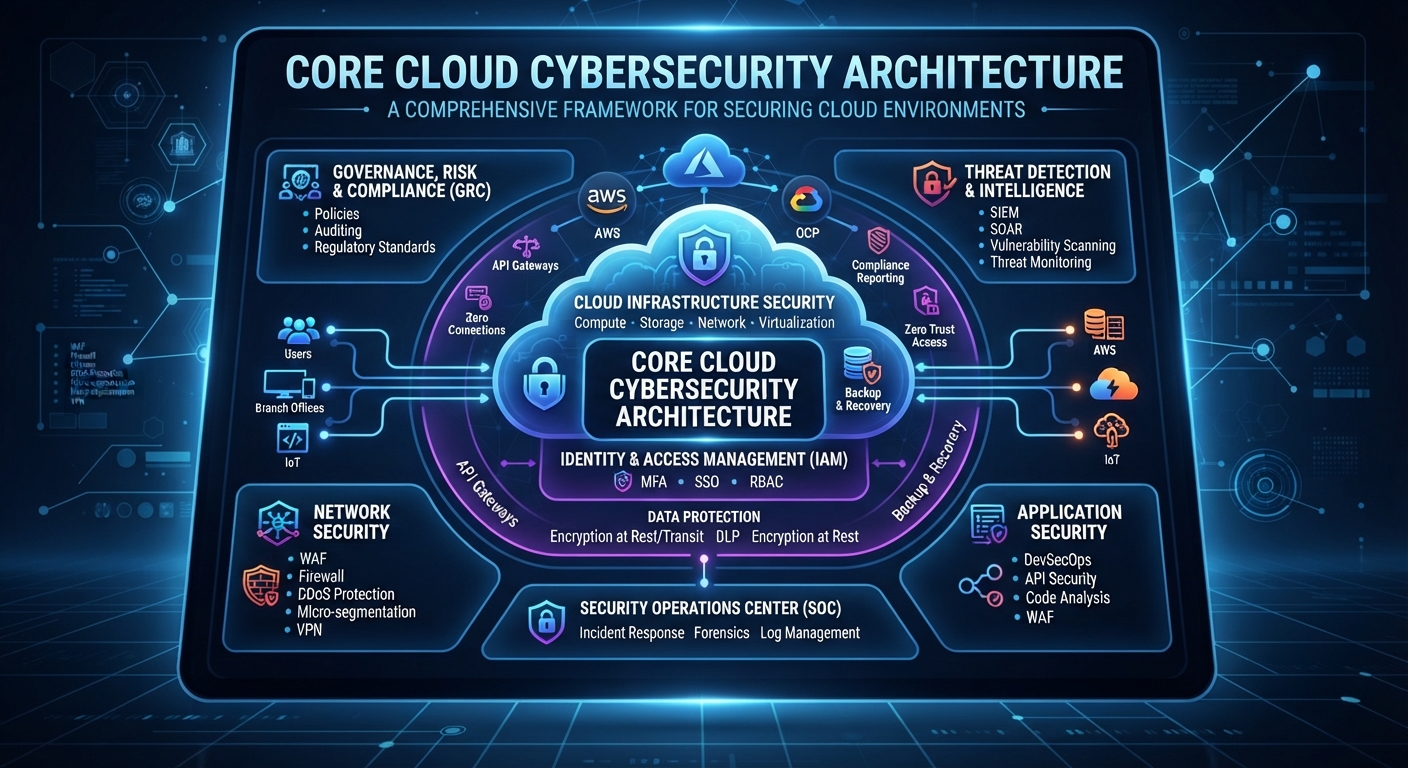
11. What is cybersecurity architecture?
Cybersecurity architecture is the organized structure of technologies, policies, processes, and controls that protect a digital environment.
Its purpose is to protect:
- Confidentiality — information is only accessible to authorized people or systems.
- Integrity — information remains accurate and trustworthy.
- Availability — services and information remain accessible when needed.
- Authenticity — identities and information sources can be verified.
- Accountability — activities can be traced to responsible accounts or systems.
These five ideas are foundational to trustworthy digital infrastructure.
12. The cybersecurity protection layers
Identity SecurityPeople, accounts, permissions, identity verification
Endpoint SecurityComputers, phones, servers, connected devices
Network SecuritySecure communications, network visibility, access controls
Application SecuritySecure software, APIs, authentication, validation
Data SecurityEncryption, permissions, retention, classification
Governance & RecoveryPolicies, risk, monitoring, incident response, backups
A weakness in one layer can affect the entire organization. Security therefore requires multiple coordinated protections rather than dependence on one security product.
13. Identity and access management (IAM)
Identity management answers three fundamental questions:
- Who or what is requesting access?
- What resources are they permitted to access?
- Under what conditions should access be permitted?
Authentication
Authentication verifies identity.
Examples of methods include:
- Passwords
- Passkeys
- Multi-factor authentication
- Security keys
- Device identity
- Certificates
Authorization
Authorization determines what an authenticated identity is permitted to do.
Permissions may include:
- Read
- Write
- Modify
- Approve
- Create
- Delete
- Administer
Least privilege
Users and services should receive only the permissions required for their responsibilities.
Identity lifecycle
A mature identity system manages:
- Account creation
- Identity verification
- Role changes
- Permission reviews
- Account suspension
- Account retirement
Identity is increasingly central because cloud services, mobile devices, remote employees, applications, and automated systems do not necessarily operate inside one physical network.
14. Zero Trust architecture
Zero Trust is a modern security model that does not automatically trust a user, device, or application merely because it is located inside an organization’s network.
Instead, access is evaluated according to identity, permissions, device state, context, and risk.
NIST’s Zero Trust Architecture publication, SP 800-207, establishes this resource-focused model. Its principles extend across users, devices, applications, infrastructure, data, and network connections. NIST+2
Zero Trust Architecture in Cybersecurity
NIST and Zero Trust Architecture Evolution | Ivanti
Zero Trust and SASE Unpacked: A Comprehensive Guide
7
Core principles
- Verify access rather than relying on assumed trust.
- Apply access permissions according to need.
- Consider the identity and condition of devices.
- Protect individual resources.
- Monitor activity.
- Reevaluate access when conditions change.
- Maintain visibility across the environment.
NIST’s implementation guidance published in June 2025 includes example architectures and implementation lessons for environments spanning on-premises systems and multiple cloud providers. NIST Computer Security Resource Center+1
PART V — INTEGRATED ARCHITECTURE
15. How data, core, cloud and cybersecurity connect
The four pillars operate as a connected system.
USERS, BUSINESSES & DEVICESCustomers, employees, machines, applications
CONNECTIVITYInternet, telecom, enterprise networks
CORE COMPUTINGServers, operating systems, applications
CLOUD PLATFORMCompute, storage, databases, APIs
DATA ENGINECollect, process, store, analyze, distribute
INTELLIGENCE & DECISIONSAI, analytics, business intelligence, automation
Cybersecurity is a continuous protective layer across every component, not merely a final layer at the bottom.
It covers identities, hardware, networks, applications, cloud resources, data, and management systems.
16. Enterprise architecture components
| Architecture component | Responsibility | Economic importance |
|---|---|---|
| Data architecture | Information management | Knowledge and decision quality |
| Core architecture | Computing foundation | Operational capability |
| Cloud architecture | Flexible computing capacity | Scalability and cost flexibility |
| Network architecture | Connectivity | Communication and service delivery |
| Cybersecurity | Risk reduction and protection | Trust and continuity |
| Application architecture | Digital services | Productivity and customer services |
| AI architecture | Prediction and intelligence | Innovation and automation |
| Governance architecture | Rules and accountability | Compliance and sustainable management |
PART VI — REAL-WORLD CASE STUDY: DIGITAL BANK
17. Architecture of a modern digital bank
Imagine a customer using a banking application to make a payment.
Customer mobile banking application
Secure connectivity & identity verification
Banking application services
Transaction processing & business rules
Database & financial records
What happens?
Step 1: The customer enters the banking application.
Step 2: The identity system verifies the customer’s identity and checks the authorization requirements.
Step 3: The application communicates with the bank’s service platform.
Step 4: Business logic validates the transaction and applicable rules.
Step 5: The transaction system records the appropriate information.
Step 6: The database stores the transaction record.
Step 7: Monitoring systems record operational events and support service reliability.
Step 8: Security systems continuously protect and monitor the environment.
The customer’s experience may be simple, but underneath it exists an extensive technological architecture.
PART VII — DATA CENTER INFRASTRUCTURE
18. Physical architecture of a data center
Cloud services are supported by physical infrastructure.
Powder Coatings for Data Centers and Server Racks
Custom Die Casting Supplier & Manufacturer | GuangWei
Tier III Redundancy: Power & Cooling for Modern Data Centers – Heather Technologies Corporation
10
Major components
| Infrastructure | Function |
|---|---|
| Server racks | House computing equipment |
| CPUs and GPUs | Execute computing tasks |
| RAM | Temporary working memory |
| Storage arrays | Retain digital information |
| Network switches | Connect computing systems |
| Fiber-optic cables | High-capacity communication |
| UPS systems | Temporary backup electrical power |
| Cooling systems | Remove heat |
| Fire detection | Detect environmental emergencies |
| Monitoring systems | Observe infrastructure health |
| Physical access controls | Protect facilities |
Electricity and cooling
Computing equipment consumes electrical energy and produces heat.
Therefore, data-center engineering must coordinate:
- Electrical distribution
- Power redundancy
- Cooling efficiency
- Temperature monitoring
- Airflow
- Equipment placement
- Energy management
Cloud computing is consequently not only a software industry. It is also an industry of electrical engineering, mechanical engineering, telecommunications, construction, semiconductor technology, and logistics.
PART VIII — CYBERSECURITY RISK AND GOVERNANCE
19. Common categories of digital risk
Organizations must manage risks across the entire architecture.
| Risk category | Description | Business consequence |
|---|---|---|
| Human error | Incorrect configuration or accidental action | Disruption or data loss |
| Identity risk | Mismanaged accounts or permissions | Unauthorized access |
| Software risk | Defects and outdated components | Reliability and security problems |
| Data risk | Poor quality, exposure, loss | Financial and reputational damage |
| Infrastructure risk | Hardware or power failures | Service interruption |
| Third-party risk | Dependency on external services | Supply-chain exposure |
| Governance risk | Weak policies and accountability | Compliance and operational failures |
| Availability risk | Systems unavailable | Lost productivity and revenue |
20. Security governance framework
Cybersecurity should be governed by an organizational structure.
Executive LeadershipStrategy, accountability, risk appetite, investment
Technology & Security GovernanceStandards, policies, architecture, oversight
Operational TeamsInfrastructure, data, cloud, applications, security
Monitoring & AssessmentPerformance, risk, audit, improvement
Governance establishes:
- Who owns systems and information?
- Who approves access?
- Who is responsible for security?
- Who evaluates risks?
- Who approves major technology investments?
- Who manages service failures?
- Who ensures compliance?
21. Business continuity and disaster recovery
Digital systems must be designed not only to operate under normal conditions but also to recover when problems occur.
Business continuity
Business continuity focuses on keeping essential organizational activities functioning during disruptions.
Disaster recovery
Disaster recovery focuses on restoring systems, infrastructure, applications, and data after a major disruption.
Important architectural concepts include:
- Backups
- Replication
- Recovery procedures
- Redundant infrastructure
- Alternate environments
- Disaster recovery planning
- Recovery testing
Two important measurements:
Recovery Time Objective (RTO): the target time within which a service should be restored.
Recovery Point Objective (RPO): the target for how much data loss, measured in time, can be tolerated.
For example, if an organization has an RPO of 15 minutes, its recovery strategy aims to limit lost data to approximately that interval under the defined scenario.
PART IX — ARCHITECTURE PERFORMANCE AND MATHEMATICS
22. Measuring architecture efficiency
An architecture can be evaluated using mathematical and operational indicators.
Availability
Availability measures the proportion of time a service is operational.
\[ A=\frac{\text{Available Time}}{\text{Total Time}} \]
If a service is available for 99.9% of a measurement period:
\[ A=0.999 \]
The unavailable fraction is:
\[ 1-0.999=0.001 \]
For a 365-day year, this corresponds to approximately 8.76 hours of downtime, assuming the availability percentage applies continuously across that year.
Latency
Latency measures how long a request takes to complete or travel through a system.
\[ L=t_{\text{response}}-t_{\text{request}} \]
Lower latency generally improves responsiveness, although acceptable latency depends on the service.
Throughput
Throughput measures how many tasks or transactions are completed in a given period.
\[ T=\frac{\text{Completed Transactions}}{\text{Time}} \]
Example:
If a system processes 12,000 transactions in 60 seconds:
\[ T=200\text{ transactions/second} \]
Scalability
Scalability describes the ability to increase or decrease capacity as workloads change.
Vertical scaling
Increasing the capacity of an individual computing system.
Horizontal scaling
Increasing the number of computing systems working together.
Cost efficiency
One useful measure is:
\[ \text{Cost per Transaction} = \frac{\text{Total Operating Cost}}{\text{Transactions Processed}} \]
This allows organizations to evaluate whether technological investment is improving economic efficiency.
PART X — THE DIGITAL ECONOMY
23. How the four pillars create economic value
The four architectural pillars support the creation of economic value through the following chain:
Digital InfrastructureComputing, networks, data centers
Information GenerationTransactions, measurements, records
Digital ProcessingSoftware, cloud, computing, algorithms
Knowledge & IntelligenceAnalytics, AI, forecasting, optimization
Economic ProductivityInnovation, better services, lower costs, new industries
Economic sectors transformed
Banking: digital payments, financial records, risk analysis and customer services.
Agriculture: precision farming, soil monitoring, irrigation optimization, crop forecasting.
Manufacturing: predictive maintenance, automation, quality control, digital production systems.
Healthcare: information systems, medical research, laboratory processing, digital administration.
Transport: fleet management, logistics, traffic analysis, tracking systems.
Government: digital records, administration, service delivery, statistical analysis.
Education: digital learning, scientific computing, educational platforms, research systems.
PART XI — ARTIFICIAL INTELLIGENCE ARCHITECTURE CONNECTION
24. How AI fits into data, core, cloud and cybersecurity
Artificial intelligence depends on all four architectural pillars.
| Pillar | Role in AI |
|---|---|
| Data | Training and inference information |
| Core | CPUs, GPUs, memory, storage |
| Cloud | Scalable compute and AI services |
| Cybersecurity | Protects data, accounts, models and services |
AI data pipeline
Data collection
Data preparation
Model training
Model evaluation
Deployment and inference
Monitoring and improvement
The AI system consumes data, uses computational infrastructure, produces outputs, and operates inside a security and governance environment.
PART XII — IMPLEMENTATION BLUEPRINT
25. How an organization builds its digital architecture
A successful implementation should proceed in stages rather than attempting to construct everything simultaneously.
Phase 1 — Assessment
Determine:
- Current technology infrastructure
- Existing databases
- Business applications
- Network connectivity
- Data quality
- Cybersecurity maturity
- Available budget
- Skills and human capital
- Operational requirements
Phase 2 — Architecture design
Develop a blueprint defining:
- Data architecture
- Hardware architecture
- Network architecture
- Cloud architecture
- Application architecture
- Security architecture
- Backup and recovery
- Governance and accountability
Phase 3 — Infrastructure development
Build or acquire the required infrastructure:
- Computing
- Networking
- Storage
- Cloud services
- Identity systems
- Monitoring systems
Phase 4 — Data engineering
Establish the information infrastructure:
- Data collection
- Data integration
- Databases
- Data standards
- Data quality
- Information governance
Phase 5 — Application development
Develop applications that convert the infrastructure into practical services.
Phase 6 — Security integration
Security should be included throughout the design and implementation lifecycle, rather than added only after development.
Phase 7 — Testing and evaluation
Test:
- Functionality
- Performance
- Reliability
- Security controls
- Recovery procedures
- Data quality
- User experience
Phase 8 — Continuous improvement
Architecture evolves as technologies, business requirements, threats, workloads, and organizational capabilities change.
26. Proposed digital architecture for a developing economy
A national or regional digital development system could be structured as follows:
DIGITAL SERVICESEducation • Banking • Agriculture • Healthcare • Government • Industry
DATA & INTELLIGENCEDatabases • Analytics • AI • Statistics • Information exchange
CORE & CLOUD INFRASTRUCTURECompute • Storage • Software • Cloud • Data centers
NATIONAL CONNECTIVITYFiber • Mobile networks • Internet exchange • Satellite • Submarine cables
PHYSICAL INFRASTRUCTURE & HUMAN CAPITALEnergy • Facilities • Engineers • Technicians • Researchers
Strategic development priorities
- Affordable, reliable connectivity.
- Stable electrical infrastructure.
- Skilled digital workforce.
- High-quality data systems.
- Local digital service development.
- Secure public and private cloud infrastructure.
- Cybersecurity education and governance.
- Research, innovation, and technology entrepreneurship.
- Digital inclusion and accessibility.
- Sustainable infrastructure investment.
PART XIII — COMPARATIVE ANALYSIS OF THE FOUR PILLARS
27. Data vs Core vs Cloud vs Cybersecurity
| Dimension | Data | Core | Cloud | Cybersecurity |
|---|---|---|---|---|
| Fundamental purpose | Information | Computation | Resource delivery | Protection |
| Primary asset | Records | Hardware/software | Services and capacity | Trust and resilience |
| Main function | Store and transform information | Execute instructions | Provide flexible resources | Reduce risk |
| Key technologies | Databases, pipelines | CPUs, OS, storage | Virtualization, containers | IAM, encryption, monitoring |
| Major challenge | Quality and governance | Reliability and capacity | Cost and complexity | Evolving threats and risk |
| Economic contribution | Knowledge | Operational power | Scalability | Confidence and continuity |
The four pillars have different functions but depend on one another.
A cloud environment without useful data has limited value.
A data system without computing infrastructure cannot operate efficiently.
Computing infrastructure without connectivity limits access.
Digital services without cybersecurity undermine trust.
PART XIV — THE ARCHITECTURE OF TRUST
28. Why cybersecurity is an economic foundation
Cybersecurity is not only a technical expense. It is a foundation for digital trust.
When businesses, governments, and individuals use digital systems, they need confidence that:
- Their information is appropriately protected.
- Their transactions are dependable.
- Their accounts are properly managed.
- Their services will remain available.
- Their information will not be altered improperly.
- Their digital interactions can be trusted.
Trust allows digital commerce and communication to grow.
For example, businesses are more likely to adopt online financial systems when they have confidence in transaction integrity, system availability, identity management, and privacy protections.
Modern security architecture therefore needs to include identity, data, applications, devices, infrastructure, and operational management. NIST’s Zero Trust guidance emphasizes protection of resources rather than relying solely on traditional network boundaries. NIST+1
PART XV — FUTURE TECHNOLOGICAL EVOLUTION
29. The next generation of digital architecture
The architecture will increasingly evolve toward more intelligent, automated, interconnected, and distributed computing systems.
AGP Insights – Edge computing and industrial automation | Asia Growth Partners
Quantum Computing | QuantumBytz
10
Emerging developments
Edge computing: processing information closer to the devices generating it, reducing delays and sometimes reducing network traffic.
AI-native infrastructure: computing systems designed specifically to support large-scale AI workloads.
Automation: automated provisioning, monitoring, scaling, and routine infrastructure management.
Advanced semiconductor architecture: new processors, accelerators, memory technologies, and interconnects.
Distributed computing: computing resources distributed across different locations but operating as coordinated systems.
Intelligent cybersecurity: more automated identification, classification, and prioritization of security events, with appropriate human oversight.
Digital twins: computational representations of physical systems used for analysis, planning, simulation, and monitoring.
30. Final thesis conclusion
Data, core computing, cloud infrastructure, and cybersecurity constitute four fundamental pillars of modern digital civilization.
Their relationship can be summarized through a technological and economic equation:
\[ \boxed{ \begin{aligned} \text{Digital Progress} ={}& \text{Data}\\ &+\text{Computing Infrastructure}\\ &+\text{Connectivity}\\ &+\text{Cloud Capacity}\\ &+\text{Cybersecurity}\\ &+\text{Human Capital}\\ &+\text{Innovation} \end{aligned} } \]
Data provides the information.
Core computing provides the processing machinery.
Cloud architecture provides flexible access to computing resources.
Cybersecurity protects the integrity, confidentiality, availability, and trustworthiness of the entire ecosystem.
Human capital transforms these systems into productive capabilities.
Innovation transforms these capabilities into new products, services, industries, and economic opportunities.
The most important strategic lesson is that successful digital development cannot depend on a single technology. It requires an integrated architecture of infrastructure, information, engineering, mathematics, management, cybersecurity, education, and economic planning.
For nations, businesses, and communities seeking long-term technological development, the ability to build, maintain, govern, and continually improve this integrated architecture is one of the most important foundations of the modern economy.
Recommended reference literature
1. NIST — Zero Trust Architecture, SP 800-207.
Official publication
2. NIST — Implementing a Zero Trust Architecture: High-Level Document, SP 1800-35, June 2025.
Official implementation guide
3. NIST — Planning for a Zero Trust Architecture.
Architecture planning guide
4. Amazon Web Services — Cloud infrastructure and architecture documentation.
5. Microsoft Azure — Cloud architecture and enterprise design documentation.
6. Google Cloud — Infrastructure, data engineering, AI, and cloud architecture documentation.
7. ISO/IEC 27001 — Information security management systems.
8. ISO/IEC 27017 — Security controls for cloud services.
9. TOGAF — Enterprise architecture methodology.
10. COBIT — IT governance and management framework.




Be First to Comment