
Comprehensive Thesis
1. Executive thesis
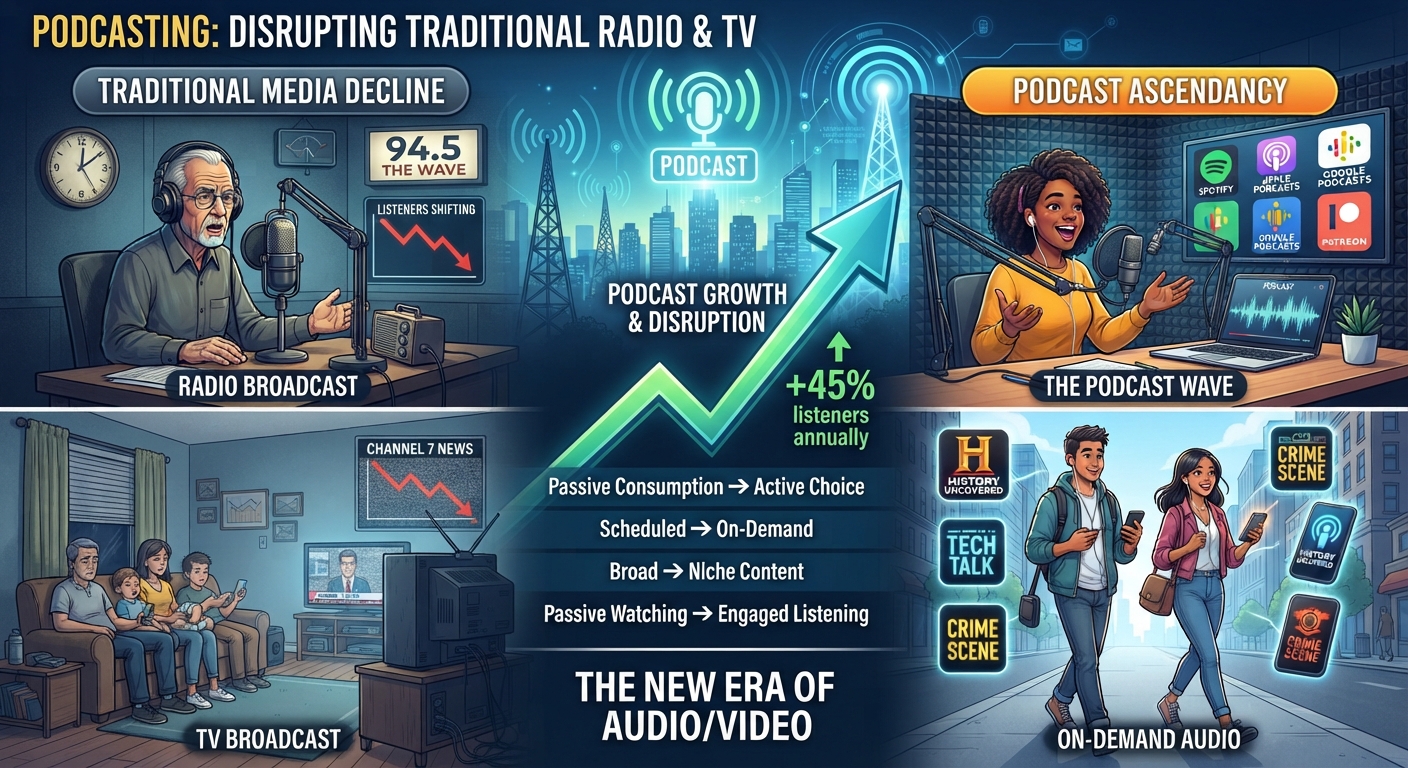
Podcasting represents a major structural transformation in the global media, broadcasting, communication, entertainment, education, journalism, and advertising industries.
Traditional radio and television were built around a centralized broadcasting model: a limited number of broadcasters produce programmes and transmit them to millions of audiences according to fixed schedules.
Podcasting introduces a more flexible digital, on-demand, creator-driven, globally distributed model, where audiences can choose what to listen to or watch, when they want, on devices they already use.
The disruption is not simply that podcasts will replace radio. Rather, podcasting is changing the entire architecture of media production, distribution, audience relationships, advertising, ownership, data, and monetization.
The future media ecosystem will increasingly combine:
- Traditional radio broadcasting
- Traditional television
- Audio podcasts
- Video podcasts
- Streaming platforms
- Social media distribution
- AI-assisted content production
- Interactive digital communities
- On-demand educational content
- Digital advertising and sponsorship
The central economic transformation is the shift from broadcasting content to scheduled audiences toward distributing personalized content to audiences who actively choose it.
Chapter 1: Historical architecture of mass media
1.1 The evolution of communication
PARKERSBURG, WEST VIRGINIA: WTAP-TV (vintage photos)
Podcast Studio Design & Installation — Yellow Technology – Professional Audio Consultants
8
Communication technology has continuously changed the cost, speed, reach, and accessibility of information.
| Era | Technology | Communication architecture |
|---|---|---|
| Ancient | Oral communication | Person-to-person |
| Historical | Written documents | Physical distribution |
| 15th century onwards | Printing press | Mass publication |
| 19th century | Telegraph | Long-distance electronic communication |
| Early 20th century | Radio | One-to-many broadcasting |
| Mid-20th century | Television | Audio-visual broadcasting |
| Late 20th century | Satellite and cable | Expanded broadcasting |
| 21st century | Internet | Global digital distribution |
| Modern digital era | Podcasting | On-demand, decentralized content distribution |
| Emerging era | AI-assisted media | Personalized and intelligent media experiences |
Every technological transition changes the economics of information.
The printing press reduced the cost of reproducing written knowledge. Radio reduced the cost of transmitting sound across geographical distances. Television added visual storytelling. The internet reduced the barriers to publishing and distributing digital content.
Podcasting extends this digital transformation into a media model where creators can publish content without necessarily owning broadcasting infrastructure.
Chapter 2: The architecture of traditional radio
2.1 How traditional radio operates
Traditional radio is based primarily on a broadcasting architecture.
A radio station typically contains:
- Programme production studios
- Audio recording equipment
- Sound mixing systems
- Broadcast scheduling systems
- Transmission equipment
- Radio towers or other transmission infrastructure
- Frequency allocation
- Advertising sales departments
- Programme presenters
- Newsrooms and editorial departments
The station produces content and broadcasts it through radio-frequency transmission infrastructure.
Traditional radio architecture
Programme production
Presenters • News • Music • Interviews
Broadcast control and scheduling
Studio • Audio mixing • Transmission control
Transmission infrastructure
Radio transmitter • Antenna • Frequency
Audience reception
Car radios • Household radios • Mobile radio receivers
2.2 The advantages of radio
Traditional radio possesses important strengths:
- Very broad geographical reach
- Low-cost reception for listeners
- Immediate live broadcasting
- Strong local news and community connections
- Emergency communication capabilities
- Familiar presenters and trusted personalities
- Shared real-time experiences
- Accessibility without requiring high-speed internet
Radio remains particularly valuable in communities where mobile data, electricity, or internet access may be unreliable.
2.3 The structural limitations
However, traditional radio also faces structural limitations.
Fixed schedules
Listeners generally have to tune in when a programme is broadcast.
Limited programme choice
A particular frequency normally carries one programme stream at a time.
Geographic limitations
Broadcast coverage depends on transmission infrastructure, frequency planning, and signal coverage.
Audience measurement limitations
Historically, broadcasters often relied on surveys, ratings estimates, and advertising research rather than precise individual-level engagement information.
Limited content lifespan
A programme may be broadcast once or repeated, but traditional broadcasting is not inherently designed for permanent searchable access to every episode.
These limitations create opportunities for podcasting.
Chapter 3: The architecture of podcasting
3.1 What is podcasting?
Podcasting is a digital content distribution system that allows people to create, publish, distribute, listen to, and watch episodic media through internet-connected devices.
A podcast may contain:
- Interviews
- Educational lectures
- News analysis
- Science and technology
- Business discussions
- Documentary storytelling
- Historical analysis
- Entertainment
- Video conversations
- Tutorials
Unlike traditional broadcasting, podcast content is often available as a library that audiences can access whenever they choose.
3.2 Podcast infrastructure
Content creation
Research • Script • Interviews • Recording
Production
Editing • Sound engineering • Video • Captions
Digital publishing
Hosting • Metadata • Episode archive • RSS
Distribution
Podcast applications • Websites • Video platforms • Social media
Audience access
Smartphones • Computers • Smart TVs • Cars • Headphones
The key difference is that a podcast does not necessarily require a broadcaster to operate a large radio transmitter or own a television transmission network.
A small production team can potentially reach an international audience using digital infrastructure.
Chapter 4: The fundamental disruption — broadcasting versus on-demand media
Traditional media and podcasting are built around different audience relationships.
| Traditional radio/TV | Podcasting |
|---|---|
| Scheduled programming | On-demand programming |
| Broadcaster selects programme timing | Audience selects timing |
| Limited channels | Vast content libraries |
| Regional transmission infrastructure | Internet distribution |
| Programme-centered | Programme and creator-centered |
| Advertising based on broadcast audience | Advertising based on digital audience segments and engagement |
| Mostly linear programming | Episodic, searchable, replayable |
| Limited direct feedback | Comments, communities, subscriptions, social feedback |
| Broadcast reach | Potential global distribution |
| Station brand | Individual creator, show, network, or platform brand |
The greatest disruption comes from the change in control of time.
In traditional television, the broadcaster largely determines when content is available.
In podcasting, the audience determines when to consume the content.
This seemingly simple change affects the entire business model.
Chapter 5: The disruption of radio
5.1 The migration of listening habits
Radio traditionally competes for listening time during:
- Morning commutes
- Afternoon commutes
- Household activities
- Workplace background listening
- News consumption
- Music entertainment
Podcasts compete directly for many of these same situations.
A listener can replace a scheduled radio discussion with a recorded discussion covering exactly the subject they want.
For example:
- A radio station broadcasts a general business programme.
- A podcast offers a dedicated programme about entrepreneurship.
- Another podcast focuses specifically on artificial intelligence.
- Another concentrates on economics.
- Another covers agriculture.
- Another discusses semiconductor technology.
The audience can select a narrow subject rather than accepting the general programming available on a particular radio station.
5.2 The fragmentation of radio audiences
Historically, radio stations attempted to attract large audiences through broad categories.
Podcasting allows audiences to fragment into thousands or millions of specialized communities.
Mass broadcasting
One programme → large general audience
Podcast ecosystem
Many specialized programmes → smaller but highly interested audiences
This creates a major advertising opportunity.
A business selling agricultural technology may find a specialized farming podcast more valuable than advertising to a large audience that includes many people with no interest in agriculture.
The future advertising market may increasingly value audience relevance over audience size alone.
5.3 Radio’s competitive response
Radio will not necessarily disappear.
Radio broadcasters can evolve into hybrid media companies by:
- Recording radio programmes for later podcast distribution
- Producing exclusive podcasts
- Creating video versions of popular presenters’ shows
- Publishing short clips
- Developing digital applications
- Offering live-streamed programmes
- Creating subscriber communities
- Building searchable programme archives
- Using audience data to improve content
The strongest radio stations may become multimedia content businesses rather than simply transmitters of sound.
Chapter 6: The disruption of traditional television
6.1 Television’s traditional architecture
Television was historically organized around a limited number of channels, programme schedules, production studios, broadcasters, advertising breaks, and distribution networks.
Its traditional model:
- Television networks commission content.
- Producers create programmes.
- Broadcasters schedule programmes.
- Television networks distribute programmes.
- Audiences watch according to schedules.
- Advertisers purchase television time.
Podcast video is challenging this model by combining long-form conversation with internet distribution.
Walter Cronkite School of Journalism / KAET | Virtual Tour | ASU
Clerkenwell Podcast Studio – Clerkenwell Studios – Event Venue Hire – Tagvenue.com
12
6.2 Video podcasts are creating a new television competitor
Video podcasts can now be watched on:
- Smartphones
- Computers
- Tablets
- Smart televisions
- Connected television devices
This means a programme originally designed as a podcast can compete for the same living-room viewing time that television programmes traditionally occupied.
The disruption is especially significant for:
- Interviews
- Political discussions
- Business discussions
- Sports analysis
- Educational programmes
- Documentary conversations
- Entertainment talk shows
A television viewer may increasingly choose a two-hour conversation with a specialist or creator instead of a conventional television programme.
6.3 The transformation of television economics
Traditional television programmes often require expensive production infrastructure.
Video podcasts can operate with comparatively smaller production teams and simpler sets.
| Television production | Video podcast production |
|---|---|
| Large studio | Smaller recording studio |
| Multiple departments | Small production team |
| High production budgets | Flexible production budgets |
| Broadcast scheduling | On-demand publishing |
| Network commissioning | Independent or self-financed production |
| Limited distribution outlets | Multiple digital platforms |
| Large audience targeting | Niche audience targeting |
This does not mean that every podcast is inexpensive or that television production costs will disappear. High-quality documentaries, dramas, sports, and major live events still require significant investment.
However, podcasting lowers the barriers to producing certain categories of content that previously depended heavily on television infrastructure.
Chapter 7: The creator economy and the decentralization of media ownership
7.1 The broadcaster is no longer the only gatekeeper
Traditional media historically had powerful gatekeepers:
- Television executives
- Radio station managers
- Programme commissioners
- Advertising departments
- Distribution companies
- Editorial institutions
Podcasting allows creators to establish their own media identities.
A creator can develop:
- A personal media brand
- A dedicated programme
- A recurring audience
- A digital community
- An archive of content
- A newsletter
- A website
- Educational products
- Live events
The creator’s reputation can become the central asset of the media enterprise.
7.2 The new media company
A successful creator may operate a small but sophisticated media company.
Independent media enterprise
Content production
Audience community
Digital distribution
Advertising & sponsorship
Subscriptions
Intellectual property
The creator may own the content, brand, production workflow, and relationship with the audience.
This represents a shift from institution-owned media toward a greater diversity of creator-owned media.
7.3 The new competitive landscape
Traditional media will increasingly compete with:
- Independent creators
- Specialist educators
- Scientists
- Entrepreneurs
- Journalists
- Technology experts
- Documentary creators
- Community media
- Universities
- Professional organizations
The competition is no longer only between radio stations and television channels.
It is increasingly between individual programmes, personalities, ideas, communities, and media brands.
Chapter 8: The transformation of advertising
Advertising is one of the most important economic mechanisms behind podcast disruption.
8.1 Traditional broadcast advertising
Traditional radio and television advertising is generally sold according to:
- Audience size
- Demographic characteristics
- Programme popularity
- Time of day
- Geographic coverage
- Advertising duration
Advertising is inserted into a programme through scheduled commercial breaks.
8.2 Podcast advertising
Podcast advertising may include:
- Host-read advertisements
- Sponsored episodes
- Product placement
- Brand partnerships
- Dynamically inserted advertisements
- Sponsored educational series
- Video advertisements
- Affiliate arrangements where appropriate and transparent
Host-read advertising can be particularly distinctive because it is delivered through the voice of a presenter whom listeners already know.
The audience relationship can therefore be an important part of the advertising value.
8.3 Advertising precision
Digital distribution creates opportunities to measure more than the estimated size of a broadcast audience.
Depending on the platform, advertisers may receive information such as:
- Episode downloads or plays
- Audience retention
- Completion rates
- Geographic audience information
- Campaign impressions
- Advertisement delivery
- Audience engagement
- Referral traffic
This can help advertisers assess the performance of campaigns.
The changing advertising equation
\[ \text{Advertising Value} \approx \text{Audience Reach} \times \text{Relevance} \times \text{Engagement} \]
The equation is conceptual rather than a universal industry pricing formula.
It illustrates why a smaller podcast audience with strong subject interest may sometimes be more commercially valuable than a much larger but less relevant audience.
Chapter 9: Audience data, analytics, and the new digital measurement economy
Podcasting creates an important connection between media and digital data infrastructure.
Traditional broadcasting has historically relied heavily on audience estimates, surveys, ratings, and aggregated measurements.
Digital podcast distribution can generate additional information about how content is accessed and consumed.
9.1 The digital measurement system
Podcast episode published
Digital distribution platform
Audience consumption and engagement data
Analytics and performance measurement
Advertising decisions • Content strategy • Audience development
The content producer can potentially evaluate:
- Which topics attract more listeners
- Which episodes perform better
- Which audiences return
- Which episodes are shared
- Which formats generate greater engagement
- Which content produces stronger audience retention
This supports a more evidence-based media production system.
9.2 The emergence of data-driven media
Podcasting increasingly combines:
Content + Technology + Audience Data + Advertising + Analytics
This creates a media industry where decisions can be informed by measurable audience behaviour rather than relying entirely on traditional broadcasting assumptions.
Data must nevertheless be interpreted carefully. Platform measurements differ, downloads do not necessarily equal unique listeners, and analytics may not reveal exactly why audiences engage.
Chapter 10: Podcasting, artificial intelligence, and the future media production factory
Artificial intelligence may further reduce the cost and complexity of producing media.
AI-assisted production can potentially help with:
- Research organization
- Interview preparation
- Transcription
- Captions
- Translation
- Audio cleanup
- Editing assistance
- Topic identification
- Summarization
- Content organization
- Accessibility
- Creating searchable archives
- Repurposing long-form material into shorter formats
10.1 The future media workflow
1. Knowledge collection
Research • Documents • Interviews • Data
2. Content planning
Themes • Questions • Episode structure • Editorial review
3. Recording
Audio • Video • Interviews • Presentations
4. AI-assisted production
Transcription • Captions • Editing assistance • Translation
5. Multi-format publishing
Full episodes • Audio • Video • Short clips • Articles
6. Distribution and measurement
Platforms • Audience feedback • Analytics • Improvement
10.2 One production, many media products
A single recorded episode could eventually generate several products:
| Original content | Additional output |
|---|---|
| 60-minute interview | Full audio episode |
| 60-minute interview | Full video episode |
| Interview transcript | Searchable written article |
| Important sections | Short video clips |
| Main concepts | Educational summary |
| Frequently asked questions | Learning resource |
| Expert discussion | Newsletter |
| Episode archive | Searchable knowledge database |
This changes the productivity of media production.
Instead of producing one programme for one distribution channel, the production team can develop a multi-format content asset.
The original interview becomes the raw intellectual material from which different media products are developed.
Chapter 11: Current industry evidence — the transformation is already happening
Podcasting is not merely a theoretical future disruption.
Recent industry research shows a growing overlap between audio, video, streaming platforms, and traditional broadcasting.
Industry indicators
2025–2026 research
United States
Edison Research reported in its 2025 Podcast Consumer study that 55% of Americans aged 12 and older had consumed a podcast in the previous month, and 40% in the previous week. Weekly video podcast consumption was reported at 26%. Edison Research at SSRS
United Kingdom
Ofcom’s 2026 audio research reported weekly podcast listening among 27% of adults aged 15 and older. Its research also describes the growing convergence between video podcasts and television consumption. www.ofcom.org.uk
Video transformation
A Reuters Institute report published in 2026 describes publishers increasingly adding video to podcasts, while some are retaining audio-only formats for narrative and investigative productions. reutersinstitute.politics.ox.ac.uk
Advertising
Deloitte projected global podcast and video-podcast advertising revenue at approximately US$5 billion for 2026, reflecting continued industry growth. Deloitte Insights
These findings indicate that podcasting is expanding, but they do not mean traditional radio and television have already been displaced.
The transformation is a competitive redistribution of audience time, attention, advertising, and production investment.
Chapter 12: Why traditional radio and television will not disappear completely
Technological disruption does not always mean the complete extinction of older technologies.
Radio and television possess unique advantages that podcasting cannot fully replace.
Radio’s enduring advantages
- Free-to-air reception in many markets
- Local community programming
- Emergency information
- Live news
- Live sports and events
- Low-data consumption
- Simple receiver technology
- Broad coverage in areas with limited internet
Television’s enduring advantages
- Major live sports
- Large-scale national events
- Live news
- High-budget entertainment
- Cinematic documentaries
- Large-scale productions
- Shared national experiences
The future will therefore likely be a competitive hybrid rather than a total technological replacement.
Traditional broadcasters that adapt may survive by developing stronger digital content businesses.
Chapter 13: Podcasting and the South African media economy
South Africa offers an important example of how podcasting may disrupt the traditional broadcasting industry while also creating new opportunities.
The South African broadcasting industry has historically been built around major radio stations, television networks, public broadcasters, commercial broadcasters, community radio, and advertising agencies.
Podcasting is expanding the ecosystem by enabling creators to build independent audiences around particular subjects, languages, communities, and personalities.
13.1 South African podcast development
The National Association of Broadcasters of South Africa’s industry report published in 2024 reported that monthly podcast listeners reached more than 13 million in 2023, using its cited market estimates. The report also described growth in podcast advertising. nab.org.za
The SABC itself is adapting. Its 2024/25 annual report described more than eight million podcast episode downloads across its radio portfolio during the financial year and emphasized the importance of mobile-friendly and on-demand content. Annual Report 2024/25
This is an important example of traditional media adapting rather than simply surrendering its audience.
13.2 South Africa’s future podcast industries
Potential South African podcast sectors
Education and science
Technology and AI
Business and entrepreneurship
Agriculture
Financial literacy
History and culture
Local languages
Community development
Local-language podcasting can be particularly significant because it enables content to serve communities that may be underrepresented in national television and digital media.
Podcasting can also become an educational infrastructure for South Africa, distributing knowledge about science, mathematics, finance, entrepreneurship, farming, engineering, and technology.
Chapter 14: Employment and new economic industries
Podcasting can generate employment beyond the presenter.
The podcast value chain
Production economy
- Presenters and hosts
- Researchers
- Scriptwriters
- Audio engineers
- Video editors
- Camera operators
- Graphic designers
- Animators
- Digital marketers
- Social media managers
- Advertising sales professionals
- Studio operators
- Producers
- Translators
- Captioning specialists
- Data analysts
- Event organizers
A growing podcast economy can stimulate demand for recording studios, equipment suppliers, editing services, content agencies, production companies, marketing agencies, digital advertising, and training institutions.
The economic value of podcasting therefore extends beyond the number of successful presenters.
It creates an ecosystem of services.
Chapter 15: The business models of future podcast networks
Podcast businesses may use several different revenue models.
| Business model | How revenue may be generated |
|---|---|
| Advertising | Commercial advertisements |
| Sponsorship | Companies support programmes |
| Membership | Audience pays for membership benefits |
| Subscription | Recurring payment for premium content |
| Production services | Recording and editing services for clients |
| Live events | Ticketed discussions and shows |
| Licensing | Content licensed to other media |
| Educational products | Courses and learning resources |
| Corporate media | Producing content for organizations |
| Content partnerships | Collaborations with media institutions |
The most sustainable podcast businesses will often combine several revenue streams instead of depending entirely on advertising.
Chapter 16: The risks and challenges of podcasting
Podcasting’s expansion also introduces important challenges.
16.1 Content oversupply
Because publishing barriers are relatively low, the number of programmes may increase faster than audience attention.
Thousands of creators may compete for the same limited listening time.
The central problem becomes discoverability:
How does a high-quality programme reach the audience that needs it?
16.2 Platform dependence
Creators may depend on digital platforms for:
- Distribution
- Discovery
- Advertising
- Monetization
- Audience access
Changes in algorithms, platform policies, or advertising systems can affect a podcast business.
Creators therefore benefit from developing independent websites, newsletters, archives, and direct audience relationships where appropriate.
16.3 Financial sustainability
Not every podcast will become profitable.
Producing content consistently requires time, skills, equipment, research, and sometimes staff.
A large audience does not automatically guarantee a profitable business.
16.4 Information quality
Podcasting makes it easier for people to publish opinions and information.
This creates responsibilities involving:
- Accuracy
- Fact-checking
- Editorial independence
- Privacy
- Responsible reporting
- Corrections
- Transparency regarding sponsorship
Media freedom and accessibility are valuable, but trust is an important asset that can be damaged by inaccurate or misleading content.
16.5 Digital inequality
Internet access, data costs, devices, electricity, and digital literacy can limit participation.
In South Africa, a podcast strategy that depends entirely on high-quality video and expensive data may exclude some audiences.
Audio-only distribution, downloadable episodes, transcripts, low-data formats, and local-language content can improve accessibility.
Chapter 17: The future convergence of radio, television, podcasting, and streaming
The future media industry will increasingly converge into a single digital media ecosystem.
Video Podcast Studio | Toronto ON | StartWell
Les TV connectés : une révolution technologique – Hometech SA
7
17.1 The convergence architecture
Central content production
News • Interviews • Research • Entertainment • Education
Multi-format production
Audio • Video • Live broadcast • Clips • Articles
Multiple distribution channels
Radio • Television • Podcast platforms • Websites • Social platforms
Connected audience ecosystem
Mobile • Cars • Computers • Smart TVs • Smart speakers
In this model, a media company does not create content exclusively for radio or exclusively for television.
It creates content and distributes it through several channels.
For example, a live interview could be:
- Broadcast on radio
- Streamed online
- Recorded as a podcast
- Published as a video
- Divided into short clips
- Transcribed into an article
- Archived on the organization’s website
The same intellectual content serves multiple audiences and distribution systems.
Chapter 18: A forecast of the media transformation, 2026–2035
These are strategic forecasts rather than guaranteed outcomes.
2026–2028: Expansion and experimentation
- More radio stations publish podcasts.
- More podcasts produce video versions.
- More creators enter the industry.
- Advertisers experiment with creator-led media.
- Short clips become major discovery mechanisms.
2029–2031: Professionalization
- Podcast networks become more structured.
- Advertising measurement improves.
- Media businesses develop integrated audio-video workflows.
- AI production tools become increasingly common.
- More specialist content brands develop.
2032–2035: Intelligent and personalized media
- AI may assist audiences in discovering relevant programmes.
- Automated translation may expand multilingual distribution.
- Searchable media archives become more useful.
- Educational media may become increasingly personalized.
- Interactive media experiences may expand.
- Traditional broadcasting and digital media become more integrated.
The most likely long-term outcome is not the death of radio or television.
It is the transformation of radio and television companies into digital, multi-platform media organizations.
Chapter 19: Strategic framework for a future media company
A future media organization should not depend on one broadcasting channel.
Instead, it should build an integrated media infrastructure.
19.1 The six-pillar architecture
Pillar 1 — Knowledge and research
Develop accurate, useful, original information.
Pillar 2 — Content production
Produce professional audio, video, interviews, educational programmes, and documentaries.
Pillar 3 — Digital infrastructure
Websites, hosting, archives, applications, distribution, and analytics.
Pillar 4 — Audience development
Communities, newsletters, social distribution, partnerships, and discoverability.
Pillar 5 — Monetization
Advertising, sponsorship, services, subscriptions, licensing, and partnerships.
Pillar 6 — Innovation
AI, automation, multilingual publishing, new formats, and audience research.
19.2 The modern media enterprise
A future media company may have the following organizational structure:
Media enterprise headquarters
Strategy • Finance • Governance • Innovation
Radio division
Television division
Podcast division
Digital publishing
Video production
AI and data division
The divisions share research, production infrastructure, talent, audience analytics, marketing, and advertising sales.
This architecture reduces duplication and allows content to reach multiple audiences.
Chapter 20: Podcasting as a knowledge economy
Podcasting’s most important long-term contribution may not be entertainment.
It may be the democratization and distribution of knowledge.
Historically, access to specialized knowledge was often controlled by:
- Universities
- Publishers
- Television networks
- Radio broadcasters
- Professional institutions
- Libraries
Digital podcasting allows specialists to explain their knowledge directly to audiences.
A scientist can explain scientific discoveries.
An engineer can discuss infrastructure.
An entrepreneur can discuss business systems.
An agricultural specialist can discuss farming.
An economist can explain financial systems.
A teacher can create educational programmes.
This creates a potentially powerful knowledge-distribution infrastructure.
The knowledge-production cycle
Research and knowledge creation
Media explanation and communication
Public understanding and learning
Skills development and innovation
Economic and social development
Podcasting can therefore become a supplementary educational infrastructure that complements schools, universities, libraries, newspapers, television, and professional training.
Chapter 21: The ultimate competitive advantage
In the future, the biggest competitive advantage in podcasting will not necessarily be owning the most expensive microphones or cameras.
It will be the ability to consistently produce:
- Valuable knowledge
- Original research
- Credible information
- Strong storytelling
- Relevant subject matter
- High-quality production
- Trustworthy presenters
- A loyal audience
- Sustainable financial models
- A recognizable media brand
Technology makes publishing easier.
But quality, trust, knowledge, creativity, and consistency remain the foundations of a successful media enterprise.
Conclusion: The transformation of broadcasting
Podcasting is transforming the architecture of the traditional media industry.
Radio was historically built around transmitting sound to large audiences through scheduled broadcasts.
Television was built around transmitting audio-visual programmes through scheduled channels and broadcasting infrastructure.
Podcasting introduces a different model: content can be produced by individuals, organizations, businesses, educational institutions, and independent media companies, then distributed digitally to audiences across geographical boundaries.
Its disruptive forces include:
- Audience control over viewing and listening time
- Lower barriers to content production
- Global distribution
- Specialized subject matter
- Creator ownership
- Audience communities
- Digital advertising
- Video convergence
- AI-assisted production
- Searchable content archives
- Multiple revenue streams
- Data-driven media strategy
The traditional radio station of the future may become a multimedia content company.
The traditional television broadcaster may become an integrated digital entertainment and information company.
The independent podcaster may become a media entrepreneur.
The audience may become increasingly active in selecting, sharing, discussing, and supporting content.
The future of broadcasting will therefore be shaped not only by the transmission of information, but by the intelligent creation, distribution, discovery, monetization, and preservation of digital knowledge.
The fundamental media revolution is the transition from a world in which a limited number of broadcasters controlled the distribution of content to a world in which millions of creators can participate in the global information economy.
Selected research and references
- Ofcom — Audio Report 2026
- Reuters Institute for the Study of Journalism — The Changing Shape and New Economics of News Podcasting, 2026
- Edison Research — The Podcast Consumer 2025
- Deloitte — Technology, Media and Telecommunications Predictions 2026
- National Association of Broadcasters, South Africa — State of the Broadcasting Industry Report 2019–2024
- South African Broadcasting Corporation — Annual Report 2024/25
- Interactive Advertising Bureau South Africa — Podcasting and branded-content industry research
- SSRS / Edison Research — The Infinite Dial South Africa 2022





Be First to Comment