
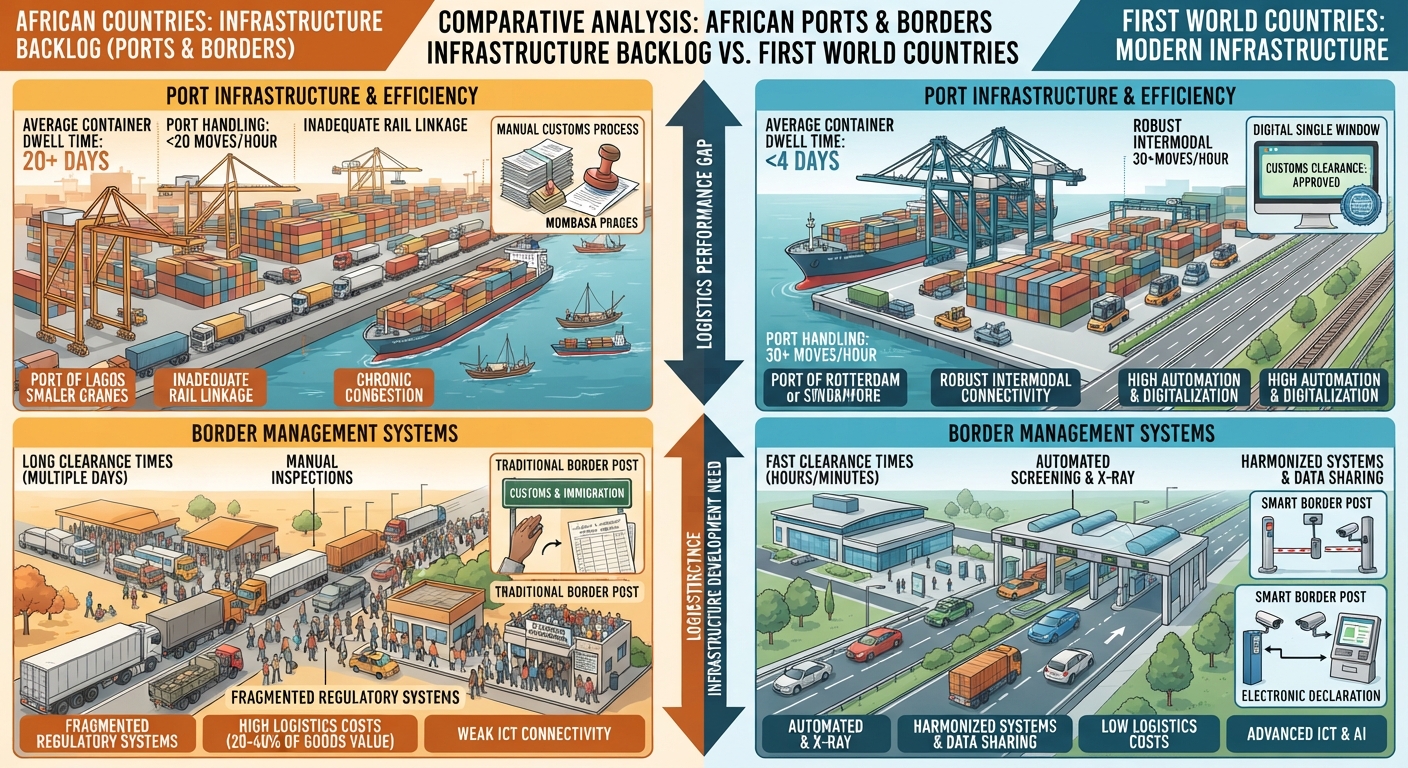
Comprehensive Thesis Infrastructure Backlogs, Technological Gaps and Comparisons with Developed Economies
A strategic infrastructure, economic development, logistics and technological modernisation study | 2026
1. Executive introduction
Ports and border management systems are among the most important components of a modern country’s economic infrastructure. They determine how efficiently a nation imports goods, exports products, transports raw materials, attracts foreign investment and participates in international trade.
A country’s ports and borders are not simply physical entry and exit points. They are interconnected economic systems comprising:
- Seaports and harbour infrastructure.
- Roads, railways and inland freight corridors.
- Customs administration and border control.
- Digital trade documentation systems.
- Cargo inspection and scanning technologies.
- Warehousing and distribution facilities.
- Shipping terminals and container management.
- Maritime navigation and vessel traffic systems.
- International trade information networks.
- Security, regulatory and financial institutions.
The central development challenge facing many African countries is that their infrastructure, administrative processes and digital systems have not developed at the same pace as international trade, industrialisation and technological innovation.
Meanwhile, countries such as Singapore, the Netherlands, Germany, South Korea, Japan and the United States have invested heavily in integrated transport networks, automated terminals, sophisticated customs systems and digital logistics platforms.
However, it is important to recognise that Africa is not one uniform infrastructure environment. Morocco, Egypt, South Africa, Kenya, Djibouti and other countries have developed significant port and logistics capabilities. Their challenges and performance differ considerably.
The central thesis: Africa’s competitiveness in the global economy depends partly on transforming individual ports and border posts into integrated, technologically advanced trade and logistics ecosystems.
2. Understanding the architecture of a modern port
Ports and planes: The 2 Singapore firms helping to keep the world moving – Temasek
[수출물류 전초기지를 가다-③] 선진 자동화항만, 어디까지 왔나
Durban Harbour and Port | South African History Online
8
A modern international seaport is a complex industrial and information-processing environment.
It must coordinate ships, containers, customs officials, freight companies, railway networks, trucking companies, financial institutions and international shipping organisations.
2.1 The seven principal infrastructure layers
Layer 1 — Maritime infrastructure
Harbour basins, navigation channels, breakwaters, dredging, berths and vessel access.
Layer 2 — Cargo-handling infrastructure
Container cranes, ship-to-shore equipment, automated guided vehicles, forklifts and loading facilities.
Layer 3 — Storage and distribution
Container yards, warehouses, cold storage, bonded facilities and inland logistics centres.
Layer 4 — Transport connections
Railways, highways, bridges, inland ports, pipelines and freight corridors.
Layer 5 — Customs and border administration
Cargo declarations, tariffs, inspections, permits, immigration and regulatory compliance.
Layer 6 — Digital information infrastructure
Port Community Systems, electronic customs, tracking platforms, data centres and electronic payments.
Layer 7 — Management and institutional governance
Port authorities, customs agencies, maritime regulators, transport ministries and private-sector operators.
The effectiveness of a port depends on how well these seven layers work together. A country may have a deep-water harbour but still experience significant delays if its railway infrastructure, customs administration or digital systems are inefficient.
3. African ports versus developed countries: the infrastructure comparison
Ports and planes: The 2 Singapore firms helping to keep the world moving – Temasek
Photo report: Maersk cold store now operational at Maasvlakte II
6
The difference between many African ports and leading international ports is not simply the number of cranes or the size of the harbour. It is the degree of integration between infrastructure, technology, institutions and transportation networks.
3.1 Comparative infrastructure assessment
| Infrastructure category | Leading developed economies | Common African challenges |
|---|---|---|
| Harbour capacity | Deep-water access and modern terminals | Dredging and expansion backlogs |
| Container handling | High-capacity and automated equipment | Older equipment and limited capacity |
| Rail networks | Integrated freight rail corridors | Unreliable or insufficient rail capacity |
| Road infrastructure | Efficient freight highways | Congestion and road maintenance backlogs |
| Customs | Highly digitised clearance | Paperwork and fragmented processes |
| Cargo scanning | Integrated inspection technology | Uneven scanner availability |
| Warehousing | Advanced logistics and distribution centres | Insufficient storage and cold-chain facilities |
| Digital systems | Integrated trade platforms | Disconnected government databases |
| Border management | Coordinated agency operations | Repeated inspections and administrative delays |
| Data analytics | Real-time logistics monitoring | Limited real-time visibility |
| Port management | Strong performance monitoring | Inconsistent operational accountability |
| Energy | Reliable industrial power | Electricity reliability constraints in some countries |
These are broad structural comparisons, not descriptions of every port in either group.
3.2 How developed economies organise their port ecosystems
Op-Ed: Singapore’s Tuas Port is pioneering automation transformation – Marine Log
1. Singapore — Integrated digital port management
Singapore demonstrates how port authorities, shipping companies, terminal operators and customs agencies can coordinate within a highly integrated maritime ecosystem.
Coole foto’s: zo ziet de Maasvlakte eruit vanuit de lucht
2. Netherlands — Logistics and inland connectivity
Rotterdam connects maritime transport to inland waterways, railways, highways, industrial facilities and European distribution markets.
Port of Hamburg | Port of Hamburg: Growth in container throughput and rail transport
3. Germany — Industrial freight integration
Hamburg illustrates the importance of combining seaports with manufacturing industries, inland freight networks and European rail connections.
‘국내 첫 완전 자동화 부두’ 부산 신항 서컨 2-5단계 준공 | 서울신문
4. South Korea — Advanced industrial technology
Busan demonstrates the relationship between port infrastructure, industrial production, shipping connectivity and technological investment.
Innovative Transportation Solutions: Port of Los Angeles, Pier 400 On-Dock Rail Expansion | WTS
5. United States — Large-scale freight infrastructure
Major American ports connect shipping terminals to extensive road, railway, warehousing and inland distribution systems.
The important lesson is that these economies do not treat ports as isolated government facilities. They treat them as essential components of national industrial and commercial infrastructure.
4. The African port infrastructure landscape
Tanger Med Port accelerates green transition, targets carbon neutrality – The North Africa Post
Les dynamiques de l’Afrique australe | Lelivrescolaire.fr
Ports & Terminals | Kenya Ports Authority
6
Africa has several strategically important ports serving international shipping and regional economic corridors.
4.1 Major African maritime gateways
| Country | Major port | Strategic economic importance |
|---|---|---|
| Morocco | Tanger Med | Europe–Africa trade and international transshipment |
| Egypt | Port Said | Suez Canal and Mediterranean shipping |
| South Africa | Durban | Southern African container trade |
| South Africa | Ngqura | Container transshipment and regional trade |
| Kenya | Mombasa | East African regional trade |
| Djibouti | Port of Djibouti | Ethiopia’s maritime gateway |
| Ghana | Tema | West African trade |
| Côte d’Ivoire | Abidjan | West African industrial and commercial gateway |
| Senegal | Dakar | Atlantic trade and regional distribution |
| Nigeria | Lagos | Large domestic and regional import market |
4.2 Important international performance evidence
The World Bank and S&P Global Market Intelligence publish the Container Port Performance Index (CPPI).
The index evaluates container-port efficiency primarily through the time container vessels spend in port.
Some important findings:
- In the 2023 index, Morocco’s Tanger Med ranked fourth globally.
- In the 2024 index, Cape Town recorded one of the largest year-on-year improvements.
- Cotonou in Benin and Dakar in Senegal also recorded significant improvements.
- Sub-Saharan African ports continue to face structural difficulties involving automation and connections to inland markets.
This evidence demonstrates two things: Africa has internationally competitive port facilities, but substantial operational and infrastructure gaps remain elsewhere. World Bank+3
An important distinction: A port can improve substantially from its previous performance and still have considerable distance to cover before matching the most efficient international terminals.
5. The seven major infrastructure backlogs affecting African ports
Un “chaos total”: le port de Lagos au bord de la crise de nerfs
ICOAST-ABIDJAN-MARITIME-TRANSPORT
Uganda prefers European standard for SGR, throwing off Kenya – The EastAfrican
9
5.1 Backlog number one: Harbour and terminal capacity
Many African ports face increasing pressure from growing trade volumes.
Typical infrastructure requirements include:
- Deeper navigation channels.
- Expanded berthing facilities.
- Modern container terminals.
- Additional container storage yards.
- Modern ship-to-shore cranes.
- Improved vessel navigation systems.
- Better maintenance of harbour infrastructure.
When vessel capacity increases faster than terminal capacity, ships may wait longer to access berths.
The economic consequences include increased shipping costs, unreliable delivery schedules and higher inventory expenses.
5.2 Backlog number two: Railway infrastructure
This is one of Africa’s most important structural challenges.
A modern port needs an efficient connection to the national railway system.
Consider the following simplified example:
An integrated freight transportation architecture
International cargo vesselContainer arrival
Container terminalUnloading and cargo processing
Freight railwayBulk and container movement
Freight highwaysRegional distribution
Inland logistics and industrial centresWarehousing, manufacturing and distribution
When railway capacity is insufficient, excessive cargo movement shifts to trucks.
This can create:
- Highway congestion.
- Increased fuel consumption.
- Higher freight costs.
- Road maintenance expenses.
- Delayed delivery of industrial materials.
- Reduced competitiveness of locally manufactured products.
Africa therefore needs to view railway modernisation as part of port development rather than as an entirely separate infrastructure programme.
5.3 Backlog number three: Customs and administrative inefficiency
Customs administration is the institutional brain of international border trade.
Its responsibilities include:
- Verifying imported and exported goods.
- Assessing customs duties.
- Enforcing international trade regulations.
- Preventing prohibited or undeclared trade.
- Verifying certificates and permits.
- Processing cargo declarations.
- Coordinating inspections with other government agencies.
The problem arises when the same information has to be submitted repeatedly to different government departments.
For example, an imported shipment may involve customs, agriculture, health, standards, transport and port authorities.
Without integrated information systems, these departments can operate as separate administrative islands.
The solution is an integrated National Single Window, allowing traders to submit relevant information through one coordinated electronic platform.
5.4 Backlog number four: Digital technology
Leveraging Information Technology to Enhance Port Management in East Africa
Automated & autonomous vehicles | Ministry of Transport
12
Leading international ports increasingly use:
- Artificial intelligence.
- Internet of Things sensors.
- Automated cargo tracking.
- Electronic customs declarations.
- Digital vessel scheduling.
- Predictive equipment maintenance.
- Port Community Systems.
- Digital twins.
- Automated container identification.
Many African ports have adopted some of these technologies, but implementation and integration remain uneven.
The biggest opportunity is not simply buying new computers. It is connecting every relevant institution to a common, secure and interoperable information architecture.
5.5 Backlog number five: Warehousing and inland logistics
A port can unload cargo efficiently and still experience congestion because the surrounding distribution network cannot receive the goods.
The solution requires:
- Modern inland container depots.
- Dry ports.
- Bonded warehouses.
- Cold-chain storage.
- Industrial distribution centres.
- Rail-connected logistics parks.
- Efficient truck staging facilities.
These facilities are particularly important for landlocked countries.
For example, Uganda, Rwanda, Burundi, Zambia, Zimbabwe, Botswana and Malawi depend on regional corridors to reach international maritime markets.
5.6 Backlog number six: Energy and electricity infrastructure
Modern port operations require reliable electricity.
Electricity supports:
- Container cranes.
- Refrigerated containers.
- Warehouse operations.
- Cargo scanning.
- Information systems.
- Lighting and security.
- Automated handling equipment.
Energy instability can interrupt port operations and increase operating costs.
Future infrastructure should combine reliable grid connections, energy storage, efficient electrical systems and suitable renewable-energy generation.
5.7 Backlog number seven: Skills and institutional management
Technology cannot independently modernise a port.
Countries also need trained:
- Port engineers.
- Railway engineers.
- Customs specialists.
- Maritime economists.
- Logistics planners.
- Cybersecurity professionals.
- Data scientists.
- Industrial automation technicians.
- Infrastructure project managers.
Human capital is therefore as important as physical infrastructure.
6. African border management systems: the second major challenge
Botswana, Zambia Open Beautiful “Curved Bridge” Designed To Snub Zimbabwe (PIX) – Travel – Nigeria
9
African border management involves more than passport control.
A commercial border crossing must coordinate the movement of people, trucks, goods, animals, vehicles, commercial documents and government inspections.
A typical border may involve:
- Immigration.
- Customs.
- Police.
- Agriculture and veterinary services.
- Health authorities.
- Road transport regulators.
- Standards inspection authorities.
- Revenue collection agencies.
When these institutions operate independently, a truck may be required to complete several administrative processes at different locations.
6.1 The traditional border management model
Fragmented border architecture
CustomsGoods declaration
ImmigrationPeople and travel documents
AgriculturePlant and animal controls
PoliceLaw enforcement
Repeated administrative processingSeparate queues, paperwork and information checks
6.2 The modern integrated border model
Integrated One Stop Border Post architecture
Shared electronic border information platformCoordinated customs, immigration and inspection information
Country ADeparture and export controls
Country BArrival and import controls
Coordinated inspection and clearanceReduced duplication, better information sharing and improved accountability
A One Stop Border Post does not mean removing legitimate customs, immigration or safety inspections. It means coordinating them more efficiently.
6.3 Major African border crossings
| Border crossing | Countries connected | Economic significance |
|---|---|---|
| Beitbridge | South Africa–Zimbabwe | Southern African freight and trade |
| Kazungula | Botswana–Zambia | Regional freight corridor |
| Chirundu | Zambia–Zimbabwe | North–south trade |
| Malaba | Kenya–Uganda | East African trade |
| Busia | Kenya–Uganda | Regional commerce |
| Moyale | Kenya–Ethiopia | East African regional connectivity |
| Lebombo/Ressano Garcia | South Africa–Mozambique | Southern African trade |
| Tunduma/Nakonde | Tanzania–Zambia | Southern and East African connectivity |
Botswana, Zambia Open Beautiful “Curved Bridge” Designed To Snub Zimbabwe (PIX) – Travel – Nigeria
The Kazungula Bridge and associated border facilities illustrate how transport infrastructure and coordinated border management can improve regional connectivity.
7. Quantifying Africa’s trade and border delays
The economic consequences of inefficient border administration are significant.
A World Bank document published in 2025 reported an average waiting time of approximately 3.5 days at African borders for import or export processes, and an average of 17 days for intra-African shipments to reach their destinations. These are broad regional estimates, not waiting-time measurements for every crossing. World Bank
The World Bank also highlighted how some African border crossings experience substantial truck queues, with observed queues reaching up to 40 kilometres in certain cases. World Bank
These delays affect the whole economy.
Consider an agricultural exporter:
- Produce is harvested.
- The exporter arranges transport.
- The truck reaches a border.
- Documents are checked.
- Cargo undergoes relevant inspections.
- The shipment waits for clearance.
- The goods continue to the destination.
Every unnecessary delay increases the risk of spoilage, additional transport expenses and missed delivery commitments.
This is particularly serious for agricultural products, refrigerated foods, industrial components and time-sensitive manufacturing inputs.
8. The economic cost of infrastructure backlogs
Port and border inefficiency affects nearly every sector of a national economy.
The economic transmission mechanism
Port and border infrastructure deficiencies
Longer cargo processing and transport times
Higher logistics and inventory costs
Reduced industrial competitiveness
Reduced trade opportunities and investment potential
8.1 Impact on major economic sectors
| Economic sector | Consequence of inefficient logistics |
|---|---|
| Agriculture | Higher spoilage and distribution costs |
| Mining | Delayed mineral exports and equipment imports |
| Manufacturing | Production interruptions due to delayed components |
| Retail | Higher inventory and import costs |
| Construction | Delayed delivery of machinery and materials |
| Automotive | More expensive component supply chains |
| Pharmaceuticals | Increased pressure on temperature-controlled logistics |
| Technology | Delayed delivery of electronic components |
| Tourism | Reduced efficiency in international passenger transport |
8.2 The mathematical economics of logistics
A country should evaluate the cost of its logistics system using measurable economic variables.
A simplified model is:
\[ C_L=C_T+C_H+C_D+C_A+C_I \]
Where:
- \(C_L\) = Total logistics cost.
- \(C_T\) = Transportation costs.
- \(C_H\) = Handling costs.
- \(C_D\) = Delay costs.
- \(C_A\) = Administrative costs.
- \(C_I\) = Inventory costs.
The national objective should be to minimise the total logistics cost without compromising safety, security or regulatory compliance.
Example:
Assume a business imports industrial components worth R1 million.
If delays and additional logistics expenses amount to 8% of cargo value, the additional cost is:
\[ R1\,000\,000 \times 0.08=R80\,000 \]
If infrastructure and administrative improvements reduce this hypothetical burden to 4%:
\[ R1\,000\,000 \times 0.04=R40\,000 \]
The business saves R40,000 per shipment.
These percentages are illustrative, not measured African national averages.
The important economic principle is that improved logistics can increase business productivity without requiring a company to manufacture a single additional product.
9. The technological architecture Africa should build
This is where Africa can move beyond traditional port administration and develop an intelligent continental trade infrastructure.
Roboții care fac într-o zi inventarierea depozitelor. Ar dura un an cu
12
9.1 Artificial intelligence in port administration
AI can support port management by analysing:
- Vessel arrival patterns.
- Container movement.
- Berth utilisation.
- Equipment maintenance.
- Cargo processing times.
- Truck arrival schedules.
- Congestion forecasts.
- Weather-related disruptions.
For example, an AI-supported port system could predict that a particular terminal will experience unusually high container demand during the following week.
Management could then adjust staffing, equipment maintenance schedules and container storage allocation.
AI should support human decision-makers, with clear accountability for regulatory decisions and inspections.
9.2 Internet of Things (IoT)
IoT technology connects physical infrastructure to digital monitoring systems.
Examples include:
| IoT device | Function |
|---|---|
| Container sensors | Cargo location and condition |
| Temperature sensors | Cold-chain monitoring |
| Equipment sensors | Crane and machinery condition |
| Vehicle tracking | Truck movement |
| Environmental sensors | Air, water and weather conditions |
| Infrastructure sensors | Structural condition monitoring |
This creates a connection between the physical movement of goods and the digital information required to manage them.
9.3 Digital twin technology
A digital twin is a computer-based representation of a real physical system.
An African port could create a digital representation of:
- Harbour channels.
- Container terminals.
- Railway connections.
- Truck entrances.
- Warehouses.
- Cargo movement.
- Electricity infrastructure.
Managers could use the model to evaluate different capacity scenarios before investing in physical construction.
9.4 National Single Window
The National Single Window should become one of Africa’s most important trade infrastructure investments.
Proposed national digital trade platform
National Trade Single WindowOne coordinated electronic submission platform
Customs
Immigration
Agriculture
Health
Transport
Standards
Port authority
Revenue services
Integrated cargo clearance and trade information
The system should include secure access controls, digital signatures, common data standards, audit trails, interoperability and protection of confidential commercial information.
UNCTAD identifies trade single windows, maritime single windows and port community platforms as important mechanisms for improving maritime trade facilitation. UN Trade and Development (UNCTAD)+1
10. Africa’s strategic opportunity: regional economic corridors
A port’s economic value extends beyond the country in which it is located.
Landlocked countries depend on neighbouring coastal countries to access international markets.
This creates an opportunity to develop regional logistics ecosystems.
Ministry of Works and Transport
These giant infrastructure projects are set to reshape Africa | World Economic Forum
9
10.1 Three strategic continental corridors
A. East African Northern Corridor
Illustrative trade network
- Mombasa, Kenya.
- Nairobi, Kenya.
- Kampala, Uganda.
- Kigali, Rwanda.
- Eastern Democratic Republic of the Congo.
Its purpose is to connect maritime imports and exports with inland markets.
B. Southern African North–South Corridor
- Durban, South Africa.
- Johannesburg, South Africa.
- Botswana.
- Zimbabwe.
- Zambia.
- Democratic Republic of the Congo.
This corridor is important for mining, agriculture, manufacturing and regional trade.
C. West African coastal and inland trade network
- Abidjan, Côte d’Ivoire.
- Accra and Tema, Ghana.
- Lomé, Togo.
- Cotonou, Benin.
- Lagos, Nigeria.
This network connects major coastal economies with inland markets.
10.2 The African Continental Free Trade Area
The African Continental Free Trade Area (AfCFTA) provides an important institutional framework for reducing trade barriers and expanding intra-African commerce.
However, free-trade agreements alone cannot make goods move efficiently.
Africa also needs:
- Interconnected customs systems.
- Harmonised product standards.
- Mutual recognition of trade documents.
- Reliable railway and road infrastructure.
- Efficient border facilities.
- Regional payment systems.
- Integrated logistics information.
The World Bank’s 2026 analysis emphasises that substantial trade costs arise from domestic barriers such as customs delays, inefficient logistics, fragmented standards and restrictions on services. World Bank+1
11. South Africa: a case study of the infrastructure modernisation challenge
Les dynamiques de l’Afrique australe | Lelivrescolaire.fr
Transnet National Ports Authority relocates headquarters to PE
8
South Africa is strategically positioned to become one of Africa’s most important logistics and industrial gateways.
Its advantages include:
- Established maritime infrastructure.
- A substantial railway network.
- Developed financial institutions.
- Industrial manufacturing capabilities.
- Major mining and agricultural industries.
- Access to Southern African regional markets.
- Established international shipping connections.
However, the country has faced significant operational challenges in its freight logistics system.
11.1 Principal South African challenges
| Infrastructure area | Strategic challenge |
|---|---|
| Durban Port | Terminal capacity and operational efficiency |
| Cape Town Port | Equipment, capacity and weather-related disruption |
| Ngqura Port | Terminal utilisation and connectivity |
| Freight rail | Infrastructure reliability and network capacity |
| Road freight | Heavy dependence on trucking |
| Border administration | Delays and coordination across agencies |
| Digital logistics | Integration between government and private operators |
| Infrastructure investment | Maintenance and modernisation requirements |
11.2 The role of Transnet
Transnet is central to South Africa’s freight rail and port infrastructure.
Its modernisation priorities should include:
- Railway maintenance.
- Locomotive availability.
- Signalling and telecommunications.
- Port equipment renewal.
- Terminal capacity.
- Digital cargo tracking.
- Private-sector participation under suitable governance arrangements.
- Transparent operational performance reporting.
The objective should be to improve the whole freight network rather than focusing on individual terminals in isolation.
11.3 A strategic South African logistics model
South Africa should develop a connected national freight ecosystem:
International maritime gatewaysDurban • Cape Town • Ngqura • Richards Bay • Saldanha Bay
National freight transport networkRailways • highways • inland terminals
Industrial and agricultural centresGauteng • Limpopo • Mpumalanga • Free State • other provinces
Southern African regional distributionExports, imports and regional manufacturing supply chains
South Africa’s opportunity is to become a major regional logistics and manufacturing distribution hub, not simply an exporter of minerals and agricultural commodities.
12. A 15-year African ports and border modernisation master plan
The most effective approach would be a phased continental programme rather than constructing expensive facilities without addressing the operational systems around them.
Proposed strategic framework
Phase 1: 2027–2030 — Repair and institutional modernisation
Primary objective: eliminate critical infrastructure and administrative bottlenecks.
Projects:
- Rehabilitate existing port equipment.
- Repair critical freight railway infrastructure.
- Modernise major border facilities.
- Introduce electronic customs declarations.
- Establish integrated border management teams.
- Improve electricity and telecommunications reliability.
- Introduce national logistics performance dashboards.
- Establish maintenance funding programmes.
Phase 2: 2031–2035 — Digital integration and capacity expansion
Primary objective: connect ports, borders and inland logistics networks.
Projects:
- Expand National Single Window platforms.
- Connect customs systems between neighbouring countries.
- Expand dry ports and inland container depots.
- Modernise railway freight terminals.
- Introduce advanced cargo monitoring.
- Develop AI-assisted port scheduling.
- Integrate electronic payment and trade documentation.
- Expand refrigerated agricultural logistics.
Phase 3: 2036–2040 — Intelligent logistics infrastructure
Primary objective: establish internationally competitive African logistics ecosystems.
Projects:
- Develop advanced automated terminals where commercially justified.
- Introduce digital twins for major ports.
- Develop predictive infrastructure maintenance.
- Establish regional freight information exchanges.
- Connect African maritime gateways with industrial corridors.
- Develop advanced logistics engineering institutions.
- Expand low-carbon port infrastructure.
- Establish regional logistics research and innovation centres.
The transformation sequence
- RepairRestore the performance of existing infrastructure.
- ConnectIntegrate roads, railways, ports and borders.
- DigitiseConnect government agencies and private operators.
- OptimiseApply data science, AI and predictive management.
- IndustrialiseUse efficient logistics to support manufacturing, agriculture and regional commerce.
13. Infrastructure investment and financing architecture
Modernising African ports requires substantial capital investment.
Governments cannot rely exclusively on annual public infrastructure budgets.
A diversified funding architecture is needed.
| Financing mechanism | Potential contribution |
|---|---|
| National infrastructure budgets | Public infrastructure and maintenance |
| Development banks | Long-term infrastructure financing |
| Public-private partnerships | Terminal development and operation |
| Infrastructure bonds | Long-term institutional investment |
| Pension funds | Suitable long-duration infrastructure investments |
| Private terminal operators | Equipment, technology and operational expertise |
| Regional development funds | Cross-border transport corridors |
| Climate finance | Sustainable energy and climate-resilient infrastructure |
Institutions such as the African Development Bank, World Bank and African Export-Import Bank can contribute financing, technical assistance and project preparation.
13.1 Investment prioritisation methodology
Not every port needs the same infrastructure.
Governments should evaluate projects according to:
\[ P_i=\frac{B_i \times R_i \times S_i}{C_i} \]
Where:
- \(P_i\) = Project priority score.
- \(B_i\) = Expected economic benefit.
- \(R_i\) = Regional connectivity benefit.
- \(S_i\) = Strategic importance.
- \(C_i\) = Total lifecycle cost.
This is a proposed prioritisation model, not an established international index.
It helps decision-makers distinguish between projects with high economic returns and projects that are politically attractive but economically weak.
14. The performance measurement system: how Africa should measure progress
A major infrastructure problem is that governments sometimes measure development through the amount of money spent rather than the actual improvement in services.
Africa needs a measurable logistics performance management system.
Proposed African Ports and Borders Performance Dashboard
| Performance indicator | What it measures |
|---|---|
| Vessel turnaround time | Time ships spend in port |
| Container dwell time | Time containers remain in port |
| Berth productivity | Cargo-handling efficiency |
| Rail freight reliability | Dependability of freight transport |
| Truck turnaround time | Time trucks spend at port |
| Border clearance time | Time required for border processing |
| Customs processing time | Time required to complete customs procedures |
| Cargo inspection time | Efficiency of legitimate inspection |
| Infrastructure availability | Operational condition of facilities |
| Digital clearance rate | Share of eligible procedures completed electronically |
| Logistics cost per container | Total cost of container movement |
| Infrastructure maintenance backlog | Uncompleted critical maintenance |
14.1 Proposed targets for a national modernisation programme
The following are illustrative planning targets, not current national performance statistics or official international standards.
Illustrative reduction in cargo processing time
Example of a reform target using a hypothetical baseline of 72 hours.
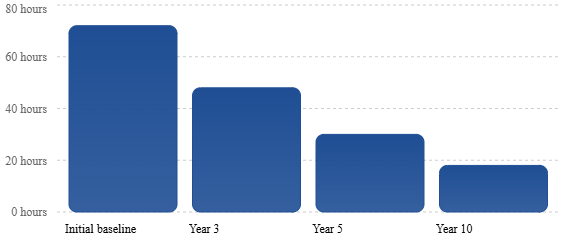
The actual targets should be established through baseline measurements at each port and border crossing.
A good performance system should publish monthly and annual results so that citizens, investors and logistics operators can evaluate whether improvements are taking place.
15. The scientific and mathematical methodology behind modern port management
Port infrastructure is also an excellent application of mathematics, physics, computer science and industrial engineering.
15.1 Queueing theory
Queueing theory studies waiting lines and processing capacity.
It can be used to analyse:
- Trucks waiting at border posts.
- Ships waiting for berths.
- Containers waiting for inspection.
- Vehicles waiting for cargo loading.
A basic relationship is Little’s Law:
\[ L=\lambda W \]
Where:
- \(L\) = Average number of items in the system.
- \(\lambda\) = Average arrival rate.
- \(W\) = Average time spent in the system.
Suppose a port processes an average of 100 trucks per day, and each truck spends an average of 2 days in the relevant system.
\[ L=100\times2=200 \]
The average number of trucks in that system is 200.
Reducing processing time can reduce congestion even without constructing a larger port.
15.2 Operations research
Operations research can optimise:
- Crane allocation.
- Berth scheduling.
- Container stacking.
- Railway timetables.
- Truck dispatching.
- Warehouse capacity.
- Cargo inspection scheduling.
15.3 Physics and engineering
Physics and engineering determine:
- Harbour depth.
- Vessel displacement.
- Crane load capacity.
- Structural stability.
- Wind resistance.
- Bridge engineering.
- Railway load distribution.
- Energy consumption.
15.4 Computer science and data engineering
Computer science enables:
- Real-time cargo tracking.
- Information exchange.
- Cybersecurity.
- AI-based forecasting.
- Digital customs.
- Infrastructure monitoring.
- National logistics databases.
The combination of these disciplines produces an intelligent infrastructure management system.
16. What Africa can learn from international infrastructure development
There are five particularly important lessons.
Lesson 1: Build integrated systems, not isolated projects.
A modern port without an efficient railway or highway connection is an incomplete logistics investment.
Lesson 2: Digitalise administrative processes.
Government departments should exchange authorised information rather than requiring traders to repeatedly submit identical documents.
Lesson 3: Maintenance is an economic investment.
Repairing an existing railway, crane or terminal can sometimes provide better economic returns than constructing a completely new facility.
Lesson 4: Develop regional infrastructure.
African countries should coordinate major logistics investments because international trade corridors frequently cross national boundaries.
Lesson 5: Build local technological capabilities.
African universities, engineering companies and technology businesses should participate in designing, maintaining and developing the next generation of logistics infrastructure.
17. Final strategic conclusion: ports and borders as the foundation of Africa’s industrial future
The modernisation of African ports and border management systems is much more than a transport infrastructure programme.
It is an industrial development strategy.
The relationship can be represented as:
\[ \text{Infrastructure} + \text{Technology} + \text{Human Capital} + \text{Governance} = \text{Logistics Competitiveness} \]
And:
\[ \text{Logistics Competitiveness} \rightarrow \text{Industrial Growth} \rightarrow \text{Trade Expansion} \rightarrow \text{Economic Development} \]
Africa has considerable geographical advantages: strategic coastlines, maritime access, natural resources, agricultural potential and a large emerging consumer market.
But these advantages cannot be fully converted into economic prosperity without efficient transportation and border infrastructure.
The next generation of African development should therefore establish a continental logistics ecosystem in which ports, railways, highways, border posts, customs administrations, financial institutions and digital information systems operate as interconnected components.
The ultimate objective should not be to copy Europe, America or Asia. It should be to develop African infrastructure that achieves internationally competitive performance while addressing Africa’s own geographical, economic, industrial and demographic requirements.
18. Recommended research and reference documents
The following institutional publications provide a foundation for developing this thesis into a university-level infrastructure and economic development research project.
1. World Bank — Container Port Performance Index 2024. Global comparative port performance and operational efficiency. Read the CPPI report.
2. World Bank — Container Port Performance Index 2025. The latest index publication available in the research results. Explore the 2025 index.
3. UNCTAD — Review of Maritime Transport 2025. Maritime trade, port infrastructure, connectivity and shipping economics. Read the report.
4. UNCTAD — Economic Development in Africa Report 2024. Regional trade, logistics infrastructure and border administration. Read the report.
5. World Bank — Africa’s trade and transportation infrastructure analysis. Border delays, inland transport and trade barriers. Read the research document.
6. OECD — Trade Facilitation. Digital customs, border cooperation and administrative reform. Explore the research.
7. World Bank — How Satellites and AI Can Transform Trade and Cut Congestion in Africa (2026). Emerging technologies for African border management. Read the analysis.
19. Suggested next research project
A particularly valuable continuation would be a dedicated African Continental Ports, Railways and Border Infrastructure Master Plan, covering all 54 African countries.
It could examine each country’s:
- Existing ports and border facilities.
- Railway and highway infrastructure.
- Customs and immigration systems.
- Infrastructure investment backlog.
- Digital technology capabilities.
- Industrial and agricultural trade corridors.
- Modernisation requirements.
- Financing needs.
- Long-term economic development opportunities.
This would turn the present thesis into a structured continental infrastructure development blueprint, with individual country assessments and measurable investment priorities.






Be First to Comment