
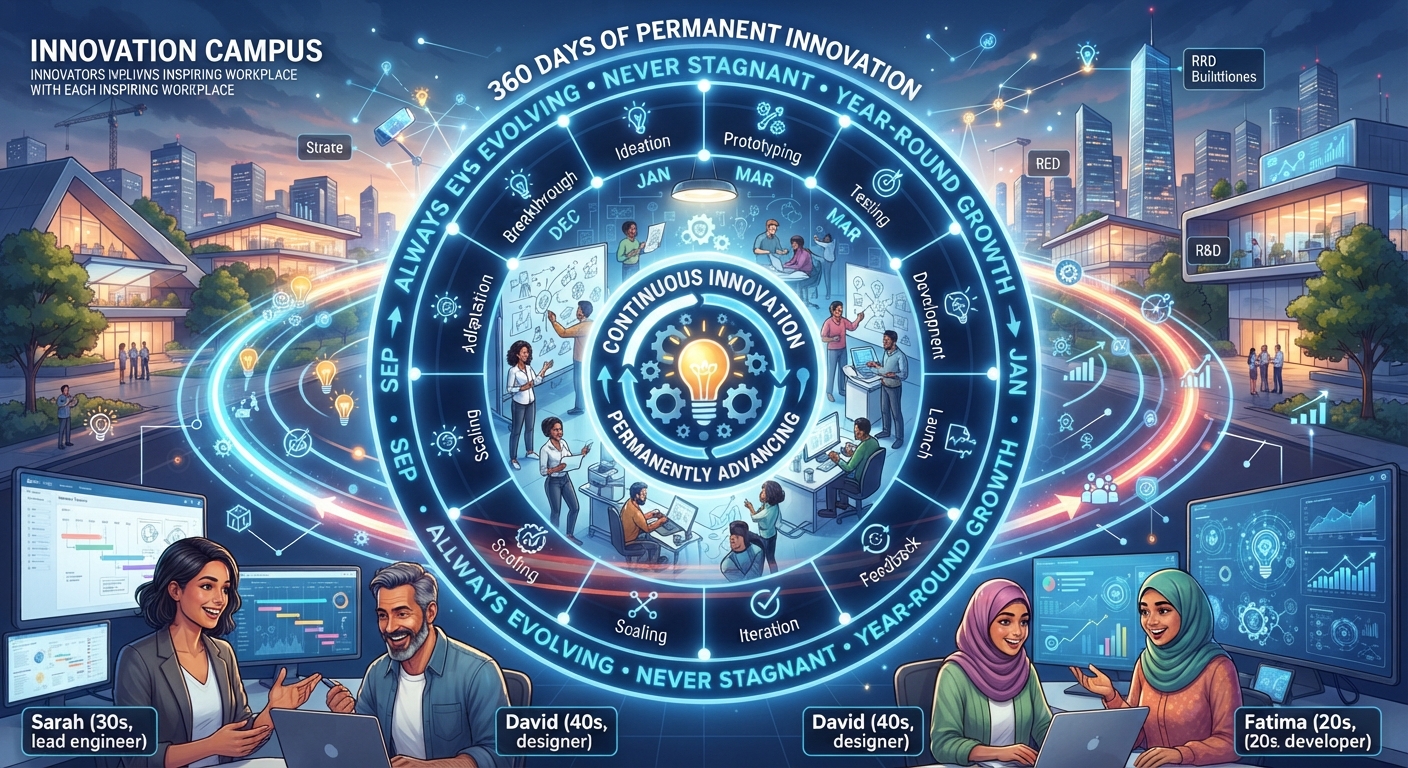
A Comprehensive Thesis on Building a Lifetime Culture of Innovation
A 360-Day Innovation Philosophy • Human Intelligence • Mathematics • Science • Technology • Economics • Problem-Solving
1. Introduction: What is a 360 Days Permanent Innovator?
A 360 Days Permanent Innovator is a person who develops a continuous habit of observing, questioning, learning, researching, experimenting, creating and improving ideas throughout the year.
It is a philosophy of lifelong intellectual development.
The central principle is:
Innovation should not be an occasional activity. It should become a permanent human capability and a disciplined way of thinking.
A permanent innovator does not wait for inspiration, a business opportunity, a financial crisis or a technological breakthrough before thinking creatively.
Instead, the individual develops the ability to identify problems and investigate possible solutions every day.
The number 360 represents a complete cycle of development, viewed from every direction. The remaining five or six calendar days, depending on the year, can be used for reflection, recovery and annual evaluation.
The objective is not to work continuously without rest. It is to maintain a continuous learning and improvement mindset.
2. The fundamental architecture of a permanent innovator
A permanent innovator requires several interconnected intellectual systems.
Physics-Informed Machine Learning for Energy and Environment | PNNL
The architecture consists of eight major components:
- Observation: Recognising problems, opportunities and changes in the surrounding world.
- Curiosity: Asking questions about how things work and why they work.
- Knowledge acquisition: Studying mathematics, science, economics, technology and human behaviour.
- Critical thinking: Examining information, assumptions and evidence.
- Logical reasoning: Connecting information to reach sound conclusions.
- Creative thinking: Developing alternative explanations and possible solutions.
- Experimentation: Testing ideas safely and evaluating their performance.
- Implementation: Turning proven ideas into useful products, services, systems or knowledge.
These components form a continuous cycle rather than eight independent activities.
The permanent innovation cycle
OBSERVE
Identify a problem or opportunity
INVESTIGATE
Research and acquire knowledge
THINK AND DESIGN
Apply logic, mathematics and creativity
TEST AND EVALUATE
Examine evidence and improve the idea
IMPLEMENT AND IMPROVE
Create measurable value and learn from results
The results generate new questions, restarting the cycle.
3. The 12 intellectual disciplines of a permanent innovator
A permanent innovator should develop knowledge across multiple disciplines because modern problems rarely belong to only one subject.
| Discipline | Its contribution to innovation |
|---|---|
| 1. Mathematics | Measurement, calculation and modelling |
| 2. Physics | Understanding energy, matter, motion and forces |
| 3. Biology | Understanding living systems |
| 4. Chemistry | Understanding materials and transformations |
| 5. Computer science | Computation, algorithms and digital systems |
| 6. Artificial intelligence | Pattern recognition, prediction and intelligent assistance |
| 7. Economics | Scarcity, resources, production and markets |
| 8. Accounting | Measuring financial performance and resources |
| 9. Engineering | Turning scientific knowledge into practical systems |
| 10. Psychology | Understanding human thinking and behaviour |
| 11. History | Learning from previous discoveries and mistakes |
| 12. Philosophy and logic | Examining assumptions, reasoning and evidence |
The real advantage comes from combining disciplines.
Example: Developing an automated agricultural business
- Biology explains crop growth.
- Chemistry explains soil nutrients.
- Mathematics calculates water requirements.
- Physics explains pumps and energy.
- Computer science develops monitoring systems.
- AI helps analyse agricultural information.
- Economics evaluates production costs.
- Accounting measures profitability.
- Engineering connects the equipment.
- Psychology helps understand customers and workers.
This is interdisciplinary innovation: bringing different areas of knowledge together to solve one practical problem.
4. The 360-day innovation development programme
The year can be divided into twelve 30-day learning and development cycles.
The Rockefeller University » Office of Technology Transfer
| Days | Development theme | Main objective |
|---|---|---|
| 1–30 | Intellectual foundation | Build curiosity, observation and questioning |
| 31–60 | Mathematical intelligence | Develop quantitative reasoning |
| 61–90 | Scientific understanding | Study physics, biology and chemistry |
| 91–120 | Digital intelligence | Understand computing, data and AI |
| 121–150 | Engineering thinking | Understand how systems are designed |
| 151–180 | Economic intelligence | Understand markets and productivity |
| 181–210 | Business innovation | Develop business models and opportunities |
| 211–240 | Research methodology | Investigate problems using evidence |
| 241–270 | Creative innovation | Generate and evaluate new ideas |
| 271–300 | Practical development | Build and test small projects |
| 301–330 | Strategic thinking | Develop long-term implementation plans |
| 331–360 | Evaluation and mastery | Measure progress and plan the next cycle |
Each 30-day cycle should produce something tangible: a research document, mathematical model, experiment report, prototype, business proposal or improved process.
5. The daily operating system of a permanent innovator
The philosophy becomes powerful when translated into manageable daily activities.
A sample daily learning schedule
Illustrative schedule, adjustable around school, work, rest and family responsibilities.
Morning
20 minutes
Observe the world, review yesterday’s learning and identify one question.
Learning session
30 minutes
Study one scientific, mathematical or technological concept.
Critical thinking
20 minutes
Investigate a problem and develop possible explanations.
Innovation practice
30 minutes
Draw a design, calculate a model or develop a small project.
Evening reflection
10 minutes
Record what you learned, what remains uncertain and what to improve.
An important rule is to prioritise understanding over the number of hours studied. A short session of focused learning can be more valuable than several hours of unfocused activity.
6. The mathematics of continuous innovation
Mathematics provides a useful way of understanding how small improvements accumulate.
Consider a hypothetical learning model:
\[ K_n=K_0(1+r)^n \]
Where:
- \(K_0\) = initial knowledge level.
- \(r\) = assumed improvement rate per learning cycle.
- \(n\) = number of cycles.
- \(K_n\) = modelled knowledge level after those cycles.
For example, if an imaginary learning index improves by 1% per day:
\[ K_{30}=100(1.01)^{30} \]
\[ K_{30}\approx134.78 \]
This represents approximately 34.78% growth in the modelled index.
However, this is a mathematical illustration, not a scientifically established rate of human intelligence growth. Real learning is uneven, and knowledge cannot be measured accurately using one universal index.
A second useful mathematical principle is the Plan–Do–Study–Act cycle:
- Plan an improvement.
- Do a small test.
- Study the results.
- Act on what was learned.
This approach connects innovation with scientific investigation and continuous improvement. ScienceDirect+1
7. The 36 characteristics of a permanent innovator
A permanent innovator develops intellectual habits rather than depending exclusively on natural talent.
A. Intellectual characteristics
- Curiosity about unfamiliar subjects.
- Independent thinking.
- Logical reasoning.
- Mathematical reasoning.
- Scientific curiosity.
- Willingness to question assumptions.
- Ability to recognise patterns.
- Ability to connect different disciplines.
- Intellectual humility.
- Commitment to lifelong learning.
B. Research characteristics
- Evidence-based decision-making.
- Information verification.
- Systematic observation.
- Problem identification.
- Data analysis.
- Research documentation.
- Experiment design.
- Comparison of alternative solutions.
C. Innovation characteristics
- Creative imagination.
- Design thinking.
- Engineering thinking.
- Practical problem-solving.
- Adaptability.
- Patience with complex problems.
- Responsible experimentation.
- Continuous improvement.
D. Leadership and economic characteristics
- Strategic planning.
- Financial literacy.
- Resource management.
- Communication.
- Collaboration.
- Ethical decision-making.
- Environmental responsibility.
- Entrepreneurship.
- Knowledge sharing.
- Long-term vision.
These characteristics combine intellectual development with practical economic and social contribution.
8. The significance of a permanent innovator in the modern economy
2026 Global Tech & Industry Outlook: How AI Is Moving Into the Physical Economy | Domain-b.com
Innovation is an important contributor to productivity, economic development and industrial transformation.
Consider six major economic sectors.
| Sector | Permanent innovation opportunities |
|---|---|
| Agriculture | Automated irrigation, soil monitoring and improved production |
| Healthcare | Medical research, diagnostics and biotechnology |
| Manufacturing | Robotics, automation and quality control |
| Finance | Digital banking, data management and financial technology |
| Education | Digital learning and scientific research |
| Energy | Renewable energy and improved energy efficiency |
For South Africa, this philosophy can contribute to developing local technical skills, agricultural productivity, manufacturing capacity, digital infrastructure and entrepreneurship.
The objective is to transform knowledge into productive capacity.
The economic transformation process can be represented as:
\[ \text{Knowledge} \rightarrow \text{Innovation} \rightarrow \text{Technology} \rightarrow \text{Productivity} \rightarrow \text{Economic Value} \]
However, innovation also requires infrastructure, investment, education, skilled people, good institutions and access to markets.
9. How to measure the performance of a permanent innovator
An innovator should not measure success only by the number of ideas produced.
The important question is whether those ideas produce useful knowledge and measurable improvements.
Here is a proposed personal innovation dashboard:
| Performance indicator | What to measure |
|---|---|
| Learning | Concepts understood |
| Research | Investigations completed |
| Creativity | Ideas documented |
| Mathematics | Problems solved |
| Technology | Technical skills developed |
| Experimentation | Tests completed |
| Implementation | Projects developed |
| Productivity | Processes improved |
| Communication | Knowledge shared |
| Reflection | Lessons recorded |
A simple innovation scorecard could allocate 100 points:
Illustrative innovation scorecard
Suggested allocation of attention across ten innovation capabilities, not measured performance.
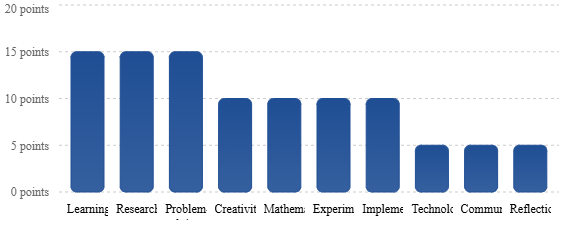
These are suggested planning weights, not scientific measurements of intelligence.
10. Practical example: Applying 360-day innovation to an agricultural project
Imagine developing a technologically advanced ginger farm.
A permanent innovator approaches the project from multiple directions:
Stage 1: Scientific research
- Understand ginger biology.
- Investigate soil structure.
- Study plant nutrients.
- Understand water requirements.
Stage 2: Mathematical investigation
- Calculate land area.
- Estimate planting requirements.
- Calculate irrigation demand.
- Estimate production costs.
Stage 3: Engineering
- Design irrigation infrastructure.
- Investigate water pumps.
- Plan drainage systems.
- Develop monitoring equipment.
Stage 4: Digital technology
- Introduce soil sensors.
- Collect agricultural data.
- Develop a farm-management database.
- Investigate AI-assisted crop monitoring.
Stage 5: Economic development
- Calculate operating expenditure.
- Estimate potential revenue.
- Analyse supply and demand.
- Develop a distribution strategy.
Stage 6: Continuous improvement
- Compare actual results against expectations.
- Identify production problems.
- Investigate the causes.
- Improve the agricultural system.
The result is more than an agricultural project. It becomes an integrated scientific, technological and economic development system.
11. The dangers of misunderstanding permanent innovation
Permanent innovation does not mean that someone must invent something new every day.
There are important distinctions:
- Innovation versus information: Collecting information is not automatically innovation.
- Creativity versus evidence: An interesting idea still needs investigation.
- Technology versus usefulness: Advanced technology is not necessarily economically valuable.
- Speed versus quality: Rushing development can create expensive mistakes.
- Persistence versus stubbornness: A permanent innovator must be willing to change an unsuccessful idea.
- Productivity versus exhaustion: Rest and recovery are necessary for sustainable learning.
The strongest innovators combine ambition with discipline, evidence, ethics and patience.
12. The 360-day permanent innovation philosophy: Final strategic principles
I propose the following ten principles as the foundation of this philosophy:
- Learn something meaningful every day.
- Ask questions about how the world works.
- Use mathematics to understand measurable problems.
- Use science to investigate natural phenomena.
- Use technology to expand human capabilities.
- Use logic to evaluate information.
- Use research to distinguish facts from assumptions.
- Convert useful knowledge into practical solutions.
- Measure the results of implemented ideas.
- Share knowledge and continuously improve.
13. Recommended academic foundations
The following resources provide established foundations for developing this philosophy:
- Innovation 360° — research on organisational innovation culture, continuous learning, adaptability and experimentation. Wiley Online Library
- OECD Public Sector Innovation Lifecycle — problem identification, idea generation, implementation and evaluation. OECD
- Plan–Do–Study–Act — systematic improvement through testing and learning. ScienceDirect
- Continuous Innovation Framework — ownership, validation, experimentation and implementation. Continuous Innovation Framework
14. The ultimate vision: Becoming a knowledge-producing individual
The deepest meaning of a 360 Days Permanent Innovator is the transformation of an individual from a passive consumer of information into an active producer of knowledge.
There are three important levels:
| Level | Intellectual development |
|---|---|
| Level 1 | Understanding existing knowledge |
| Level 2 | Applying existing knowledge to solve problems |
| Level 3 | Producing new knowledge, methods and useful inventions |
A person who develops these three levels over time becomes better equipped to participate in scientific discovery, technological development, business creation and economic transformation.
My central conclusion:
A permanent innovator is not defined by how many inventions they produce. They are defined by their continuous commitment to understanding problems, expanding knowledge, testing ideas and creating solutions that improve human life.
The 360-day philosophy should become a lifelong intellectual development system, not simply a one-year challenge.

Be First to Comment