
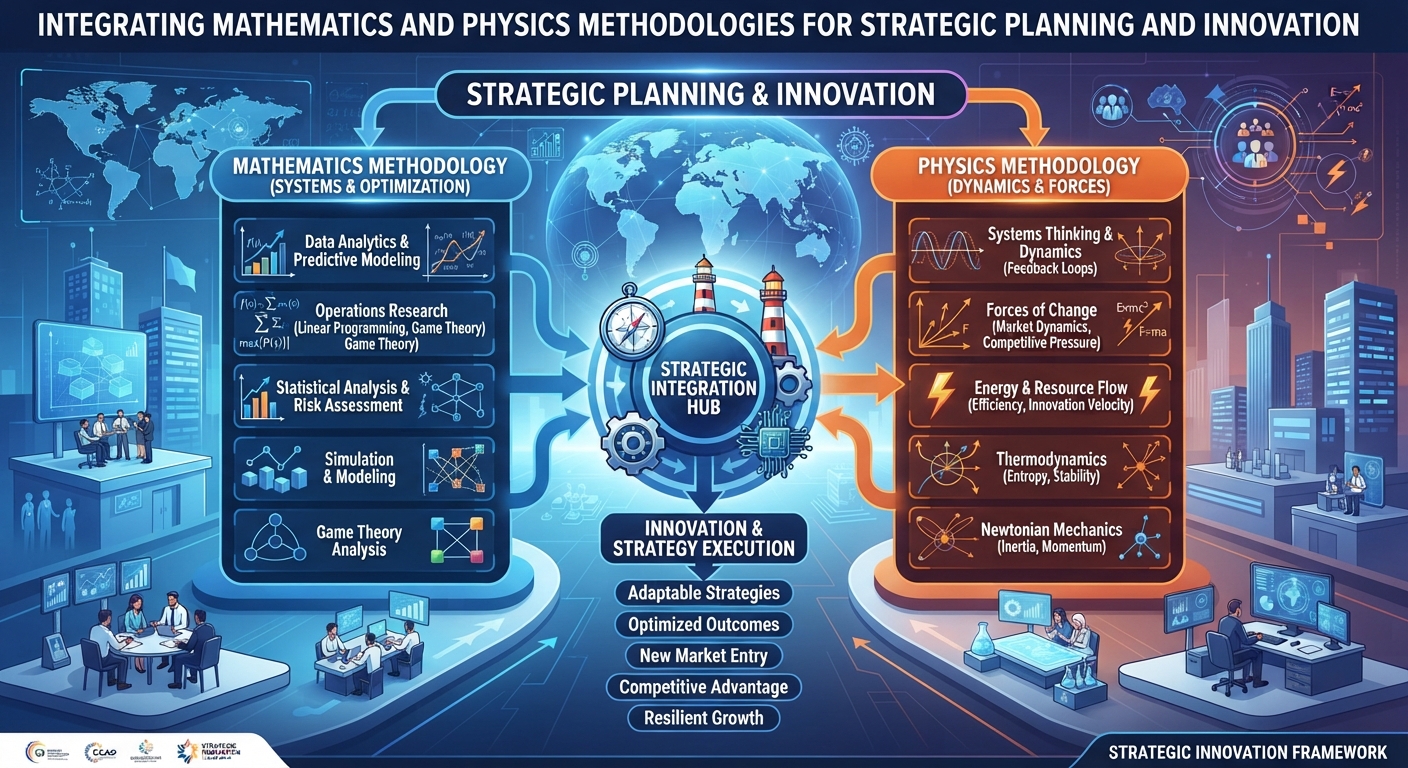
COMPREHENSIVE SCIENTIFIC THESIS
A scientific and technological framework for intelligent decision-making, strategic management, innovation, engineering, economic development and the design of future industries.
Automate Budget Planning Using Linear Programming | TDS Archive
PhysicsPlayground — Free Interactive Physics Simulations for Teachers
Industrial Digital Twin Platform | PETRAN | Ombrulla
12
Abstract
Strategic planning and innovation are two fundamental mechanisms through which individuals, businesses, governments, scientific institutions and economies transform ideas into measurable results.
However, strategic planning becomes significantly more powerful when supported by the methodologies of mathematics and physics.
Mathematics provides the tools for measuring, calculating, modelling, predicting, optimizing and evaluating decisions. Physics provides a deeper understanding of how systems behave, how energy moves, how forces interact, how materials respond, how structures remain stable and how complex systems change over time.
Combining these disciplines creates a scientific approach to strategic innovation.
The central proposition of this thesis is:
A successful innovation strategy should not depend exclusively on intuition. It should be designed using measurable variables, mathematical models, physical principles, scientific experimentation and continuous feedback.
This methodology can be applied to:
- Business development and entrepreneurship.
- Artificial intelligence and digital infrastructure.
- Agricultural automation and food production.
- Semiconductor manufacturing.
- Banking and financial technology.
- Transport and infrastructure development.
- Energy generation and distribution.
- Industrial engineering.
- National economic development.
- Scientific research and technological discoveries.
PART I — THE SCIENTIFIC FOUNDATIONS
Chapter 1. Understanding strategic planning
1.1 What is strategic planning?
Strategic planning is the systematic process of determining:
- Where an organization or project currently stands.
- What it wants to achieve.
- What resources are required.
- What obstacles may prevent success.
- Which methods should be implemented.
- How progress will be measured.
- How the strategy should adapt to changing circumstances.
Strategic planning is essentially the architecture of achieving objectives through organized decisions.
Consider a company intending to establish an automated agricultural production facility.
Its strategic questions include:
- How much land is required?
- What soil conditions are necessary?
- How much water is available?
- What production capacity is economically sustainable?
- What machinery is required?
- What will the operating costs be?
- What technology can improve productivity?
- How will production quality be measured?
These questions can be transformed into mathematical problems and physical engineering models.
1.2 The strategic planning architecture
Continuous Improvement (Kaizen) Keynote Template | Nulivo Market
A strategic planning system contains seven interconnected components:
| Component | Main responsibility |
|---|---|
| Vision | Define the future destination |
| Objectives | Establish measurable targets |
| Research | Understand the existing environment |
| Resources | Identify available capabilities |
| Methodology | Determine how to achieve objectives |
| Implementation | Execute the strategic plan |
| Evaluation | Measure results and improve |
The important principle is that each component must connect logically to the next.
A vision without measurable objectives is difficult to implement. Objectives without resources are unrealistic. Implementation without evaluation makes it difficult to establish whether the strategy is working.
Chapter 2. Why mathematics is essential to strategic innovation
Mathematics is the science of relationships, quantities, structures, patterns and logical reasoning.
It allows strategic planners to transform complicated problems into measurable systems.
For example, imagine that a business wants to increase production from 10,000 units to 50,000 units annually.
The mathematical methodology asks:
- What is the current production rate?
- What is the required production rate?
- What percentage increase is necessary?
- How much additional capacity is required?
- What investment is needed?
- What is the expected return?
- What constraints might limit production?
2.1 Seven mathematical disciplines for strategic planning
The hand that writes the formula with white chalk on the blackboard
1. Algebra
Studies unknown quantities and relationships between variables.
Application: calculating costs, production capacity, investment and resource requirements.
Mathematical formulae background in square format
2. Calculus
Studies rates of change, accumulation, growth and optimization.
Application: understanding production growth, marginal costs and maximum efficiency.
3. Statistics and probability
Study data, uncertainty, variation and likelihood.
Application: market forecasting, quality control and risk assessment.
4. Optimization mathematics
Determines the best solution within available constraints.
Application: maximizing production while minimizing cost.
More on Matrices – 3D Math Primer for Graphics and Game Development
5. Linear algebra
Studies vectors, matrices and multidimensional relationships.
Application: artificial intelligence, interconnected systems and industrial modelling.
7. Strategische Situationen – Buffl
6. Game theory
Studies strategic decisions involving multiple participants.
Application: competition, negotiations, pricing and market positioning.
7. Graph theory
Studies relationships between connected objects.
Application: telecommunications, transport networks, supply chains and digital infrastructure.
Chapter 3. Mathematical methodology: transforming strategy into equations
One of the most important capabilities in strategic planning is converting an objective into a mathematical model.
Consider a simplified business production model.
Let:
- \(Q\) = total production.
- \(L\) = labour input.
- \(K\) = capital investment.
- \(T\) = technology capability.
- \(R\) = available raw materials.
Production can be represented as:
\[ Q=f(L,K,T,R) \]
This means production depends on the combined contribution of labour, capital, technology and materials.
Increasing machinery alone may not increase production if raw materials, labour or electricity become limiting factors.
This is why mathematical modelling is important: it identifies the relationships between resources rather than treating each resource independently.
3.1 Growth calculations
Suppose a company produces 10,000 units annually and wants to produce 15,000 units.
The percentage increase is:
\[ Growth=\frac{New-Original}{Original}\times100 \]
\[ =\frac{15,000-10,000}{10,000}\times100 \]
\[ =50\% \]
The company therefore needs to increase annual production by 50%.
However, the mathematical result does not automatically establish whether the target is technically or economically achievable. Further analysis is required.
3.2 Optimization methodology
Suppose a manufacturer wants to minimize operating costs.
The objective function is:
\[ \min C(x) \]
Where:
- \(C\) represents total operating costs.
- \(x\) represents the decisions being made.
The company must satisfy constraints:
\[ Production \geq Required\ Output \]
\[ Labour \leq Available\ Labour \]
\[ Energy \leq Available\ Energy \]
\[ Capital \leq Available\ Budget \]
This is the foundation of constrained mathematical optimization.
It allows management to identify the best feasible combination of resources.
PART II — PHYSICS METHODOLOGY FOR STRATEGIC PLANNING
Chapter 4. Understanding physics as a strategic innovation discipline
Physics is the scientific study of matter, energy, motion, forces, space, time and the fundamental laws governing physical systems.
Its importance to strategic innovation is that it explains how the physical world operates.
Mathematics tells us how to calculate a system. Physics helps us understand the physical principles behind that system.
For example, when designing a modern manufacturing facility, mathematical models can calculate the production target, while physics helps engineers understand:
- Electricity consumption.
- Mechanical movement.
- Heat transfer.
- Material strength.
- Fluid movement.
- Pressure.
- Energy efficiency.
- Structural stability.
- Electromagnetic communication.
Physics therefore provides a scientific foundation for designing physical infrastructure and technological systems.
Chapter 5. Eight branches of physics that support innovation
Introductory physics labs: We can do better – Physics Today
1. Classical mechanics
Studies motion, forces, acceleration, momentum and equilibrium.
Strategic application: machinery, robotics, transport systems, construction and manufacturing.
2. Electromagnetism
Studies electric charges, electric fields, magnetic fields and electromagnetic waves.
Strategic application: computers, semiconductors, telecommunications, motors and electrical infrastructure.
3. Thermodynamics
Studies heat, temperature, energy transfer and energy transformation.
Strategic application: industrial efficiency, refrigeration, batteries, power stations and data centres.
4. Fluid mechanics
Studies liquids, gases, pressure, flow and fluid resistance.
Strategic application: agriculture, irrigation, water infrastructure, chemical industries and aerodynamics.
File:Hydrogen Density Plots.png – Wikimedia Commons
5. Quantum physics
Studies the behaviour of matter and energy at atomic and subatomic scales.
Strategic application: semiconductor devices, quantum sensors, lasers and emerging computing technologies.
Tech Light Lab – Learn About Light! (Activity Guide) – Laser Classroom
6. Optics and photonics
Studies light, reflection, refraction, diffraction and optical technologies.
Strategic application: fibre-optic communication, cameras, medical imaging, laser manufacturing and lithography.
7. Materials physics
Studies the physical properties and behaviour of materials.
Strategic application: batteries, construction materials, semiconductor wafers, industrial equipment and advanced manufacturing.
Feedback Systems | Tutorials on Electronics | Next Electronics
8. Statistical physics
Studies the collective behaviour of large numbers of interacting particles and systems.
Strategic application: understanding complex systems, reliability, material behaviour and large-scale technological processes.
Chapter 6. The major physical laws behind strategic innovation
Certain physical laws provide particularly useful foundations for industrial and technological decisions.
6.1 Newton’s laws of motion
Newton’s laws explain the relationship between force, mass and acceleration.
The second law is:
\[ F=ma \]
Where:
- \(F\) = force, measured in newtons.
- \(m\) = mass, measured in kilograms.
- \(a\) = acceleration, measured in metres per second squared.
Innovation application: When designing an automated production system, engineers must calculate the forces required to move materials, operate machinery and control robotic equipment.
6.2 The conservation of energy
Energy cannot be created or destroyed in an isolated system. It can only be transferred or transformed.
\[ E_{initial}=E_{final} \]
In practical engineering, energy efficiency is essential.
Consider a data centre. Electricity is transformed into computational activity, heat and other energy outputs.
Strategic planners must consider:
- Electrical supply.
- Cooling requirements.
- Equipment efficiency.
- Heat management.
- Backup power.
- Operating expenditure.
6.3 Thermodynamic efficiency
Efficiency measures how much useful output is obtained from the energy supplied.
\[ \eta=\frac{Useful\ Output}{Total\ Input}\times100 \]
For example, if an industrial machine receives 100 units of energy and produces 80 units of useful output:
\[ \eta=\frac{80}{100}\times100=80\% \]
The remaining energy is not necessarily wasted in an absolute sense; some may be transferred into heat, sound or other outputs.
The strategic objective is to improve useful output while managing energy losses.
6.4 The laws of thermodynamics
| Law | Scientific principle | Strategic significance |
|---|---|---|
| Zeroth law | Thermal equilibrium defines temperature | Temperature measurement and control |
| First law | Energy is conserved | Energy accounting |
| Second law | Entropy of an isolated system does not decrease | Efficiency and energy-loss management |
| Third law | Entropy approaches a minimum as temperature approaches absolute zero | Low-temperature physics and advanced materials |
These principles are especially important in power generation, industrial refrigeration, batteries and data-centre engineering.
6.5 Electromagnetic principles
Maxwell’s equations form the mathematical foundation of classical electromagnetism.
They explain the relationships between electric fields, magnetic fields and electromagnetic waves.
Their technological applications include:
- Radio communication.
- Mobile networks.
- Satellite systems.
- Radar.
- Electric motors.
- Wireless connectivity.
- Semiconductor technologies.
A strategic planner developing a modern telecommunications network must understand that digital communication depends on physical electromagnetic infrastructure.
PART III — COMBINING MATHEMATICS AND PHYSICS
Chapter 7. The mathematics–physics innovation architecture
This is the central intellectual framework of the thesis.
Mathematics and physics should not be treated as two separate knowledge systems when solving complex industrial problems.
They should work together.
Smart manufacturing in the process industries
Consider a simplified automated manufacturing system.
| Strategic question | Mathematical methodology | Physics methodology |
|---|---|---|
| How much can we produce? | Production functions | Machine operation and material behaviour |
| How much energy is needed? | Energy calculations | Thermodynamics and electrical physics |
| How fast can machines operate? | Rates and optimization | Mechanics and dynamics |
| How reliable is the system? | Probability and statistics | Physical wear and material fatigue |
| How can we automate? | Algorithms and control theory | Sensors, motors and electronics |
| How can we reduce costs? | Optimization | Energy and material efficiency |
| How can we improve technology? | Modelling and simulation | Experimental physics |
The combined methodology creates a more complete picture of the system.
Chapter 8. Systems thinking: understanding the whole architecture
One of the greatest mistakes in strategic planning is concentrating on individual components without understanding their interdependencies.
A factory is not simply a collection of machines.
It is an interconnected ecosystem involving:
- Energy.
- Materials.
- Labour.
- Machinery.
- Information.
- Communication.
- Financial capital.
- Logistics.
- Quality control.
- Management.
A failure in one important component can affect the entire production system.
8.1 Systems theory and feedback loops
A feedback loop measures the difference between an expected result and an actual result.
\[ Error=Target-Actual \]
Suppose an automated irrigation system is designed to maintain a particular soil-moisture level.
Sensors measure the actual moisture level. A controller compares the measurement with the desired level. The irrigation system then adjusts water delivery.
Modern Control – Lec 01 – Introduction to Control System | PDF
This same principle applies to strategic management.
- Establish a target.
- Measure actual performance.
- Calculate the difference.
- Investigate the cause.
- Make corrective adjustments.
- Measure again.
This creates continuous improvement.
Chapter 9. Differential equations and forecasting
Calculus becomes particularly useful when studying how systems change over time.
A simple exponential growth model is:
\[ \frac{dP}{dt}=rP \]
Where:
- \(P\) = quantity being measured.
- \(t\) = time.
- \(r\) = growth rate.
Its solution is:
\[ P(t)=P_0e^{rt} \]
This model can describe certain forms of population, investment or technology adoption growth over a limited period.
However, unlimited exponential growth is not realistic for most physical and economic systems because resources and other constraints eventually become important.
A more realistic model for some constrained growth processes is the logistic equation:
\[ \frac{dP}{dt}=rP\left(1-\frac{P}{K}\right) \]
Where \(K\) represents the carrying capacity or limiting level.
Strategic significance: Innovation planners should not assume that growth continues indefinitely. They must identify the resources, infrastructure, market conditions and technical constraints that determine sustainable growth.
Chapter 10. Operations research and scientific decision-making
Operations research applies mathematics to complex organizational decisions.
It helps answer questions such as:
- Which project should receive funding?
- Which production method is most efficient?
- How should transport routes be organized?
- How should resources be distributed?
- How much inventory should be maintained?
- Which investment produces the greatest measurable benefit?
A simplified investment allocation model is:
\[ \max \sum_{i=1}^{n}R_ix_i \]
Subject to:
\[ \sum_{i=1}^{n}C_ix_i\leq B \]
Where:
- \(R_i\) = expected return from project \(i\).
- \(C_i\) = cost of project \(i\).
- \(x_i\) = decision variable representing project selection.
- \(B\) = available budget.
This is a simplified form of the capital-allocation problem.
Real investment decisions must also consider uncertainty, risk, timing, liquidity and strategic value.
PART IV — INNOVATION METHODOLOGY
Chapter 11. What is scientific innovation?
Innovation is the process of developing and implementing a new or significantly improved product, service, process, organizational method or business model.
Innovation is not simply inventing something new.
A scientific invention becomes economically meaningful when it can be developed, tested, reproduced and implemented to solve a genuine problem.
A useful innovation sequence is:
01
Identify the problem
Establish the problem using evidence.
02
Research existing knowledge
Study scientific principles and existing technologies.
03
Develop a hypothesis
Define a possible solution and its expected outcome.
04
Construct a mathematical model
Represent the system using variables and equations.
05
Develop the physical design
Determine engineering requirements and constraints.
06
Build a prototype
Create a testable version of the proposed solution.
07
Conduct experiments
Measure performance under controlled conditions.
08
Analyze the results
Compare measured outcomes against predictions.
09
Optimize the design
Improve performance, reliability and cost.
10
Implement and scale
Introduce the validated innovation into practical use.
Chapter 12. The 12 mathematical methodologies for innovation
The following methodologies can be used as a scientific innovation toolkit.
| No. | Methodology | Innovation purpose |
|---|---|---|
| 1 | Algebraic modelling | Represent unknown variables |
| 2 | Calculus | Measure change and growth |
| 3 | Linear programming | Allocate limited resources |
| 4 | Probability | Evaluate uncertainty |
| 5 | Statistics | Interpret experimental data |
| 6 | Matrix mathematics | Model interconnected variables |
| 7 | Differential equations | Predict dynamic behaviour |
| 8 | Game theory | Evaluate strategic interactions |
| 9 | Graph theory | Model interconnected networks |
| 10 | Numerical analysis | Approximate difficult solutions |
| 11 | Simulation | Test possible scenarios |
| 12 | Optimization | Find better feasible solutions |
Chapter 13. The 10 physics methodologies for innovation
| No. | Methodology | Innovation purpose |
|---|---|---|
| 1 | Mechanics | Design movement and machinery |
| 2 | Thermodynamics | Improve energy efficiency |
| 3 | Electromagnetism | Develop electrical and communication systems |
| 4 | Fluid dynamics | Improve water and gas movement |
| 5 | Quantum physics | Develop advanced electronic technologies |
| 6 | Optics | Improve imaging and optical communication |
| 7 | Materials science | Develop stronger and more efficient materials |
| 8 | Acoustics | Study sound and vibration |
| 9 | Statistical physics | Understand complex physical systems |
| 10 | Experimental physics | Test and validate physical principles |
These methods are complementary. Not every innovation requires all of them.
PART V — APPLYING THE METHODOLOGY TO THE MODERN ECONOMY
Chapter 14. Five major industrial applications
14.1 Artificial intelligence and data centres
AI infrastructure is an excellent example of mathematical and physical methodologies working together.
Mathematical requirements:
- Algorithms and computational complexity.
- Linear algebra and matrix operations.
- Probability and statistical learning.
- Optimization of computing resources.
- Forecasting electricity demand.
- Data-centre capacity planning.
Physics requirements:
- Semiconductor physics.
- Electromagnetism.
- Heat transfer.
- Electrical power engineering.
- Materials science.
- Cooling-system thermodynamics.
For example, AI processors perform large numbers of mathematical operations. These operations consume electrical energy and generate heat.
The strategic challenge is to maximize computational performance while maintaining acceptable energy consumption, cooling capacity and operating cost.
14.2 Semiconductor manufacturing
Semiconductor manufacturing is one of the clearest demonstrations of the integration of mathematics, physics, engineering and economics.
Its mathematical requirements include:
- Statistical process control.
- Probability distributions.
- Optimization algorithms.
- Computational geometry.
- Manufacturing yield calculations.
- Process simulation.
Its physics requirements include:
- Quantum mechanics.
- Solid-state physics.
- Electromagnetism.
- Optics.
- Materials science.
- Thermodynamics.
A semiconductor company must optimize thousands of interconnected production variables.
The strategic objective is to manufacture increasingly capable chips with acceptable yield, reliability, performance and cost.
14.3 Automated agriculture
Precision Farming Tech ROI 2026
Agriculture can become a technologically advanced industry through the integration of mathematical modelling and physical sciences.
Mathematical applications:
- Crop-yield forecasting.
- Water-demand calculations.
- Land-use optimization.
- Financial modelling.
- Statistical analysis of soil and crop measurements.
- Harvest scheduling.
Physics applications:
- Soil-water movement.
- Fluid mechanics.
- Solar energy.
- Heat transfer.
- Sensor electronics.
- Agricultural machinery.
Consider an automated ginger farm.
A scientific production strategy could integrate:
- Soil chemical analysis.
- Soil moisture measurement.
- Irrigation flow modelling.
- Temperature monitoring.
- Nutrient management.
- Crop-growth measurement.
- Disease surveillance.
- Harvest forecasting.
- Production-cost modelling.
- Market-demand analysis.
The result is an agricultural system based on measured evidence rather than guesswork.
14.4 Banking and financial technology
Fintech Infrastructure Explained: Digital Systems
Modern banking depends on mathematical models and physical digital infrastructure.
Mathematical applications:
- Probability and statistics.
- Financial optimization.
- Risk modelling.
- Time-series forecasting.
- Cryptographic mathematics.
- Algorithmic fraud detection.
Physics and engineering applications:
- Electrical infrastructure.
- Computer hardware.
- Semiconductor systems.
- Fibre-optic communications.
- Data-centre cooling.
- Network reliability.
A bank’s digital transaction ecosystem depends on both mathematical information processing and reliable physical infrastructure.
14.5 Energy and infrastructure development
SBTi launches pilot to shape the power sector’s Net-Zero Standard – Science Based Targets Initiative
Energy development provides another important application.
Mathematics is used to calculate:
- Electricity demand.
- Generation capacity.
- Transmission losses.
- Investment requirements.
- Energy-storage requirements.
- Long-term demand forecasts.
Physics is used to understand:
- Electromagnetic induction.
- Solar radiation.
- Thermodynamic conversion.
- Battery electrochemistry.
- Electrical resistance.
- Mechanical energy conversion.
The strategic challenge is to develop a reliable, affordable and efficient energy system.
PART VI — A NEW MODEL FOR STRATEGIC INNOVATION
Chapter 15. The 15-stage scientific strategic planning framework
The following framework brings the entire thesis together.
Space Systems Engineering Framework
| Stage | Strategic activity | Scientific methodology |
|---|---|---|
| 1 | Identify the problem | Logical reasoning |
| 2 | Define the objective | Mathematical specification |
| 3 | Collect information | Scientific research |
| 4 | Study the environment | Systems analysis |
| 5 | Identify variables | Algebra and measurement |
| 6 | Establish constraints | Mathematical modelling |
| 7 | Study physical requirements | Physics and engineering |
| 8 | Develop possible solutions | Innovation design |
| 9 | Calculate resource requirements | Optimization |
| 10 | Evaluate uncertainty | Probability and statistics |
| 11 | Construct a prototype | Engineering |
| 12 | Conduct experiments | Experimental science |
| 13 | Analyze performance | Data analysis |
| 14 | Implement the solution | Project management |
| 15 | Evaluate and improve | Feedback and optimization |
The framework can be used for a small business, a manufacturing plant, a digital technology project or a national infrastructure programme.
Chapter 16. Mathematical performance indicators
Strategic planning requires measurable performance indicators.
The following equations can help management evaluate the effectiveness of a project.
1. Productivity
\[ Productivity=\frac{Total\ Output}{Total\ Input} \]
2. Return on investment
\[ ROI=\frac{Net\ Gain}{Investment\ Cost}\times100 \]
3. Operational efficiency
\[ Efficiency=\frac{Useful\ Output}{Total\ Input}\times100 \]
4. Production capacity utilization
\[ Utilization=\frac{Actual\ Output}{Maximum\ Capacity}\times100 \]
5. Defect rate
\[ Defect\ Rate=\frac{Defective\ Units}{Total\ Units}\times100 \]
6. Forecast error
\[ Error=Actual\ Value-Forecast\ Value \]
7. Innovation adoption rate
\[ Adoption=\frac{Number\ of\ Active\ Users}{Target\ Users}\times100 \]
These indicators convert strategic intentions into observable performance.
Chapter 17. Risk management through mathematical and physical methodologies
No strategic project operates in a perfectly predictable environment.
Risks can arise from:
- Financial constraints.
- Technology failures.
- Resource shortages.
- Energy interruptions.
- Human error.
- Market fluctuations.
- Engineering limitations.
- Environmental changes.
Mathematical risk management helps estimate the probability and consequences of different events.
A simplified expected-loss model is:
\[ Expected\ Loss=P(E)\times L(E) \]
Where:
- \(P(E)\) = probability of an event.
- \(L(E)\) = financial loss if the event occurs.
For example, if an equipment failure has a 10% annual probability and its estimated financial consequence is R200,000:
\[ Expected\ Loss=0.10\times200,000 \]
\[ =R20,000 \]
This is an illustrative expected-loss estimate, not a guarantee of actual annual losses.
Physics and engineering add another dimension: identifying the physical mechanisms that might cause failure, such as overheating, excessive vibration, material fatigue or electrical instability.
The combination helps planners move from reacting to failures towards preventing them.
PART VII — ADVANCED SCIENTIFIC THINKING
Chapter 18. The relationship between mathematics, physics, artificial intelligence and innovation
Beyond Black Boxes: How Physics-Informed AI is Revolutionizing Environmental Modeling
One of the most important developments in modern innovation is the integration of scientific knowledge with computational intelligence.
Consider the following architecture:
REAL-WORLD PROBLEM
Industrial, economic, scientific or technological challenge
MATHEMATICS
Equations, statistics, algorithms, optimization and probability
PHYSICS
Energy, matter, forces, motion, fields and physical laws
COMPUTATIONAL MODELLING
Simulation, numerical methods and digital twins
ARTIFICIAL INTELLIGENCE
Pattern recognition, forecasting and decision support
SCIENTIFICALLY VALIDATED INNOVATION
Prototype, experimentation, implementation and continuous improvement
18.1 How artificial intelligence contributes
AI can help researchers and strategic planners:
- Analyze large quantities of scientific data.
- Identify patterns that are difficult to recognize manually.
- Predict possible outcomes.
- Simulate different operating conditions.
- Optimize resource allocation.
- Assist with engineering design.
- Identify unusual system behaviour.
- Support scientific experimentation.
However, AI-generated predictions must be checked against reliable data, mathematical consistency and physical laws.
An AI system can produce a mathematically plausible prediction that is physically impossible if its training data or model assumptions are inadequate.
18.2 Digital twins
A digital twin is a computational representation of a physical asset, process or system.
For example, a factory can have a digital model representing its:
- Machinery.
- Production capacity.
- Energy consumption.
- Temperature.
- Equipment condition.
- Material movement.
- Operating performance.
Engineers can use the digital model to evaluate proposed changes before implementing them in the real factory.
This can reduce experimentation costs and improve decision-making, provided that the digital model is properly validated and kept aligned with the physical system.
Chapter 19. The economics of scientific innovation
Scientific innovation must eventually be connected to economic value.
An invention may be scientifically impressive but commercially unsuccessful if it cannot be manufactured economically, adopted by customers or maintained sustainably.
A successful innovation must therefore satisfy several conditions:
\[ Innovation\ Value=f(T,C,M,S) \]
Where:
- \(T\) = technological performance.
- \(C\) = economic competitiveness.
- \(M\) = market acceptance.
- \(S\) = sustainability.
This is a conceptual relationship, not a universal empirical equation.
The strategic planner must examine all four dimensions.
| Dimension | Critical question |
|---|---|
| Technology | Does the solution actually work? |
| Economics | Can it be produced and operated affordably? |
| Market | Is there a genuine demand? |
| Sustainability | Can it operate reliably over time? |
The strongest innovation strategies consider scientific feasibility and economic feasibility simultaneously.
PART VIII — IMPLEMENTATION: A PRACTICAL SCIENTIFIC EXAMPLE
Chapter 20. Designing an intelligent automated production facility
Let us bring all these scientific methodologies together in one hypothetical project.
Project objective: Establish a technologically advanced agricultural production facility in South Africa.
Intelligent farming: AI and IoT reshape modern greenhouse agriculture | Technology
Step 1. Establish the strategic objective
Develop a production facility that can produce high-quality agricultural products consistently, efficiently and economically.
Step 2. Apply mathematical methodology
Calculate:
- Land requirements.
- Production capacity.
- Water requirements.
- Labour requirements.
- Capital expenditure.
- Operating expenditure.
- Expected revenue.
- Expected profitability.
Step 3. Apply physics methodology
Investigate:
- Soil-water movement.
- Irrigation pressure.
- Water flow rates.
- Solar energy availability.
- Temperature variations.
- Pump efficiency.
- Electrical requirements.
- Sensor performance.
Step 4. Apply engineering methodology
Design:
- Water storage.
- Irrigation infrastructure.
- Automated pumping.
- Sensor networks.
- Electrical infrastructure.
- Environmental monitoring.
- Production equipment.
Step 5. Apply artificial intelligence
Introduce AI-supported systems for:
- Agricultural data analysis.
- Irrigation recommendations.
- Crop-growth monitoring.
- Disease detection.
- Production forecasting.
- Resource optimization.
Step 6. Apply economic methodology
Calculate whether the production system can generate sufficient revenue to cover:
- Initial investment.
- Electricity.
- Water.
- Labour.
- Maintenance.
- Packaging.
- Transportation.
- Marketing.
Step 7. Apply continuous improvement
Measure production results, identify inefficiencies, conduct experiments and improve the system.
This demonstrates how mathematics, physics, engineering, economics and AI can be integrated into one strategic development programme.
PART IX — DEVELOPING YOUR SCIENTIFIC INNOVATION INTELLIGENCE
Chapter 21. The 20 thinking principles of a scientific strategic planner
These principles can help develop a disciplined approach to solving complex problems.
| No. | Thinking principle | Main intellectual skill |
|---|---|---|
| 1 | Question everything scientifically | Curiosity |
| 2 | Identify the real problem | Critical reasoning |
| 3 | Separate facts from assumptions | Analytical thinking |
| 4 | Measure before making decisions | Quantitative reasoning |
| 5 | Understand relationships between variables | Mathematical thinking |
| 6 | Study the physical laws governing systems | Scientific understanding |
| 7 | Identify limitations and constraints | Systems thinking |
| 8 | Investigate the root cause | Problem-solving |
| 9 | Develop alternative solutions | Creative thinking |
| 10 | Build mathematical models | Abstraction |
| 11 | Test hypotheses | Experimental thinking |
| 12 | Analyze evidence | Statistical reasoning |
| 13 | Understand uncertainty | Probability thinking |
| 14 | Optimize resources | Operational intelligence |
| 15 | Evaluate technological feasibility | Engineering judgment |
| 16 | Understand economic consequences | Economic reasoning |
| 17 | Anticipate future developments | Strategic foresight |
| 18 | Use AI as a research assistant | Computational intelligence |
| 19 | Learn from experimental failures | Scientific adaptability |
| 20 | Continuously improve | Innovation discipline |
Chapter 22. A daily scientific innovation exercise
A useful way to develop these skills is to study one practical problem each day.
For example:
Problem: How can a community reduce water consumption without reducing agricultural production?
Approach the problem using five disciplines:
- Mathematics: Calculate existing water consumption.
- Physics: Study water movement, pressure and evaporation.
- Engineering: Investigate irrigation technologies.
- Economics: Calculate installation and operating costs.
- Artificial intelligence: Analyze water-use patterns and predict demand.
Then develop a hypothesis, test it and evaluate the results.
This is the foundation of scientific innovation thinking.
PART X — CONCLUSION
Chapter 23. The future of strategic planning through mathematical and physical sciences
Mathematics and physics are not merely academic subjects. They are foundational instruments of modern civilization.
Mathematics enables humanity to quantify the world, recognize relationships, calculate possibilities and optimize complex decisions.
Physics explains the fundamental behaviour of the physical universe, enabling humanity to design machines, generate electricity, manufacture semiconductors, build communication networks and develop advanced technologies.
When these disciplines are integrated with engineering, economics, computer science and artificial intelligence, they create a powerful foundation for innovation.
The future of strategic planning will increasingly depend on the ability to combine:
- Scientific knowledge.
- Mathematical modelling.
- Physical understanding.
- Engineering design.
- Computational intelligence.
- Economic reasoning.
- Evidence-based management.
The most important lesson is that innovation should be treated as a systematic scientific process rather than simply an activity of generating ideas.
The ultimate objective is to transform knowledge into measurable improvements in productivity, technological capability, economic development and human welfare.
PART XI — SCIENTIFIC KNOWLEDGE AND REFERENCE LIBRARY
To develop a deeper understanding of these methodologies, the following scientists and academic works provide important foundations.
Saiko Isaac Newton omenan päähänsä? | historianet.fi
Isaac Newton
Classical mechanics, calculus and mathematical physics.
Porträt von JAMES CLERK MAXWELL, schottischer Physiker
James Clerk Maxwell
Electromagnetism and mathematical field theory.
Einstein, Albert : Photographic Archive : The University of Chicago
Albert Einstein
Relativity and modern theoretical physics.
Leonhard Euler
Calculus, graph theory and mathematical analysis.
What Wiener knew about (artificial) intelligence in 1948
Norbert Wiener
Cybernetics, control systems and feedback.
John von Neumann
Game theory, computation and mathematical systems.
Recommended academic textbooks
- Principles of Mathematical Analysis — Walter Rudin.
- Introduction to Operations Research — Frederick Hillier and Gerald Lieberman.
- Fundamentals of Physics — David Halliday, Robert Resnick and Jearl Walker.
- The Feynman Lectures on Physics — Richard Feynman and colleagues.
- Engineering Mechanics — Russell Hibbeler.
- Introduction to Probability — Dimitri Bertsekas and John Tsitsiklis.
- An Introduction to Systems Thinking — Daniel H. Kim.
These references provide a foundation for progressing from basic mathematical and physical principles to advanced engineering and strategic applications.
Final scientific framework: The seven pillars
The architecture of scientific innovation
01
Mathematics
Measure and calculate
02
Physics
Understand nature
03
Engineering
Design and construct
04
Computer science
Compute and automate
05
Economics
Allocate resources
06
Artificial intelligence
Analyze and predict
07
Strategic management
Coordinate and implement
INNOVATION
Measurable scientific, technological and economic progress

Be First to Comment