
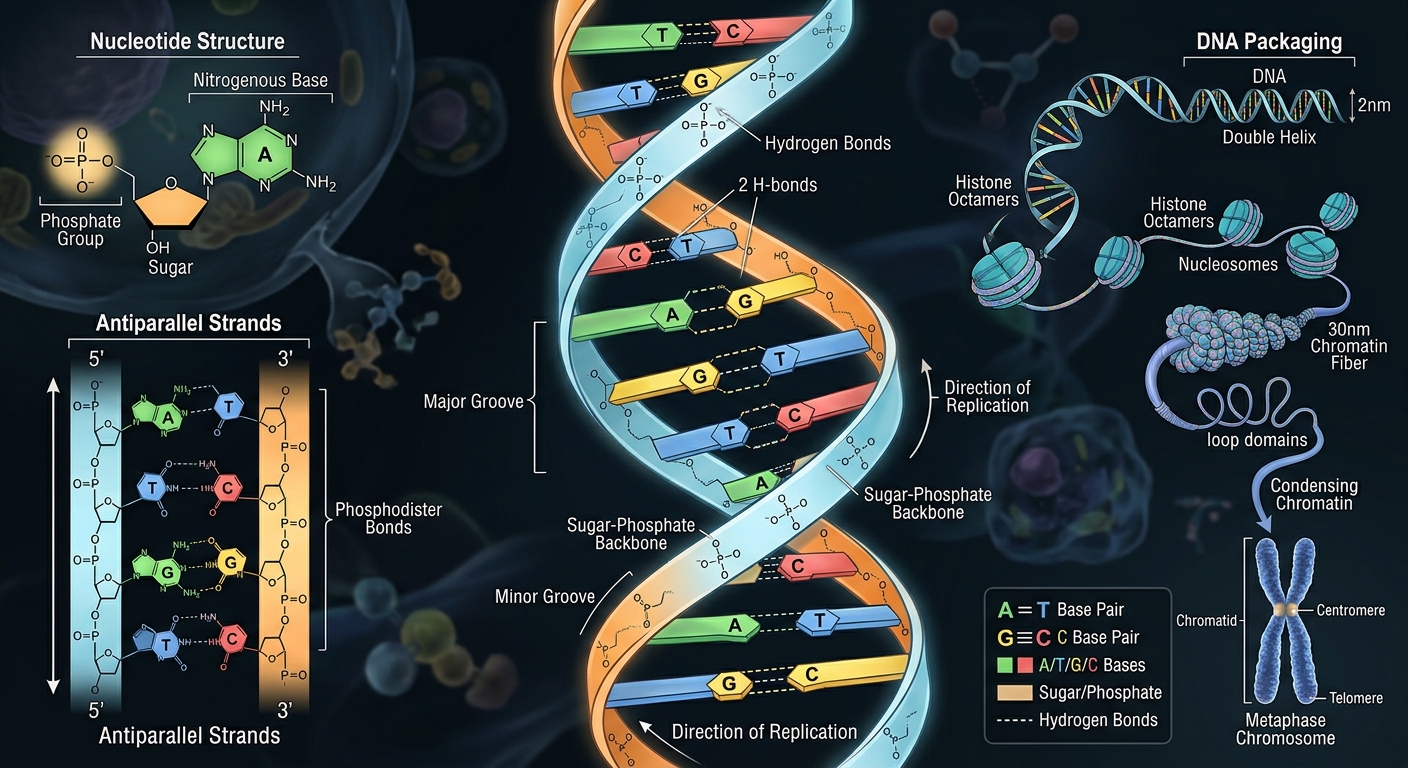
Understanding the molecular structure, genetic information, biological functions, inheritance, and significance of DNA in human survival and modern science
Genetika šiuolaikiniame pasaulyje | Brainy Boom
Free DNA Structure Diagram Generator | Figviz
Niveles de organización de la cromatina. Imagen: Paco Antequera.
8
Abstract
Human DNA (Deoxyribonucleic Acid) is one of the most sophisticated biological information-storage systems known to science. It contains the inherited genetic instructions that help construct, maintain, regulate and reproduce the human organism.
DNA is more than a double helix. It is an integrated molecular information architecture involving:
- Chemical building blocks.
- A double-stranded molecular structure.
- Genetic information encoded in four nucleotide bases.
- Genes and regulatory sequences.
- Chromosomes and chromatin packaging.
- DNA replication and cellular inheritance.
- RNA transcription and protein synthesis.
- Genetic regulation and cellular differentiation.
- DNA repair and genomic protection.
- Mitochondrial DNA and cellular energy production.
Understanding DNA requires connecting chemistry, physics, molecular biology, genetics, cellular architecture, evolution and modern biotechnology.
The central scientific principle is that DNA stores biological information, while cellular machinery reads, interprets, regulates and uses that information.
Chapter 1. What exactly is human DNA?
Genes, DNA, Chromosomes, and Genomes | by Michael Hall | PhD Files | Medium
DNA is a biological molecule found primarily inside the nucleus of almost every human cell.
It carries instructions that influence:
- How cells develop.
- How proteins are produced.
- How tissues form.
- How organs develop and function.
- How biological characteristics are inherited.
- How cells respond to environmental signals.
- How organisms grow, repair and reproduce.
The human body contains trillions of cells, although the exact number varies between individuals.
Most nucleated human cells contain approximately the same nuclear DNA information, but different cell types use different portions of that information.
For example:
| Cell type | Main biological responsibility |
|---|---|
| Neurons | Communication within the nervous system |
| Muscle cells | Movement and force production |
| Liver cells | Metabolism and chemical processing |
| Red blood cells | Oxygen transportation; mature human red blood cells lack a nucleus |
| Immune cells | Defence against infections |
| Skin cells | Protection and tissue maintenance |
| Pancreatic cells | Production of digestive enzymes or hormones, depending on cell type |
An important discovery is that a neuron and a liver cell generally possess the same inherited genome, but activate different groups of genes.
This is called differential gene expression.
Chapter 2. The chemical architecture of DNA
3 Parts of a Nucleotide and How They Are Connected
DNA is a polymer: a large molecule constructed from repeating smaller chemical units called nucleotides.
Each DNA nucleotide has three components.
2.1 The three components of a nucleotide
1. Phosphate group
- Contains phosphorus and oxygen.
- Connects neighbouring sugar molecules.
- Contributes to the negatively charged DNA backbone.
2. Deoxyribose sugar
- A five-carbon sugar.
- Forms part of the structural backbone.
- Provides attachment points for the phosphate group and nitrogenous base.
3. Nitrogenous base
This is the information-bearing component of the nucleotide.
There are four nitrogenous bases in DNA:
A
Adenine
Purine base
T
Thymine
Pyrimidine base
C
Cytosine
Pyrimidine base
G
Guanine
Purine base
The four bases form the alphabet of DNA.
Their arrangement creates the genetic code.
2.2 Purines and pyrimidines
The bases belong to two chemical families:
| Purines | Pyrimidines |
|---|---|
| Adenine (A) | Cytosine (C) |
| Guanine (G) | Thymine (T) |
| Two-ring structure | One-ring structure |
This chemical distinction helps explain why DNA pairs one purine with one pyrimidine.
2.3 Complementary base pairing
DNA uses a highly organised pairing system:
- Adenine pairs with thymine (A–T).
- Guanine pairs with cytosine (G–C).
10.5 Nucleic Acids | NCERT 12 Chemistry
A–T normally forms two hydrogen bonds.
G–C normally forms three hydrogen bonds.
These interactions help stabilise the DNA double helix.
Why is this important?
Because each DNA strand contains information that can guide the reconstruction of its complementary strand during DNA replication.
Chapter 3. The double-helix architecture
PPT – Nucleic Acid Structure and Stability PowerPoint Presentation, free download – ID:2045214
The DNA molecule has a double-helical architecture, meaning that two long molecular strands twist around one another.
The classical double-helix model was established in 1953 through the work of James Watson and Francis Crick, drawing importantly on experimental evidence from Rosalind Franklin and Maurice Wilkins.
3.1 Two complementary strands
The two strands are complementary because their bases pair according to specific chemical rules.
For example:
Strand 1:  A T G C C A T G
           | | | | | | | |
Strand 2:  T A C G G T A C
Each strand carries a sequence of genetic information.
3.2 Antiparallel orientation
The two strands run in opposite chemical directions:
- One runs from 5′ to 3′.
- The other runs from 3′ to 5′.
This arrangement is called antiparallel orientation.
It is essential to the way DNA replication and many DNA-processing enzymes operate.
3.3 Major and minor grooves
The double helix has two characteristic grooves:
- Major groove.
- Minor groove.
These grooves provide access points where proteins can recognise particular DNA sequences and interact with the molecule.
This is especially important for gene regulation.
3.4 DNA dimensions
Typical B-form DNA has approximately:
| Property | Approximate measurement |
|---|---|
| Diameter | 2 nanometres |
| Distance between adjacent base pairs | 0.34 nanometres |
| Helical repeat | 10.5 base pairs |
| Length per complete turn | 3.6 nanometres |
These dimensions illustrate how enormous quantities of biological information can be stored in an extremely small molecular structure.
Chapter 4. The human genome: the complete DNA information system
The human genome is the complete collection of DNA sequences in a human cell.
It includes:
- Nuclear DNA.
- Mitochondrial DNA.
The nuclear genome contains approximately 3.2 billion base pairs in one haploid set.
Most people have 46 chromosomes arranged in 23 pairs in their nucleated somatic cells.
4.1 The 23 chromosome pairs
| Chromosome group | Description |
|---|---|
| 1–22 | Autosomes |
| 23rd pair | Sex chromosomes, typically XX or XY |
One chromosome of each pair is generally inherited from the biological mother and the other from the biological father.
The 23rd chromosome pair is involved in sex development, although biological sex development is more complex than a simple chromosome label.
4.2 How many genes does a human have?
The human genome contains approximately 19,000–20,000 protein-coding genes.
However, genes account for only a small proportion of the entire genome.
The remaining DNA includes:
- Regulatory sequences.
- Introns within genes.
- Repetitive DNA.
- Structural regions.
- Sequences with other known or incompletely understood functions.
This leads to a major scientific distinction:
The genome is much larger than the collection of protein-coding genes.
Chapter 5. Chromosome architecture: how DNA is organised inside the cell
DNA Structure Packaging, Characteristics, Role
The DNA inside a human cell is extremely long compared with the size of the nucleus. It must therefore be carefully organised and packaged.
This packaging system involves several levels.
5.1 The five levels of DNA organisation
DNA packaging hierarchy
- DNA double helixThe original two-stranded molecular structure.
- NucleosomesDNA wrapped around histone protein complexes.
- ChromatinDNA combined with histones and other associated proteins.
- Chromatin loops and domainsOrganised regions that help control DNA accessibility and gene activity.
- ChromosomesHighly organised DNA-protein structures, particularly condensed during cell division.
5.2 Histone proteins
Histones are specialised proteins that help organise DNA.
The main histones forming the nucleosome core are:
- H2A
- H2B
- H3
- H4
Two copies of each form a histone octamer.
DNA wraps approximately 1.7 times around this protein complex.
Another histone, H1, helps organise linker DNA and higher-order chromatin structure.
Significance: Histones do more than package DNA. Chemical modifications to histones can influence whether particular DNA regions are accessible for gene expression.
5.3 Euchromatin and heterochromatin
There are two important descriptions of chromatin organisation.
| Euchromatin | Heterochromatin |
|---|---|
| Generally more accessible | Generally more compact |
| Often associated with active genes | Often associated with reduced gene activity |
| Allows easier access for transcription machinery | Restricts access to many DNA regions |
These are general patterns, not absolute rules.
5.4 Chromosome architecture
Structural organization of Chromosome | PPTX
A replicated chromosome contains two sister chromatids joined at a centromere.
Its important structural components include:
- Centromere: Helps organise chromosome separation during cell division.
- Telomeres: Protective repetitive DNA structures at chromosome ends.
- p arm: The shorter chromosome arm.
- q arm: The longer chromosome arm.
- Sister chromatids: Two copies of a replicated chromosome.
Telomeres help protect chromosome ends from being mistaken for broken DNA.
Chapter 6. Gene architecture: how biological instructions are organised
A gene is a specific DNA sequence that contributes to the production of a functional biological product, usually a protein or functional RNA.
However, a gene is not simply a single uninterrupted stretch of coding DNA.
File:Gene structure eukaryote 2 annotated.svg – Wikimedia Commons
6.1 Main components of a gene
| Component | Function |
|---|---|
| Promoter | Helps initiate transcription |
| Enhancer | Increases gene activity under appropriate conditions |
| Silencer | Can reduce gene activity |
| Exons | Sequences retained in mature RNA; some encode protein |
| Introns | Sequences removed during RNA processing in many genes |
| Untranslated regions | Help regulate RNA stability and translation |
| Polyadenylation signal | Helps direct processing of many eukaryotic RNA transcripts |
Promoters
Promoters are DNA regions where transcription machinery assembles to initiate RNA production.
Enhancers
Enhancers can influence gene expression from considerable distances along the DNA molecule.
They work through interactions between DNA, regulatory proteins and the three-dimensional organisation of chromatin.
Exons and introns
Exons and introns are especially important in human gene architecture.
Consider a simplified gene:
DNA gene:

Promoter
   |
   v
[Exon 1] -- [Intron 1] -- [Exon 2] -- [Intron 2] -- [Exon 3]
During RNA processing, introns are commonly removed and exons joined together.
This process is called RNA splicing.
6.2 Alternative splicing
One gene can sometimes produce different mature RNA molecules through alternative splicing.
This allows the same gene to contribute to the production of different protein forms.
It is one reason why the complexity of the human body cannot be understood simply by counting genes.
Chapter 7. DNA replication: how the genetic information is copied
DNA Replication for the DAT: Enzymes, Directionality, and Key Concepts — King of the Curve
DNA replication is the biological process through which DNA is copied before a cell divides.
Without replication, newly formed cells could not receive the necessary genetic information.
Replication takes place during the synthesis phase, or S phase, of the cell cycle.
7.1 The semi-conservative principle
DNA replication is described as semi-conservative.
This means that each new DNA double helix contains:
- One original parental strand.
- One newly synthesised strand.
The original strands serve as templates for producing complementary strands.
7.2 Important replication proteins and enzymes
| Component | Biological responsibility |
|---|---|
| Helicase | Separates the DNA strands |
| Topoisomerase | Relieves DNA twisting and mechanical tension |
| Primase | Produces short RNA primers |
| DNA polymerase | Adds DNA nucleotides |
| Sliding clamp | Helps DNA polymerase remain associated with DNA |
| RNase H and other processing enzymes | Help remove RNA primers |
| DNA ligase | Joins DNA fragments |
| Telomerase | Extends telomeres in cells where it is active |
7.3 Leading and lagging strands
DNA polymerases generally synthesise DNA in the 5′ to 3′ direction.
Because the original strands are antiparallel, the two new strands are synthesised differently.
- The leading strand is synthesised continuously.
- The lagging strand is synthesised in shorter sections called Okazaki fragments.
DNA ligase subsequently joins the fragments.
7.4 Why replication accuracy matters
The human genome contains billions of base pairs.
Replication must therefore be highly accurate.
DNA polymerases have proofreading capabilities, and additional repair systems correct many remaining mistakes.
This protects the integrity of genetic information across successive cell generations.
Chapter 8. Gene expression: how DNA becomes biological activity
Chapter: Transcription & Translation — The Biology Primer
DNA stores information, but it does not independently carry out all the biological work of the cell.
The information must be interpreted by cellular machinery.
This process is called gene expression.
The central framework is:
DNA
Stored genetic information
TRANSCRIPTION
RNA
Working genetic message
TRANSLATION
PROTEIN
Functional biological molecule
This is called the central dogma of molecular biology. It describes a major information pathway, although biology also includes important exceptions and additional forms of RNA activity.
8.1 Transcription: DNA to RNA
Transcription is the process in which an enzyme called RNA polymerase uses a DNA strand as a template to synthesise RNA.
In human cells, much of this activity occurs inside the nucleus.
The process involves:
- Recognition of regulatory DNA sequences.
- Assembly of transcription machinery.
- Opening of a small region of DNA.
- RNA synthesis using complementary base pairing.
- Processing of the RNA transcript.
DNA uses thymine (T), whereas RNA normally uses uracil (U).
8.2 The different types of RNA
RNA is not a single-purpose molecule.
| RNA type | Function |
|---|---|
| Messenger RNA (mRNA) | Carries coding information to ribosomes |
| Transfer RNA (tRNA) | Delivers amino acids during translation |
| Ribosomal RNA (rRNA) | Forms the structural and catalytic core of ribosomes |
| MicroRNA (miRNA) | Helps regulate gene expression |
| Small nuclear RNA (snRNA) | Participates in RNA processing |
| Long non-coding RNA (lncRNA) | Performs various regulatory functions |
8.3 Translation: RNA to protein
Researchers clear major obstacle in genetic engineering of proteins
Translation occurs at ribosomes.
The ribosome reads the mRNA sequence in groups of three bases called codons.
Each codon specifies an amino acid or a translation signal.
The genetic code uses:
- 64 possible codons.
- 61 codons that specify amino acids.
- 3 stop codons.
Amino acids are joined together to form a polypeptide chain.
That chain subsequently folds and may undergo chemical modifications to become a functional protein.
8.4 Why proteins are essential
Proteins perform a remarkable range of biological functions.
| Protein | Function |
|---|---|
| Haemoglobin | Transports oxygen |
| Insulin | Regulates blood glucose |
| Collagen | Provides structural support to tissues |
| Actin | Supports cellular structure and movement |
| Myosin | Generates muscle contraction |
| Antibodies | Help recognise and neutralise foreign substances |
| Enzymes | Accelerate biochemical reactions |
| Kinesin | Transports cellular materials along microtubules |
This reveals the relationship between your earlier study of kinesin proteins and DNA: DNA contains genes that contribute to producing proteins such as kinesin, which subsequently perform essential cellular functions.
Chapter 9. Gene regulation: how cells decide which genes to use
Transcriptional Regulation — The Bruneau Lab
One of the most fascinating characteristics of human DNA is that not all genes are active at the same time.
A cell regulates which genes are expressed, when they are expressed and how much RNA or protein is produced.
This is called gene regulation.
9.1 Transcription factors
Transcription factors are proteins that bind particular DNA sequences and influence transcription.
They may:
- Activate gene expression.
- Suppress gene expression.
- Respond to environmental signals.
- Coordinate developmental processes.
- Control cell differentiation.
9.2 Cell differentiation
How does a fertilised human egg eventually develop into a human organism containing neurons, muscles, bones, skin and organs?
A major part of the explanation is differential gene expression.
Most of these cells contain essentially the same inherited nuclear genome, but their gene-expression patterns differ.
For example:
- Neurons activate genes important for electrical signalling.
- Muscle cells activate genes involved in contraction.
- Liver cells activate genes important for metabolism.
- Immune cells activate genes involved in defence.
This is a fundamental principle of developmental biology.
Chapter 10. Epigenetics: controlling DNA activity without changing its sequence
Frontiers | Mechanisms and technologies in cancer epigenetics
Epigenetics studies molecular mechanisms that influence gene activity without changing the underlying DNA base sequence.
Two major mechanisms are DNA methylation and histone modification.
10.1 DNA methylation
DNA methylation involves the attachment of chemical methyl groups to DNA.
In many contexts, increased methylation at gene promoters is associated with reduced gene expression.
However, the effect depends on the DNA location and biological context.
10.2 Histone modification
Histones can undergo different chemical modifications, including:
- Acetylation.
- Methylation.
- Phosphorylation.
- Ubiquitination.
These modifications can influence chromatin structure and gene accessibility.
10.3 Why epigenetics matters
Epigenetic mechanisms contribute to:
- Embryonic development.
- Cell differentiation.
- Tissue identity.
- Responses to environmental conditions.
- Regulation of metabolism.
- Normal cellular ageing.
- Some disease processes.
A crucial distinction:
DNA sequence is the underlying genetic information; epigenetics helps regulate how that information is used.
Chapter 11. DNA repair: protecting the integrity of human genetic information
DNA is constantly exposed to conditions that can damage its molecular structure.
Sources include:
- Natural chemical reactions inside cells.
- Errors during DNA replication.
- Ultraviolet radiation.
- Certain environmental chemicals.
- Reactive oxygen species generated during metabolism.
The human body therefore has sophisticated DNA repair systems.
Trait: ATM and DNA damage | FitnessGenes®
11.1 Major DNA repair mechanisms
| Repair mechanism | Main function |
|---|---|
| Base excision repair | Corrects certain damaged individual bases |
| Nucleotide excision repair | Removes sections containing bulky DNA damage |
| Mismatch repair | Corrects many replication-related base mismatches |
| Homologous recombination | Repairs certain DNA double-strand breaks using a matching template |
| Non-homologous end joining | Joins broken DNA ends |
11.2 DNA damage and cellular health
If DNA damage is not properly repaired, mutations may accumulate.
Depending on the affected genes and cellular circumstances, this can contribute to:
- Abnormal cellular function.
- Developmental disorders.
- Age-related changes.
- Cancer development.
Cells also have systems that can temporarily stop cell division, activate repair mechanisms or initiate programmed cell death when damage cannot be adequately resolved.
DNA repair is therefore essential for maintaining biological stability.
Chapter 12. Mitochondrial DNA: the second human genetic system
Generador de Diagramas de Mitocondria | Etiquetado y Gratis | SciDraw AI
Human genetic information is not stored exclusively in the nucleus.
Mitochondria, the structures involved in cellular energy production, also contain their own DNA.
This is called mitochondrial DNA, or mtDNA.
12.1 Architecture of mitochondrial DNA
Human mitochondrial DNA has the following characteristics:
| Property | Description |
|---|---|
| Structure | Circular double-stranded DNA |
| Length | 16,569 base pairs |
| Genes | 37 |
| Protein-coding genes | 13 |
| Ribosomal RNA genes | 2 |
| Transfer RNA genes | 22 |
| Main location | Mitochondrial matrix region |
| Inheritance | Predominantly maternal |
Unlike nuclear DNA, which is organised into 23 chromosome pairs, mitochondrial DNA is a relatively small circular genome.
12.2 What does mitochondrial DNA control?
Its 13 protein-coding genes contribute to proteins involved in oxidative phosphorylation.
Oxidative phosphorylation is the process through which mitochondria generate much of the ATP used by human cells.
ATP stands for adenosine triphosphate.
It is the principal immediate energy-carrying molecule used in cellular processes.
12.3 Relationship between nuclear DNA and mitochondrial DNA
Mitochondria depend on genetic instructions from two sources:
- Their own mitochondrial genome.
- Nuclear genes whose products are transported into mitochondria.
Most mitochondrial proteins are encoded by nuclear DNA.
This means the two genetic systems work together.
Two cooperating genetic systems
Nuclear DNA
Encodes the vast majority of cellular and mitochondrial proteins.
Mitochondrial DNA
Encodes 13 proteins and the mitochondrial RNA machinery components.
Coordinated mitochondrial function
Energy production, metabolism and cellular maintenance.
This relationship is particularly important in tissues with high energy requirements, such as the brain, heart and skeletal muscles.
Chapter 13. Genetic inheritance: how DNA passes between generations
About Genetics and Hearing Loss | Parent Guides to Hearing Loss | CDC
Human genetic inheritance explains how DNA information is passed from parents to offspring.
Most human cells contain 46 chromosomes.
However, reproductive cells (egg and sperm) normally contain 23 chromosomes each.
This is possible because of a special cell division process called meiosis.
13.1 The contribution of each biological parent
At fertilisation:
- The egg contributes 23 chromosomes.
- The sperm contributes 23 chromosomes.
- The resulting fertilised egg normally contains 46 chromosomes.
The resulting organism therefore receives nuclear genetic information from both biological parents.
13.2 Meiosis and genetic variation
Meiosis produces genetic diversity through processes including:
Crossing over: Homologous chromosomes exchange corresponding DNA segments.
Independent assortment: Chromosome pairs are distributed into reproductive cells in different combinations.
These processes generate genetic combinations that make individuals genetically distinct.
13.3 Dominant and recessive inheritance
Some genetic characteristics follow relatively simple inheritance patterns.
- A dominant allele can influence a trait when one copy is present.
- A recessive allele generally influences a trait under a particular inheritance model when two copies are present.
However, not every human characteristic follows simple dominant-recessive inheritance.
Many characteristics involve multiple genes and environmental influences.
13.4 Genetic variation
Differences in DNA sequences between individuals are called genetic variation.
Important forms include:
| Variation | Explanation |
|---|---|
| Single-nucleotide variant | A difference involving one DNA base |
| Insertion | Addition of DNA bases |
| Deletion | Loss of DNA bases |
| Duplication | Repetition of a DNA segment |
| Inversion | Reversal of a DNA segment |
| Copy-number variation | Differences in the number of copies of particular DNA regions |
| Chromosomal rearrangement | Structural changes involving chromosomes |
Genetic variation is a fundamental source of biological diversity and a major part of human evolution.
Chapter 14. Mutations: changes in DNA information
🧬 Mutations – Point, Frameshift & Their Effects on Protein Synthesis — King of the Curve
A mutation is a change in a DNA sequence.
Mutations can arise naturally during DNA replication or following exposure to DNA-damaging influences.
They can have different biological consequences.
14.1 Four important mutation categories
| Mutation type | Description |
|---|---|
| Substitution | One nucleotide is replaced by another |
| Insertion | One or more nucleotides are added |
| Deletion | One or more nucleotides are removed |
| Frameshift | An insertion or deletion changes the reading frame of a coding sequence |
14.2 Are all mutations harmful?
No.
Mutations may be:
- Neutral: having no noticeable biological effect.
- Beneficial: providing an advantage in particular environments.
- Harmful: interfering with normal biological functions.
Some mutations occur in reproductive cells and can be passed to subsequent generations.
Others occur in body cells and remain within the affected cell lineage.
14.3 Mutation and evolution
Over many generations, inherited genetic variations contribute to evolution.
Natural selection can influence how frequently particular genetic variants occur within populations.
Mutations, recombination, genetic drift and migration all contribute to changes in population genetics.
This is one of the most important connections between molecular biology and the history of life on Earth.
Chapter 15. DNA and the architecture of the human brain
Clinical Neurogenetics – Clinical Tree
The brain is an excellent example of how DNA information produces specialised biological systems.
A neuron contains genetic information in its nucleus, but its specialised functions depend on particular patterns of gene expression.
DNA contributes to the production of proteins involved in:
- Neuron development.
- Axon formation.
- Dendrite formation.
- Synapse development.
- Electrical signalling.
- Neurotransmitter production.
- Ion-channel formation.
- Cellular energy metabolism.
- Neuron maintenance.
- Communication between neurons.
15.1 DNA and ion channels
Neurons communicate through electrical and chemical signals.
Their electrical properties depend partly on proteins that form ion channels.
Examples include:
- Sodium channels.
- Potassium channels.
- Calcium channels.
- Chloride channels.
Genes encode many of these proteins.
The proteins subsequently help regulate the movement of ions across neuronal membranes.
15.2 DNA and synaptic communication
Synapses are specialised communication junctions between neurons.
DNA contributes to the production of proteins involved in:
- Neurotransmitter receptors.
- Synaptic vesicles.
- Synaptic structural organisation.
- Signal transmission.
- Synaptic plasticity.
15.3 DNA and learning
Learning involves changes in the strength and organisation of neural connections.
These processes can involve changes in gene expression and protein production.
For example, transcription factors such as CREB participate in molecular pathways associated with memory formation and synaptic plasticity.
An important distinction is that DNA does not contain a complete record of an individual’s experiences or memories.
Rather, it provides biological instructions that help construct and maintain the machinery through which learning and memory operate.
Chapter 16. DNA and the architecture of the immune system
Adaptive immune system | BioRender Science Templates
The immune system uses specialised genetic mechanisms to recognise a remarkably diverse range of foreign substances.
One of the most extraordinary examples is the genetic rearrangement used to produce antibody diversity.
16.1 Antibody production
Antibodies are proteins produced by specialised B lymphocytes.
They recognise specific molecular structures called antigens.
The genes involved in antibody production undergo a process called V(D)J recombination.
This rearranges selected gene segments to generate a large variety of antibody receptors.
16.2 Why is this significant?
The immune system cannot depend on a separate inherited gene for every possible antigen.
Instead, it uses genetic rearrangement to generate enormous receptor diversity from a limited collection of gene segments.
This is a remarkable example of biological information processing.
16.3 T-cell receptors
T lymphocytes also use V(D)J recombination to create diverse antigen receptors.
These receptors allow the immune system to recognise different antigenic structures.
The immune system therefore demonstrates how DNA-based instructions, cellular machinery and biological adaptation cooperate.
Chapter 17. DNA and human development
Biology: Embryonic Development Infographic | LivePhysics™
Human development begins with a fertilised egg.
The fertilised egg contains genetic material from both biological parents.
Through repeated cell division and carefully regulated gene expression, it develops into an increasingly complex organism.
17.1 Major developmental stages
| Stage | Biological process |
|---|---|
| Fertilisation | Egg and sperm unite |
| Cleavage | Rapid early cell divisions |
| Blastocyst | Early organised embryonic structure |
| Gastrulation | Formation of the three primary germ layers |
| Neurulation | Development of the early nervous system |
| Organogenesis | Formation of major organs |
| Fetal development | Growth and maturation |
17.2 The three germ layers
During embryonic development, three fundamental tissue layers are established.
PART 4 FERTILIZATION AND EMBRYONIC DEVELOPMENT Fertilization How
Ectoderm
Nervous system and epidermis, among other structures.
Derivados de la capa germinal mesodermica – Jesus Ruano – Podcast en iVoox
Mesoderm
Muscles, bones, blood and connective tissues.
Embryology Glossary: Germ Layers | ditki medical & biological sciences
Endoderm
Many internal epithelial linings and associated organs.
DNA-regulated developmental processes help coordinate the formation of these structures.
Genes such as the HOX family are important in organising body-pattern development.
Chapter 18. DNA and cellular ageing
Human cells undergo continuous maintenance, renewal and adaptation.
DNA plays an important role in these processes.
Three important areas are:
18.1 Telomeres
Telomeres are repetitive DNA sequences located at chromosome ends.
They help protect chromosomes from deterioration and inappropriate repair responses.
In many dividing human cells, telomeres gradually shorten with repeated cell divisions.
However, this is not the only mechanism involved in ageing.
18.2 DNA repair and ageing
DNA damage accumulates through normal biological processes.
Cells possess repair systems, but their effectiveness can change with age and cellular conditions.
18.3 Cellular senescence
Cellular senescence describes a state in which cells stop dividing while remaining metabolically active.
Senescence can help prevent the propagation of certain damaged cells.
However, the accumulation of senescent cells can also contribute to age-associated tissue changes.
The relationship between DNA, ageing, metabolism, inflammation and cellular repair is an important area of modern biomedical research.
Chapter 19. DNA and modern biotechnology
Why Genome Sequencing May Hold the Key to Preventing Genetic Diseases
CRISPR-Cas9: Transformations in Gene Editing | AmBioTech
A scientist inserting micro tubes into a PCR machine
8
Understanding DNA has transformed medicine, agriculture, biological research and biotechnology.
The following technologies are particularly important.
19.1 DNA sequencing
DNA sequencing determines the order of nucleotide bases in a DNA sample.
It allows researchers to investigate:
- Genetic variation.
- Inherited conditions.
- Evolutionary relationships.
- Microorganisms.
- Cancer-associated mutations.
- Population genetics.
Two important sequencing approaches are:
Sanger sequencing: A foundational DNA sequencing method that remains useful for selected applications.
Next-generation sequencing (NGS): Technologies that can analyse enormous numbers of DNA fragments in parallel.
19.2 Polymerase chain reaction (PCR)
PCR is a laboratory method for producing many copies of a selected DNA region.
It is used in research, medical testing, forensic science and infectious-disease investigations.
19.3 CRISPR gene editing
CRISPR Genome Editing Explained: How It Works, Cas9, Curing Diseases – Los Angeles Times
CRISPR-based technologies provide ways of targeting particular DNA sequences.
The CRISPR-Cas9 system uses:
- Guide RNA.
- Cas9 protein.
- A target DNA sequence.
Cas9 can cut DNA at a targeted location, after which cellular repair processes may produce changes to the DNA sequence.
Potential applications include:
- Studying gene function.
- Investigating genetic disorders.
- Developing new medical treatments.
- Agricultural research.
- Understanding biological mechanisms.
Genome editing requires careful consideration of accuracy, unintended changes, safety and ethical implications.
19.4 DNA profiling
DNA profiling examines selected genetic markers to establish whether biological samples are consistent with particular individuals or biological relationships.
Applications include:
- Forensic investigations.
- Identification of human remains.
- Paternity testing.
- Population studies.
DNA profiling is powerful, but results must be interpreted using appropriate scientific and statistical standards.
Chapter 20. The economic and industrial significance of human DNA
The discovery and understanding of DNA have created an entirely new scientific and economic ecosystem.
This is the foundation of the biotechnology and life-sciences industries.
20.1 Major industries built around DNA science
| Industry | Economic and scientific contribution |
|---|---|
| Pharmaceutical biotechnology | Development of biological medicines |
| Genomics | Analysis of complete genomes |
| Medical diagnostics | Identification of genetic and molecular markers |
| Agricultural biotechnology | Research into crop characteristics |
| Bioinformatics | Computational analysis of biological data |
| Synthetic biology | Design and engineering of biological systems |
| Personalised medicine | Use of relevant biological information to guide healthcare |
| Forensic science | DNA-based identification |
20.2 The relationship between DNA and artificial intelligence
Modern genomics generates enormous quantities of biological data.
AI and machine learning can help researchers:
- Identify patterns in DNA sequences.
- Predict aspects of protein structure and function.
- Investigate genetic associations.
- Analyse gene-expression data.
- Compare genomes.
- Identify candidate biological mechanisms.
- Support drug-discovery research.
However, AI predictions are not automatically proven biological facts. They require experimental validation.
20.3 Bioinformatics architecture
Bioinformatics connects several disciplines:
The modern genomics information ecosystem
Biological data collection
DNA sequencing and gene-expression measurements.
Computational infrastructure
High-performance computing, storage and databases.
Bioinformatics and AI
Statistical analysis, sequence comparison and predictive modelling.
Scientific interpretation
Biological hypotheses and experimentally testable discoveries.
Practical applications
Medicine, diagnostics, agriculture and biotechnology.
Chapter 21. The scientific limitations of DNA
An accurate understanding of genetics requires recognising what DNA does not explain on its own.
DNA is enormously important, but human development and health are influenced by several interacting systems.
These include:
- Genetic inheritance.
- Gene regulation.
- Epigenetic mechanisms.
- Cellular metabolism.
- Hormonal signalling.
- Nervous-system activity.
- Immune-system function.
- Nutrition and environmental conditions.
- Social and developmental environments.
A person’s biological characteristics are not determined by DNA alone.
For many characteristics, the outcome reflects complex interactions between multiple genes and environmental influences.
This is called gene-environment interaction.
Chapter 22. The complete human DNA architecture: an integrated model
We can now bring the different scientific layers together.
DNA Basics: Nucleotides, Genes, and the Genome | Federal Judicial Center
The complete architecture can be understood through ten interconnected levels.
| Level | Architecture | Principal responsibility |
|---|---|---|
| 1 | Nucleotides | Chemical information units |
| 2 | Double helix | Genetic information storage |
| 3 | Genes | Functional biological instructions |
| 4 | Regulatory DNA | Control of gene activity |
| 5 | Chromatin | DNA organisation and accessibility |
| 6 | Chromosomes | Large-scale genome organisation |
| 7 | Genome | Complete inherited DNA information |
| 8 | RNA | Information processing and regulation |
| 9 | Proteins | Biological structure and activity |
| 10 | Cellular systems | Integrated organismal function |
The levels do not operate independently.
They form a connected biological information system.
Chapter 23. The most important discoveries in the history of DNA
Understanding DNA required contributions from chemistry, physics, genetics and molecular biology.
| Year | Scientist / discovery | Scientific significance |
|---|---|---|
| 1869 | Friedrich Miescher | First isolated a substance later identified as DNA |
| 1928 | Frederick Griffith | Discovered bacterial transformation |
| 1944 | Avery, MacLeod and McCarty | Demonstrated DNA’s role in bacterial heredity |
| 1950 | Erwin Chargaff | Established important relationships between DNA bases |
| 1952 | Rosalind Franklin and Maurice Wilkins | Produced important X-ray diffraction evidence |
| 1953 | James Watson and Francis Crick | Published the double-helix structural model |
| 1958 | Meselson and Stahl | Demonstrated semi-conservative DNA replication |
| 1960s | Nirenberg, Khorana and others | Helped decipher the genetic code |
| 1977 | Frederick Sanger | Developed a major DNA sequencing method |
| 1983 | Kary Mullis | Developed PCR |
| 2003 | Human Genome Project | Announced completion of the first reference human genome sequence |
| 2012 | CRISPR-Cas9 research | Established a widely applicable programmable genome-editing approach |
These discoveries transformed DNA from an unknown biological substance into one of the most important scientific subjects in modern civilisation.
Chapter 24. Twenty-five essential DNA scientific concepts
Use this as a reference vocabulary when studying molecular biology.
| No. | Scientific term | Meaning |
|---|---|---|
| 1 | DNA | Deoxyribonucleic acid |
| 2 | RNA | Ribonucleic acid |
| 3 | Nucleotide | Basic DNA/RNA building block |
| 4 | Adenine | DNA nitrogenous base |
| 5 | Thymine | DNA nitrogenous base |
| 6 | Guanine | DNA nitrogenous base |
| 7 | Cytosine | DNA nitrogenous base |
| 8 | Genome | Complete genetic material |
| 9 | Gene | Functional hereditary sequence |
| 10 | Chromosome | Organised DNA-protein structure |
| 11 | Chromatin | DNA and associated proteins |
| 12 | Histone | DNA-packaging protein |
| 13 | Nucleosome | DNA wrapped around histones |
| 14 | Replication | DNA copying |
| 15 | Transcription | RNA production from DNA |
| 16 | Translation | Protein production from mRNA |
| 17 | Codon | Three-base genetic code unit |
| 18 | Amino acid | Protein building block |
| 19 | Mutation | Change in DNA sequence |
| 20 | Epigenetics | Regulation of gene activity without changing DNA sequence |
| 21 | Methylation | Addition of methyl groups |
| 22 | Telomere | Protective chromosome-end structure |
| 23 | Centromere | Chromosome region important in segregation |
| 24 | Mitochondrial DNA | DNA found in mitochondria |
| 25 | Bioinformatics | Computational analysis of biological information |
Chapter 25. Recommended scientific reading and research
To develop deeper university-level knowledge, these are valuable reference materials.
- Molecular Biology of the Cell — Bruce Alberts and colleagues. Comprehensive cellular and molecular biology.
- Molecular Biology of the Gene — James Watson and colleagues. DNA, RNA and gene expression.
- The Cell: A Molecular Approach — Geoffrey Cooper. Cellular architecture and molecular processes.
- Genetics: A Conceptual Approach — Benjamin Pierce. Genetics and inheritance.
- Nature — A major scientific research journal.
- National Human Genome Research Institute — Human genome research and educational resources.
- National Center for Biotechnology Information — Genetics, genomes and molecular biology databases.
Final scientific conclusion
Google’s New AI AlphaGenome Just Unlocked the Code of Human Life
Human DNA represents one of the most extraordinary molecular information systems in nature.
Its architecture demonstrates how chemistry can organise information, how information can guide biological construction, and how biological structures can cooperate to sustain life.
Consider the complete relationship:
DNA → Genes → RNA → Proteins → Cells → Tissues → Organs → Human organism.
However, this is not simply a one-directional production line. Cells continuously regulate their genes through feedback systems, environmental signals, metabolic processes and interactions between different tissues.
The most important scientific understanding is that DNA provides the inherited molecular instructions, while the living cell supplies the machinery that interprets and implements those instructions.
Understanding DNA therefore opens the door to understanding:
- Human biology and inheritance.
- Brain development and neural communication.
- Cellular energy and mitochondria.
- Protein architecture and molecular transport.
- Immunity and disease.
- Human evolution.
- Biotechnology and genetic medicine.
- Artificial intelligence applied to biological research.
It connects molecular chemistry to the entire architecture of human life.
One final insight: DNA is the information-storage foundation of human biology, but life emerges from the coordinated operation of DNA, RNA, proteins, membranes, organelles, cells and the environment.
That integrated system is what makes human biology so remarkable.
The connection between DNA-encoded proteins and cellular transport is particularly interesting: proteins such as kinesin, which we discussed previously, are part of the machinery that allows cells to move important materials internally.


Be First to Comment