
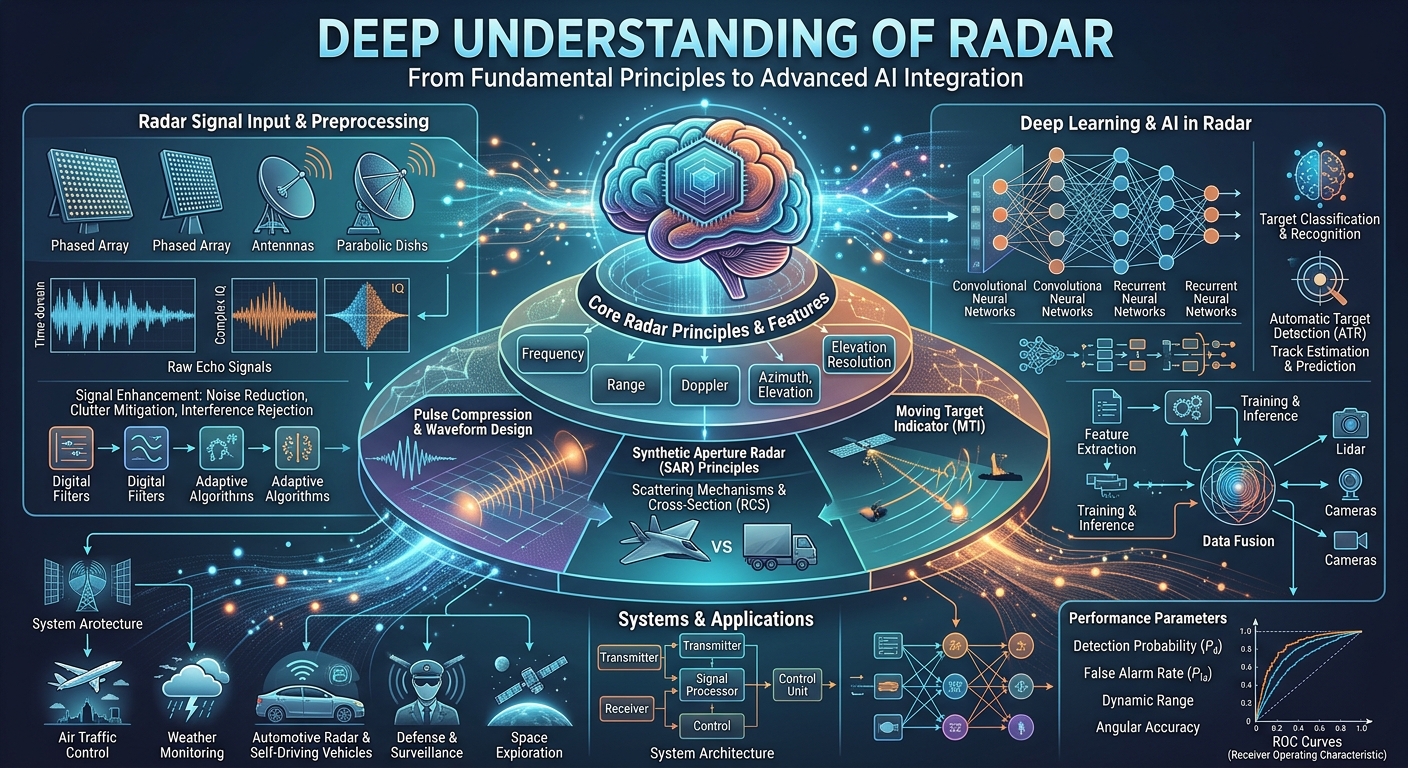
The architecture, physics, engineering, intelligence and economic significance of Radar Technology
SOCAL TRACON – Air traffic radar control facility in San Diego. – Album on Imgur
Купить судовую рлс Simrad R3016 в Санкт-Петербурге и Москве, доставка по России
8
1. Introduction: What is Radar?
RADAR stands for Radio Detection and Ranging.
Radar is an electronic sensing technology that uses electromagnetic waves, particularly radio and microwave frequencies, to detect objects, measure their distance, determine their movement and observe certain characteristics of the surrounding environment.
Radar is one of the most important inventions in modern electronic engineering because it enables machines to observe objects and environmental conditions without requiring direct physical contact.
Think of radar as an electronic observation system. It sends out electromagnetic energy, receives energy reflected by objects, and processes the returning information into meaningful measurements.
Radar has transformed several areas of civilisation:
- Aviation and air traffic management.
- Weather forecasting and climate research.
- Maritime navigation and ocean safety.
- Space exploration and astronomical research.
- Industrial automation and scientific measurement.
- Transportation and vehicle safety.
- Environmental monitoring and disaster prediction.
Its importance comes from combining physics, mathematics, electronics, computer science and signal processing into one technological ecosystem.
2. The scientific foundations of radar
To understand radar deeply, we must first understand five scientific principles.
Electromagnetic Radiation Explained for Kids | EM Spectrum Science
6
2.1 Electromagnetic waves
Radar operates through electromagnetic radiation.
Electromagnetic waves consist of changing electric and magnetic fields that propagate through space.
Other examples of electromagnetic radiation include:
- Radio waves.
- Microwaves.
- Infrared radiation.
- Visible light.
- Ultraviolet radiation.
- X-rays.
- Gamma rays.
Radar primarily uses radio-frequency and microwave portions of the electromagnetic spectrum.
Electromagnetic waves travel at approximately the speed of light in a vacuum:
\[ c=299,792,458\text{ m/s} \]
This extraordinary speed allows radar systems to measure distances using very small time differences.
2.2 Frequency
Frequency describes how many complete wave cycles occur each second.
It is measured in hertz (Hz).
\[ f=\frac{1}{T} \]
Where:
- \(f\) = frequency.
- \(T\) = period of one complete cycle.
For example, a frequency of 1 GHz represents one billion cycles per second.
2.3 Wavelength
Wavelength is the physical distance between corresponding points on consecutive waves.
The fundamental relationship is:
\[ \boxed{c=f\lambda} \]
Where:
- \(c\) = speed of light.
- \(f\) = frequency.
- \(\lambda\) = wavelength.
This relationship is fundamental to radar engineering because wavelength influences antenna design, resolution characteristics and how electromagnetic energy interacts with objects.
2.4 Reflection
When electromagnetic energy encounters an object, several things can happen:
- Some energy is reflected.
- Some energy is absorbed.
- Some energy passes through.
- Some energy is scattered in different directions.
The amount and nature of reflected energy depend on the object’s physical and electrical properties, its geometry, its orientation and the wavelength involved.
Radar systems analyse the returning electromagnetic signals to obtain information about their surroundings.
2.5 Signal processing
A returning radar signal is not automatically useful information.
It must be processed using mathematical and computational techniques.
Signal processing helps distinguish meaningful information from background noise and other unwanted signal variations.
This is where computer science and mathematics become essential to radar technology.
3. The complete architecture of a radar system
PPT – Introduction to RADAR System PowerPoint Presentation, free download – ID:7427393
A radar system is made up of interconnected electronic and computational components.
The major architectural components include:
| Component | Main responsibility |
|---|---|
| Transmitter | Generates electromagnetic signals |
| Antenna | Radiates and receives electromagnetic energy |
| Receiver | Processes incoming signals |
| Signal processor | Extracts useful information |
| Computer system | Organises and analyses measurements |
| Display interface | Presents information to human operators |
| Timing system | Coordinates measurements |
| Power supply | Provides electrical energy |
3.1 Transmitter
The transmitter generates the electromagnetic signal.
It is an electronic subsystem that converts electrical energy into a radio-frequency signal.
3.2 Antenna
The antenna is the interface between the radar’s electronic equipment and the electromagnetic environment.
It performs two fundamental functions:
- Transmitting electromagnetic energy.
- Receiving electromagnetic energy.
Antenna engineering involves electromagnetic theory, materials science, electrical engineering and mathematical design.
3.3 Receiver
The receiver detects and converts incoming electromagnetic signals into electrical information that electronic systems can process.
Incoming signals can be extremely weak, so receiver design is an important aspect of radar engineering.
3.4 Signal processor
This is the computational intelligence component.
It processes information through mathematical operations and digital algorithms.
Its broad functions include:
- Noise reduction.
- Signal analysis.
- Measurement extraction.
- Pattern recognition.
- Data organisation.
- Presentation of useful observations.
3.5 Display and human interface
The display converts processed measurements into understandable visual information.
For example, meteorologists use radar displays to observe precipitation patterns and changes in weather systems.
4. How radar measures distance
One of the most fascinating features of radar is its ability to measure distance using the speed of electromagnetic waves.
The principle is called time-of-flight measurement.
The process is conceptually simple:
- A radar system emits an electromagnetic pulse.
- The pulse travels through the atmosphere.
- It encounters an object or precipitation.
- A portion of the energy is scattered back.
- The receiver detects the returning signal.
- The computer analyses the elapsed time.
Because the signal travels to the object and back, the measured distance corresponds to half the total journey.
The underlying scientific relationship is:
\[ R=\frac{c\Delta t}{2} \]
Where:
- \(R\) = distance to the reflecting object.
- \(c\) = speed of electromagnetic propagation.
- \(\Delta t\) = elapsed time between transmission and reception.
Important scientific principle: Radar does not directly measure distance with a ruler. It calculates distance from the time taken by electromagnetic energy to complete its journey.
This is a fundamental example of how physics becomes practical engineering.
5. Understanding Doppler radar
Exploring the Doppler Effect With NASA – Science Lesson | NASA JPL Education
June 25, 2019 Twin Tornadoes near Hulett, WY
9
Doppler radar is an important development in radar technology.
Ordinary radar can provide information about the location and strength of reflected signals.
Doppler radar adds information about movement.
It uses a scientific phenomenon called the Doppler effect.
The Doppler effect describes how the observed frequency of a wave changes when there is relative motion between the source and the observer.
You can understand this using an ambulance siren:
- When an ambulance approaches, the siren sounds higher in pitch.
- When it moves away, the siren sounds lower in pitch.
Radar applies a related principle to electromagnetic waves.
Why is Doppler technology important?
It helps scientists understand:
- Wind movement.
- Atmospheric circulation.
- Storm development.
- Precipitation movement.
- Weather patterns.
- Movement of other observable objects.
For example, weather scientists can use Doppler measurements to investigate the movement of air inside thunderstorms.
NOAA explains how Doppler radar combines reflected-signal information with measurements of motion. National Oceanic and Atmospheric Administration+2
6. The different classifications of radar
Radar is not one single technology. It is a family of sensing systems designed for different scientific and engineering purposes.
Example of one of NOAA’s Doppler radar | The Planetary Society
6.1 Weather radar
Studies rainfall, storms, precipitation, atmospheric movement and severe weather conditions.
6.2 Aviation radar
Supports air traffic awareness, aircraft separation, airport operations and aviation safety.
航海の安全を見守る船の”目”、世界トップシェアを誇るFURUNOのレーダーに迫る!|海の音 – umi no oto – by FURUNO
6.3 Marine radar
Supports navigation and awareness of surrounding maritime conditions.
RADAR | Automotive – AD/ADAS | 村田製作所
6.4 Automotive radar
Supports vehicle safety systems by sensing nearby objects and their relative movement.
America’s First Commercial SAR
6.5 Synthetic Aperture Radar (SAR)
An advanced satellite and airborne imaging technology that produces images using radar measurements. It is valuable for Earth observation, including through clouds and during nighttime.
The Lovell Telescope and its role in pulsar astronomy | Nature Astronomy
6.6 Radio astronomy
Uses radio-frequency sensing and receiving technologies to investigate natural radio emissions from astronomical objects. Radio astronomy is related to radar through electromagnetic engineering, although passive radio telescopes generally receive natural signals rather than transmit radar pulses.
7. Radar signal processing: The computational brain
Targetless Radar–Camera Extrinsic Parameter Calibration Using Track-to-Track Association | MDPI
This is one of the most important areas for understanding modern radar.
A radar receiver collects electrical signals. However, these signals are not automatically a complete picture of the environment.
They require mathematical interpretation.
Radar signal processing involves several major scientific disciplines.
| Discipline | Contribution |
|---|---|
| Mathematics | Measurement and modelling |
| Statistics | Understanding uncertainty |
| Digital signal processing | Analysing incoming signals |
| Computer science | Organising computation |
| Machine learning | Recognising patterns |
| Physics | Understanding wave behaviour |
| Data engineering | Storing and transporting measurements |
7.1 Noise
Noise refers to unwanted variations or disturbances in a signal.
Examples include:
- Atmospheric interference.
- Electronic background noise.
- Reflections from environmental objects.
- Unwanted signal variations.
7.2 Filtering
Filtering is a mathematical process that helps separate useful signal information from unwanted components.
7.3 Pattern recognition
Computer systems can identify recurring patterns in radar observations.
For example, weather-analysis software can distinguish different precipitation patterns and assist meteorologists in understanding developing weather systems.
7.4 Data visualisation
The processed information is transformed into maps, charts, images and graphical displays.
This makes complicated scientific measurements understandable to human operators.
8. Dual-polarisation radar: Seeing more information
Wallops Precipitation Science Research Facility
Dual-polarisation radar represents an important advancement in meteorology.
Traditional radar observations provide information about reflected electromagnetic energy.
Dual-polarisation systems provide additional information by examining horizontally and vertically polarised components.
Why does this matter?
Rain droplets, hailstones, snowflakes and ice particles have different physical characteristics.
Their shapes, sizes and orientations influence how they scatter electromagnetic energy.
By analysing additional polarisation information, meteorologists can improve their understanding of precipitation.
Applications include:
- Identifying different types of precipitation.
- Improving rainfall estimation.
- Distinguishing rain from certain other atmospheric particles.
- Improving severe-weather observations.
- Supporting better weather warnings.
NOAA’s WSR-88D weather radar network incorporates dual-polarisation technology. National Oceanic and Atmospheric Administration+1
9. The relationship between radar and artificial intelligence
Công nghệ AI giúp người dân du Xuân an toàn hơn
Radar and artificial intelligence are increasingly important partners in modern scientific observation.
Radar collects observations. AI and advanced computational models can help interpret those observations.
Consider the following architecture:
1. Radar observation
Electromagnetic measurements
2. Signal processing
Noise reduction and measurement extraction
3. Data engineering
Data storage, integration and quality control
4. Artificial intelligence
Pattern recognition and forecasting assistance
5. Scientific interpretation
Predictions, visualisations and decision support
AI can contribute through:
Machine learning: Recognising recurring patterns in historical radar observations.
Deep learning: Learning complex relationships in large scientific datasets.
Computer vision: Analysing radar images and identifying visual structures.
Predictive analytics: Helping estimate how environmental conditions may change.
However, AI predictions are not automatically correct. They require quality data, scientific validation and human oversight.
10. Radar’s significance in the modern economy
Radar is not merely an electronic instrument. It is part of the infrastructure supporting modern economies.
| Economic sector | Contribution |
|---|---|
| Agriculture | Rainfall monitoring and agricultural planning |
| Aviation | Air traffic safety and operational awareness |
| Maritime | Navigation and shipping safety |
| Transportation | Vehicle safety and traffic awareness |
| Insurance | Weather-related risk assessment |
| Energy | Weather monitoring for renewable energy operations |
| Mining | Certain environmental and geological measurement applications |
| Telecommunications | Radio-frequency engineering and interference studies |
| Scientific research | Atmospheric and Earth observation |
10.1 Radar and agriculture in South Africa
South Africa has significant agricultural regions where rainfall variability affects production.
Radar-supported meteorological observations can help farmers and agricultural planners understand:
- Rainfall distribution.
- Approaching storms.
- Severe weather conditions.
- Regional precipitation patterns.
- Changes in atmospheric conditions.
For a ginger-farming operation, for example, weather information can contribute to irrigation planning, soil-moisture management and protection against excessive rainfall.
Radar observations should be combined with local rain gauges, soil-moisture sensors and weather forecasts rather than treated as direct measurements of soil moisture.
11. The limitations and challenges of radar technology
Although radar is extraordinarily powerful, it does not provide perfect information.
Understanding its limitations is just as important as understanding its capabilities.
| Limitation | Scientific explanation |
|---|---|
| Atmospheric interference | Weather and atmospheric conditions can influence propagation |
| Signal attenuation | Some materials and precipitation can weaken signals |
| Clutter | Unwanted reflections can complicate interpretation |
| Resolution limitations | Closely spaced objects may not always be distinguishable |
| Line-of-sight limitations | Some objects may be obscured by terrain or other obstacles |
| Measurement uncertainty | Observations contain errors and statistical uncertainty |
| Infrastructure costs | Advanced systems require investment, maintenance and skilled personnel |
Why does radar sometimes miss rainfall?
A radar beam spreads as it travels. At greater distances, the beam covers a larger region and may pass above precipitation close to the ground.
Consequently, the radar might detect rainfall at higher atmospheric levels without accurately representing rainfall reaching the ground.
This is why meteorologists combine radar observations with ground-based measurements and other meteorological information. National Oceanic and Atmospheric Administration+1
12. Radar and the telecommunications ecosystem
RF & Microwave Engineering: From kHz to GHz | Rathod Arvind posted on the topic | LinkedIn
Radar and telecommunications share important engineering foundations.
Both depend on electromagnetic wave theory, radio-frequency engineering, antennas, receivers and signal processing.
However, their purposes are different.
| Radar | Telecommunications |
|---|---|
| Observes the surrounding environment | Communicates information |
| Analyses reflected signals | Transmits and receives messages |
| Measures physical characteristics | Transfers digital information |
| Uses sensing and signal interpretation | Uses encoding and decoding |
Their shared technological foundations include:
- Electromagnetic theory.
- Antenna engineering.
- Semiconductor electronics.
- Radio-frequency components.
- Digital signal processing.
- Computer architecture.
- Communication networks.
This is why radar engineering overlaps with electrical engineering, computer engineering and telecommunications.
13. The semiconductor technology inside radar
£1.3M UK funding for semiconductor process development – News
Modern radar depends on semiconductor technology.
Semiconductor devices provide the electronic foundation for generating, receiving, processing and displaying radar information.
Important technologies include:
- Transistors.
- Integrated circuits.
- Analog-to-digital converters.
- Digital signal processors.
- Microprocessors.
- Memory systems.
- Radio-frequency integrated circuits.
- Power-management components.
Why are semiconductors important?
A semiconductor is a material whose electrical conductivity can be controlled.
Silicon is the most widely used semiconductor material in conventional integrated-circuit manufacturing.
Modern electronic systems combine millions or billions of microscopic electronic structures to perform complex calculations.
In radar, this technology enables increasingly sophisticated digital processing, data analysis and system integration.
The radar ecosystem therefore connects three major technological industries:
File:Motorola68040die.jpg – Wikimedia Commons
SemiconductorsElectronic foundation
Signal Integrity: Optimizing RF Signal Chains – Webinars – Webinar – EngineerZone
ElectronicsSignal generation and reception
ComputingInformation processing
14. The future of radar technology
Aptiv Gen 8 Radar Selected to Deliver Next-Generation Performance for Volvo Cars
GEOFORUM – Wiadomości – Najmniejszy satelita SAR przesyła pierwsze obrazy
12
Radar development is continuing across several important scientific fields.
14.1 AI-enhanced radar
Artificial intelligence can help scientists interpret increasingly complex observations.
14.2 Automotive sensing
Radar technology continues to support advanced driver-assistance systems and automated vehicle perception.
14.3 Satellite radar
Satellite radar provides important information about Earth’s surface, vegetation, flooding, ice and environmental changes.
14.4 Environmental monitoring
Advanced radar systems can contribute to understanding climate-related events, precipitation and atmospheric dynamics.
14.5 Industrial automation
Radar sensors can support contactless measurement and monitoring in industrial environments.
14.6 Integrated sensing and communications
An emerging research direction is combining communication and environmental sensing capabilities within shared radio-frequency systems.
The long-term significance is the development of increasingly intelligent, connected and computationally capable sensing infrastructure.
15. The history and scientific evolution of radar
Radar developed through decades of scientific discoveries in electromagnetism, electronics and engineering.
From Tower to Nosecone: Why Shorter Waves Changed Radar | Radar History
| Period | Scientific development |
|---|---|
| 1860s | James Clerk Maxwell develops the mathematical theory of electromagnetism |
| 1880s | Heinrich Hertz experimentally demonstrates electromagnetic waves |
| 1900s | Early experiments explore radio-wave detection of objects |
| 1930s | Practical radio-detection systems develop in several countries |
| 1940s | Radar technology advances significantly during World War II |
| 1950s–1970s | Civilian aviation and meteorological radar expand |
| 1980s–1990s | Digital signal processing and operational Doppler radar become increasingly important |
| 2000s–2010s | Advanced digital radar and dual-polarisation systems expand |
| 2020s | AI, satellite radar and advanced integrated sensing gain importance |
The scientific foundation began long before modern radar equipment existed. Maxwell’s electromagnetic theory and Hertz’s experiments helped establish the physics that made radar possible. training.weather.gov+1
16. The mathematics behind understanding radar
A student seeking advanced knowledge of radar should understand the following mathematical disciplines.
| Mathematical discipline | Importance |
|---|---|
| Algebra | Understanding physical relationships |
| Trigonometry | Understanding angles and geometry |
| Calculus | Modelling continuous physical changes |
| Linear algebra | Understanding signal transformations |
| Probability | Understanding measurement uncertainty |
| Statistics | Analysing observations |
| Fourier analysis | Understanding frequency components |
| Numerical methods | Performing computational calculations |
Radar is an excellent example of applied mathematics.
It demonstrates how abstract mathematical principles can become practical technologies that support human civilisation.
17. Radar’s relationship with other scientific disciplines
Radar is not an isolated engineering invention. It sits at the intersection of numerous scientific fields.
RADAR TECHNOLOGYIntegrated sensing and measurement system
PhysicsElectromagnetic waves
MathematicsMeasurement and modelling
ElectronicsSignal generation and reception
Computer scienceDigital computation
AI and MLPattern recognition
Materials scienceElectronic components
MeteorologyAtmospheric observation
EngineeringSystem integration
This integration is the real intellectual significance of radar: it transforms scientific knowledge into measurable information.
18. A structured educational pathway to mastering radar
For someone studying radar from foundational science to advanced engineering, I recommend the following learning sequence.
- Level 1: Physics foundationsStudy electromagnetism, radio waves, frequency, wavelength, reflection and wave propagation.
- Level 2: Electronic engineeringUnderstand antennas, receivers, transmitters, semiconductors and integrated circuits.
- Level 3: Mathematical foundationsStudy algebra, trigonometry, calculus, probability and statistics.
- Level 4: Digital signal processingLearn how computers interpret, filter and analyse electronic signals.
- Level 5: Radar classificationsStudy weather, aviation, maritime, automotive and satellite radar from a civilian scientific perspective.
- Level 6: Artificial intelligenceUnderstand machine learning, deep learning and AI-supported environmental observation.
- Level 7: Economic applicationsInvestigate how radar contributes to agriculture, transportation, aviation, environmental science and industrial development.
19. Important scientific terminology
| Term | Meaning |
|---|---|
| Radar | Radio Detection and Ranging |
| Electromagnetic wave | Energy propagated through electric and magnetic fields |
| Frequency | Number of wave cycles per second |
| Wavelength | Distance between corresponding points on successive waves |
| Antenna | Device that transmits or receives electromagnetic energy |
| Reflection | Return of electromagnetic energy from an object |
| Doppler effect | Frequency change associated with relative motion |
| Signal processing | Mathematical analysis of signals |
| Polarisation | Orientation of an electromagnetic wave’s electric field |
| Resolution | Ability to distinguish separate features |
| SAR | Synthetic Aperture Radar |
| AI | Artificial Intelligence |
| Semiconductor | Material with controllable electrical conductivity |
20. Recommended scientific references
These are useful starting points for deeper academic study.
- National Oceanic and Atmospheric Administration (NOAA) — How Radar Works. Excellent introduction to weather radar and Doppler principles.
- NOAA — A Guide for Interpreting Doppler Velocity Patterns. More advanced meteorological understanding.
- NASA — Electromagnetics and the Doppler Effect. Fundamental electromagnetic physics.
- National Weather Service — Radar Basics. Technical educational material.
- National Weather Service — Using and Understanding Doppler Radar. Understanding radar observations.
21. Final scientific conclusion
Radar is one of the great achievements of applied physics and modern electronic engineering.
Its deeper significance is not simply that it can detect objects. Its importance is that it allows humanity to obtain information about the physical world through electromagnetic observation.
Radar demonstrates the extraordinary relationship between:
- Physics and mathematics.
- Electromagnetic waves and electronic engineering.
- Semiconductors and computer architecture.
- Signal processing and artificial intelligence.
- Scientific discovery and economic development.
The technology represents a powerful combination of scientific knowledge and practical intelligence.
One of the most important lessons to understand is this:
Radar transforms invisible electromagnetic energy into measurable information, and transforms that information into knowledge that people can use to understand and manage the world around them.
For modern civilisation, this is the foundation of intelligent sensing technology.




Be First to Comment