
Molecular Architecture, Biological Functions, Intracellular Transportation and Their Significance for Human Survival
High-Resolution Microscope Watches Proteins Strut Their Stuff | The Scientist
Kinesin – Altmeyers Encyclopedia – Department Internal medicine
9
Abstract
One of the most remarkable discoveries in modern molecular biology is that the human body contains microscopic biological machines capable of transporting essential materials inside living cells.
These machines are called kinesin family proteins (KIFs).
Kinesins are specialised motor proteins that move along microscopic structures called microtubules. They use chemical energy from ATP (adenosine triphosphate) to transport cellular materials, including proteins, vesicles, organelles and molecular complexes.
Their work is fundamental to the organisation, maintenance and survival of cells.
Consider the human body as an enormous interconnected biological economy:
- The brain depends on transportation within neurons.
- Muscles depend on organised cellular machinery.
- Cells depend on the movement of proteins and organelles.
- Developing tissues depend on accurate distribution of cellular components.
- Cell division depends on molecular transportation and chromosome organisation.
Kinesin proteins participate in these processes by connecting molecular energy to physical movement.
The central scientific principle: A living cell is not simply a collection of chemical substances. It is a highly organised transportation, communication, manufacturing and energy-management system. Kinesins are among the molecular machines that make this organisation possible.
Chapter 1. Understanding the kinesin family
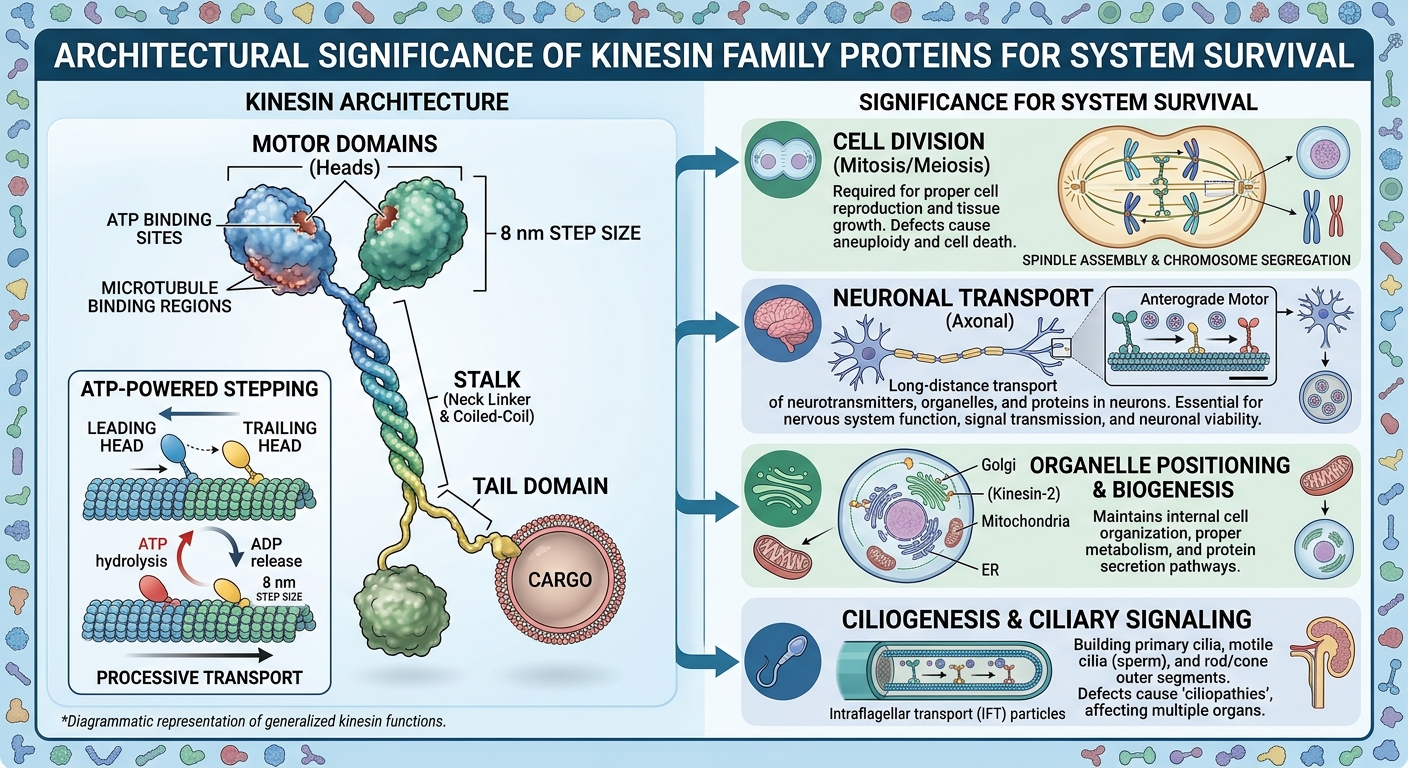
Schematic diagram of a kinesin-cargo complex
1.1 What is kinesin?
Kinesin is a family of motor proteins found in eukaryotic cells.
Eukaryotic cells include the cells of humans, animals, plants and fungi.
Kinesins perform mechanical work at the molecular level.
They generally move along microtubules, which are cylindrical structures forming part of the cell’s internal skeleton.
Their major responsibilities include:
- Transporting cellular materials.
- Distributing organelles.
- Supporting neuronal communication.
- Participating in cell division.
- Organising the internal architecture of cells.
- Helping maintain cellular organisation.
1.2 Why are they called molecular motors?
A motor converts energy into movement.
A conventional electric motor converts electrical energy into mechanical movement.
A kinesin motor converts chemical energy into mechanical movement.
The energy comes primarily from ATP.
This makes kinesin a biological nanomachine.
Comparison: three different motor systems
Electric motorElectrical energy → movement
Combustion engineChemical fuel → movement
KinesinATP energy → molecular movement
The important difference is scale: kinesin operates at the nanometre level, inside living cells.
Chapter 2. The molecular architecture of kinesin
A conventional kinesin-1 molecule contains several important structural regions.
2.1 The two motor heads
The motor heads are the most important mechanical components.
A conventional kinesin-1 has two motor domains.
Each head contains:
- An ATP-binding region.
- An ATP-hydrolysis catalytic region.
- A microtubule-binding surface.
- Structural elements that change their configuration during the movement cycle.
The heads coordinate their activities to produce directional movement.
2.2 The neck linker
The neck linker connects each motor head to the remaining protein structure.
It plays an important role in converting chemical changes associated with ATP into mechanical movement.
It also helps coordinate the alternating steps of the two motor heads.
2.3 The coiled-coil stalk
The stalk is a long structural region formed by two protein chains wrapping around each other.
Its responsibilities include:
- Supporting the overall molecular architecture.
- Connecting the motor region to the cargo-binding region.
- Helping maintain the dimeric structure.
2.4 The cargo-binding tail
The tail region helps kinesin associate with the material it transports.
Depending on the kinesin family member, the cargo may include:
- Vesicles.
- Mitochondria.
- Protein complexes.
- Membrane-bound organelles.
- Other cellular structures.
Cargo recognition frequently involves adaptor proteins that connect kinesin to its transported material.
Summary of the architecture
| Structural component | Primary function |
|---|---|
| Motor heads | ATP-powered movement |
| ATP-binding pocket | Recognises ATP |
| Neck linker | Coordinates mechanical stepping |
| Coiled-coil stalk | Structural connection |
| Tail | Cargo association |
| Adaptor proteins | Cargo recognition and regulation |
Important distinction: Not every kinesin has exactly this architecture. The kinesin family contains many members with different structural arrangements and biological responsibilities.
Chapter 3. The transportation infrastructure: microtubules
To understand kinesin, we must understand the transportation infrastructure on which it operates.
That infrastructure is called the microtubule network.
3.1 What are microtubules?
Microtubules are hollow cylindrical structures made from two proteins:
- Alpha-tubulin.
- Beta-tubulin.
These proteins assemble into repeating structures called tubulin dimers.
The dimers form long microtubule filaments.
Microtubules provide:
- Internal structural support.
- Transportation pathways.
- Organisation of organelles.
- Support for cell division.
- Organisation of cellular architecture.
3.2 Microtubule polarity
Microtubules have two different ends:
- Plus end (+).
- Minus end (−).
This polarity is extremely important because motor proteins recognise directional information along the microtubule.
Most conventional kinesin-1 molecules move towards the plus end.
Dynein, another family of motor proteins, generally moves towards the minus end.
Checking your browser – reCAPTCHA
This creates a two-direction transportation arrangement.
| Motor protein | General movement direction | Main role |
|---|---|---|
| Kinesin | Towards plus end | Outward transport in many cells |
| Dynein | Towards minus end | Inward transport in many cells |
The exact direction and destination depend on the organisation of microtubules in each cell.
Chapter 4. How kinesin converts ATP energy into movement
High-Resolution Microscope Watches Proteins Strut Their Stuff | The Scientist
This is one of the most fascinating mechanisms in molecular biology.
Kinesin does not have muscles, wheels or electrical wiring. Its movement is generated through changes in molecular structure.
4.1 Understanding ATP
ATP stands for adenosine triphosphate.
It is one of the principal energy-carrying molecules in living cells.
ATP consists of three major components:
- Adenine: a nitrogen-containing base.
- Ribose: a five-carbon sugar.
- Three phosphate groups.
When ATP is hydrolysed, it becomes ADP and inorganic phosphate, with free energy available to drive cellular processes.
\[ ATP + H_2O \rightarrow ADP + P_i \]
The energy released by this reaction is coupled to changes in the kinesin motor domain.
4.2 The walking mechanism
In conventional kinesin-1, two motor heads coordinate their movements.
The general cycle involves:
- One head attaches strongly to the microtubule.
- ATP binding changes the motor head’s conformation.
- The neck linker changes configuration, helping position the other head forward.
- ATP hydrolysis and phosphate release alter the interactions between the motor and microtubule.
- The heads alternate their attachment and movement.
This produces a coordinated walking mechanism.
A conventional kinesin-1 typically advances approximately 8 nanometres per step, corresponding to one tubulin-dimer spacing along a protofilament.
4.3 Why this is scientifically extraordinary
A molecule measuring only tens of nanometres can transport cargo over distances vastly greater than its own size.
This is an example of molecular-scale mechanical engineering.
The cell achieves movement through:
- Chemical energy.
- Protein structure.
- Molecular interactions.
- Mechanical force.
- Precisely regulated timing.
Chapter 5. The major kinesin families and their responsibilities
Thread by @Innov_Medicine on Thread Reader App – Thread Reader App
The kinesin family is not one single machine. It is a large group of specialised molecular motors.
Humans have approximately 45 kinesin-related genes, grouped into different subfamilies, although classification and gene counts depend on the species and classification system. PubMed Central (PMC)+1
Some important members include:
| Kinesin | Major biological responsibility |
|---|---|
| KIF5 | Transport of cellular cargo, including neuronal cargo |
| KIF1A | Transport of synaptic vesicle precursors |
| KIF1B | Transport of selected cellular materials, including mitochondrial-related cargo |
| KIF3 | Transport associated with cilia and other cellular structures |
| KIF11 | Separation and organisation of spindle microtubules during cell division |
| KIF4 | Chromosome organisation and cellular transport |
| KIF2 | Regulation and disassembly of microtubules |
| KIF7 | Regulation of Hedgehog signalling and developmental processes |
These functions are not necessarily exclusive. Individual kinesins can have multiple roles depending on cell type and biological conditions.
5.1 KIF5: the transportation specialist
KIF5 proteins are particularly important in neurons.
They transport materials from the cell body towards distant regions of the neuron.
These materials include:
- Mitochondria.
- Membrane vesicles.
- Proteins.
- Components required for synaptic function.
5.2 KIF1A: neuronal transportation
KIF1A is particularly important for transporting synaptic vesicle precursors and other neuronal cargo.
This matters because neurons have long extensions called axons.
Some axons extend over considerable distances, making internal transportation essential.
5.3 KIF3: cilia and cellular organisation
Some KIF3 proteins participate in intraflagellar transport.
This is the movement of molecular components along the internal microtubule structures of cilia and flagella.
Cilia have important functions in sensing and signalling, as well as movement of fluids in certain tissues.
5.4 KIF11: cell division
KIF11 is also called Eg5.
It helps organise the mitotic spindle, a structure responsible for separating chromosomes during cell division.
Without properly organised spindle structures, accurate chromosome separation can be disrupted.
5.5 KIF7: developmental signalling
KIF7 participates in the regulation of Hedgehog signalling.
This signalling pathway helps control embryonic development, tissue organisation and the formation of different body structures.
Chapter 6. Kinesin and the human brain
Physiology, Neurons, Nervous system anatomy
8
This is perhaps one of the most important areas for understanding kinesin’s contribution to human survival.
The brain contains billions of neurons.
A neuron has three principal structural regions:
- Cell body.
- Dendrites.
- Axon.
The axon can be extremely long compared with the size of its cell body.
This creates a major biological transportation challenge.
6.1 The transportation problem inside neurons
Imagine a neuron whose cell body is located far from its communication terminal.
The terminal requires a continuous supply of:
- Mitochondria.
- Synaptic vesicles.
- Membrane proteins.
- Enzymes.
- Structural proteins.
- Molecular signalling components.
These materials must reach their destinations.
Kinesin motors help transport many of them along microtubules.
6.2 Kinesin and communication between neurons
Neurons communicate through specialised junctions called synapses.
At a chemical synapse, neurotransmitters are released from synaptic vesicles.
Kinesin supports the delivery of materials required to maintain synaptic structures and function.
This contributes indirectly to:
- Learning.
- Memory formation.
- Sensory processing.
- Movement coordination.
- Communication throughout the nervous system.
Kinesin does not itself create thoughts or memories. Rather, it supports the cellular infrastructure that allows neurons to remain functional.
6.3 Why neuronal transportation is so important
Neurons cannot simply depend on random diffusion to supply every distant region.
They require organised long-distance transportation.
This is why kinesin and dynein work together in neuronal cells.
Kinesin generally supports transport towards the axon terminal, while dynein helps return selected materials towards the cell body.NCBI+2
Chapter 7. Kinesin and mitochondrial energy production
Biology: The Electron Transport Chain Infographic | LivePhysics™
Mitochondria are specialised organelles responsible for much of the energy production in human cells.
They generate ATP through cellular respiration, particularly oxidative phosphorylation.
But mitochondria must also be distributed to locations where energy is needed.
7.1 Why mitochondrial transportation matters
Consider a long neuron.
Its distant axon terminals require energy to support:
- Electrical signalling.
- Ion balance.
- Synaptic activity.
- Maintenance of cellular structures.
Mitochondria must be positioned appropriately to support these energy demands.
Kinesins, together with dynein and other regulatory proteins, participate in mitochondrial transport.
7.2 The energy relationship
There is an interesting relationship between these systems:
Energy production
MitochondriaGenerate ATP through cellular respiration
ATPProvides chemical energy for molecular motors
KinesinConverts chemical energy into mechanical movement
Cellular transportationMoves selected materials to required locations
Biological outcome
Cellular maintenance and function
This demonstrates how energy production and molecular transportation are interconnected.
An important scientific distinction: mitochondria help supply cellular energy, but kinesin is powered by ATP rather than generating ATP itself.
Chapter 8. Kinesin and cell division: maintaining biological continuity
Mechanism and regulation of kinesin motors | Nature Reviews Molecular Cell Biology
Human survival depends on the ability of cells to grow, divide, repair and replace themselves.
Examples include:
- Skin-cell renewal.
- Formation of blood cells.
- Growth during childhood.
- Tissue development.
- Replacement of damaged cells.
Kinesins participate in the machinery responsible for organising cell division.
8.1 Understanding the mitotic spindle
The mitotic spindle is a specialised structure made primarily from microtubules.
It helps organise and separate duplicated chromosomes during cell division.
Some kinesins:
- Organise spindle microtubules.
- Slide microtubules against one another.
- Control spindle length and organisation.
- Help position chromosomes.
- Regulate microtubule growth and disassembly.
8.2 The significance of KIF11
KIF11 is particularly important because it helps separate the two spindle poles during mitosis.
This allows the cell to establish the organisation required for chromosome separation.
The broader biological significance is that accurate cell division is essential for development, tissue maintenance and reproduction.
Chapter 9. Kinesin and the immune system
The immune system is a complicated network of cells, proteins, tissues and signalling molecules.
Its responsibilities include identifying threats, coordinating immune responses and maintaining tissue protection.
Kinesins contribute to cellular organisation and transportation in immune cells.
For example, immune cells require internal movement of:
- Signalling proteins.
- Membrane receptors.
- Secretory vesicles.
- Organelles.
- Components involved in cellular communication.
These processes support the ability of immune cells to respond to their environment.
However, kinesins are not immune-system controllers. They are part of the molecular machinery that helps immune cells function.
The relationship is important because the immune system depends on properly organised intracellular processes.
Chapter 10. What happens when kinesin transportation malfunctions?
Microtubule Motor Proteins | BioRender Science Templates
A transportation network is only effective when its components operate correctly.
The same principle applies to the cellular transportation system.
Kinesin dysfunction can arise through genetic changes, altered protein regulation, abnormal cargo attachment or disruption of microtubule tracks.
10.1 Neurological disorders
Certain genetic alterations affecting kinesin proteins are associated with neurological and developmental disorders.
Examples include:
| Kinesin protein | Biological significance of dysfunction |
|---|---|
| KIF1A | Associated with neurological and neurodevelopmental disorders |
| KIF5A | Associated with certain hereditary neurological conditions |
| KIF5C | Associated with some neurodevelopmental disorders |
| KIF2A | Associated with abnormal brain development |
| KIF11 | Associated with microcephaly and developmental abnormalities |
| KIF7 | Associated with developmental disorders involving Hedgehog signalling |
These are complex genetic conditions. A change in a kinesin gene does not automatically mean that someone will develop a particular disorder.
10.2 Why neurons are particularly vulnerable
Neurons have long cellular extensions.
Their transportation requirements are therefore especially demanding.
When intracellular transportation becomes impaired, neurons may struggle to maintain distant axonal regions and synapses.
This is one reason kinesin research is important in understanding certain neurological diseases.
10.3 Kinesin and cancer research
Kinesins are also important in cancer research.
For example, KIF11 participates in mitotic spindle organisation.
Researchers have investigated whether disrupting particular kinesin activities could interfere with the rapid division of certain cancer cells.
This has contributed to the development and investigation of experimental and clinical drug approaches targeting mitotic motor proteins.
However, kinesins also perform essential functions in normal cells. Targeting them requires careful consideration of effectiveness and toxicity.Nature+2
Chapter 11. How the kinesin system is regulated
Kinesin does not simply transport everything continuously.
Its activity must be controlled.
The cell regulates when a motor becomes active, what cargo it carries, where it moves and when it releases its cargo.
11.1 Important regulatory mechanisms
| Regulatory mechanism | Function |
|---|---|
| ATP availability | Supplies energy for motor activity |
| Adaptor proteins | Connect motors to cargo |
| Phosphorylation | Changes protein activity and interactions |
| Calcium signalling | Influences certain cellular transport processes |
| Microtubule-associated proteins | Influence track organisation and accessibility |
| Autoinhibition | Keeps certain kinesins inactive until required |
| Cargo-binding regulation | Controls which materials are transported |
11.2 Autoinhibition: the biological standby mechanism
Some kinesin proteins can fold into configurations that reduce their motor activity.
This is called autoinhibition.
When appropriate cellular signals and cargo interactions occur, the motor can become activated.
This is an important energy-management principle.
It prevents certain motors from operating unnecessarily.
11.3 The transportation network is coordinated
Kinesin does not operate independently.
It interacts with:
- Dynein.
- Microtubules.
- Tubulin.
- Adaptor proteins.
- Cargo proteins.
- Cellular signalling systems.
- ATP-producing metabolic pathways.
This interconnected architecture makes intracellular transport a regulated biological network rather than a simple movement mechanism.Nature+1
Chapter 12. The complete relationship between kinesin and human survival
Let us connect the different biological systems.
Animal Cell Diagram Generator — Labeled & Unlabeled | SciFig
The following table summarises the relationship.
| Biological system | Contribution of kinesin |
|---|---|
| Nervous system | Supports neuronal intracellular transport |
| Brain | Helps maintain neuronal structures and synaptic machinery |
| Muscular system | Supports intracellular distribution of selected cellular materials |
| Mitochondrial system | Participates in mitochondrial positioning and transport |
| Cell division | Helps organise mitotic spindle structures |
| Development | Supports cellular processes required for tissue development |
| Immune system | Contributes to intracellular organisation in immune cells |
| Cilia | Certain kinesins support intraflagellar transport |
| Cellular maintenance | Supports distribution of proteins and organelles |
The five major survival principles
1. Distribution: Essential materials must reach the correct cellular locations.
2. Energy utilisation: ATP must be converted into useful mechanical work.
3. Communication: Neurons and other cells require properly maintained structures and signalling machinery.
4. Development: Cells need organised molecular transportation to grow and differentiate.
5. Maintenance: Cellular structures must be continuously maintained and renewed.
Kinesin contributes to all these principles through different members of its protein family.
Chapter 13. The relationship between kinesin, biotechnology and the modern economy
Cryo-EM’s renaissance: NERSC resources help illuminate human molecular machinery
9
Kinesin research has significance beyond understanding human biology.
It is contributing to several areas of modern scientific and technological development.
13.1 Molecular medicine
Understanding kinesin mutations can help researchers investigate the molecular causes of neurological and developmental disorders.
13.2 Drug discovery
KIF11 and other kinesins provide important research targets for studying cell division and potential cancer treatments.
13.3 Biotechnology
Scientists study kinesin motors to understand how biological molecules can generate controlled movement.
This knowledge is relevant to molecular engineering and experimental nanotechnology.
13.4 Advanced microscopy
Researchers use fluorescence microscopy, cryo-electron microscopy and other advanced techniques to investigate the structure and movement of kinesins.
13.5 Synthetic molecular machines
One long-term scientific ambition is to use biological motor proteins in engineered systems.
Potential research areas include:
- Molecular-scale cargo transportation.
- Programmable molecular assemblies.
- Biosensing systems.
- Experimental nanotechnology.
- Biomolecular manufacturing.
These applications remain at different stages of research; they are not yet equivalent to mature industrial transportation technologies.
Chapter 14. Kinesin compared with a modern transportation network
One way to understand the entire kinesin system is to compare it with the infrastructure of a modern city.
| Modern transportation infrastructure | Biological equivalent |
|---|---|
| Roads and railway tracks | Microtubules |
| Trucks and locomotives | Kinesin motor proteins |
| Electricity and fuel | ATP energy |
| Cargo containers | Cellular cargo |
| Distribution centres | Cellular compartments |
| Traffic management | Molecular regulation |
| Delivery destinations | Cellular structures |
This analogy helps explain the architecture, but there is an important difference: kinesin is not an externally controlled vehicle. It is a molecular machine whose operation emerges from chemical interactions and biological regulation.
Chapter 15. Ten fundamental scientific lessons from kinesin
- Molecular engineering: Nature produces sophisticated mechanical machines from proteins.
- Energy conversion: Chemical energy can be converted into mechanical movement.
- Biological organisation: Cells require structured internal transportation.
- Specialisation: Different kinesins perform different biological responsibilities.
- Neuronal maintenance: Long-distance cellular transportation is essential for neuronal function.
- Energy distribution: Mitochondrial positioning helps support local energy requirements.
- Cell reproduction: Kinesins participate in the machinery of cell division.
- Genetic importance: Kinesin genes influence important biological processes.
- Molecular regulation: Transportation must be controlled according to cellular requirements.
- Scientific innovation: Understanding molecular motors creates opportunities for future biotechnology.
Chapter 16. Important scientific research questions
For advanced study, the following questions provide an excellent research foundation:
- How does ATP hydrolysis produce directional movement?
- How do two kinesin motor heads coordinate their movements?
- How do kinesins recognise specific cargo?
- How does microtubule polarity determine transportation direction?
- Why are certain neurons particularly dependent on kinesin?
- How do kinesins and dyneins coordinate their activities?
- How does mitochondrial positioning affect neuronal function?
- How do genetic mutations change kinesin motor activity?
- Can engineered molecular motors improve biotechnology?
- How can researchers develop better treatments for diseases involving defective intracellular transport?
These questions connect biochemistry, molecular biology, genetics, physics, medicine and engineering.
Final conclusion: Why kinesin matters to human survival
Questa famosa animazione mostra davvero com’è la “felicità”?
The kinesin family represents one of the most extraordinary examples of biological engineering.
At the microscopic level, human cells operate sophisticated transportation networks. These networks distribute materials, position organelles, maintain cellular structures and support communication.
Kinesins help make these processes possible.
Without properly functioning intracellular transportation, many cells would struggle to maintain their normal organisation and biological activities.
The most important lesson is this:
Human survival is not dependent only on the organs we can see. It also depends on millions of molecular processes taking place continuously inside microscopic cells.
Kinesin is one of the molecular machines that helps connect energy, movement and cellular organisation.
Understanding kinesin therefore helps us understand a deeper principle of life: biological survival depends on the coordinated operation of molecular systems.
Scientific reference library
For further academic study, these are valuable scientific publications and resources:
- Mechanism and Regulation of Kinesin Motors — Ahmet Yildiz, 2025. Read scientific review.
- The Developmental Biology of Kinesins — 2021. Read full research article.
- Kinesin Superfamily Motor Proteins and Intracellular Transport — Hirokawa and colleagues. Read publication.
- Molecular Motors: Kinesin, Dynein and Myosin — Read textbook chapter.
- Molecular Motors — Read educational resource.
Recommended next scientific subject
A particularly valuable continuation would be Dynein Family Proteins: Their Molecular Architecture, ATP Energy Conversion, Reverse Transportation Mechanisms and Significance in Human Survival.
Studying kinesin and dynein together will give you a much more complete understanding of the internal transportation architecture of the human cell.

Be First to Comment