
Abstract
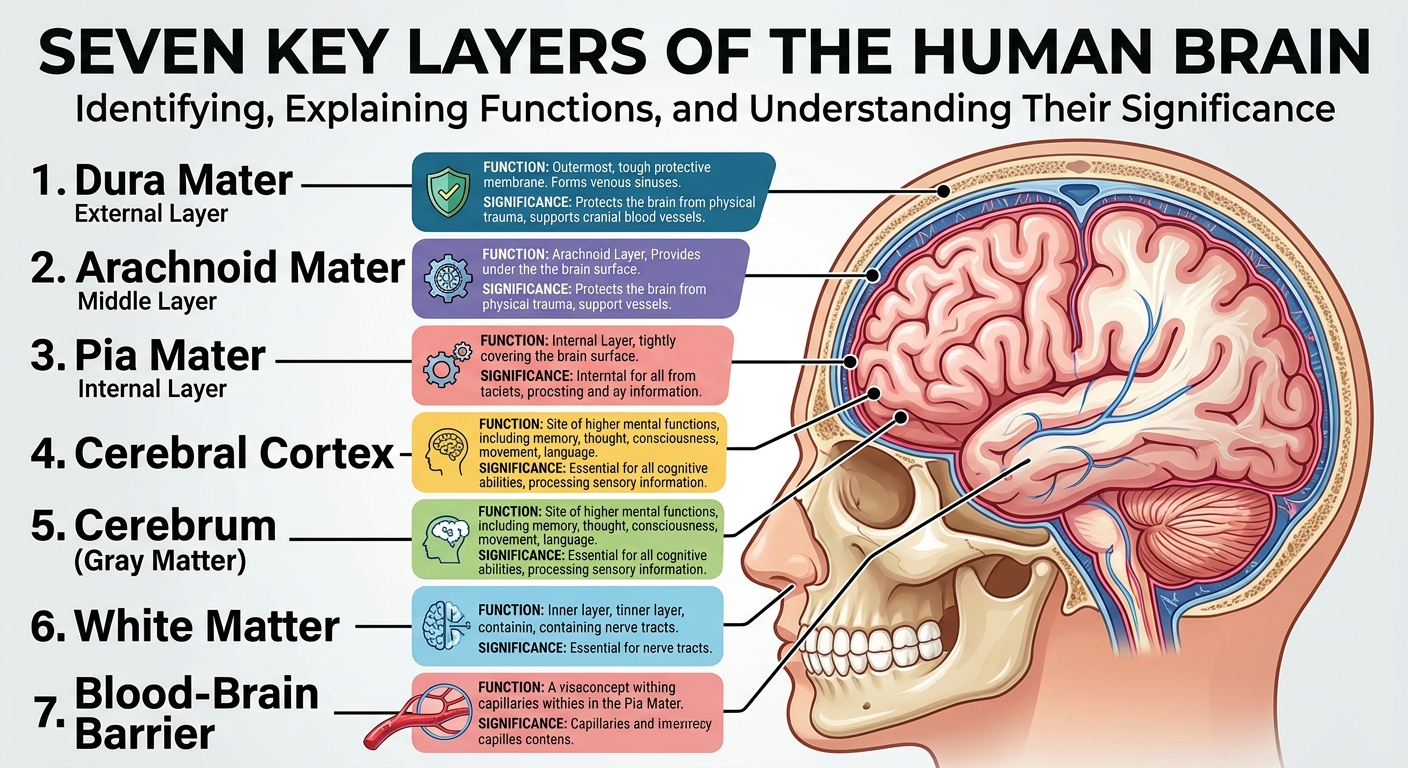
The human brain is not literally arranged as seven simple layers from the outside inward. Rather, it is a highly organized biological system containing several anatomical regions, tissue layers, protective coverings, developmental layers, and functional networks.
For educational purposes, however, the brain can be understood through seven major structural/functional layers or organizational levels:
- Scalp and skull — external protection
- Meninges — protective membranes
- Cerebral cortex — conscious processing
- Subcortical white matter — communication network
- Basal ganglia — movement and action-selection system
- Limbic and diencephalic structures — emotion, memory and regulation
- Brainstem and cerebellum — vital control, coordination and balance
These should not be confused with the six-layer microscopic structure of the neocortex, which is a different classification.
1. Introduction: The Brain as a Biological Information System
The human brain contains approximately 86 billion neurons, together with enormous numbers of supporting glial cells. These cells communicate through electrical and chemical signals.
The brain performs several fundamental operations:
- receives information from the senses;
- interprets information;
- stores and retrieves memories;
- generates movement;
- regulates internal body functions;
- produces emotions;
- supports language;
- enables reasoning and decision-making;
- regulates attention and consciousness;
- coordinates interaction with the environment.
A useful way to understand the brain is to think of it as a hierarchical information-processing architecture.
                 HUMAN BRAIN
                     │
        ┌────────────┴────────────┐
        │                         │
   PROTECTION                 PROCESSING
        │                         │
   Skull/Meninges        ┌────────┼────────┐
                         │        │        │
                      Cortex   Subcortex  Brainstem
                         │        │        │
                     Thinking   Emotion   Survival
                     Memory     Movement  Autonomic
                     Language   Learning  Functions
2. Layer 1 — Skull and External Protection
Name
Cranium/skull
The skull is the hard bony structure surrounding the brain.
Although the skull is not technically a “brain layer,” it is the brain’s first major protective boundary.
Main functions
The skull:
- protects the brain from physical impact;
- provides structural support;
- separates the brain from surrounding tissues;
- protects major blood vessels entering the cranial cavity;
- provides attachment points for muscles and membranes.
The brain itself is extremely soft. Without the skull and other protective structures, ordinary mechanical forces could cause serious injury.
Significance
The skull demonstrates an important biological principle:
A highly sophisticated information-processing organ requires equally sophisticated physical protection.
3. Layer 2 — The Meninges
Immediately inside the skull are three protective membranes collectively called the meninges.
They are:
- Dura mater
- Arachnoid mater
- Pia mater
3.1 Dura Mater
The dura mater is the tough outer membrane.
It provides mechanical protection and helps stabilize the brain inside the skull.
3.2 Arachnoid Mater
The arachnoid membrane lies beneath the dura.
Between the arachnoid and pia mater is the subarachnoid space, which contains cerebrospinal fluid.
3.3 Pia Mater
The pia mater is a delicate membrane closely attached to the brain’s surface.
It follows the contours of the brain, including many of its folds.
Cerebrospinal fluid
The spaces surrounding the brain contain cerebrospinal fluid (CSF).
CSF helps:
- cushion the brain;
- provide buoyancy;
- maintain the chemical environment;
- transport certain substances;
- assist waste clearance.
4. Layer 3 — Cerebral Cortex
The cerebral cortex is the outer layer of gray matter covering the cerebrum.
It is one of the most important structures associated with human cognition.
The cortex contains billions of neurons organized into interconnected circuits.
It is divided broadly into:
- frontal lobe;
- parietal lobe;
- temporal lobe;
- occipital lobe;
- insular cortex.
Major functions
Frontal cortex
Associated with:
- planning;
- decision-making;
- voluntary movement;
- working memory;
- attention;
- language production;
- behavioral regulation.
Parietal cortex
Important for:
- touch;
- body awareness;
- spatial processing;
- integration of sensory information.
Temporal cortex
Important for:
- hearing;
- language comprehension;
- memory;
- recognition;
- aspects of emotion.
Occipital cortex
Primarily processes:
- visual information;
- shape;
- motion;
- color;
- spatial visual information.
Insular cortex
Participates in:
- internal body awareness;
- taste;
- pain processing;
- emotional processing;
- integration of bodily states.
5. The Cortex Is Highly Folded
The brain surface contains:
- gyri — raised folds;
- sulci — grooves;
- fissures — deeper separations.
Folding allows a much larger cortical surface to fit inside the skull.
This is an extraordinary example of biological spatial engineering.
Unfolded surface
──────────────────────────────
██████████████████████████████
██████████████████████████████

Folded surface
╭─╮╭────╮╭───╮╭────╮
╰─╯╰────╯╰───╯╰────╯
The increased surface area allows extensive neural circuitry without requiring an enormous skull.
6. Layer 4 — Subcortical White Matter
Beneath the cortical gray matter lies a large network of white matter.
White matter consists primarily of nerve fibers, especially axons, many of which are surrounded by myelin.
Myelin helps electrical signals travel efficiently along axons.
White matter as the brain’s communication infrastructure
A useful analogy is:
Gray matter = major processing stations
White matter = communication highways
White matter connects:
- different cortical regions;
- the two cerebral hemispheres;
- cortex and deeper brain structures;
- brain regions with the spinal cord.
Important pathways
Examples include:
- corpus callosum;
- internal capsule;
- projection fibers;
- association fibers;
- commissural fibers.
The corpus callosum connects the left and right cerebral hemispheres.
7. Layer 5 — Basal Ganglia
Deep inside the cerebral hemispheres are interconnected structures collectively known as the basal ganglia.
Major components include:
- caudate nucleus;
- putamen;
- globus pallidus.
Related structures include the substantia nigra and subthalamic nucleus.
Major functions
The basal ganglia participate in:
- movement initiation;
- movement selection;
- movement suppression;
- habit learning;
- procedural learning;
- reward-related behavior;
- action selection.
They do not simply “control movement.” They help the brain determine which actions should be facilitated and which should be inhibited.
Example
When a person reaches for an object:
INTENTION
   ↓
Motor planning
   ↓
Basal ganglia
   ↓
Action selection
   ↓
Motor cortex
   ↓
Spinal cord
   ↓
Muscles
   ↓
Movement
This demonstrates that movement is a coordinated network operation rather than the work of a single brain region.
8. Layer 6 — Limbic and Diencephalic Systems
This level contains several deep structures that are extremely important for emotion, memory, motivation and internal regulation.
Important structures include:
- hippocampus;
- amygdala;
- hypothalamus;
- thalamus.
These structures do not form one literal anatomical “layer”; they are grouped here as a functional level.
8.1 Hippocampus
The hippocampus is strongly involved in:
- formation of new memories;
- spatial navigation;
- organization of contextual information;
- learning.
It is particularly important for converting certain forms of newly experienced information into longer-lasting memories.
8.2 Amygdala
The amygdala participates in:
- emotional processing;
- threat detection;
- emotional learning;
- assigning significance to experiences.
It does not simply produce “fear.” It participates in broader networks that evaluate emotionally important information.
8.3 Thalamus
The thalamus is a major information-relay structure.
It communicates extensively with the cerebral cortex.
Many sensory pathways pass through or interact with thalamic circuits before reaching the cortex.
The thalamus also participates in:
- attention;
- consciousness;
- motor regulation;
- information integration.
8.4 Hypothalamus
The hypothalamus is relatively small but extraordinarily important.
It helps regulate:
- body temperature;
- hunger;
- thirst;
- sleep-wake rhythms;
- endocrine functions;
- autonomic activity;
- reproductive physiology;
- energy balance.
It links nervous-system activity with the endocrine system, particularly through its relationship with the pituitary gland.
9. Layer 7 — Brainstem and Cerebellum
This final organizational level contains structures essential for survival, movement and coordination.
Brainstem
The brainstem consists of:
- midbrain
- pons
- medulla oblongata
It connects the brain with the spinal cord.
Brainstem functions
The brainstem participates in:
- breathing;
- cardiovascular regulation;
- consciousness and arousal;
- swallowing;
- protective reflexes;
- eye movements;
- communication between brain and spinal cord.
Some cranial nerves also emerge from the brainstem.
10. Cerebellum
The cerebellum is located behind the brainstem.
Its major functions include:
- coordination of movement;
- balance;
- posture;
- motor learning;
- timing and precision of movements.
The cerebellum does not simply “make muscles move.”
Instead, it helps compare intended and actual movements and contributes to correcting movement errors.
A simplified model is:
Intended movement
       ↓
Motor commands
       ↓
   Movement
       ↓
Sensory feedback
       ↓
   Cerebellum
       ↓
Error correction
       ↓
Improved movement
This feedback architecture is fundamental to skilled movement.
11. An Important Distinction: The Six Microscopic Layers of the Neocortex
There is another meaning of “brain layers” that is particularly important in neuroscience.
The neocortex is traditionally described as having six cellular layers.
They are numbered from the surface inward:
| Layer | Common name | General role |
|---|---|---|
| I | Molecular layer | Local connections and dendritic/axonal interactions |
| II | External granular layer | Local cortical processing |
| III | External pyramidal layer | Cortical-to-cortical communication |
| IV | Internal granular layer | Major input layer for many sensory cortices |
| V | Internal pyramidal layer | Major output to subcortical structures |
| VI | Multiform layer | Communication with thalamus and other regions |
These six layers are microscopic cellular layers, not the seven large anatomical/functional levels described earlier.
This distinction is essential.
12. How the Seven Organizational Levels Work Together
The brain should not be imagined as seven independent compartments.
It operates as a massively interconnected network.
For example, consider learning a new mathematical concept.
Sensory information
        ↓
   Thalamic systems
        ↓
      Cortex
        ↓
Attention + working memory
        ↓
 Hippocampal systems
        ↓
 Memory formation
        ↓
 Cortical networks
        ↓
Long-term knowledge
At the same time:
Hypothalamus
     ↓
Arousal / physiological state
     ↓
Attention and motivation

Basal ganglia
     ↓
Action selection

Cerebellum
     ↓
Timing and coordination
Therefore, learning is not located in one “learning layer.”
It is an emergent property of interacting neural networks.
13. Brain Information Architecture
The entire system can be summarized as:
                 HUMAN BRAIN
                     │
          ┌──────────┴──────────┐
          │                     │
      PROTECTION             PROCESSING
          │                     │
    Skull + meninges            │
                                │
             ┌──────────────────┼─────────────────┐
             ↓                  ↓                 ↓
          CORTEX            SUBCORTEX         BRAINSTEM
             │                  │                 │
       perception           emotion          survival
       reasoning            memory           autonomic
       language             movement         functions
       planning             motivation
             │                  │
             └──────────┬───────┘
                        ↓
                  INTEGRATED
                 BRAIN NETWORK
                        ↓
              BEHAVIOUR + ACTION
14. Significance of the Brain’s Layered Architecture
The layered organization provides several major advantages.
14.1 Protection
The skull, meninges and cerebrospinal fluid protect delicate neural tissue.
14.2 Information processing
The cortex provides enormous computational capacity.
14.3 Communication
White matter allows distant brain regions to communicate rapidly.
14.4 Regulation
Deep structures regulate physiological states and internal balance.
14.5 Movement
Basal ganglia, motor cortex, cerebellum, brainstem and spinal pathways cooperate to produce controlled movement.
14.6 Memory
Memory emerges from coordinated activity involving multiple regions, particularly cortical and hippocampal networks.
14.7 Consciousness
Conscious experience depends on complex interactions involving cortical and subcortical systems rather than one isolated anatomical structure.
15. The Brain as a Biological Computer
The analogy between the brain and a computer can be useful, provided we remember that the brain is not literally a digital computer.
A simplified comparison is:
| Biological brain | Computing analogy |
|---|---|
| Neurons | Processing elements |
| Synapses | Adjustable connections |
| Axons | Communication pathways |
| White matter | Network infrastructure |
| Cortex | Distributed processing |
| Hippocampus | Memory formation system |
| Thalamus | Information-routing hub |
| Basal ganglia | Action-selection system |
| Cerebellum | Error-correction/coordination system |
| Brainstem | Essential control infrastructure |
But there is a fundamental difference.
A conventional computer generally uses explicitly engineered digital logic, whereas the brain is a living, adaptive, self-organizing biological network.
16. Neuroplasticity: The Brain Can Change
One of the most important discoveries in modern neuroscience is neuroplasticity.
Neural circuits can change through:
- learning;
- experience;
- development;
- repeated practice;
- environmental interaction;
- recovery after some forms of injury.
Synaptic connections can strengthen or weaken.
Therefore:
The brain’s architecture is relatively stable at the large anatomical level but dynamically changing at the microscopic and network levels.
This is one reason education and experience can have long-lasting effects on neural function.
17. The Brain and Human Intelligence
Human intelligence does not reside in one particular “layer.”
It emerges from interactions among:
- perception;
- attention;
- memory;
- language;
- reasoning;
- learning;
- executive control;
- emotion;
- motivation;
- decision-making;
- social cognition.
The cerebral cortex is particularly important for complex cognition, but cognition depends upon communication with deeper brain structures.
18. The Brain as a Hierarchical Network
A powerful way to understand the entire system is as a hierarchy:
Level 1 — Protection
Skull → meninges → CSF
Level 2 — Reception and processing
Sensory systems → cortex
Level 3 — Communication
White matter → long-distance neural pathways
Level 4 — Action selection
Basal ganglia → selection and regulation of actions
Level 5 — Emotion and memory
Limbic/diencephalic networks → memory, motivation and internal regulation
Level 6 — Coordination
Cerebellum → timing, balance and motor correction
Level 7 — Vital integration
Brainstem → breathing, cardiovascular regulation, arousal and communication with spinal cord
These levels continuously interact rather than operating sequentially.
19. Final Scientific Perspective
The most important lesson is that the human brain does not have seven literal layers like a seven-layer cake.
There are several different ways neuroscientists classify its organization:
Macroscopic anatomy
- cerebrum;
- diencephalon;
- brainstem;
- cerebellum.
Protective anatomy
- skull;
- dura mater;
- arachnoid mater;
- pia mater;
- cerebrospinal fluid.
Microscopic cortical anatomy
- six neocortical layers.
Functional organization
- sensory networks;
- motor networks;
- cognitive networks;
- emotional networks;
- memory networks;
- autonomic networks.
Consequently, the most scientifically accurate understanding is that the brain is a three-dimensional, interconnected, hierarchical biological network, rather than a simple stack of layers.
The central principle
The remarkable power of the human brain comes not merely from the number of neurons, but from the enormous complexity, organization, adaptability and communication among its neural networks.
This architecture allows humans to transform electrical and chemical signals into perception, memory, thought, emotion, movement, language, learning and conscious experience.






Be First to Comment