
Abstract
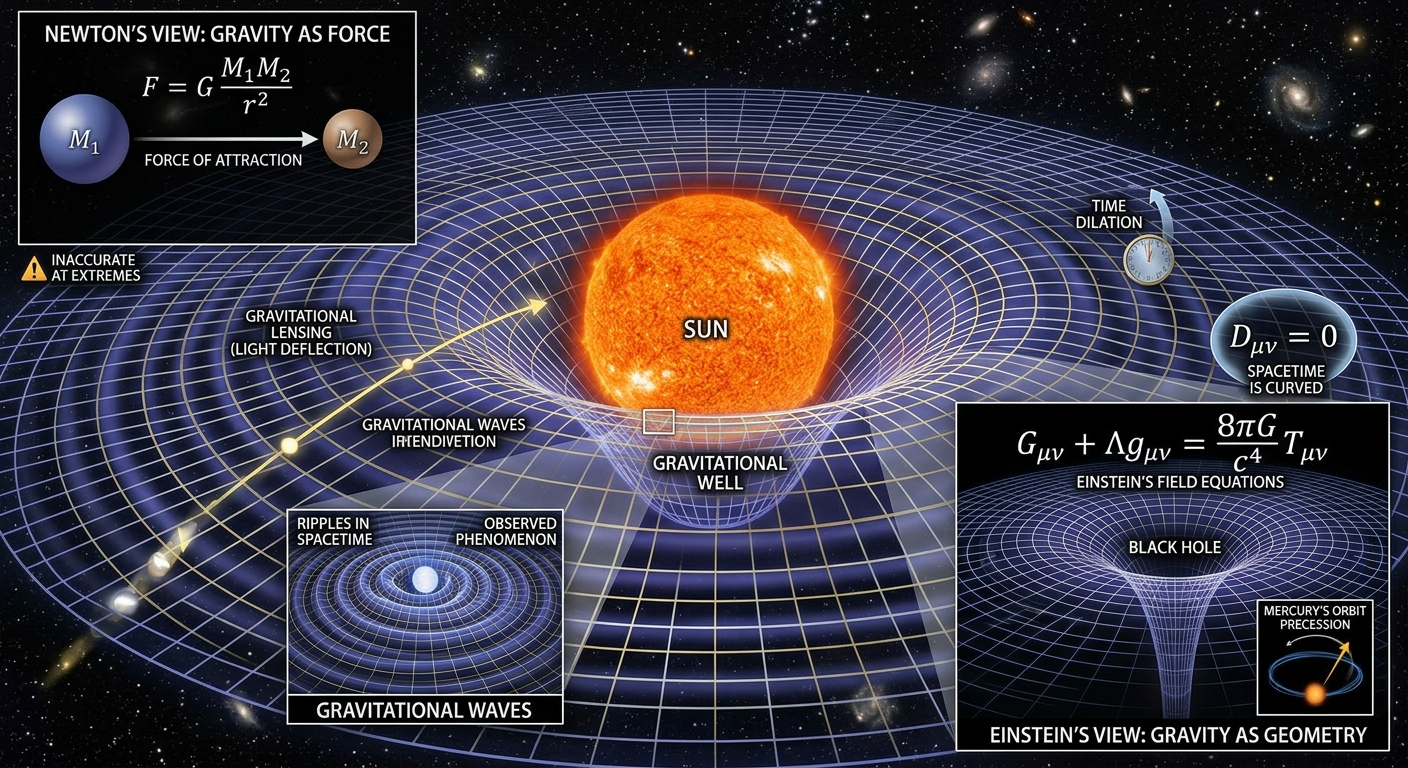
The modern law of gravity is our scientific understanding of how matter, energy, space, and time interact to produce what we experience as gravity. In classical physics, gravity was described by Isaac Newton as a force of attraction between masses. In modern physics, especially through Albert Einstein’s general theory of relativity, gravity is understood more fundamentally as the curvature of spacetime caused by mass and energy.
This does not mean that Newton’s law is wrong. Newtonian gravity remains extraordinarily useful for ordinary situations such as calculating the motion of objects near Earth, designing buildings and bridges, predicting many planetary orbits, and launching satellites. Einstein’s theory provides a deeper description that becomes essential when gravity is very strong, objects move extremely rapidly, or very high precision is required.
At the frontier of physics, scientists are still seeking a complete theory that reconciles gravity with quantum mechanics. Consequently, the “modern law of gravity” is best understood as a hierarchy of theories: Newtonian gravitation for weak fields and everyday scales, general relativity for relativistic gravity, and ongoing research toward quantum gravity for the deepest level of nature.
1. What Does the Law of Gravity Mean?
At its simplest, gravity describes the relationship between mass-energy and motion through the universe.
A traditional statement is:
Every object with mass attracts other objects with mass.
Newton expressed this mathematically as:
where:
- = gravitational force
- = gravitational constant
- = masses of the two objects
- = distance between their centers of mass
The equation tells us several important things:
- Increasing either mass increases gravitational attraction.
- Increasing the distance decreases the attraction.
- The decrease follows an inverse-square relationship.
- Gravity acts universally between masses.
However, this is the Newtonian approximation. Modern physics goes further.
2. From Newton’s Gravity to Einstein’s Gravity
The great conceptual change occurred in the early twentieth century.
Newton’s picture
Newton imagined gravity as a force acting between bodies.
For example:
Sun → gravitational attraction → Earth
This model successfully explained much of celestial mechanics.
Einstein’s picture
Einstein’s general relativity replaced the idea of gravity as simply a conventional force with a geometric description.
Mass and energy influence the geometry of spacetime, and objects move through that curved spacetime.
A simplified conceptual relationship is:
and
This is one of the deepest ideas in modern physics.
3. What Is Spacetime?
Modern gravity cannot be understood completely without understanding spacetime.
Before Einstein, space and time were commonly treated as separate concepts.
Relativity combines them into a four-dimensional structure:
An object’s position is therefore described not simply by:
but by:
Gravity affects the geometry of this four-dimensional spacetime.
4. Einstein’s Field Equation
The central mathematical expression of general relativity is Einstein’s field equation:
This equation is extremely compact, but its meaning is profound.
Very roughly:
The terms describe aspects of spacetime curvature, the cosmological constant, and the distribution of matter and energy.
A useful conceptual translation is:
Matter and energy tell spacetime how to curve, while curved spacetime tells matter and energy how to move.
This is a much deeper description than simply saying “objects attract each other.”
5. Is Gravity Actually a Force?
This is one of the most important questions.
In Newtonian mechanics:
Gravity is a force.
For example:
near Earth’s surface.
In general relativity:
Gravity is fundamentally associated with spacetime geometry.
An object freely falling under gravity is, in an important sense, following the natural path allowed by curved spacetime.
This produces an interesting result:
A person falling freely toward Earth does not experience their own weight in the same way that a person standing on the ground does.
The ground prevents the person from following their natural free-fall trajectory.
This is connected to Einstein’s equivalence principle.
6. Why Do We Feel Weight?
Suppose you stand on Earth’s surface.
Earth’s gravity causes your natural free-fall path to curve toward Earth’s center.
But the ground pushes upward against your feet.
That support force produces what you perceive as weight.
This gives an important distinction:
An astronaut orbiting Earth is still strongly affected by Earth’s gravity. The astronaut appears weightless because the spacecraft and astronaut are continuously falling together around Earth.
7. Newton’s Law Is Still Extremely Important
It would be incorrect to say:
“Einstein disproved Newton.”
Einstein’s theory contains Newtonian gravity as an excellent approximation under appropriate conditions.
When:
- gravitational fields are relatively weak,
- velocities are much smaller than the speed of light,
- and extremely high precision is not required,
Newton’s equation works remarkably well.
For example:
remains useful for many engineering and astronomical calculations.
Therefore:
Newtonian gravity
is an approximation of
General relativity
under ordinary conditions.
8. Gravity and the Speed of Light
One of the major insights of relativity is that information and physical influences cannot propagate faster than light in vacuum.
The speed of light is approximately:
General relativity therefore treats gravitational changes consistently with relativistic causality.
This is fundamentally different from the old Newtonian picture of gravity as an instantaneous action at a distance.
9. Gravity Affects Time
Perhaps one of the most surprising consequences of modern gravity is:
Clocks at different gravitational potentials do not necessarily run at identical rates.
A clock closer to a massive body runs differently from a clock farther away.
This phenomenon is called gravitational time dilation.
It is not merely a theoretical curiosity.
It must be considered in highly precise technologies such as satellite navigation.
10. Gravity Affects Light
Newtonian physics might lead someone to think that only objects possessing mass respond to gravity.
But light has no rest mass.
General relativity predicts that light can nevertheless be affected by gravity because light travels through spacetime.
Massive objects can curve spacetime, changing the paths followed by light.
This produces phenomena such as:
- gravitational lensing,
- gravitational redshift,
- light deflection around massive objects,
- extreme gravitational effects near black holes.
11. Gravitational Lensing
A massive galaxy or galaxy cluster can distort the paths of light coming from objects behind it.
The massive object acts somewhat like a cosmic lens.
This can produce:
- arcs,
- multiple images,
- magnification,
- distorted background galaxies.
Gravitational lensing is therefore an observational demonstration of spacetime curvature.
12. Black Holes
Black holes provide some of the strongest gravitational environments known.
A black hole forms when matter becomes sufficiently concentrated that spacetime develops a region from which signals cannot escape to distant observers.
The boundary is called the:
The simplest non-rotating black hole is described by the Schwarzschild solution.
For a non-rotating black hole, the Schwarzschild radius is:
where:
- = mass of the black hole,
- = gravitational constant,
- = speed of light.
Black holes demonstrate how dramatically gravity can differ from the everyday Newtonian experience.
13. Gravity and Orbits
The Moon orbits Earth.
Earth orbits the Sun.
The planets orbit the Sun.
Stars orbit within galaxies.
These motions are consequences of gravity combined with the initial motion of astronomical objects.
In Newtonian mechanics, an orbit can be understood as a balance between:
In general relativity, the deeper interpretation is that objects follow trajectories through curved spacetime.
14. Why Don’t Planets Simply Fall Into the Sun?
The Earth is continuously being accelerated toward the Sun by gravity.
At the same time, Earth has substantial motion perpendicular to that gravitational acceleration.
Consequently, Earth continually “falls around” the Sun.
A simplified picture is:
This is why orbital motion is not simply a stationary object being pulled straight downward.
15. Gravity and the Moon
The Moon’s motion is governed primarily by Earth’s gravitational field.
The same gravitational interaction also contributes to Earth’s tides.
The Moon’s gravitational influence causes ocean water and the solid Earth itself to respond.
The Sun also contributes significantly to Earth’s tides.
Thus:
and
16. Gravity and the Formation of Stars
Gravity is also a major engine of cosmic structure.
Large clouds of gas can collapse under their own gravity.
As material contracts:
Gravity therefore plays a fundamental role in the formation of stars.
17. Gravity and Galaxies
Gravity also helps organize enormous collections of stars, gas, dust, and dark matter into galaxies and larger structures.
The universe contains structures ranging from:
Gravity operates across all these scales.
18. Gravity and the Expansion of the Universe
Modern cosmology adds another dimension to the story.
General relativity provides the mathematical foundation for modern models of the expanding universe.
The universe is not simply a collection of galaxies moving through an otherwise fixed space. On cosmological scales, the geometry of spacetime itself evolves.
Einstein’s equations can describe dynamic spacetime.
This led to modern cosmological models involving:
- cosmic expansion,
- the early universe,
- galaxies,
- black holes,
- dark matter,
- dark energy.
19. Gravitational Waves
Einstein’s theory predicts another remarkable phenomenon:
These are propagating disturbances in spacetime geometry generated by accelerating masses in suitable configurations.
A famous example is the merger of two black holes.
The event can produce gravitational waves that travel across the universe.
The direct detection of gravitational waves in the twenty-first century provided an extraordinary confirmation of a major prediction of general relativity.
20. Gravity and Energy
Modern gravity is not determined by mass alone.
A deeper statement is that energy, momentum, pressure, and stresses contribute to spacetime curvature.
That is why the right-hand side of Einstein’s equation is represented by the stress-energy tensor:
This is broader than simply saying:
A better modern statement is:
21. Gravity Is Extremely Weak—Yet Cosmically Powerful
Compared with the other fundamental interactions, gravity is extraordinarily weak at the particle scale.
Yet gravity dominates the structure of astronomical systems because:
- It has unlimited range.
- It is universally attractive in ordinary circumstances.
- Large amounts of matter can accumulate.
- There is no ordinary gravitational analogue of positive and negative mass that allows large-scale cancellation.
Therefore gravity becomes dominant on astronomical scales.
22. The Four Fundamental Interactions
Modern physics describes four fundamental interactions:
| Interaction | Important role |
|---|---|
| Gravity | Stars, planets, galaxies, spacetime |
| Electromagnetism | Light, electricity, chemistry |
| Strong interaction | Atomic nuclei |
| Weak interaction | Particle transformations and radioactive processes |
Gravity is unique because modern theory describes it geometrically rather than simply as a quantum field in the same established framework used for the other interactions.
23. The Great Unresolved Problem: Quantum Gravity
General relativity works extraordinarily well at large scales.
Quantum mechanics works extraordinarily well at microscopic scales.
But combining the two into a complete theory remains one of the greatest unsolved problems in fundamental physics.
The desired theory is often called:
Scientists investigate possibilities including:
- string theory,
- loop quantum gravity,
- other approaches to quantum spacetime,
- emergent-gravity ideas,
- quantum field theories of gravity in appropriate regimes.
No single experimentally confirmed theory has yet replaced general relativity as the accepted fundamental description of gravity.
24. The Meaning of “Modern Law of Gravity”
Therefore, when we ask:
What is the meaning of the modern law of gravity?
the most scientifically accurate answer is:
Gravity is the phenomenon associated with the geometry and dynamics of spacetime produced by matter and energy. Objects and light respond to that geometry, producing the motions and effects that we traditionally describe as gravitational attraction.
This definition includes both the classical and modern perspectives.
25. Three Levels of Understanding
It is useful to organize gravitational physics into three levels.
Level 1 — Everyday gravity
This describes the approximate gravitational force experienced near Earth’s surface.
Level 2 — Newtonian universal gravitation
This provides a highly successful description of gravitational interactions in many ordinary astronomical and engineering situations.
Level 3 — General relativity
This describes gravity through spacetime geometry and is essential for strong gravity, relativistic systems, and precision applications.
Level 4 — Quantum gravity
Still under development.
It seeks to explain what spacetime and gravity mean at the deepest quantum level.
26. Gravity as a Universal Architecture of Nature
There is a broader philosophical significance to gravity.
Gravity connects scales.
Consider:
Although different physical processes dominate different scales, gravity provides one of the fundamental organizing principles of large-scale cosmic structure.
It determines:
- whether planets remain in orbit,
- whether stars form,
- how stars move within galaxies,
- how galaxies interact,
- how black holes form and evolve,
- how matter organizes itself across cosmic scales.
27. Gravity and Human Civilization
The modern understanding of gravity has practical consequences for civilization.
Engineering
Buildings, bridges, dams, towers, and machines must account for gravitational forces.
Aerospace
Rocket trajectories and spacecraft navigation depend heavily on gravitational mechanics.
Astronomy
Planetary and stellar motion is modeled using gravitational theories.
Satellite technology
Precise satellite navigation requires relativistic corrections.
Geophysics
Earth’s gravitational field helps scientists investigate Earth’s internal structure and mass distribution.
Cosmology
Gravity is central to our understanding of the universe’s large-scale structure and evolution.
28. Newton and Einstein: Complementary, Not Simply Opposed
| Newton | Einstein |
|---|---|
| Gravity as a force | Gravity as spacetime geometry |
| Absolute space and time in classical mechanics | Unified spacetime |
| Inverse-square law | Einstein field equations |
| Excellent weak-field approximation | More general relativistic theory |
| Excellent for ordinary engineering | Essential for strong-field/precision situations |
| Planetary mechanics | Black holes, gravitational waves, relativistic cosmology |
The important scientific lesson is that new theories often extend successful older theories rather than simply destroying them.
Newtonian gravity remains a powerful limiting approximation to general relativity.
29. The Conceptual Revolution
The most important change from Newton to Einstein is not merely a more complicated equation.
It is a change in our understanding of reality.
Newtonian worldview:
Einsteinian worldview:
This transforms gravity from a simple attraction between objects into a property of the structure of spacetime itself.
30. Conclusion
The modern law of gravity is much more than the statement that objects fall toward Earth.
Newton established the mathematical foundation of universal gravitation and provided an extraordinarily successful framework for understanding terrestrial and celestial motion.
Einstein later demonstrated that Newton’s theory is an approximation to a deeper description: gravity is fundamentally connected to the curvature and dynamics of spacetime produced by matter and energy.
This modern understanding explains phenomena ranging from ordinary falling objects to:
- planetary orbits,
- gravitational time dilation,
- gravitational lensing,
- black holes,
- gravitational waves,
- stellar formation,
- galaxies,
- and the evolution of the universe.
Yet the story is not finished. General relativity and quantum mechanics remain difficult to reconcile at the deepest level. The search for quantum gravity therefore represents one of the great frontiers of twenty-first-century physics.
In its broadest meaning, gravity can be viewed as one of nature’s fundamental organizing principles: matter and energy influence the geometry of spacetime, and that geometry governs how matter and light move.
That is the central meaning of gravity in modern physics.




Be First to Comment