
Abstract
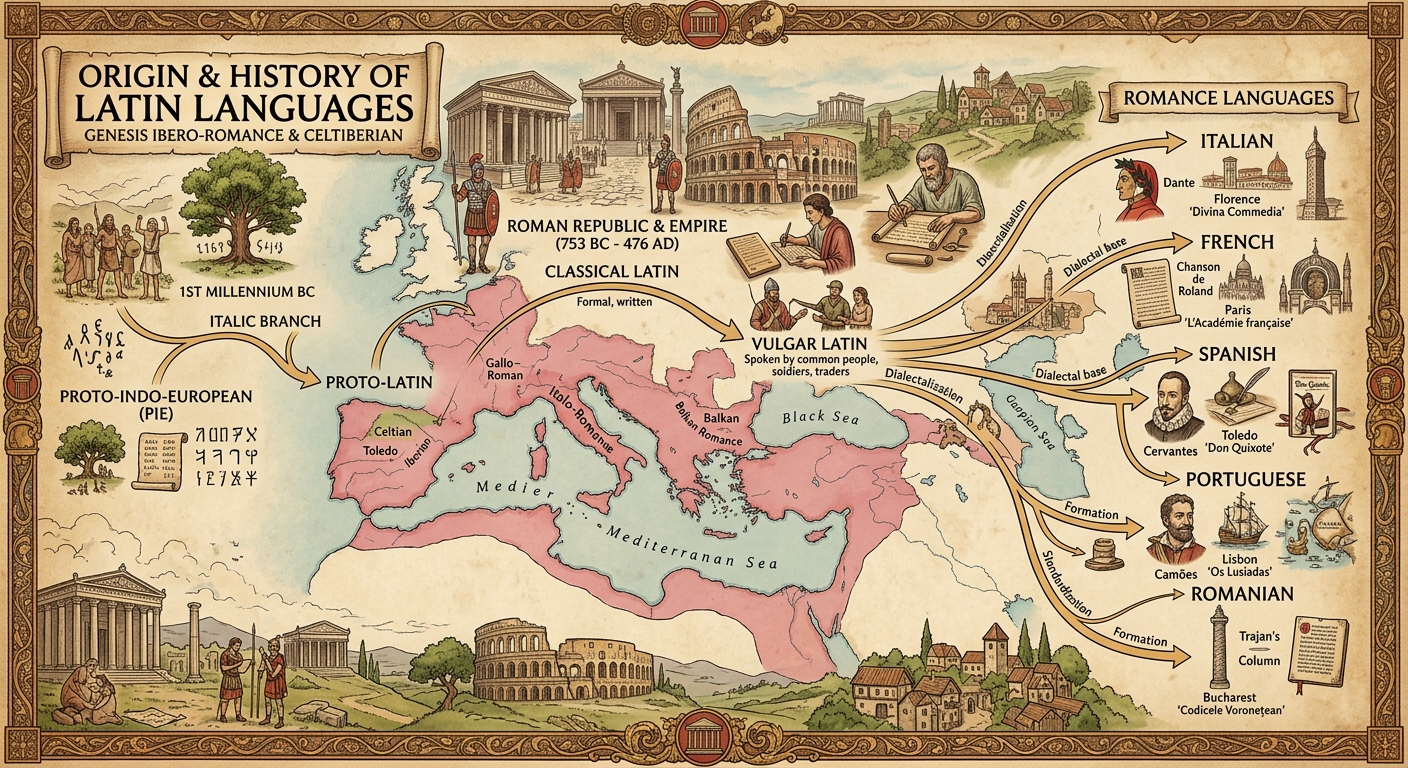
The history of the Latin language and the Romance languages descended from it is one of the most important stories in the development of European civilization. Latin began as the language of a relatively small community in central Italy and eventually became the administrative, legal, literary, religious, scientific, and educational language of a vast portion of Europe and parts of North Africa and the Middle East.
Latin itself developed from the ancient Indo-European linguistic family, particularly through the Italic branch of languages spoken in ancient Italy. The expansion of Rome transformed Latin from a regional language into an international language. After the collapse of the Western Roman Empire, spoken Latin evolved differently in different regions, eventually producing the modern Romance languages: Spanish, Portuguese, French, Italian, Romanian, Catalan, Occitan, Sardinian, Romansh, and several other regional languages.
The story of Latin therefore is not simply the history of one language. It is a history of migration, empire, trade, education, religion, law, literature, science, and cultural transformation.
1. Introduction
Language is one of humanity’s most powerful technologies.
It allows people to preserve knowledge, organize societies, conduct commerce, create laws, transmit religion, record history, and communicate across generations.
Few languages demonstrate this more dramatically than Latin.
Latin began as the language of Latium, the region surrounding ancient Rome in central Italy. From this relatively limited geographical origin, it became the language of the Roman Republic and Roman Empire. Its influence subsequently spread across much of Europe.
Even after Latin ceased to be the ordinary spoken language of most Europeans, it remained extraordinarily influential.
For centuries, Latin served as:
- the language of Roman administration;
- the language of Roman law;
- a major literary language;
- the language of Western Christianity;
- the language of medieval scholarship;
- a language of European diplomacy;
- a language of universities;
- a language of science and medicine;
- and an important source of modern European vocabulary.
Most importantly, Latin did not simply disappear.
Its everyday spoken varieties gradually transformed into new languages.
These descendants are called the Romance languages.
2. What Is Latin?
Latin belongs to the Indo-European language family.
A simplified linguistic family tree is:
Indo-European
│
├── Germanic
│   ├── English
│   ├── German
│   └── Scandinavian languages
│
├── Slavic
│   ├── Russian
│   ├── Polish
│   └── Czech
│
├── Celtic
│
├── Greek
│
├── Indo-Iranian
│
└── Italic
    │
    └── Latin
        │
        └── Romance languages
            ├── Spanish
            ├── Portuguese
            ├── French
            ├── Italian
            ├── Romanian
            ├── Catalan
            ├── Occitan
            ├── Sardinian
            └── Romansh
This tree is a simplified representation. The historical relationships among ancient Italic languages and the precise classification of some Romance varieties are more complicated.
3. The Indo-European Background
Latin did not appear suddenly.
It belongs to a much older linguistic history.
The ancestors of Latin were part of the prehistoric Indo-European linguistic community. Over thousands of years, populations speaking related languages spread and diversified across Europe and Asia.
The original Indo-European language is generally called Proto-Indo-European (PIE).
It was not written down directly. Linguists reconstruct aspects of it by comparing later languages.
For example, relationships can be observed among words in languages such as:
- Latin;
- Greek;
- Sanskrit;
- Gothic;
- Old Irish;
- Old Church Slavonic;
- and many others.
This comparative approach allows linguists to reconstruct aspects of ancient linguistic development.
4. The Italic Languages
Before Latin became dominant in Italy, the Italian peninsula contained numerous peoples and languages.
Among the ancient Italic languages were:
- Latin;
- Faliscan;
- Oscan;
- Umbrian;
- and other related varieties.
Latin was originally associated particularly with Latium.
The earliest Latin-speaking communities were therefore not initially masters of the entire Italian peninsula.
Rome itself developed within a highly multilingual environment.
5. The Geographic Birthplace of Latin
The birthplace of Latin was Latium, located in central western Italy.
Rome was established in this region.
The surrounding Mediterranean world contained several major civilizations and languages, including:
- Etruscan;
- Greek;
- Phoenician/Punic;
- and numerous Italic languages.
Consequently, Latin developed through contact with neighboring cultures.
The Etruscans were particularly important in early Roman civilization.
Greek influence was also enormous, especially in:
- literature;
- philosophy;
- art;
- education;
- science;
- architecture;
- and vocabulary.
6. Early Latin
The earliest surviving Latin inscriptions date from the early centuries of Roman history.
Early Latin differed considerably from the classical form later taught in schools.
Its development can broadly be divided into periods.
| Period | Approximate era | Characteristics |
|---|---|---|
| Old Latin | c. 7th–2nd centuries BCE | Early inscriptions and literature |
| Classical Latin | c. 1st century BCE–1st century CE | Highly standardized literary Latin |
| Imperial Latin | c. 1st–3rd centuries CE | Administrative and literary expansion |
| Late Latin | c. 3rd–7th centuries CE | Increasing linguistic change |
| Medieval Latin | c. 6th–15th centuries | Language of scholarship and Church |
| Renaissance Latin | c. 14th–16th centuries | Classical revival |
| Neo-Latin | c. 16th–19th centuries | Scientific, academic and international use |
| Modern Latin | Today | Primarily specialized and ecclesiastical use |
These periods overlap rather than representing sharp boundaries.
7. The Roman Republic and the Expansion of Latin
One of the most important stages in Latin’s history occurred during the expansion of the Roman Republic.
Rome progressively conquered territories throughout Italy.
As Roman political and military power expanded, Latin gained importance.
Latin became associated with:
- Roman citizenship;
- government;
- military organization;
- law;
- taxation;
- commerce;
- and administration.
This created a powerful linguistic network.
The Roman political system effectively turned Latin into an infrastructure for communication.
8. Latin and Romanization
The expansion of Rome produced what historians often call Romanization.
Romanization did not mean that every conquered population immediately abandoned its original language.
Instead, Latin often became increasingly important alongside local languages.
People might use:
- a local language at home;
- Latin for government;
- Latin for military service;
- Latin for commercial transactions;
- and eventually Latin for broader communication.
Over generations, this produced profound linguistic change.
9. Classical Latin
Classical Latin represents the highly developed literary language associated with the late Roman Republic and early Roman Empire.
Important writers included:
- Marcus Tullius Cicero
- Gaius Julius Caesar
- Virgil
- Horace
- Ovid
- Livy
- Tacitus
Their works established important models of Latin literary style.
10. Classical Latin Versus Spoken Latin
A critical distinction is necessary.
There was never simply one uniform form of Latin spoken identically throughout the Roman world.
There was a difference between formal literary Latin and the many varieties of everyday spoken Latin.
The everyday language is often called Vulgar Latin.
Here, “vulgar” does not mean vulgar in the modern sense of being offensive.
It comes from the Latin vulgus, meaning the common people.
Vulgar Latin therefore refers broadly to the spoken varieties used by ordinary people.
These spoken forms were the principal ancestors of the Romance languages.
11. The Latin Language as a Living System
Languages constantly change.
Latin speakers:
- shortened words;
- changed pronunciation;
- altered grammar;
- borrowed vocabulary;
- created new expressions;
- and adapted language to local environments.
These changes occurred naturally across generations.
For example:
Latin → regional spoken Latin → early Romance → medieval Romance → modern Romance
The transformation was gradual.
There was no single day when people stopped speaking Latin and began speaking Spanish or French.
12. The Roman Empire and the Linguistic Map
At its greatest extent, Roman political authority covered enormous territories.
Latin became dominant particularly in the western parts of the Roman world.
These included areas corresponding broadly to:
- Italy;
- Iberia;
- Gaul;
- parts of North Africa;
- parts of the Balkans;
- and other territories.
Greek remained extremely important in the eastern Mediterranean and Eastern Roman Empire.
This distinction would eventually contribute to the different linguistic histories of Western and Eastern Europe.
13. Latin in North Africa
Latin was also important in Roman North Africa.
Roman Africa produced major Latin writers and intellectuals.
One of the most famous was Augustine of Hippo, who wrote extensively in Latin.
The region was linguistically diverse, however, and Latin existed alongside languages including Punic and various local languages.
The later disappearance of Latin as a major spoken language in much of North Africa demonstrates that political control alone does not guarantee permanent linguistic survival.
14. The Fall of the Western Roman Empire
The Western Roman imperial system underwent major political transformation during late antiquity.
The traditional date for the fall of the Western Roman Empire is 476 CE, when the western emperor Romulus Augustulus was deposed.
However, the linguistic transformation of Latin had already been occurring for centuries.
The fall of the Western Empire did not instantly destroy Latin.
Instead, political fragmentation accelerated regional differentiation.
15. Why Latin Became Many Languages
Several forces drove the fragmentation of spoken Latin.
15.1 Geographic separation
Communities became increasingly separated.
15.2 Political fragmentation
Western Europe was divided among different kingdoms and political systems.
15.3 Local languages
Latin interacted with pre-Roman and later languages.
15.4 Different pronunciation
Regional pronunciation developed differently.
15.5 Changing grammar
The complex Latin case system gradually weakened in many regions.
15.6 Vocabulary change
Different areas adopted different words.
15.7 Limited communication
Long-distance communication became more difficult after the decline of Roman imperial infrastructure.
16. Birth of the Romance Languages
The Romance languages emerged from varieties of spoken Latin.
The word Romance comes from the Latin concept of Romanice, meaning broadly “in the Roman manner/language.”
The major Romance languages include:
- Spanish;
- Portuguese;
- French;
- Italian;
- Romanian;
- Catalan;
- Occitan;
- Sardinian;
- Romansh.
There are also numerous regional languages and varieties.
17. Spanish
Spanish developed primarily from varieties of Latin spoken in the Iberian Peninsula.
Its history was influenced by:
- Latin;
- pre-Roman Iberian languages;
- Basque;
- Germanic languages;
- Arabic;
- and other Romance varieties.
Spanish later became one of the world’s major languages through the expansion of Spain.
Today it is spoken across Spain and much of Latin America.
18. Portuguese
Portuguese developed in the western Iberian Peninsula.
It evolved from local Romance varieties and eventually became the language of Portugal.
Portuguese subsequently spread through Portuguese maritime expansion.
It became particularly important in:
- Brazil;
- Angola;
- Mozambique;
- Portugal;
- and several other countries.
19. French
French developed primarily from the Romance varieties of northern Gaul.
Its evolution was influenced by:
- Latin;
- Gaulish;
- Frankish;
- and other regional languages.
The language eventually became associated with the political and cultural power of France.
French later became an important international language of:
- diplomacy;
- literature;
- philosophy;
- science;
- administration;
- and international organizations.
20. Italian
Italian is particularly interesting because it developed in the geographical heartland of Latin.
Modern standard Italian is historically connected especially with the Tuscan literary tradition.
The writings of Dante Alighieri were enormously influential in the development of literary Italian.
Italy remained linguistically diverse for centuries, with many regional languages and dialects.
Modern standard Italian was consolidated relatively late compared with the ancient history of Latin.
21. Romanian
Romanian developed in southeastern Europe.
It is particularly significant because it represents a Romance language surrounded largely by Slavic and other non-Romance languages.
Romanian therefore demonstrates how Latin-derived languages could survive in geographically isolated regions.
Its vocabulary contains substantial influences from surrounding languages.
22. Catalan
Catalan developed in northeastern Iberia and surrounding areas.
It occupies an important position between the linguistic traditions of the Iberian Peninsula and southern France.
Catalan has developed a substantial literary and cultural tradition.
23. Occitan
Occitan developed in southern France and neighboring regions.
It was particularly important during the medieval period.
The medieval troubadour tradition made varieties of Occitan internationally influential in European literary culture.
24. Sardinian
Sardinian is spoken on Sardinia.
It is widely considered one of the Romance languages that has retained particularly distinctive characteristics.
Its development reflects the island’s geographical history and interaction with other Mediterranean cultures.
25. Romansh
Romansh refers to a group of Romance varieties spoken in Switzerland.
Its survival demonstrates that Romance languages did not develop only in the large political centers.
Small Romance-speaking communities survived in mountainous regions despite surrounding Germanic-language influence.
26. The Medieval Latin World
Latin did not disappear when Romance languages developed.
Instead, Europe effectively developed a form of linguistic duality.
People increasingly spoke local languages while educated institutions continued using Latin.
Latin became particularly important within:
- the Catholic Church;
- monasteries;
- universities;
- legal institutions;
- scholarship;
- diplomacy;
- and administration.
This produced a remarkable situation:
A person might speak one language at home while reading and writing another language in education or religious life.
27. Latin and Christianity
Christianity played an enormous role in preserving Latin.
As Christianity expanded throughout Western Europe, Latin became the principal language of the Western Church.
The Latin Bible tradition, especially the Vulgate, became enormously influential.
Latin was used in:
- theology;
- liturgy;
- church administration;
- biblical scholarship;
- sermons;
- religious philosophy;
- and ecclesiastical law.
28. Latin and the Catholic Church
Latin remained a major liturgical and administrative language of the Roman Catholic tradition for many centuries.
This helped preserve Latin after it ceased being an ordinary community language.
The Church therefore became one of the world’s most important institutional custodians of Latin.
29. Monasteries and the Preservation of Knowledge
During the medieval period, monasteries and scholarly centers played an important role in preserving manuscripts.
Monks copied works dealing with:
- theology;
- philosophy;
- history;
- grammar;
- medicine;
- astronomy;
- mathematics;
- law;
- and classical literature.
Without this manuscript tradition, much ancient knowledge might have been lost.
30. Latin and the Medieval University
European universities developed strongly during the medieval period.
Latin became a major academic language.
Students and scholars from different regions could communicate through Latin even when their native languages differed.
This created an early form of an international scholarly network.
A scholar from one European region could write to another scholar hundreds of kilometers away using Latin.
31. Latin and Science
Latin remained important in scientific communication for centuries.
Scientific terminology contains enormous numbers of Latin and Greek-derived terms.
Examples include:
- species;
- genus;
- formula;
- radius;
- data;
- maximum;
- minimum;
- medium;
- index.
Many scientific names continue to use Latinized forms.
32. Latin and Medicine
Medicine is another major area of Latin influence.
Medical terminology contains many Latin and Greek elements.
Examples include:
- corpus;
- vertebra;
- musculus;
- radius;
- ulna;
- cerebrum;
- femur.
Anatomical terminology preserves a substantial Latin heritage.
33. Latin and Law
Latin’s influence on law is particularly powerful.
Legal terminology includes expressions such as:
- habeas corpus;
- bona fide;
- de facto;
- de jure;
- status quo;
- pro bono;
- versus.
Roman law itself became one of the foundations of many European legal traditions.
34. Latin and Government
The Roman administrative tradition helped establish Latin as a language of governance.
Medieval and early modern governments continued using Latin for:
- treaties;
- official documents;
- diplomatic correspondence;
- legal records;
- royal charters;
- and administrative documents.
35. Latin and Literature
Latin produced one of the world’s great literary traditions.
Important genres included:
- epic poetry;
- lyric poetry;
- satire;
- history;
- rhetoric;
- philosophy;
- biography;
- theology;
- drama;
- and political writing.
The Roman literary tradition became one of the foundations of European literature.
36. Latin and the Renaissance
The Renaissance produced a renewed interest in classical antiquity.
Humanist scholars studied ancient Latin manuscripts and attempted to recover classical literary styles.
They emphasized:
- grammar;
- rhetoric;
- history;
- classical literature;
- philosophy;
- and textual criticism.
Latin therefore experienced a major intellectual revival.
37. The Printing Revolution
The invention and spread of printing in Europe transformed the distribution of Latin knowledge.
The printing press allowed Latin books to circulate much more efficiently.
Latin became one of the major languages of early European printed scholarship.
It created a transnational intellectual network.
38. Latin and the Scientific Revolution
Many major scientific works were written in Latin.
For example, Nicolaus Copernicus published major astronomical work in Latin.
Isaac Newton published Philosophiæ Naturalis Principia Mathematica in Latin.
Latin therefore became an important vehicle for the emergence of modern science.
39. Latin and Philosophy
Latin became one of the major languages of European philosophy.
Philosophical works were written in Latin by thinkers such as:
- Augustine;
- Boethius;
- Anselm;
- Thomas Aquinas;
- Descartes in parts of his scholarly output;
- and many other medieval and early modern thinkers.
Latin allowed philosophical concepts to circulate across linguistic borders.
40. Latin and European Education
For centuries, learning Latin was a central component of European education.
Students learned:
- grammar;
- vocabulary;
- rhetoric;
- composition;
- classical texts;
- logic;
- and literature.
Latin education shaped European intellectual culture.
41. The Decline of Latin as an International Language
From the seventeenth through nineteenth centuries, Latin gradually lost ground to national languages.
Languages such as:
- French;
- English;
- German;
- Italian;
- Spanish;
- and Portuguese
increasingly became important in scholarship and diplomacy.
The rise of nation-states encouraged education in national languages.
42. Latin Never Completely Disappeared
Although Latin ceased to be a normal mother tongue, it survived institutionally.
It continues to exist in:
- Catholic liturgy;
- Vatican usage;
- academic traditions;
- legal expressions;
- scientific nomenclature;
- biological classification;
- mottos;
- inscriptions;
- and classical education.
Latin is therefore often described as a dead language, but this description requires qualification.
It is no longer normally acquired as a community’s native spoken language, but it remains actively studied and used in specialized contexts.
43. The Vatican and Modern Latin
Latin remains an official language of the Holy See and Vatican institutions.
The Vatican demonstrates an unusual phenomenon:
Latin has no large native-speaking population but remains institutionally maintained.
This distinguishes Latin from ordinary extinct languages.
44. Latin’s Vocabulary Legacy
Latin’s influence on modern vocabulary is enormous.
English itself is not a Romance language, yet a large portion of its vocabulary comes directly or indirectly from Latin.
Examples include words related to:
- government;
- education;
- science;
- medicine;
- law;
- religion;
- philosophy;
- technology.
For example:
Latin computare → compute → computer → computation
This demonstrates how an ancient linguistic root can participate in modern technological vocabulary.
45. Latin and English
English is fundamentally a Germanic language.
However, Latin has influenced English through several major historical pathways.
Roman contact
Some Latin words entered early Germanic languages.
Christianity
Christianization introduced many Latin religious terms.
Norman French
After the Norman Conquest, enormous numbers of Latin-derived French words entered English.
Medieval scholarship
Latin remained the language of education.
Renaissance
Classical learning introduced additional Latin vocabulary.
Consequently, modern English contains a vast Latin-derived vocabulary layer.
46. Latin and African Languages
Latin’s historical influence also reached Africa through Roman expansion.
Roman North Africa became an important Latin-speaking region.
Latin interacted with languages including:
- Punic;
- Berber/Amazigh languages;
- Greek;
- and other local languages.
The history demonstrates that Latin was not exclusively a European phenomenon.
The Roman Mediterranean was multilingual.
47. Latin and the Mediterranean World
The Mediterranean was the great communication environment of antiquity.
Latin interacted with:
- Greek;
- Phoenician/Punic;
- Egyptian languages;
- Hebrew;
- Aramaic;
- Berber languages;
- Celtic languages;
- Germanic languages;
- and numerous other linguistic traditions.
Languages therefore influenced each other through:
- trade;
- migration;
- warfare;
- administration;
- religion;
- and cultural exchange.
48. Latin’s Linguistic Architecture
Latin possessed a complex grammatical system.
Important characteristics included:
- grammatical gender;
- noun cases;
- verb conjugations;
- extensive inflection;
- agreement between grammatical elements;
- relatively flexible word order;
- and a rich system of verb forms.
The Romance languages simplified many aspects of this system.
49. The Transformation of Latin Grammar
One of the major developments from Latin to Romance was the reduction of the case system.
Classical Latin had several major cases, including:
- nominative;
- accusative;
- genitive;
- dative;
- ablative;
- vocative.
Romance languages generally reduced this complexity.
Instead, they increasingly relied on:
- word order;
- prepositions;
- auxiliary verbs;
- and other grammatical structures.
50. From Latin Vocabulary to Romance Vocabulary
Consider a simplified example:
Latin: aqua
Italian:
acqua
Spanish:
agua
Portuguese:
água
French:
eau
Romanian:
apă
The differences demonstrate that related languages can transform the same ancestral word in dramatically different ways.
51. Why French Looks Different
French is clearly a Romance language, but its appearance can seem quite different from Italian or Spanish.
This is partly because French underwent substantial phonological change.
French also experienced strong influence from:
- Gaulish;
- Frankish;
- neighboring Germanic languages;
- and regional Romance varieties.
Therefore, shared Latin ancestry does not guarantee superficial similarity.
52. Why Romanian Looks Different
Romanian developed at the eastern edge of the Romance-speaking world.
It experienced strong contact with:
- Slavic languages;
- Greek;
- Turkish;
- Albanian;
- and neighboring Balkan languages.
Nevertheless, its fundamental historical development from Latin remains evident.
53. The Romance Language Family Today
A simplified modern classification is:
Latin
│
└── Romance
    │
    ├── Western Romance
    │   ├── Spanish
    │   ├── Portuguese
    │   ├── French
    │   ├── Catalan
    │   └── Occitan
    │
    ├── Italo-Romance
    │   └── Italian and related varieties
    │
    ├── Eastern Romance
    │   └── Romanian
    │
    └── other Romance varieties
        ├── Sardinian
        ├── Romansh
        └── others
The precise classification of Romance varieties is debated by linguists, and the family contains a much richer continuum than this simplified diagram suggests.
54. Latin’s Two Great Legacies
Latin produced two enormous historical legacies.
Legacy 1: The Romance Languages
Latin became:
- Spanish;
- Portuguese;
- French;
- Italian;
- Romanian;
- Catalan;
- Occitan;
- Sardinian;
- Romansh;
- and other regional varieties.
Legacy 2: The Latin Vocabulary Network
Even languages that did not descend from Latin absorbed huge amounts of Latin-derived vocabulary.
English is the most famous example.
55. Latin as a Civilization Language
Latin’s importance therefore cannot be measured merely by the number of native speakers.
Its deeper significance lies in its role as an infrastructure language of civilization.
It connected:
Government → Law → Religion → Education → Science → Medicine → Literature → Philosophy → Diplomacy
This network operated for approximately two millennia.
56. A Timeline of Latin
| Date/Period | Development |
|---|---|
| Prehistory | Indo-European linguistic ancestry |
| 1st millennium BCE | Latin develops in Latium |
| Early Rome | Latin becomes language of Roman community |
| Roman Republic | Latin expands across Italy |
| 1st century BCE | Classical Latin reaches literary maturity |
| Roman Empire | Latin spreads across western provinces |
| 3rd–6th centuries CE | Spoken Latin increasingly differentiates |
| 5th–8th centuries | Regional Romance varieties emerge |
| Middle Ages | Latin remains major scholarly and ecclesiastical language |
| Renaissance | Classical Latin revived by humanists |
| Scientific Revolution | Latin remains major scientific language |
| 17th–19th centuries | National languages increasingly replace Latin |
| 20th–21st centuries | Latin survives in specialized and institutional contexts |
57. The Latin Language as a Historical Technology
Latin can be understood as a kind of information infrastructure.
The Roman Empire required systems for:
- recording laws;
- collecting taxes;
- issuing orders;
- maintaining military administration;
- conducting commerce;
- documenting property;
- recording citizenship;
- and communicating across enormous distances.
Latin became one of the principal linguistic systems supporting that infrastructure.
Later, the Church, universities, and scientific institutions inherited and extended this role.
58. Latin and the Transmission of Knowledge
The historical chain can be represented as:
Ancient oral traditions
        ↓
Early written Latin
        ↓
Roman literature
        ↓
Roman administration
        ↓
Christian Latin
        ↓
Medieval manuscripts
        ↓
Universities
        ↓
Printing
        ↓
Scientific Latin
        ↓
Modern scientific terminology
This is one reason Latin remains visible in modern civilization even though most people no longer speak it.
59. Latin and the Modern World
Modern society contains Latin everywhere.
Examples include:
Education
curriculum, alumni, lecture
Law
versus, status quo, bona fide
Science
species, genus, data
Medicine
radius, femur, corpus
Government
senate, administration
Technology
computer, information, data
Religion
amen, altar, spirit
Everyday English
Thousands of English words ultimately contain Latin ancestry.
60. Latin and Computer Science
The connection between Latin and modern computing is especially interesting.
The Latin verb computare means roughly “to calculate” or “to reckon.”
From this linguistic root came:
computare → compute → computation → computer
Thus, a central word of the digital age has an ancient Latin ancestry.
This illustrates a broader principle:
Modern technology frequently uses ancient linguistic foundations to name new concepts.
61. Latin and the Architecture of Modern Knowledge
Latin contributed not only words but also an intellectual tradition.
European knowledge systems inherited concepts associated with:
- classification;
- rhetoric;
- legal reasoning;
- grammatical analysis;
- formal education;
- textual scholarship;
- scientific naming;
- and philosophical argument.
Its influence therefore extends beyond vocabulary.
62. Latin as a Bridge Between Eras
Latin connects:
Ancient Rome → Medieval Europe → Renaissance → Scientific Revolution → Modern academia
Few languages have maintained such a long institutional continuity.
Ancient Latin inscriptions can be studied alongside medieval manuscripts and modern scientific terminology.
63. Why Latin Matters Today
Studying Latin can help researchers understand:
- European history;
- Roman civilization;
- medieval Christianity;
- Western legal traditions;
- scientific terminology;
- medical terminology;
- Romance-language development;
- English vocabulary;
- historical linguistics;
- the transmission of knowledge.
64. Major Lessons from the History of Latin
Lesson 1: Languages evolve
No language remains unchanged.
Lesson 2: Political power can spread language
Roman expansion greatly increased the geographical importance of Latin.
Lesson 3: Languages can survive political collapse
Latin survived the Western Roman Empire by becoming institutionalized.
Lesson 4: Spoken language changes faster than institutions
People’s spoken Latin evolved into Romance languages while institutions continued writing Latin.
Lesson 5: Languages influence one another
Latin absorbed influences and later influenced other languages.
Lesson 6: A language can die as a mother tongue but survive culturally
Latin is the classic example.
65. The Great Historical Transformation
The entire process can be summarized as:
Proto-Indo-European
        ↓
Ancient Italic languages
        ↓
Early Latin
        ↓
Classical Latin
        ↓
Imperial Latin
        ↓
Regional spoken Latin
        ↓
Early Romance
        ↓
Medieval Romance
        ↓
Modern Romance languages
At the same time:
Classical Latin
       ↓
Christian Latin
       ↓
Medieval Latin
       ↓
Renaissance Latin
       ↓
Scientific / Academic Latin
       ↓
Modern specialized Latin
Thus Latin followed two simultaneous evolutionary pathways:
spoken evolution → Romance languages
and
institutional evolution → continued learned Latin
66. Conclusion
The history of Latin is fundamentally the history of transformation.
Latin began as the language of a relatively small population in ancient Latium. Through the expansion of Rome, it became one of the principal languages of the ancient Mediterranean and western Europe.
The Roman Empire transformed Latin into an administrative and cultural infrastructure.
After the political fragmentation of the Western Roman world, ordinary spoken Latin continued changing. Geography, local languages, migration, political separation, and natural linguistic evolution gradually produced the Romance languages.
At the same time, Latin survived through the Church, monasteries, universities, law, scholarship, science, medicine, and diplomacy.
Consequently, Latin has an extraordinary historical status:
it ceased to be the everyday native language of a large community, yet it continued to influence civilization for centuries.
Its descendants now include some of the world’s major languages, while its vocabulary remains deeply embedded in English and many other languages.
The history can therefore be summarized in one sentence:
Latin did not simply disappear; it transformed into a family of living languages while simultaneously becoming one of the great intellectual foundations of the modern world.
Its journey—from the small communities of ancient Latium, through Rome and the Roman Empire, through medieval Europe and the Renaissance, into modern science, law, medicine, education and technology—is one of humanity’s most remarkable examples of linguistic continuity and transformation.



Be First to Comment