
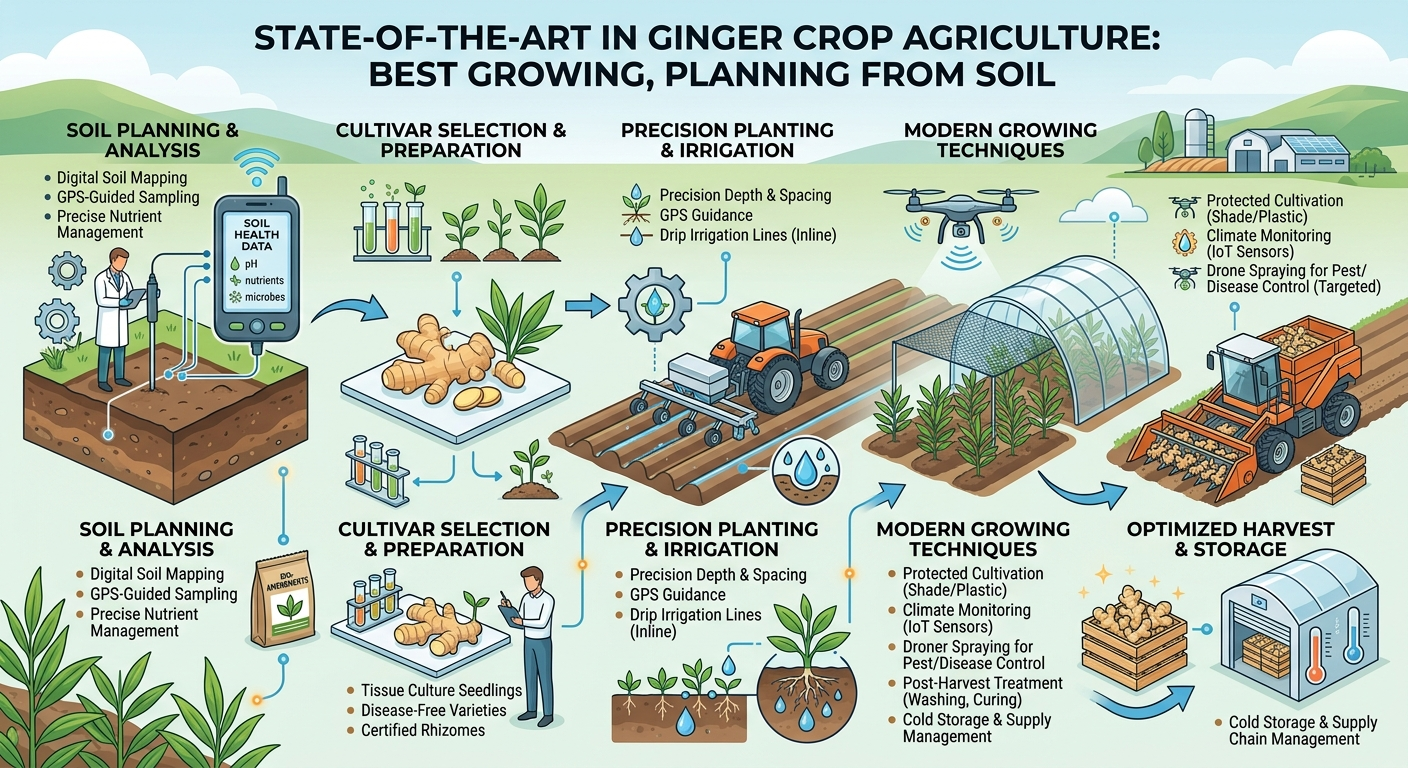
From Soil Preparation to High-Quality Harvest, Post-Harvest Management and Precision Farming
Abstract
Ginger (Zingiber officinale) is one of the world’s important spice and vegetable-like rhizome crops. Although ginger is commonly called a root, the harvested product is botanically a rhizome—an underground modified stem. Modern ginger production is no longer simply a matter of planting rhizomes and adding water and fertilizer. The most advanced approach treats the farm as an integrated biological, soil, water, disease, nutrition, climate and market-management system.
The central principle of state-of-the-art ginger farming is:
Start with healthy planting material, build a well-drained biologically active soil, manage water precisely, feed the crop according to soil and plant requirements, prevent rhizome diseases, monitor the field continuously, and harvest according to the intended market.
This is particularly important because rhizome diseases can destroy ginger production. FAO reports that disease-free planting material, single-bud propagation, certification and good agricultural practices have become important components of modern ginger production. (FAOHome)
1. Introduction: What Is Modern Ginger Agriculture?
Traditional ginger farming often follows a simple sequence:
Land → planting → fertilizer → irrigation → harvest
Modern production is much more sophisticated:
Market planning → site selection → soil analysis → drainage design → disease-free seed → nursery → field establishment → precision nutrition → precision irrigation → disease surveillance → crop monitoring → maturity management → harvesting → washing → grading → storage → marketing
The objective is not simply to produce the largest possible quantity.
A professional grower wants to produce:
- high rhizome yield;
- uniform rhizomes;
- good size and shape;
- strong aroma and pungency;
- low disease incidence;
- low soil and microbial contamination;
- good shelf life;
- consistent quality;
- efficient water use;
- efficient fertilizer use;
- profitable production.
2. Understanding the Ginger Plant
Ginger is a member of the Zingiberaceae family.
The commercially important part is its underground rhizome.
Basic plant structure
Leaves
↓
Stems/pseudostems
↓
Root system
↓
Rhizome
↓
New rhizome branches and buds
The rhizome stores carbohydrates and produces new shoots.
This makes the quality of the planting rhizome extremely important.
A farmer who begins with infected or poor-quality planting material may already have introduced a major production problem before the crop emerges.
FAO’s ginger programmes have specifically emphasized disease-free rhizomes and improved propagation technologies such as tissue culture and single-bud nursery systems. (FAOHome)
3. The First Principle: Do Not Begin With Planting
The first operation should be farm planning.
Before purchasing seed rhizomes, determine:
- What variety will be planted?
- What is the target market?
- What quantity can be sold?
- What soil is available?
- Is irrigation available?
- What is the water quality?
- What diseases occur locally?
- How will drainage be achieved?
- What machinery is available?
- Where will the harvested ginger be washed and stored?
This changes farming from:
“I have land, therefore I will plant.”
into:
“I have a production system designed around a market.”
4. Site Selection
Ginger performs best in a warm growing environment with adequate moisture but without prolonged waterlogging.
A good site should have:
- good sunlight;
- suitable temperatures;
- reliable water;
- good drainage;
- fertile soil;
- sufficient organic matter;
- reasonable access to roads;
- protection from erosion;
- sufficient space for crop rotation.
The most important warning is:
Avoid poorly drained land.
Waterlogging creates conditions that can severely increase rhizome disease risk.
This is particularly important because rhizome rot has caused serious production losses in ginger-growing regions. FAO documents cases where ginger production declined dramatically because of rhizome-rot disease. (FAOHome)
5. Soil: The Foundation of the Ginger Farm
If you want to understand the state of the art in ginger production, begin with the soil.
A modern farmer does not simply look at the soil and say:
“It looks fertile.”
The soil must be measured.
Minimum soil analysis
Before planting, test:
- pH;
- organic matter;
- nitrogen;
- phosphorus;
- potassium;
- calcium;
- magnesium;
- sulphur;
- electrical conductivity/salinity;
- soil texture;
- drainage characteristics.
Where appropriate, additional testing can include:
- boron;
- zinc;
- iron;
- manganese;
- copper;
- microbial or pathogen testing.
6. Soil Texture
A good ginger field needs soil that allows:
water to enter + air to enter + roots to develop + rhizomes to expand.
Very heavy clay can create drainage problems.
Extremely sandy soil can lose water and nutrients rapidly.
A well-structured loam or sandy-loam soil is often advantageous because it can provide a balance between:
- drainage;
- water retention;
- aeration;
- root development;
- rhizome expansion.
But soil texture alone does not determine suitability. Structure, organic matter, compaction, slope and drainage are equally important.
7. Soil pH
The exact optimum should be established using local agronomic recommendations and a soil laboratory.
For many vegetable crops, approximately pH 6–7 is broadly favourable for nutrient availability, although individual crops can have somewhat different preferences. Soil testing should therefore determine the appropriate amendment rather than applying lime or other materials blindly. (Fruit and Vegetable News)
Why pH matters
Soil pH influences the availability of:
- nitrogen;
- phosphorus;
- potassium;
- calcium;
- magnesium;
- iron;
- manganese;
- zinc;
- boron.
Therefore:
Poor pH → poor nutrient availability → poor plant development → potentially poor rhizome development.
8. Soil Organic Matter
Organic matter is one of the most valuable components of a modern ginger soil-management programme.
Organic matter can improve:
- soil structure;
- water-holding capacity;
- microbial activity;
- nutrient cycling;
- aggregation;
- infiltration.
However, modern agriculture also recognizes that more compost is not automatically better.
Excessive manure or compost can cause nutrient accumulation, particularly phosphorus and potassium, and can alter soil chemistry. Soil testing should therefore determine application requirements rather than applying large quantities routinely. (Fruit and Vegetable News)
9. Soil Preparation
The objective of land preparation is not to pulverize the soil.
The objective is to create an appropriate root and rhizome environment.
A modern preparation sequence can be:
Soil test
↓
Correct major chemical limitations
↓
Control perennial weeds
↓
Improve drainage
↓
Reduce compaction
↓
Incorporate appropriate organic material
↓
Create raised beds/ridges where appropriate
↓
Install irrigation
↓
Plant
10. Raised Beds: A Major Ginger Production Principle
Raised beds can be particularly useful where drainage is a concern.
Conceptually:
        GINGER PLANTS
          🌱   🌱   🌱
       ┌───────────────┐
      /                 \
     /    RHIZOMES       \
____/_____________________\____
       drainage channels
The raised structure allows excess water to move away from the rhizome zone.
This can be particularly valuable because ginger rhizomes are underground and prolonged saturation creates a dangerous environment for rhizome diseases.
11. The Most Important Input: Healthy Planting Material
One of the biggest differences between conventional and advanced ginger production is the attention given to seed health.
Ginger is vegetatively propagated.
Therefore:
infected planting material → infected field
can become a major pathway for disease transmission.
FAO’s ginger programmes emphasize certified disease-free planting material and propagation systems designed to reduce the introduction and multiplication of disease. (FAOHome)
12. Selecting Seed Rhizomes
Planting material should ideally be:
- healthy;
- disease-free;
- vigorous;
- genetically appropriate;
- properly matured;
- free from visible rot;
- free from insect damage;
- capable of producing strong buds.
Do not select seed merely because it is large.
The priority should be:
health + genetic quality + viability + appropriate size
rather than size alone.
13. Advanced Propagation: Single-Bud Technology
One of the interesting developments in modern ginger production is single-bud nursery technology.
Instead of planting large amounts of rhizome directly into the field, selected buds can be multiplied under controlled nursery conditions.
The advantages can include:
- improved planting-material multiplication;
- better disease management;
- more uniform plants;
- efficient use of valuable seed rhizomes;
- potential improvement in seed availability.
FAO’s recent ginger work in Jamaica specifically highlights single-bud technology for producing quality, disease-free ginger planting material. (FAOHome)
14. Tissue Culture
At the advanced end of the production system is tissue culture/micropropagation.
The conceptual system is:
Selected mother plant
↓
Laboratory propagation
↓
Disease-managed plantlets
↓
Nursery acclimatization
↓
Multiplication
↓
Field planting
This technology can help produce large quantities of uniform planting material.
However, it requires specialized facilities, technical knowledge and strict sanitation.
15. Nursery Management
A professional ginger farm can separate:
Stage 1
Mother/seed material selection
Stage 2
Propagation
Stage 3
Nursery establishment
Stage 4
Plant health inspection
Stage 5
Field transplantation
This creates a biological quality-control system.
16. Planting Design
The exact spacing should be adapted to:
- variety;
- climate;
- soil;
- mechanization;
- target rhizome size;
- irrigation system;
- disease pressure.
Avoid automatically copying spacing from another country.
A spacing that works in one climate may not be optimal elsewhere.
17. Irrigation: Water Without Waterlogging
Ginger requires adequate moisture, but:
More water does not mean more ginger.
The modern objective is precise water management.
Irrigation should be based on:
- soil moisture;
- crop growth stage;
- weather;
- soil type;
- rooting depth;
- rainfall;
- evapotranspiration;
- drainage.
Modern irrigation management recommends monitoring soil moisture and adjusting irrigation according to crop and soil conditions. (University of Minnesota Extension)
18. Drip Irrigation
Drip irrigation is particularly attractive for ginger because it can deliver water close to the crop root zone.
Conceptually:
WATER SOURCE
     │
     ▼
FILTER
     │
     ▼
PUMP
     │
     ▼
FERTILIZER INJECTION
     │
     ▼
MAINLINE
     │
 ┌───┴─────────────┐
 ▼                 ▼
DRIP LINE        DRIP LINE
💧 💧 💧           💧 💧 💧
🌱 🌱 🌱           🌱 🌱 🌱
FAO training for ginger production has specifically highlighted drip irrigation alongside disease-free planting material and nutrient management. (FAOHome)
19. Soil-Moisture Sensors
The state-of-the-art farm can install sensors that measure soil moisture.
Instead of asking:
“Should I irrigate?”
the farmer can obtain information about:
How much water remains in the root zone?
Modern irrigation management can combine:
- soil moisture sensors;
- weather stations;
- rainfall information;
- crop growth stage;
- evapotranspiration estimates.
This creates an evidence-based irrigation system. (University of Minnesota Extension)
20. Precision Irrigation
Where fields have major differences in soil texture or elevation, variable-rate irrigation can potentially apply different irrigation amounts to different management zones.
Modern systems can use:
- soil electrical conductivity;
- elevation;
- soil texture;
- satellite imagery;
- crop imagery;
- soil moisture sensors.
However, technology does not automatically determine how much water ginger needs. Agronomic knowledge and irrigation scheduling remain essential. (University of Minnesota Extension)
21. Fertilizer Management
Ginger requires balanced nutrition.
Important nutrients include:
Macronutrients
- Nitrogen — N
- Phosphorus — P
- Potassium — K
- Calcium — Ca
- Magnesium — Mg
- Sulphur — S
Micronutrients
- Zinc
- Boron
- Iron
- Manganese
- Copper
- Molybdenum
But the principle should be:
Test first, fertilize second.
Do not construct a fertilizer programme solely from a generic internet recommendation.
22. Nitrogen
Nitrogen supports:
- leaf development;
- plant growth;
- photosynthesis;
- canopy development.
But excessive nitrogen can create undesirable growth and nutrient imbalance.
Therefore nitrogen should be divided appropriately through the season rather than automatically applying a large amount at planting.
23. Phosphorus
Phosphorus contributes to:
- root development;
- energy transfer;
- plant establishment.
However, excessive phosphorus is unnecessary and can create environmental and nutrient-management problems. Research on vegetable soils has demonstrated that repeated manure/compost applications can result in excessive phosphorus accumulation. (Fruit and Vegetable News)
24. Potassium
Potassium is particularly important in crops where the harvested organ is a storage structure.
It contributes to:
- water regulation;
- enzyme activity;
- carbohydrate movement;
- stress response;
- plant development.
The correct rate should be based on soil testing and local crop recommendations.
25. Fertigation
A highly advanced system combines:
Drip irrigation + soluble fertilizer
This is called fertigation.
Instead of applying all nutrients at once, nutrients can be supplied in smaller quantities during crop development.
This can improve nutrient-use efficiency when correctly designed.
26. Disease Management: The Critical Ginger Problem
Disease prevention is one of the most important parts of ginger agriculture.
Major concerns can include:
- rhizome rot;
- bacterial diseases;
- fungal diseases;
- nematodes;
- soil-borne pathogens;
- insect pests.
Rhizome rot is especially important because the harvested product itself is underground.
FAO has documented severe economic consequences from ginger rhizome rot and emphasizes clean planting material and good farm hygiene. (FAOHome)
27. Integrated Disease Management
The modern approach is not simply:
“Spray a chemical when the plant becomes sick.”
It is:
Prevention → monitoring → early detection → diagnosis → targeted intervention
This includes:
- disease-free planting material;
- field sanitation;
- crop rotation;
- drainage;
- clean tools;
- careful irrigation;
- removal of infected plants;
- monitoring;
- appropriate biological or chemical controls where legally registered and recommended.
28. Crop Rotation
Continuous ginger production in the same soil can increase disease and pest pressure.
A rotation programme may therefore alternate ginger with suitable non-host crops.
Conceptually:
Year 1: Ginger
↓
Year 2: Non-host crop
↓
Year 3: Suitable rotation crop
↓
Year 4: Ginger
The exact rotation should be developed according to the pathogens and crops present in the local farming system.
29. Weed Management
Weeds compete with ginger for:
- water;
- nutrients;
- sunlight;
- space.
They can also provide habitat for pests and make field monitoring difficult.
An integrated system can combine:
- clean land preparation;
- mulching;
- mechanical cultivation;
- hand weeding;
- appropriate registered herbicides where applicable.
30. Mulching
Organic mulch can help:
- conserve moisture;
- moderate soil temperature;
- reduce weed emergence;
- reduce erosion;
- improve soil organic matter over time.
But mulch must be managed carefully.
Poor-quality or contaminated organic material can introduce pests, pathogens or unwanted weed seeds.
31. Climate-Smart Ginger Agriculture
Modern agriculture must account for changing weather.
Important risks include:
- drought;
- heat;
- intense rainfall;
- flooding;
- erosion;
- irregular planting seasons;
- changing pest pressure.
A climate-smart ginger farm therefore needs:
Water security
Borehole, reservoir or reliable water supply.
Drainage security
Channels, raised beds and erosion control.
Soil security
Organic matter and reduced degradation.
Biological security
Disease-free planting material.
Information security
Weather and field monitoring.
32. Digital Agriculture
The modern ginger farm can become a data-driven farm.
A digital farm can record:
- planting date;
- variety;
- seed source;
- seed batch;
- soil-test results;
- fertilizer applications;
- irrigation;
- rainfall;
- disease observations;
- pesticide applications;
- labour;
- yield;
- market price.
This produces a digital history of every field.
33. Satellite and Drone Monitoring
Remote sensing can potentially help identify:
- uneven crop growth;
- water stress;
- nutrient stress;
- poor drainage zones;
- gaps in plant establishment;
- disease hotspots.
For example:
Satellite/drone imagery
↓
Vegetation index
↓
Identify abnormal area
↓
Ground inspection
↓
Diagnosis
↓
Corrective action
The critical point is that imagery should trigger field investigation, not replace agronomic diagnosis.
34. Artificial Intelligence in Ginger Farming
AI can become an additional decision-support layer.
A future-oriented system could integrate:
Weather data
+
Soil sensors
+
Satellite imagery
+
Irrigation data
+
Crop history
+
Disease observations
↓
AI decision-support system
↓
Recommendations concerning:
- irrigation;
- field scouting;
- disease risk;
- nutrient management;
- harvest timing;
- yield forecasting.
AI should be regarded as a decision-support tool rather than a replacement for agricultural expertise.
35. The Ginger Production Data Architecture
A state-of-the-art farm can be understood as five connected layers:
LAYER 5 — MARKET
   ↓
Price • Quality • Customers • Logistics

LAYER 4 — CROP
   ↓
Growth • Disease • Nutrition • Yield

LAYER 3 — WATER
   ↓
Irrigation • Rainfall • Soil moisture

LAYER 2 — SOIL
   ↓
pH • Nutrients • Organic matter • Texture

LAYER 1 — BIOLOGY
   ↓
Seed • Microbes • Roots • Rhizomes
The farmer’s objective is to manage all five layers simultaneously.
36. Harvest Management
Ginger can be harvested at different maturity stages depending on the market.
Young/fresh ginger
Generally targeted toward:
- fresh consumption;
- tender texture;
- processing;
- specialty markets.
Mature ginger
Generally targeted toward:
- dried ginger;
- spice production;
- processing;
- longer storage;
- industrial applications.
Therefore:
Harvest date should be determined by the market specification, not simply by the calendar.
37. Harvesting
Care must be taken to minimize:
- cuts;
- bruising;
- broken rhizomes;
- soil contamination;
- mechanical damage.
Damage creates opportunities for deterioration during storage.
38. Post-Harvest Handling
The production system does not end at harvest.
A modern chain is:
Harvest
↓
Field cleaning
↓
Washing
↓
Sorting
↓
Grading
↓
Quality inspection
↓
Drying/curing where appropriate
↓
Packaging
↓
Storage
↓
Transportation
↓
Market
39. Storage
Storage conditions must be matched to the intended product.
Important factors include:
- temperature;
- humidity;
- ventilation;
- cleanliness;
- disease status;
- physical damage.
FAO describes improved ginger rhizome storage systems in which stored rhizomes are inspected periodically and diseased or deteriorating material removed. (FAO STI Portal)
40. Quality Control
A professional ginger operation should establish quality specifications.
For example:
| Quality factor | Objective |
|---|---|
| Rhizome size | Uniform |
| Shape | Market appropriate |
| Disease | Minimal/absent |
| Damage | Minimal |
| Soil contamination | Controlled |
| Moisture | Appropriate for product |
| Colour | Appropriate |
| Aroma | Strong/normal |
| Packaging | Clean |
| Traceability | Documented |
41. Economics: The Farmer Must Calculate Yield AND Profit
High yield does not necessarily mean high profit.
A basic economic equation is:
Gross revenue = Yield × Selling price
Then:
Net profit = Gross revenue − Total production cost
Production costs include:
- land preparation;
- seed;
- fertilizer;
- irrigation;
- electricity/fuel;
- labour;
- pest and disease management;
- harvesting;
- washing;
- packaging;
- transport;
- storage;
- marketing.
42. The State-of-the-Art Farm Model
The most advanced practical ginger production system can therefore be represented as:
                    MARKET
                      ▲
                      │
               QUALITY CONTROL
                      ▲
                      │
                  HARVEST
                      ▲
                      │
             CROP MATURATION
                      ▲
                      │
       ┌──────────────┼──────────────┐
       │              │              │
    NUTRITION      IRRIGATION      DISEASE
       │              │              │
       └──────────────┼──────────────┘
                      ▲
                      │
                CROP MONITORING
                      ▲
                      │
                PLANT ESTABLISHMENT
                      ▲
                      │
             HEALTHY SEED RHIZOME
                      ▲
                      │
                 NURSERY
                      ▲
                      │
                SOIL PREPARATION
                      ▲
                      │
                SOIL ANALYSIS
                      ▲
                      │
               SITE SELECTION
43. A Practical Planning Calendar
A professional grower should prepare a calendar similar to this:
Phase 1 — 3–6 months before planting
- Market research
- Variety selection
- Soil testing
- Water testing
- Field mapping
- Drainage planning
- Irrigation design
- Seed sourcing
Phase 2 — 1–3 months before planting
- Land preparation
- Soil amendment according to test
- Bed/ridge construction
- Irrigation installation
- Seed preparation
- Nursery establishment
Phase 3 — Planting
- Establish uniform planting material
- Record planting date
- Record seed batch
- Begin irrigation monitoring
- Establish crop-monitoring system
Phase 4 — Vegetative growth
- Weed management
- Irrigation
- Nutrient management
- Disease scouting
- Pest monitoring
- Mulching where appropriate
Phase 5 — Rhizome development
- Maintain appropriate soil moisture
- Monitor nutrient status
- Monitor disease
- Avoid unnecessary waterlogging
- Record crop development
Phase 6 — Maturation
- Reduce unnecessary irrigation according to crop needs and local recommendations
- Monitor maturity
- Plan labour
- Secure buyers
- Prepare harvesting equipment
Phase 7 — Harvest
- Harvest carefully
- Avoid rhizome injury
- Clean
- Grade
- Record yield
Phase 8 — Post-harvest
- Storage
- Packaging
- Sales
- Customer feedback
- Economic analysis
Phase 9 — Next season
Use the data collected to improve the next crop.
44. The 10 Commandments of Modern Ginger Farming
1. Test the soil.
Never assume that soil is fertile because plants previously grew there.
2. Test the water.
Water quality can influence irrigation, salinity and nutrient management.
3. Start with clean planting material.
Disease prevention begins before planting. (FAOHome)
4. Build drainage.
Ginger needs moisture, but the rhizome zone must not remain waterlogged.
5. Feed according to soil analysis.
Avoid indiscriminate fertilizer use.
6. Irrigate according to soil and crop conditions.
Modern irrigation management uses soil moisture, crop stage and weather information. (University of Minnesota Extension)
7. Scout continuously.
Do not wait for a major disease outbreak.
8. Rotate crops.
Reduce the biological pressure associated with continuous ginger cultivation.
9. Protect the harvested rhizome.
Post-harvest damage can destroy value created in the field.
10. Record everything.
The best farm becomes progressively better because each season generates information for the next.
45. What Is Really State of the Art?
The phrase “state of the art” does not simply mean buying the most expensive agricultural technology.
The genuinely advanced ginger farm combines simple fundamentals with precision technology.
The hierarchy is approximately:
Level 1 — Traditional
Plant → fertilize → irrigate → harvest.
Level 2 — Improved
Soil testing → improved seed → drainage → better fertilizer → better irrigation.
Level 3 — Professional
Disease-free planting material → nursery → drip irrigation → fertigation → crop rotation → post-harvest quality control.
Level 4 — Precision
Soil mapping → moisture sensors → weather station → satellite/drone monitoring → digital farm records.
Level 5 — State of the art
Genetically/propagatively superior planting material + disease certification + soil-health management + precision irrigation + precision nutrition + integrated pest management + remote sensing + AI decision support + traceability + market intelligence.
This is the direction in which advanced ginger production is developing.
46. A Model “Ginger Smart Farm”
A particularly strong future farm could have:
1. Soil laboratory analysis
↓
2. Digital soil map
↓
3. Disease-free seed nursery
↓
4. Raised beds and drainage
↓
5. Drip irrigation
↓
6. Fertigation
↓
7. Soil-moisture sensors
↓
8. Weather station
↓
9. Crop scouting
↓
10. Satellite/drone monitoring
↓
11. Disease early-warning system
↓
12. AI-assisted farm records
↓
13. Harvest forecasting
↓
14. Grading and traceability
↓
15. Market-connected production
47. Special Consideration for South African Production
For a South African ginger project, the system should be adapted to the specific province, altitude, soil type, water source, rainfall pattern and market rather than simply importing a production recipe from India, Jamaica, China or another major ginger-producing region.
This is especially important because irrigation requirements, planting dates, disease pressure and soil conditions can vary substantially between South African production environments.
For a project in Limpopo, for example, the farm plan should be built around actual soil and water tests, local climatic conditions, irrigation availability, drainage and access to markets rather than assuming that all of Limpopo has the same conditions.
48. Final Conclusion
The future of ginger agriculture is not simply about producing more rhizomes.
It is about producing better rhizomes with less wasted water, fertilizer, land, labour and energy while reducing disease and environmental risk.
The fundamental production equation can be expressed as:
Healthy seed + healthy soil + appropriate water + balanced nutrition + drainage + disease prevention + climate management + technology + good harvesting + good marketing = modern ginger agriculture.
The most important lesson is that the ginger crop begins before the ginger is planted.
It begins with the soil.
A professional farmer should therefore work backwards from the desired harvest:
Market specification
← quality
← harvest maturity
← rhizome development
← plant health
← water and nutrition
← soil biology and structure
← drainage
← soil preparation
← soil testing
← site selection.
That is the real foundation of state-of-the-art ginger farming.
Key evidence
FAO’s recent ginger work demonstrates that disease-free planting material and improved propagation technologies such as single-bud systems are increasingly important in professional ginger production. (FAOHome) Precision irrigation research likewise shows the value of matching water application to soil variability, crop demand and measured soil moisture rather than simply applying a uniform amount of water. (University of Minnesota Extension)





Be First to Comment