
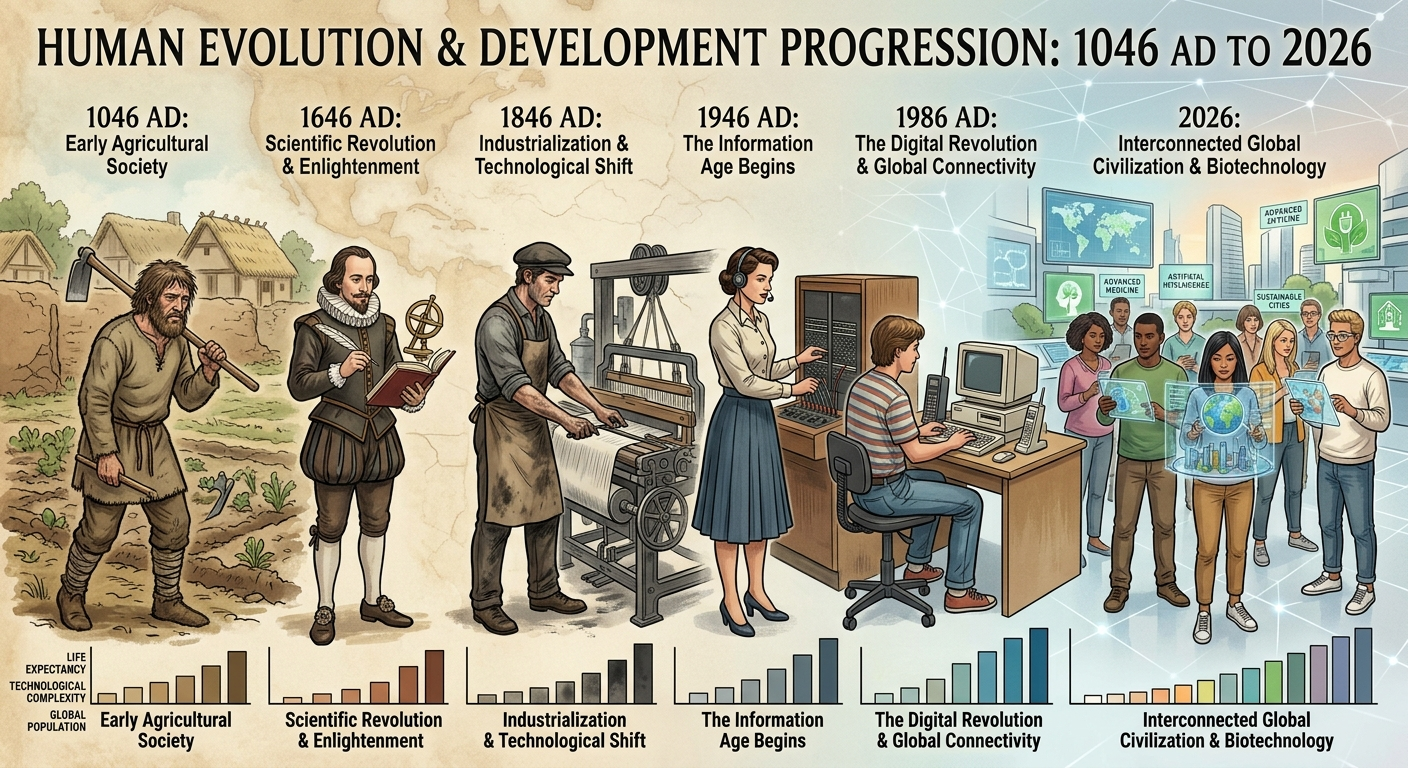
Note: “Spices” -> “Species” – interpreted as Homo sapiens
Abstract
980 years ago is 1046 AD – the High Middle Ages. Biologically, Homo sapiens has not become a new species in this time, but we have undergone significant genetic, anatomical, demographic, cultural and technological evolution. This thesis covers the progression from medieval humans to the modern, networked, bio-engineered human of 2026.
1. Starting Point: Humans 980 Years Ago – 1046 AD
Who were we in 1046?
- Population: ∼300 million worldwide. No city over 1 million except maybe Kaifeng, China.
- Life Expectancy: 30-35 years at birth. If you survived to 15, you could live to 50-60.
- Anatomy: Identical to us – same brain size, same skeleton. Homo sapiens sapiens.
- Genetics: Already differentiated into broad populations, but far less mixed than today.
- Society: 90% farmers. Knowledge stored in manuscripts. Travel limited to walking speed.
- Health: No germ theory. Famines, plague, smallpox controlled population.
We were biologically modern, but technologically medieval.
2. Biological Evolution in 980 Years: Is It Real?
Evolution usually takes tens of thousands of years, but 980 years is ∼35-40 generations. Recent studies show human evolution actually accelerated in the last 10,000 years.
A. Natural Selection Examples 1046-2026:
- Lactase Persistence: In 1046, most adults worldwide were lactose intolerant. Mutation for digesting milk after infancy spread rapidly in Europe and parts of Africa. From ∼20% to >90% in Northern Europe in 1000 years.
- Disease Resistance:
- Black Death (1347-1351) killed 30-60% of Europe. Survivors had immune variants (e.g., ERAP2 gene). This shaped European immune systems.
- Smallpox, malaria, cholera exerted strong selection. Genes for blood groups, sickle cell trait.
- High Altitude Adaptations: Tibetans, Andeans, Ethiopians evolved distinct adaptations for low oxygen in the last <1000 years.
- Stature and Body: Average height in Europe fell after the Middle Ages due to disease and nutrition, then increased dramatically. Dutch men: average 165cm in 1800s, 184cm in 2026 – due to genetics + nutrition selection.
- Brain Genes? Genes like ASPM and microcephalin show continued selection, but no major brain size change.
Conclusion: No speciation. But allele frequencies shifted measurably.
3. Development Progression: 6 Major Phases in 980 Years
Phase 1: Medieval Stability (1046-1450)
- Agriculture, feudalism, Islamic Golden Age preserving Greek science.
- Little biological change, slow cultural accumulation.
- Key: Paper mills reach Europe, gunpowder from China.
Phase 2: Global Connection (1450-1700)
- Printing press (1440) – first information revolution. Literacy explodes.
- Columbian Exchange: Crops (potato, maize) double world food supply. Population jumps to 600M.
- Human migration mixes continents for first time in 15,000 years – massive gene flow between Old and New World.
- Scientific Revolution: Galileo, Newton. Humanity learns scientific method.
Phase 3: Industrial Human (1700-1900)
- Industrial Revolution: Energy from coal/steam, not muscle.
- Demographic Transition: Population 600M -> 1.6 Billion.
- Nutrition improves, childhood mortality drops.
- Darwin publishes Origin of Species (1859) – humans understand their own evolution.
- Life expectancy: 35 -> 45 years.
Phase 4: Scientific Human (1900-1950)
- Medicine: Vaccines, antibiotics, sanitation. We stop dying of infection.
- Genetics: Rediscovery of Mendel, understanding DNA (1953).
- Two World Wars accelerate technology but kill ∼80M – a selective event.
- Population: 1.6B -> 2.5B.
Phase 5: Technological Human (1950-2000)
- Green Revolution: Food production triples.
- Population Boom: 2.5B -> 6.1B in 50 years. Fastest evolution of culture ever.
- Contraception: First time humans separate sex from reproduction voluntarily.
- Computers & Space: Humans leave planet (1969). Computation externalizes memory.
- Medicine: Organ transplants, heart surgery, childhood leukemia becomes curable.
- Life expectancy: 45 -> 67 years globally.
Phase 6: Augmented Human (2000-2026)
- Networked: Internet and smartphones – 5.5B people connected. Human cognition becomes distributed.
- Genomic: Human Genome Project finished 2003. Now we can sequence for $100. CRISPR gene editing (2012).
- Physical Change: Obesity epidemic, myopia epidemic from screens, allergies increase – mismatch between medieval bodies and modern environment.
- Demographic: Population 6.1B -> 8.2B. Urbanization: In 1046 <5% lived in cities, in 2026 ∼57%.
- Life Expectancy: 67 -> 73 years globally, 80+ in developed countries.
- New Evolution Pressures: Fertility treatments allow genes that would have been selected against to persist. Medicine relaxes natural selection but introduces new selection for late-onset disease resistance.
4. What Changed Most? Not Bones, But Systems
980 years ago progression was biological. Today it is cultural and technological.
Dimension | 1046 | 2026
Energy Use | 3,000 kcal/day (food+wood) | 60,000 kcal/day (food+fuel+electricity)
Information Access | <1 book per lifetime | 100,000+ books equivalent per day on phone
Mobility | 30 km/day max | 1,000 km/hour by air
Child Survival | 50% died before age 10 | <4% globally
Work | Physical labor | Cognitive / creative labor
We are the same hardware, running radically different software.
5. Significance: Where Are We Going?
The next phase of human evolution is no longer Darwinian, it is directed:
- Self-Directed Evolution: IVF embryo screening, gene therapy for sickle cell approved in 2023, future selection against BRCA, Huntington’s.
- Cybernetic Integration: Neural implants, bionic limbs, AI as cognitive prosthesis.
- Species Divergence Debate: Will humans split due to isolation? Unlikely, because we are more connected than ever. Instead we are becoming more genetically homogeneous through global mixing.
- Anthropocene: For the first time, one species is the dominant geological force on the planet.
6. Conclusion
In 980 years, Homo sapiens did not evolve into a new species. Our skeletons from 1046 would be indistinguishable in a modern airport.
What evolved was the human system: Our population grew 27-fold, our lifespan doubled, our information storage moved from memory to cloud, and our selection pressures moved from starvation and plague to lifestyle diseases and fertility choices.
The story of the last 980 years is proof that human progress is no longer about waiting for mutations. It is about what we build outside our bodies – culture, technology, medicine – that then changes the environment our bodies evolve in.
We are still Homo sapiens, but we are Homo sapiens 8.2 billion strong, living twice as long, thinking together through networks our ancestors 980 years ago could not have imagined.


Be First to Comment