
Abstract
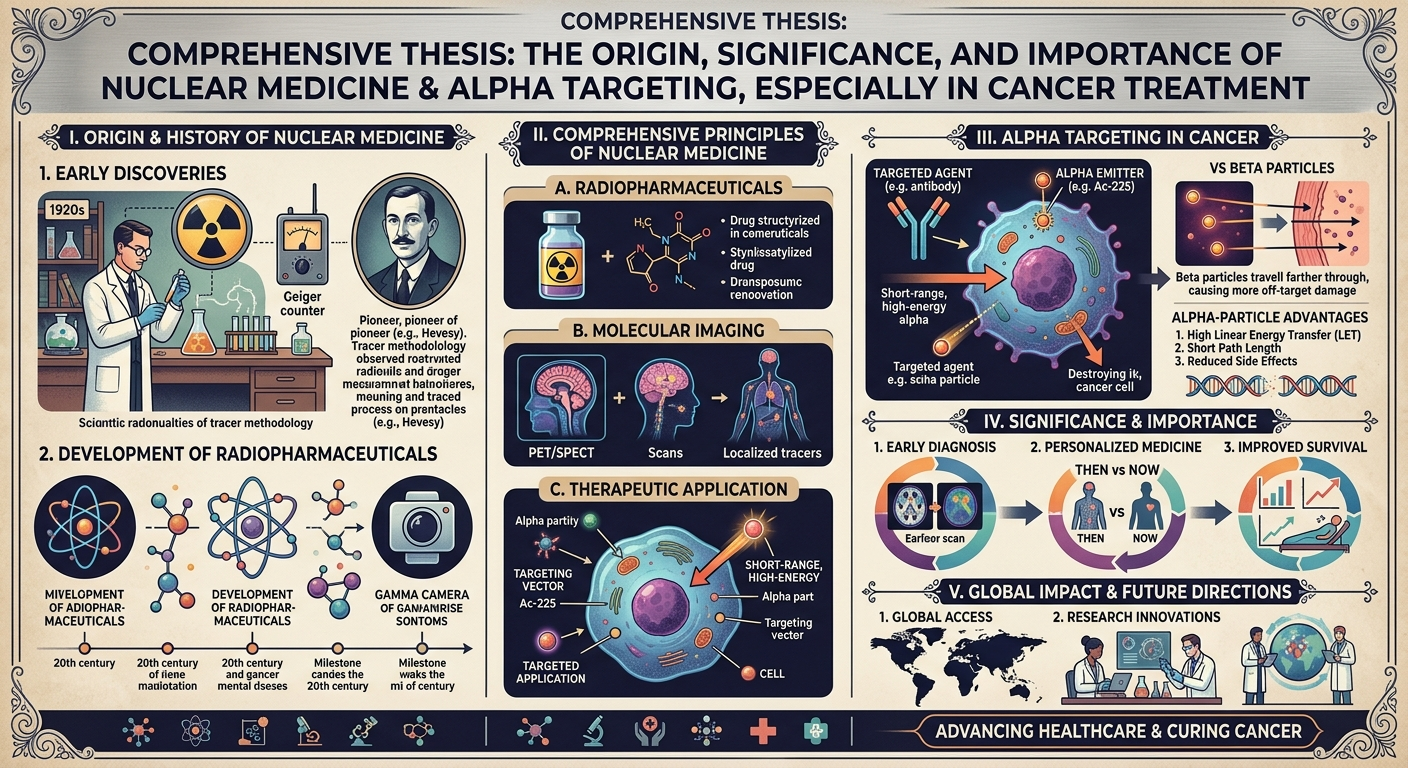
Nuclear medicine is medicine that uses radioactive atoms to see and treat disease from inside the body. While imaging and conventional radiotherapy have been used for decades, Targeted Alpha Therapy (TAT) represents a paradigm shift in oncology: delivering extremely potent, extremely short-range radiation directly to cancer cells, while largely sparing healthy tissue. This thesis covers its origin, principles, and its growing importance in cancer care.
1. Origin and History of Nuclear Medicine
A. Discovery Era (1895-1930s)
- 1895: Roentgen discovers X-rays.
- 1896: Becquerel discovers radioactivity. Marie and Pierre Curie isolate radium and polonium.
- Concept born: radiation can both image and destroy tissue.
B. Birth of Nuclear Medicine (1930s-1950s)
- 1934: Frederic Joliot and Irene Joliot-Curie create artificial radioactivity.
- 1936: First therapeutic use of artificial radioisotope – John Lawrence uses Phosphorus-32 for leukemia.
- 1946: First use of Iodine-131 for thyroid cancer – the first true targeted radionuclide therapy, still used today.
- 1950s: Development of the rectilinear scanner and then Anger gamma camera – to see where radioactivity goes.
C. Modern Era (1970s-Present)
- 1970s: Technetium-99m becomes the workhorse for 90% of diagnostic scans.
- Development of PET: Fluorine-18 FDG to image cancer metabolism.
- 2000s: Theranostics concept – use same target for diagnosis and therapy. E.g., see tumor with Ga-68, treat with Lu-177.
- 2010s: Alpha emitters enter mainstream clinical trials.
2. What is Nuclear Medicine? Two Branches
1. Diagnostic: A tracer (radiopharmaceutical) that emits gamma rays is injected. A camera detects it.
Examples: Bone scan (Tc-99m), PET-CT for cancer staging (F-18 FDG), myocardial perfusion scan.
2. Therapeutic: A tracer that emits cell-killing radiation (beta or alpha) is attached to a molecule that seeks cancer.
This is Targeted Radionuclide Therapy.
3. Alpha Targeting – The Core Science
To understand why alpha is special, compare radiation types:
Feature | Beta Particle | Alpha Particle
What is it | Electron | Helium nucleus (2 protons + 2 neutrons)
Energy | Low to moderate | Very High: 5-9 MeV
Range in tissue | Long: 1-10 mm (100s of cells) | Very Short: 0.05-0.1 mm (2-10 cells)
DNA Damage | Sparse, repairable | Dense double-strand breaks, almost irreparable
Effect | Crossfire, good for large tumors | Precision scalpel, good for micro-metastases
Linear Energy Transfer (LET): Alpha has High LET. It deposits massive energy over a tiny distance. One to three alpha tracks through a nucleus can kill a cell. Beta needs thousands of hits.
How Alpha Targeting Works:
- Target: Identify a protein highly expressed on cancer but not on normal tissue. Examples: PSMA for prostate cancer, SSTR2 for neuroendocrine tumors, CD33 for leukemia.
- Vector: A molecule that binds that target: antibody, peptide, or small molecule.
- Warhead: An alpha-emitting isotope chemically linked to the vector.
- Delivery: Injected IV, circulates, binds to cancer cell, internalizes, alpha decay kills cell from inside.
Key Alpha Isotopes:
- Actinium-225 (Ac-225): 10-day half-life, 4 alpha emissions in its decay chain. Currently the most promising.
- Radium-223 (Ra-223): Calcium mimic, naturally goes to bone metastases. First FDA-approved alpha therapy in 2013 (Xofigo for prostate cancer bone mets).
- Lead-212 (Pb-212): 10.6-hour half-life, in-vivo generator for Bismuth-212 alpha.
- Astatine-211 (At-211): 7.2-hour half-life, halogen chemistry similar to iodine.
- Bismuth-213 (Bi-213): 46-min half-life, from Ac-225 generator.
4. Significance and Importance in Cancer
Why is this important when we have chemo, surgery, external beam radiation?
A. For Cancers Resistant to Everything Else
Beta therapy (like Lu-177 PSMA) works until cancer becomes too diffuse or resistant. Alpha can overcome resistance because its DNA damage does not depend on oxygen or cell division rate, and is too severe to repair. This is crucial for castration-resistant prostate cancer, and micro-metastatic disease.
B. Precision and Safety
Beta crossfire irradiates healthy marrow around tumors. Alpha’s 50-100 micrometer range means it can kill a single cancer cell cluster or circulating tumor cell while sparing adjacent bone marrow, kidney, or salivary glands. Lower off-target toxicity in principle.
C. Theranostics – See What You Treat
Modern approach:
Scan with Ga-68 PSMA PET -> confirms PSMA expression.
Treat with Ac-225 PSMA or Lu-177 PSMA.
Follow up with same scan.
This is personalized medicine.
D. Clinical Impact So Far
- Radium-223: Showed overall survival benefit in metastatic prostate cancer to bone.
- Ac-225 PSMA-617: Early studies in advanced prostate cancer after failure of chemo and Lu-177 show PSA drops >90% in many patients, including complete remissions of diffuse disease.
- Ac-225 DOTATATE: For neuroendocrine tumors progressing after Lu-177.
- Pb-212 and Bi-213 conjugates: Active trials in melanoma, ovarian, pancreatic cancers.
5. Challenges and Future Directions
- Supply: Ac-225 global supply is extremely limited. Produced from Thorium-229 decay or cyclotron irradiation. Scaling production is the biggest bottleneck 2024-2026.
- Chemistry: Astatine and Actinium chemistry is difficult. Need stable chelators (DOTA, Macropa) so isotope doesn’t detach.
- Dosimetry: Measuring where alpha goes is hard because alpha doesn’t escape the body to be imaged. We estimate dose via gamma co-emissions.
- Toxicity: While more precise, accumulation in kidneys, salivary glands remains a concern.
Future: Combination therapy (Alpha + immunotherapy + PARP inhibitors), new targets (FAP, HER2), and automated production.
6. Conclusion
Nuclear medicine began with the simple observation that radiation can be traced. Alpha targeting is its most refined expression.
It matters because cancer at its most lethal stage is not a big lump, but thousands of invisible micro-metastases that surgery cannot remove and external radiation cannot find. Alpha therapy is a systemic, molecular surgery – a drug that acts like radiation.
If beta therapy was the first generation of targeted internal radiation, alpha is the next: more potent, more precise, and uniquely suited for the cancers we currently cannot cure.
This information is for educational purposes. For specific medical decisions about nuclear medicine and alpha therapy, please consult a nuclear medicine specialist or oncologist and a qualified healthcare team.






Be First to Comment